Generators
The Best Home Backup Generators
Ranked on the figure that matters — running watts on the fuel you will actually use — not the peak number on the box.
Written byMike M.
Published
Disclosure: we earn a commission on purchases made through links on this page, at no cost to you. It does not affect what we recommend or what we say about it — how we are funded.
The short answer
For whole-house backup through a transfer switch, the Westinghouse WGen9500DF is the most broadly sensible choice: 9,500 running watts on gasoline and 8,500 on propane, with both an L14-30R and a 14-50R transfer-switch-ready outlet. Its one real omission is a carbon monoxide shutdown. If you want that, the WGen10500DFc adds it plus 1,000 more running watts. If a natural gas line is realistic, the Generac 12,500 W tri-fuel is the better buy at 9,500 running watts with a fuel supply that does not run out.
Almost every roundup in this category ranks by peak watts, which is the figure a generator can hold for a second or two to get a motor turning. It is not capacity. A machine sold as 13,000 watts may have 10,500 running watts, and the running figure is what has to carry your house for three days.
So this list ranks on running watts, on the fuel you intend to use, plus whether the outlets actually fit a transfer switch. Before you read it, work out your number with the load calculator — most houses need less than this page's top picks provide.
The short answer
Quick picks
| # | Product | Best for | Score | Price |
|---|---|---|---|---|
| 1 | 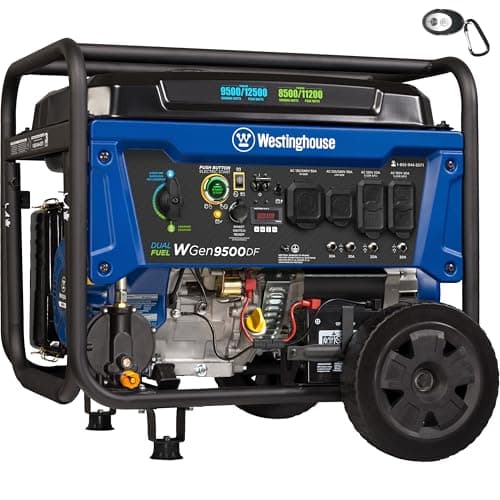 Westinghouse WGen9500DF 12,500W Dual Fuel The most broadly sensible home backup generator on the market: enough running watts for a whole essential-circuit panel, both transfer-switch outlets, and dual fuel — with the caveat that it has no CO shutoff. | The default whole-house pick | 8.8/10 | $999.00 |
| 2 | 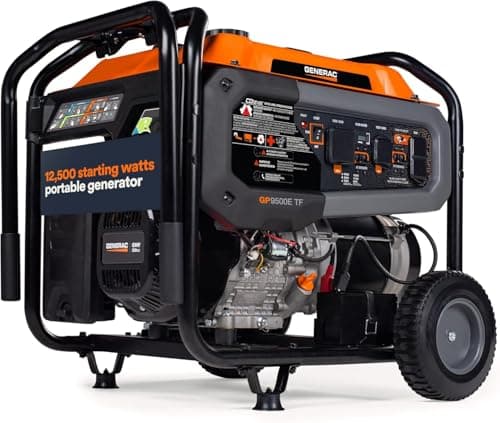 Generac 12,500W Starting Tri-Fuel The cheapest credible way to get a generator onto your home's natural gas line, which is the one fuel supply an outage usually does not interrupt. | Natural-gas hookup at the best price | 9.1/10 | $920.00 |
| 3 | 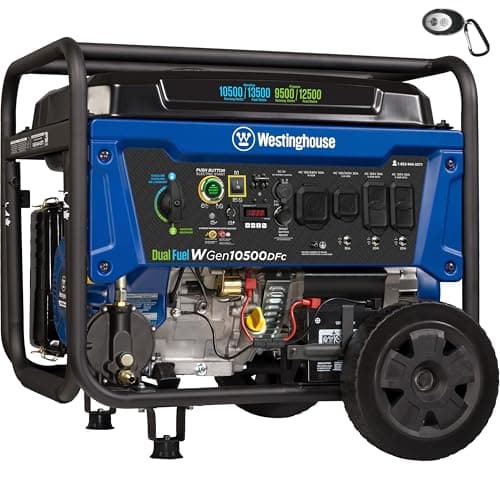 Westinghouse WGen10500DFc 13,500W Dual Fuel The WGen9500DF with the two things it is missing fixed: more running watts and a CO shutdown, at a higher price. | Same layout, with CO shutdown | 9.0/10 | $1,099.00 |
| 4 | 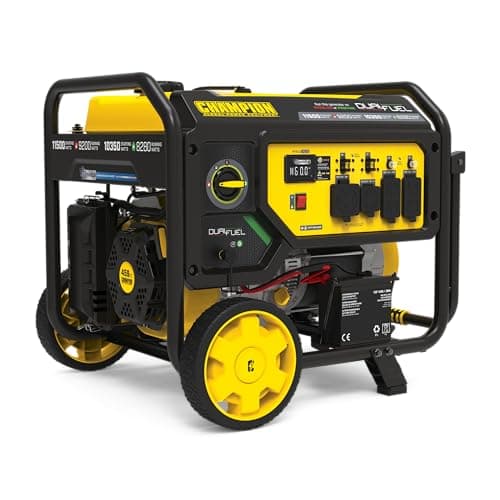 Champion 11,500W Dual Fuel Electric Start The most honestly specified generator in its class, with CO shutoff and the best after-sale support in the category. | Published propane numbers you can plan on | 8.7/10 | $989.99 |
| 5 | 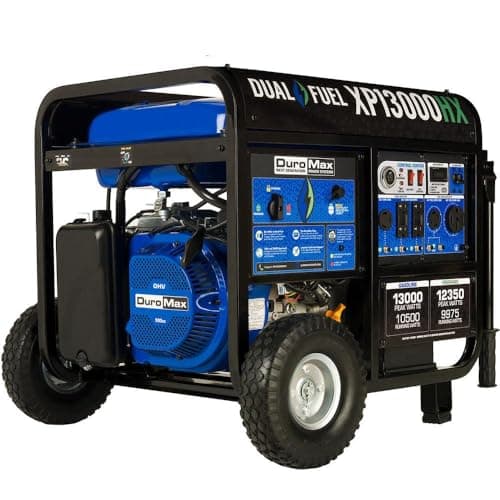 DuroMax XP13000HX 13,000W Dual Fuel The value pick in DuroMax's 13kW line: copper windings and CO shutoff for less than the older EH typically costs. | Best price per peak watt | 8.9/10 | $1,079.00 |
| 6 | 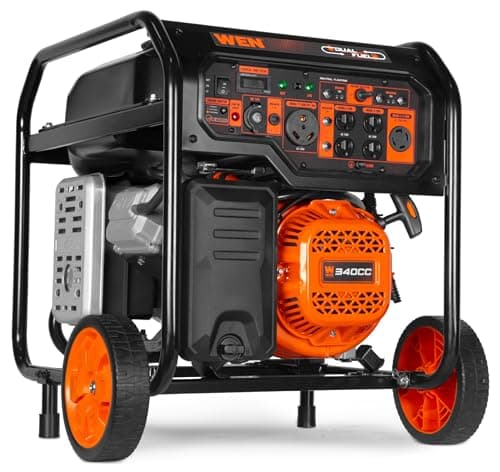 WEN DF8000X 8,000W Dual Fuel The best-value correctly-sized home backup generator here: enough for every essential circuit, dual fuel, CO shutoff, a real transfer-switch outlet, and no money spent on capacity you will not use. | Essential circuits, dual fuel, lowest cost | 8.5/10 | $623.17 |
| 7 | 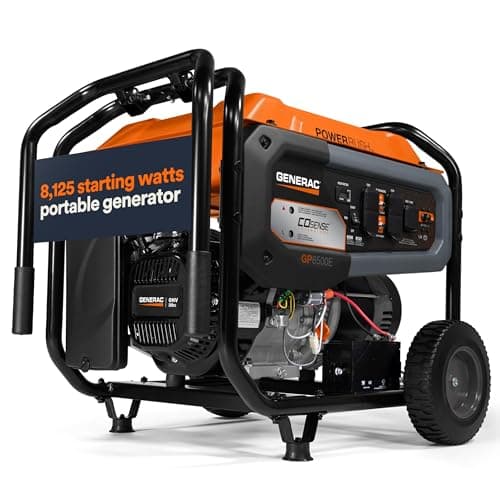 Generac 8,125W Starting Portable The right size for most people who think they need 10,000 watts: enough running capacity for every essential circuit, with surge headroom for motor startup. | Essential circuits on a budget | 7.8/10 | $899.00 |
| 8 | 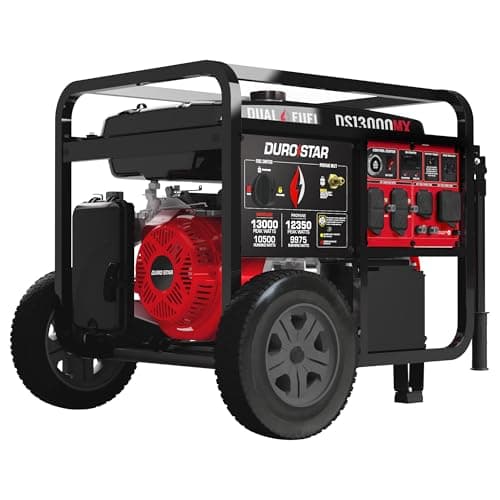 DuroStar DS13000MX 13,000W Dual Fuel If the budget is the constraint and you still want 13,000 peak watts with CO shutoff, this is the cheapest honest way there. | Cheapest route to 13,000 peak watts | 8.4/10 | $899.00 |
| 9 | 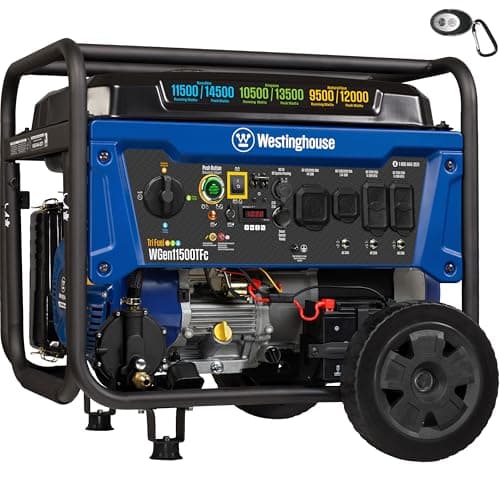 Westinghouse WGen11500TFc 14,500W Tri-Fuel Buy this when the sizing math genuinely lands above 10,000 running watts — not because bigger feels safer. | Larger homes with real 240V loads | 8.9/10 | $1,499.00 |
#ad Prices as of October 5, 2026; they may have changed since. Scores are our editorial judgment from published specifications, not test results — how we pick. How we are funded.
How these were ranked
What we weighted, in order
- Running watts, per fuel
- Published, not peak
- Transfer-switch outlets
- L14-30R and 14-50R
- Fuel flexibility
- Dual, then tri-fuel
- CO shutdown
- Still not universal
- Runtime at a stated load
- Published figure
Weight is not equal: a machine with more running watts but no 240 V transfer-switch outlet ranks below a smaller one that has them, because a generator that cannot reach your furnace is not a backup power system.
What the winner gets right, and what it does not
The Westinghouse WGen9500DF's 9,500 running watts covers a well pump, a furnace blower, a refrigerator and a great deal of lighting at the same time. Both of its 240 V outlets are transfer-switch ready, so it fits a 30 A interlock setup now and a 50 A panel later. Dual fuel means propane is a legitimate plan when the gas stations also have no power. Remote start means starting it without going out into the weather.
It has no carbon monoxide shutdown, and we are not going to soften that. Several competitors at this price include one. It is a backstop rather than a primary protection — the shutdown monitors the generator's own operating area, not your bedroom — but its absence is a genuine mark against an otherwise excellent machine, and it means the battery CO alarm is not optional.
The natural gas argument, which may override all of this
If your house has a gas line, the Generac 12,500 W tri-fuel is arguably the better buy despite ranking second. It publishes the same 9,500 running watts on gasoline, adds natural gas and propane, includes COsense shutdown, and its listing states that connecting to a natural gas line gives virtually unlimited runtime.
The cost: natural gas drops it to a lower output figure, and the house-side gas quick-connect is licensed gas work that needs arranging in advance. For anyone expecting multi-day outages, removing refueling from the plan is worth more than almost any other feature. See best tri-fuel generators.
The size most people actually need
Two machines on this list are here because the honest answer for many houses is smaller than the top picks. The WEN DF8000X publishes 6,500 running watts on gasoline with CO shutdown, dual fuel and a proper L14-30R — enough for every essential circuit in a house with gas heat. The Generac 8,125 W publishes 6,500 running watts with COsense and PowerRush surge capability.
Using EWEB's published appliance figures, a house with a fridge, a furnace blower, a well pump, a sump pump and lighting totals about 3,500 running watts. Both of those machines cover it with real headroom, cost appreciably less than the 9,500-watt class, burn less fuel and are lighter to move. Buying a 13,000-watt machine for that load is buying capacity a 30 A transfer switch cannot even deliver.
The weight question nobody mentions
These machines run from 182 lb to 345 lb, and their wheel kits are designed for flat, dry ground. If the generator lives where it runs — a concrete pad beside the inlet box — weight is irrelevant. If it has to cross a lawn in a storm, a 245 lb machine is a two-person job every single time, and that is the kind of friction that ends with a generator run somewhere it should not be.
- Running watts
- 9,500 W gas / 8,500 W LP
- Starting watts
- 12,500 W gas
- Outlets
- L14-30R + 14-50R
#1 · The default whole-house pick
Westinghouse WGen9500DF 12,500W Dual Fuel
The most broadly sensible home backup generator on the market: enough running watts for a whole essential-circuit panel, both transfer-switch outlets, and dual fuel — with the caveat that it has no CO shutoff.
#ad Price as of October 5, 2026; it may have changed since. How we are funded.
What is good
- 9,500 running watts covers a well pump, furnace blower, fridge and a lot of lighting simultaneously — the load most homes actually need
- Both the L14-30R and the 14-50R are transfer-switch ready, so it fits a 30A interlock setup now and a 50A panel later
- Dual fuel means a propane tank is a legitimate plan when the gas stations have no power either
- Remote start matters more than it sounds: you start it from inside without going out in the weather
What is not
- 210 lb is a two-person move on anything but flat, dry ground
- No carbon monoxide shutdown on this model — several competitors at this price include one, and you must supply your own CO alarm indoors
- 9,500 W will not carry central air plus a well pump plus everything else; see the sizing guide before assuming it will
Published specification & our scoring
- 9,500 running / 12,500 peak watts on gasoline (manufacturer)
- 8,500 running / 11,200 peak watts on propane (manufacturer)
- 457cc Westinghouse 4-stroke OHV engine with cast-iron sleeve
- Remote key-fob start, electric start and recoil backup
- Two 120V 5-20R GFCI, one L14-30R 30A, one 14-50R 50A — all transfer-switch ready
- Automatic low-oil shutdown and digital hour meter
- Published weight 210 lb
- 3-year limited warranty (manufacturer)
- Output headroom
- 9
- Fuel flexibility
- 9
- Transfer-switch fit
- 10
- Runtime
- 8
- Safety features
- 6
- Value
- 9
Specification figures are the manufacturer’s published values. Scores are our editorial judgment from those figures and are never published as structured review data — how we pick.
- Running watts
- 9,500 W gas
- Starting watts
- 12,500 W gas
- Fuels
- Gas / LP / natural gas
#2 · Natural-gas hookup at the best price
Generac 12,500W Starting Tri-Fuel
The cheapest credible way to get a generator onto your home's natural gas line, which is the one fuel supply an outage usually does not interrupt.
#ad Price as of October 5, 2026; it may have changed since. How we are funded.
What is good
- Natural gas capability is the single biggest runtime upgrade available — a plumbed line does not run out
- 9,500 running watts matches the Westinghouse WGen9500DF, usually for less money
- Automatic voltage regulation plus both 240V outlets
What is not
- Running on natural gas costs you output — plan from the natural-gas figure if that is your primary fuel
- A natural-gas quick-connect has to be installed by someone licensed to touch your gas line; budget for it
- 219 lb
Published specification & our scoring
- 9,500 running / 12,500 starting watts on gasoline (manufacturer)
- Runs on gasoline, liquid propane or natural gas via a dial (manufacturer)
- 500cc Generac OHV engine with automatic voltage regulation
- 7.5-gallon tank: up to 9.5 h at 50% load, 14 h at 25% load on gasoline (manufacturer)
- Two 120V 20A GFCI duplex, one L14-30R 30A twist-lock, one 120/240V 50A
- COsense CO shutdown, electric start
- Published weight 219 lb
- Output headroom
- 9
- Fuel flexibility
- 10
- Transfer-switch fit
- 10
- Runtime
- 10
- Safety features
- 9
- Value
- 10
Specification figures are the manufacturer’s published values. Scores are our editorial judgment from those figures and are never published as structured review data — how we pick.
- Running watts
- 10,500 W gas / 9,500 W LP
- Starting watts
- 13,500 W gas
- CO shutdown
- Yes
#3 · Same layout, with CO shutdown
Westinghouse WGen10500DFc 13,500W Dual Fuel
The WGen9500DF with the two things it is missing fixed: more running watts and a CO shutdown, at a higher price.
#ad Price as of October 5, 2026; it may have changed since. How we are funded.
What is good
- A thousand running watts more than the WGen9500DF, and it adds the CO shutdown that model lacks
- Propane output of 9,500 running watts is higher than many units manage on gasoline
- Same twin transfer-switch outlets, so the connection plan does not change
What is not
- Costs meaningfully more than the WGen9500DF for one extra kilowatt
- 230 lb and open-frame — this is not getting carried anywhere
- CO shutdown is a safety backstop, not permission to run it anywhere near the house
Published specification & our scoring
- 10,500 running / 13,500 peak watts on gasoline (manufacturer)
- 9,500 running / 12,500 peak watts on propane (manufacturer)
- 500cc Westinghouse 4-stroke OHV engine, cast-iron sleeve
- Automatic low-oil AND carbon monoxide (CO) shutdown
- Two 120V 5-20R GFCI, one L14-30R 30A, one 14-50R 50A
- Remote key-fob start plus electric and recoil start
- Published weight 230 lb
- Output headroom
- 10
- Fuel flexibility
- 9
- Transfer-switch fit
- 10
- Runtime
- 8
- Safety features
- 9
- Value
- 8
Specification figures are the manufacturer’s published values. Scores are our editorial judgment from those figures and are never published as structured review data — how we pick.
- Running watts
- 9,200 W gas / 8,280 W LP
- Starting watts
- 11,500 W gas
- CO shutdown
- CO Shield
#4 · Published propane numbers you can plan on
Champion 11,500W Dual Fuel Electric Start
The most honestly specified generator in its class, with CO shutoff and the best after-sale support in the category.
#ad Price as of October 5, 2026; it may have changed since. How we are funded.
What is good
- Champion publishes running AND starting watts on both fuels, which makes honest sizing possible — many brands do not
- Intelligauge hour tracking makes the maintenance schedule something you can actually follow
- Lifetime technical support is a real, usable thing when you are troubleshooting at 2am in an outage
What is not
- 9,200 running watts sits slightly below the 9,500 W class leaders
- 209 lb
- Volt Guard protects the generator, not your appliances — it is not a surge protector for the house
Published specification & our scoring
- 9,200 running / 11,500 starting watts on gasoline (manufacturer)
- 8,280 running / 10,350 starting watts on propane (manufacturer)
- 459cc Champion engine, electric start with included battery
- CO Shield carbon monoxide auto shutoff
- Intelligauge: voltage, hertz and run-time hours
- Volt Guard surge protection
- 3-year limited warranty with lifetime technical support (manufacturer)
- Published weight 209 lb
- Output headroom
- 9
- Fuel flexibility
- 9
- Transfer-switch fit
- 9
- Runtime
- 8
- Safety features
- 9
- Value
- 9
Specification figures are the manufacturer’s published values. Scores are our editorial judgment from those figures and are never published as structured review data — how we pick.
- Peak watts
- 13,000 W
- Engine
- 500cc OHV, copper windings
- CO shutdown
- CO Alert
#5 · Best price per peak watt
DuroMax XP13000HX 13,000W Dual Fuel
The value pick in DuroMax's 13kW line: copper windings and CO shutoff for less than the older EH typically costs.
#ad Price as of October 5, 2026; it may have changed since. How we are funded.
What is good
- Copper windings rather than aluminum is a genuine longevity difference, and DuroMax publishes it
- Four household GFCI outlets plus both 240V outlets covers cord-only use and transfer-switch use equally
- Adds the CO Alert shutdown the older EH does not have, usually for less money
What is not
- 245 lb is the heaviest of the 13kW DuroMax family
- Still a conventional alternator — total harmonic distortion is not published as low-THD, so treat sensitive electronics carefully
Published specification & our scoring
- 13,000 peak watts (manufacturer)
- 500cc OHV DuroMax engine with all-copper windings (manufacturer)
- CO Alert shutdown
- Four 120V GFCI household outlets, 120V 30A, 120/240V 30A twist-lock, 120/240V 50A
- Front-facing fuel interface, push-button start
- Published weight 245 lb
- Output headroom
- 10
- Fuel flexibility
- 9
- Transfer-switch fit
- 10
- Build quality
- 9
- Safety features
- 8
- Value
- 10
Specification figures are the manufacturer’s published values. Scores are our editorial judgment from those figures and are never published as structured review data — how we pick.
- Running watts
- 6,500 W gas / 5,850 W LP
- Starting watts
- 8,000 W gas
- CO shutdown
- Watchdog
#6 · Essential circuits, dual fuel, lowest cost
WEN DF8000X 8,000W Dual Fuel
The best-value correctly-sized home backup generator here: enough for every essential circuit, dual fuel, CO shutoff, a real transfer-switch outlet, and no money spent on capacity you will not use.
#ad Price as of October 5, 2026; it may have changed since. How we are funded.
What is good
- 6,500 running watts with CO shutdown, dual fuel and a proper L14-30R, for the price of a gasoline-only machine
- 10.5 hours at half load is better runtime than WEN's larger DF1100T
- The TT-30R makes it an RV generator as well, which widens its usefulness between outages
What is not
- 6,500 running watts rules out central air
- 340cc working near its rating will be audible — WEN does not publish a dB figure for this model
- No remote start
Published specification & our scoring
- Gasoline: 8,000 surge / 6,500 rated watts (manufacturer)
- Propane: 7,200 surge / 5,850 rated watts (manufacturer)
- 340cc engine, electric start
- WEN Watchdog CO shutdown sensor
- 6.7-gallon tank, up to 10.5 hours at half load (manufacturer)
- Wheel kit included; four 120V 5-20R, one TT-30R RV outlet, one L14-30R transfer-switch-ready twist-lock
- Output headroom
- 7
- Fuel flexibility
- 9
- Transfer-switch fit
- 9
- Runtime
- 9
- Safety features
- 8
- Value
- 10
Specification figures are the manufacturer’s published values. Scores are our editorial judgment from those figures and are never published as structured review data — how we pick.
- Running watts
- 6,500 W
- Starting watts
- 8,125 W
- Runtime
- Up to 10.5 h (mfr)
#7 · Essential circuits on a budget
Generac 8,125W Starting Portable
The right size for most people who think they need 10,000 watts: enough running capacity for every essential circuit, with surge headroom for motor startup.
#ad Price as of October 5, 2026; it may have changed since. How we are funded.
What is good
- 6,500 running watts is genuinely enough for a fridge, furnace blower, sump pump, lights and electronics — the realistic essential-circuit set
- PowerRush gives it surge headroom that punches above its running rating, which is exactly what a well pump needs
- Cheapest Generac with COsense and electric start
What is not
- Gasoline only
- 6,500 running watts will not run central air; plan around that or plan for a bigger machine
- No 50A outlet
Published specification & our scoring
- 6,500 running / 8,125 starting watts with PowerRush (manufacturer)
- PowerRush Advanced Technology provides 40% more starting capacity (manufacturer)
- Electric start with included battery
- Up to 10.5 hours continuous runtime (manufacturer)
- COsense CO detection with automatic shutdown
- Digital hour meter and automatic low-oil shutdown
- Published weight 182 lb
- Output headroom
- 7
- Fuel flexibility
- 4
- Transfer-switch fit
- 7
- Runtime
- 8
- Safety features
- 9
- Value
- 9
Specification figures are the manufacturer’s published values. Scores are our editorial judgment from those figures and are never published as structured review data — how we pick.
- Peak watts
- 13,000 W
- Engine
- 500cc, remote start
- CO shutdown
- Yes
#8 · Cheapest route to 13,000 peak watts
DuroStar DS13000MX 13,000W Dual Fuel
If the budget is the constraint and you still want 13,000 peak watts with CO shutoff, this is the cheapest honest way there.
#ad Price as of October 5, 2026; it may have changed since. How we are funded.
What is good
- Routinely the lowest price in the 13kW dual fuel class while still including CO shutdown and remote start
- Lighter than the DuroMax HX by 25 lb, which you will feel moving it
- Shares DuroMax's engine platform and parts ecosystem
What is not
- DuroStar is DuroMax's value brand — the spec is similar, the fit and finish is not
- Peak-watt marketing again: size from running watts
Published specification & our scoring
- 13,000 peak watts, 500cc engine (manufacturer)
- Dual fuel: gasoline or propane
- CO detection with automatic shutdown (manufacturer)
- 50A outlet for direct transfer-switch connection
- Remote electric start
- Steel frame and reinforced power panel
- Published weight 220 lb
- Output headroom
- 10
- Fuel flexibility
- 9
- Transfer-switch fit
- 9
- Build quality
- 7
- Safety features
- 8
- Value
- 10
Specification figures are the manufacturer’s published values. Scores are our editorial judgment from those figures and are never published as structured review data — how we pick.
- Running watts
- 11,500 W gas / 9,500 W NG
- Starting watts
- 14,500 W gas
- Runtime
- Up to 19 h (mfr)
#9 · Larger homes with real 240V loads
Westinghouse WGen11500TFc 14,500W Tri-Fuel
Buy this when the sizing math genuinely lands above 10,000 running watts — not because bigger feels safer.
#ad Price as of October 5, 2026; it may have changed since. How we are funded.
What is good
- 11,500 running watts is enough to add central air to the essential-circuit list in many homes
- 19-hour runtime means one overnight refuel instead of three
- Low THD on a conventional frame is unusual and genuinely useful if you are running computers and a modern furnace board
What is not
- Natural gas costs you 2,000 running watts versus gasoline
- 230 lb, and at this output you are firmly in permanent-location territory
- Price is well above the 9,500 W class for capacity many homes will not use
Published specification & our scoring
- Gasoline: 14,500 peak / 11,500 running watts (manufacturer)
- Propane: 13,500 peak / 10,500 running watts (manufacturer)
- Natural gas: 12,000 peak / 9,500 running watts (manufacturer)
- 550cc 4-stroke OHV Westinghouse engine with cast-iron sleeve
- Up to 19 hours on the 9.5-gallon tank (manufacturer)
- Low THD — manufacturer states it is safe for sensitive electronics
- Published weight 230 lb
- Output headroom
- 10
- Fuel flexibility
- 10
- Transfer-switch fit
- 10
- Runtime
- 10
- Power quality
- 9
- Value
- 7
Specification figures are the manufacturer’s published values. Scores are our editorial judgment from those figures and are never published as structured review data — how we pick.
Questions people actually ask
What is the best generator for home backup?
For most houses, the Westinghouse WGen9500DF: 9,500 running watts on gasoline, 8,500 on propane, and both transfer-switch-ready 240 V outlets. If a natural gas line is available, the Generac 12,500 W tri-fuel is the stronger choice because a plumbed supply removes refueling from the plan entirely.
How many watts do I need for a whole house generator?
Work it from your load rather than a round number. Using EWEB's published figures, a house with a fridge, furnace blower, well pump, sump pump and lighting totals about 3,500 running watts, which after derating needs roughly 4,400. Central air or electric heat pushes it above 11,000.
Do I need a dual fuel generator?
It is the sensible default for one reason: propane stores indefinitely while gasoline degrades within months, and a gummed carburetor is the most common reason a stored generator will not start. The output penalty on propane is roughly 10%.
Which home backup generators have carbon monoxide shutdown?
On this list, the Generac machines (COsense), Champion (CO Shield), WEN's DF8000X (Watchdog), DuroMax and DuroStar (CO Alert) and Westinghouse's WGen10500DFc and WGen11500TFc all publish one. The WGen9500DF and the DuroMax XP13000EH do not. A shutdown is not a substitute for a battery CO alarm indoors.
Will a 9500 watt generator run my whole house?
It will run every essential circuit including a well pump, and usually a window air conditioner as well. The constraint is often the connection rather than the generator: a 30 amp transfer switch caps delivery at about 7,200 watts, so a 9,500 watt machine needs a 50 amp switch or an interlock kit to use its full output.
How long will these generators run on a tank?
Published figures on this list range from about 9.5 hours at 50% load to 19 hours at 25% load, depending on tank size and engine. Runtime tracks load closely — the Generac tri-fuel publishes 9.5 hours at half load and 14 hours at quarter load from the same 7.5 gallon tank.
Sources
- Eugene Water & Electric Board — Generator Sizing ConsiderationsPublished appliance running and additional-starting watt figures used in the sizing arithmetic on this page.
- US Consumer Product Safety Commission — Portable Generator Information CenterThe placement and carbon monoxide guidance every generator page on this site links to.
Read next
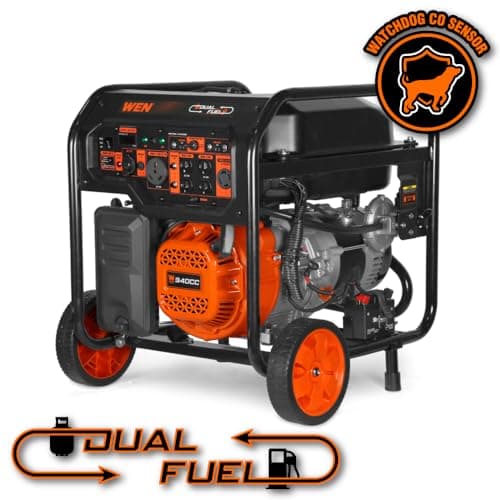
Guide
What Size Generator Do I Need?
The core sizing method: total running watts, add the single biggest surge, derate for continuous running, then match a wattage class.
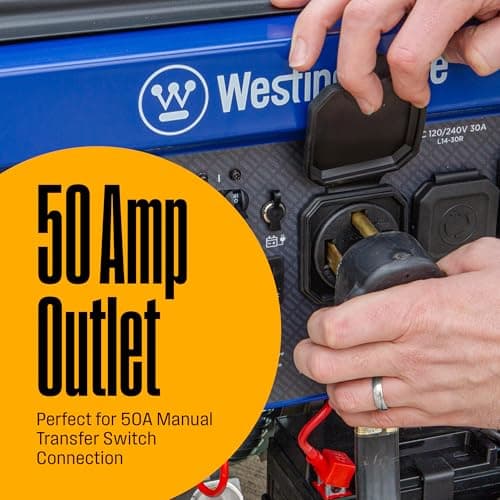
Best Dual Fuel
Best Dual Fuel Generators for Home Backup
Dual fuel generators ranked on both fuels' published running watts, with the brands that decline to publish propane figures named.
Top pick · Westinghouse WGen9500DF 12,500W Dual Fuel
$999.00View on Amazon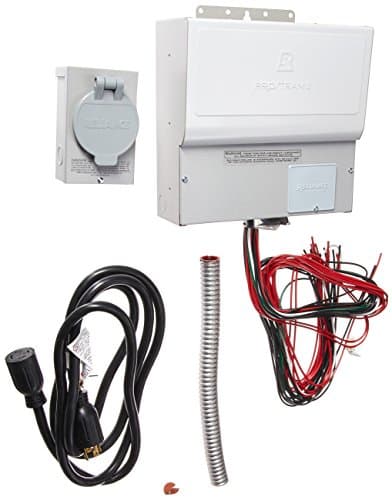
Best Transfer Switch
The Best Generator Transfer Switches
Transfer switches ranked on circuit count, amp rating and kit completeness, from 6-circuit 30A to 10-circuit 50A.
Top pick · Reliance Controls 310CRK 10-Circuit 30A Kit
$474.76View on Amazon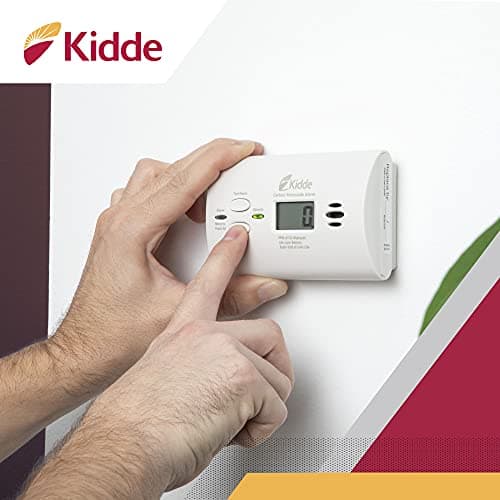
Guide
Generator Carbon Monoxide Safety
The CPSC placement rules, why a garage with the door open is still unsafe, and the battery CO alarm that should be your first purchase.
Review
Westinghouse WGen9500DF Review
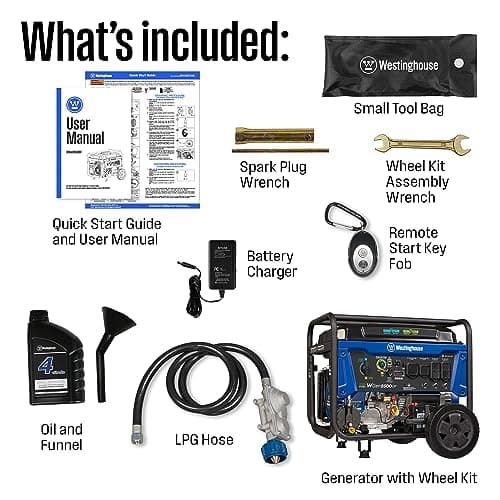
A close reading of the WGen9500DF's published specification against real household loads, including its missing CO shutdown.