Guide
What Size Generator Do I Need?
The core sizing method: total running watts, add the single biggest surge, derate for continuous running, then match a wattage class.
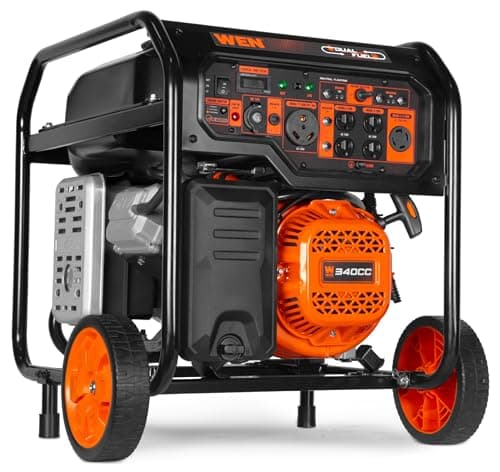
Top pick · WEN DF8000X 8,000W Dual Fuel
$623.17View on AmazonHub
Start from the load, not the catalog. Add what you need to run, and the calculator gives you running watts, the start-up surge that actually decides the answer, and the wattage class to shop in.
Disclosure: we earn a commission on purchases made through links on this page, at no cost to you. It does not affect what we recommend or what we say about it — how we are funded.
Interactive
Tick what you need running at the same time. Wattages come from two published charts and are cited on the appliance wattage chart.
Both charts agree on a 2,200 W start-up surge, and that surge is usually the single biggest number in a whole outage plan.
Not listed?
Central air conditioning, heat pumps, well pumps above 1/3 HP and full electric ranges are not in either chart we cite, and we will not print a number we cannot source for the load that most often decides which generator you buy.
Find it yourself instead: the nameplate on the equipment gives volts and amps. Multiply them for running watts (10 A at 240 V is 2,400 W). For anything with a motor or compressor, the plate may also list LRA — locked rotor amps — which is the start-up surge; multiply that by the voltage too.
Then add it to the calculator as a custom load.
Your result
Total running 1495 watts, starting 3695 watts. Recommended generator minimum 1900 running watts.
The surge figure is the single largest start-up draw on your list — Refrigerator / freezer. Only the biggest one counts, because motors do not all start in the same instant.
The generator minimum applies our 80% derating for continuous running. It is our adjustment, not the charts’ — a machine held at 100% of its rating for days runs hot and wears fast.
Your wattage class
1,800 - 4,000 running watts
A quiet inverter generator covers this cleanly: fridge, furnace blower, sump pump, lights and electronics. You do not need 9,000 watts and you will be glad of the lower noise and fuel burn.
See the picks for this classAlmost everyone shopping for a backup generator starts at the wrong end. They look at machines, compare peak watts, and pick something that feels about right. Then the power goes out, they start the well pump, the generator bogs down and trips, and they discover that the number on the box was never the number that mattered.
The question that decides which generator you need is not how big — it is what, exactly, do I need running at the same time. Answer that and the generator picks itself. That is what this hub is for, and the calculator below is the fastest route to the answer.
Every motor-driven appliance draws far more power in the half-second it starts than it does while it runs. A refrigerator runs on around 700 watts and needs roughly 2,200 extra watts to get its compressor turning. A 1/3 HP well pump runs on 1,000 watts and wants another 2,000 to start.
So you need two figures: running watts, the steady total of everything on at once, and starting watts, that total plus the biggest single start-up surge. You add only the largest surge, not all of them, because motors do not all start in the same instant. That is the method published by both of the wattage charts this site cites, and it is the method the calculator uses.
A worked example — the realistic essential-circuit house
Running-watt figures from the Eugene Water & Electric Board chart cited on the appliance wattage page. The 80% derating is ours, and we apply it everywhere: a generator held at 100% of its rating for three days runs hot and wears fast.
That house needs a generator with about 3,200 running watts and 4,700 starting watts — not the 9,500-watt machine the search results push at it. A quiet inverter generator covers it, costs less, burns less fuel and annoys the neighbors less.
Three loads, and only three, are responsible for most oversized generator purchases:
If one of those is on your list, read generator size for air conditioner or generator size for well pump before you shop — there is usually a cheaper way through than buying more generator.
A 9,500-watt generator feeding a 30 amp transfer switch can only deliver about 7,200 watts into your panel, because 30 A at 240 V is the ceiling regardless of what the engine can make. If your sizing math lands above roughly 7,500 running watts, you need a 50 amp transfer switch or an interlock kit, and that changes the installation budget. Size the connection and the generator together, in that order.
Run the calculator. Then follow the wattage class it gives you into the matching roundup — the result card links straight there with a live price. If you want to understand a specific appliance before you commit, the sizing spokes below each take one load and work it properly: a whole house, a refrigerator and deep freezer, a furnace, a sump pump, or an RV.
The appliance wattage chart is the reference underneath all of it, with every figure attributed to the published chart it came from — including the places where the two charts disagree, which is the most useful thing on the page.
Picks
Each tile carries the top pick from that page with a live price, so you can act from here rather than having to read a review first.
Guide
The core sizing method: total running watts, add the single biggest surge, derate for continuous running, then match a wattage class.
Top pick · WEN DF8000X 8,000W Dual Fuel
$623.17View on Amazon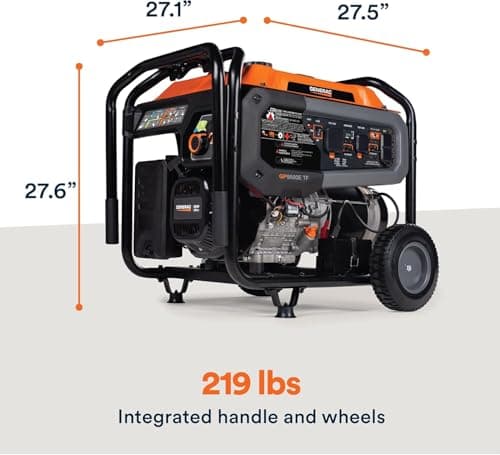
Guide
Load tables for four realistic house types — gas heat, well pump, central air and electric heat — with the generator class each needs.
Top pick · Generac 12,500W Starting Tri-Fuel
$920.00View on Amazon21% off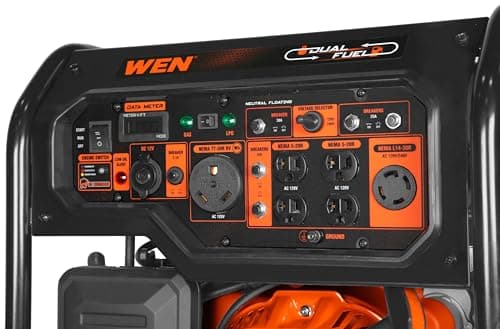
Reference
The watts needed for survival, essential and comfortable circuit sets, totaled from published figures.
Top pick · WEN DF8000X 8,000W Dual Fuel
$623.17View on Amazon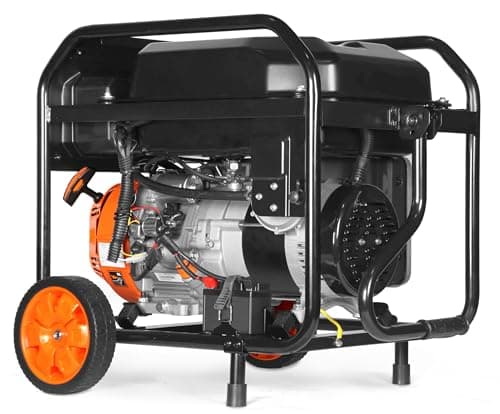
Reference
The site's reference wattage table, with each row's source named and both figures shown wherever the published charts disagree.
Top pick · WEN DF8000X 8,000W Dual Fuel
$623.17View on Amazon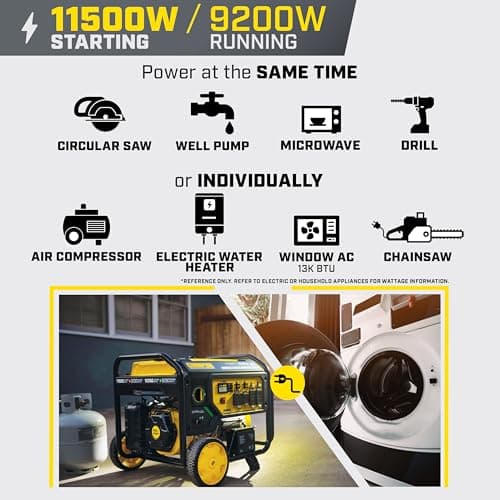
Guide
What the surge figure means, why motors need it, and how to read the peak-watt number on a generator box.
Top pick · Champion 11,500W Dual Fuel Electric Start
$989.99View on Amazon10% off
Guide
Sizing for a fridge plus a chest freezer, including why only one surge counts and when a battery beats a generator.
Top pick · Bluetti FridgePower
$899.00View on Amazon40% off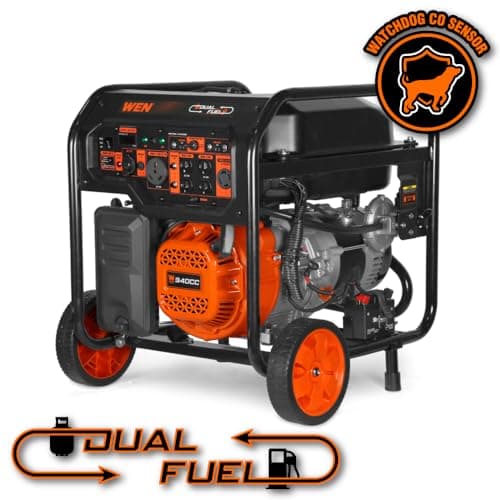
Guide
Well pump sizing from the published 1/3 HP figures, what changes on larger pumps, and the soft-starter route.
Top pick · WEN DF8000X 8,000W Dual Fuel
$623.17View on Amazon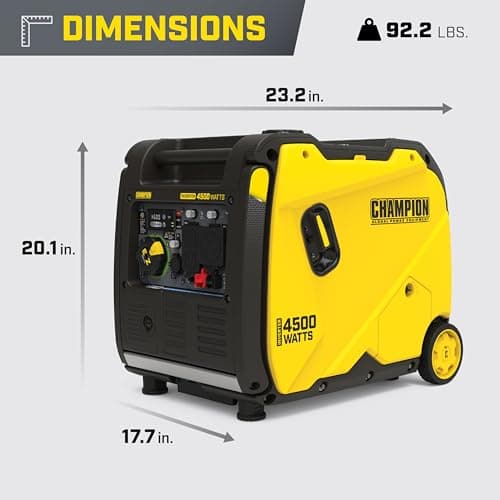
Guide
Furnace blower sizing from published figures, the gas-versus-electric divide, and why power quality matters for modern control boards.
Top pick · Champion 4,500W RV Ready Inverter
$674.10View on Amazon10% off
Guide
Window AC sizing from two published charts that disagree sharply, central AC guidance from the nameplate, and the soft-starter alternative.
Top pick · Westinghouse WGen11500TFc 14,500W Tri-Fuel
$1,499.00View on Amazon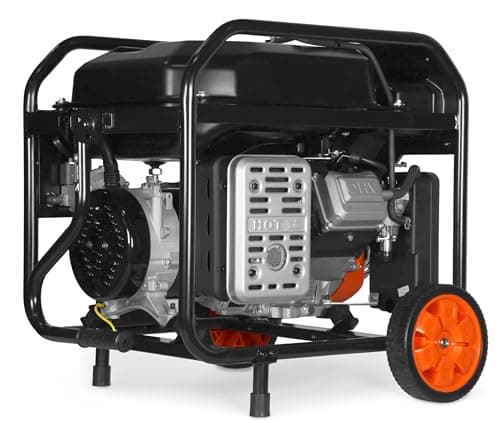
Guide
Sump pump sizing from EWEB's published 1/3 and 1/2 HP figures, plus why battery backup and a generator serve different parts of this problem.
Top pick · WEN DF8000X 8,000W Dual Fuel
$623.17View on Amazon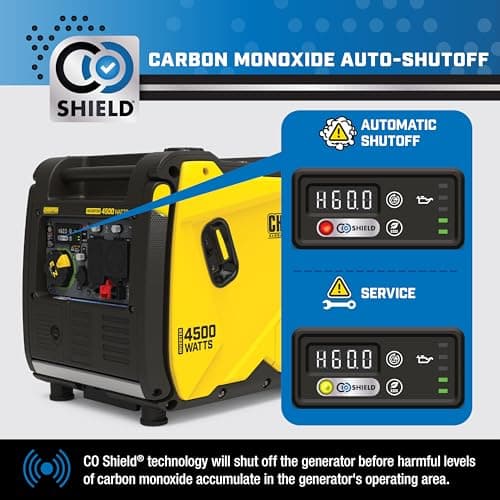
Guide
What a 30 amp RV service actually provides, and which generators match it without wasting capacity.
Top pick · Champion 4,500W RV Ready Inverter
$674.10View on Amazon10% off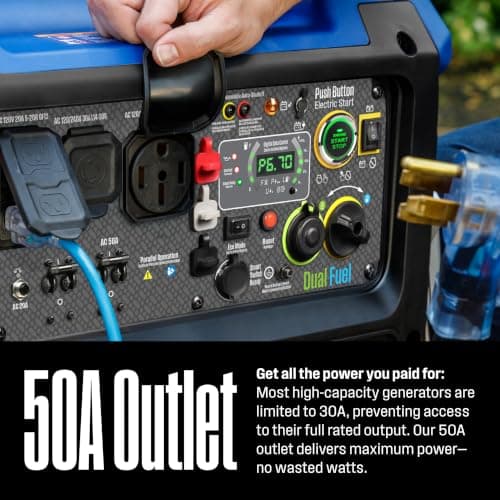
Guide
What a 50 amp RV service provides, what a big rig actually draws, and the honest answer about not needing the full 12,000 watts.
Top pick · Westinghouse iGen12000DFc 12,000W Dual Fuel Inverter
$1,899.00View on AmazonFor a house on gas heat with no central air, 5,000 to 7,500 running watts generally covers every essential circuit at once. Add central air and you are typically above 11,000. Add a deep well pump and electric heat and it climbs further. The honest answer depends entirely on which loads you need simultaneously, which is what the calculator on this page works out.
No. An oversized generator costs more, burns more fuel at light load, is heavier to move, is louder, and in many cases cannot deliver its extra capacity anyway because a 30 amp transfer switch caps throughput at about 7,200 watts. Size it to your actual load with the 80% derating applied and you get a machine that is cheaper to buy and cheaper to run.
Just the biggest one. Both the Eugene Water & Electric Board and Champion Power Equipment charts specify the same method: total the running watts of everything running at once, then add the single largest additional start-up surge. Motors do not all start in the same instant, so summing every surge produces a figure far larger than anything your house will actually demand.
Because they are describing different appliances. A refrigerator is 400 running watts to Champion and 700 to EWEB; a window air conditioner is 1,200 to one and 3,250 to the other. Those are size and vintage differences, not errors. We show both figures and size from the higher one, because undersizing is the failure that burns out motors.
Generators are rated for a continuous load, but running one at 100% of that rating for days on end makes it run hot and wear quickly. We divide the running-watt total by 0.8 to leave headroom. It is our adjustment, not the charts', and we state it wherever a result is shown so you can ignore it if you disagree.
Below about 1,800 running watts with no motor loads, often yes, and it is the better answer: no fuel, no exhaust, it runs indoors and makes no noise. Above that, or with a well pump or air conditioner in the plan, a battery cannot supply the surge and a generator wins. The comparison is worked through on our portable power station versus generator page.