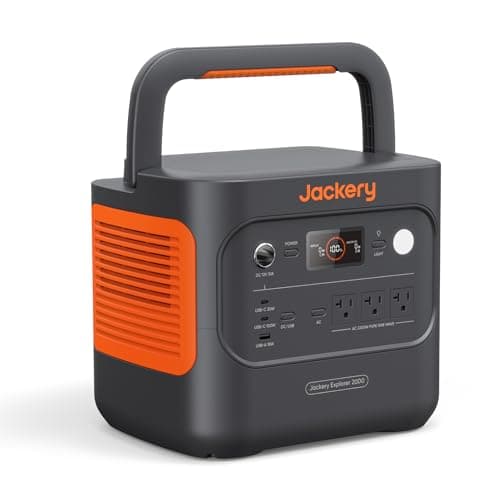
Best Overall Power Station
The Best Home Backup Power Stations
Battery power stations ranked for home backup on surge, capacity, recharge speed and cycle life.
Top pick · Jackery Explorer 2000 v2
$898.99View on Amazon10% offHub
No fuel, no exhaust, no noise, and it runs indoors. For a lot of households this is the right machine and a generator is overkill.
Disclosure: we earn a commission on purchases made through links on this page, at no cost to you. It does not affect what we recommend or what we say about it — how we are funded.
A battery power station is a lithium battery, an inverter and a set of outlets in a box. It does nothing a generator cannot do, and it does several things a generator fundamentally cannot: run indoors, make no noise, produce no exhaust, need no fuel stored in the garage, and switch over fast enough that plugged-in equipment never notices the outage.
The reason the whole category exists for home backup is that most outages are short and most essential loads are small. If the problem you are solving is "keep the fridge cold and the phones charged for eight hours", a battery solves it better than any generator at any price.
Generators are rated in watts, which is a rate. Batteries are rated in watt-hours, which is a quantity. A 2,042 Wh battery can supply 100 watts for roughly 20 hours, or 2,000 watts for about one hour, minus inverter losses of perhaps 10-15%.
What a 2 kWh battery actually carries
Our arithmetic, not a manufacturer claim: 2,042 Wh divided by the load, derated roughly 12% for inverter loss. A fridge averages far less than its running watts because the compressor cycles. A heater does not cycle, which is why resistive heat and batteries are a bad match.
That table is the whole decision. Batteries are excellent at small loads for a long time and poor at large loads for any length of time. Working through your own numbers is the point of how long will a power station run a fridge.
That last point is why solar matters, and why several units here are sold as solar kits. 400 W of panels will not refill 2 kWh in a day in real conditions — angle, cloud and winter sun all take their cut — but a partial daily recharge turns a one-day battery into a several-day one.
Avoid comparing on capacity alone: a 1,024 Wh unit with a 2,000 W output and a 49-minute recharge is a better outage machine for many people than a 2,304 Wh unit with 1,500 W output that weighs 72 lb. Start with the main roundup, or go straight to best power station for a refrigerator if that is the actual problem.
Picks
Each tile carries the top pick from that page with a live price, so you can act from here rather than having to read a review first.
Best Overall Power Station
Battery power stations ranked for home backup on surge, capacity, recharge speed and cycle life.
Top pick · Jackery Explorer 2000 v2
$898.99View on Amazon10% off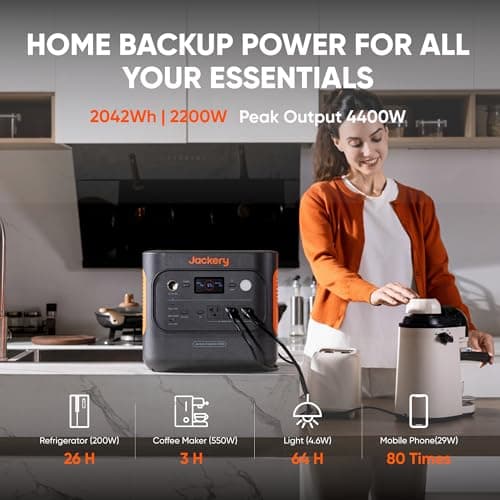
Best Solar Kit
Battery-plus-panel kits ranked on solar input ceiling and capacity, with honest expectations for real-world panel output.
Top pick · Jackery Explorer 2000 v2 + 2x200W Solar
$1,329.00View on Amazon19% off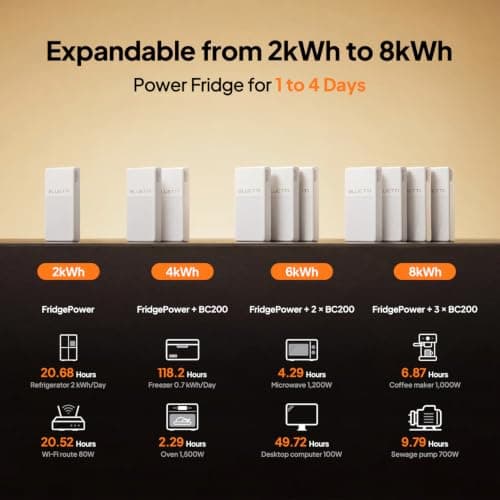
Best for a Refrigerator
Power stations that reliably start a fridge compressor, ranked on surge, idle draw and UPS switchover.
Top pick · Bluetti FridgePower
$899.00View on Amazon40% off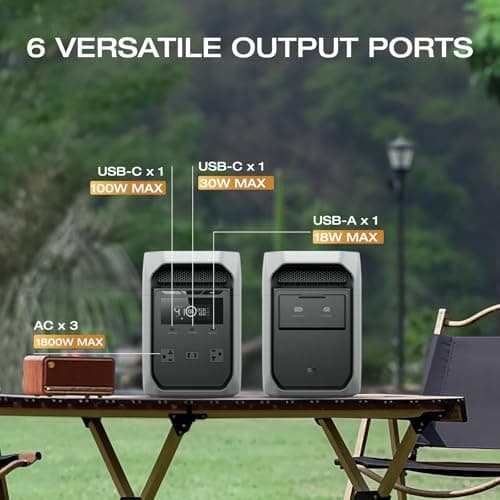
Best Budget Pick
Budget power stations worth owning, with honest limits on what 300 watts of output can do.
Top pick · EcoFlow DELTA 3 Classic
$499.00View on Amazon11% off
Best for CPAP
CPAP backup power options, with the DC-versus-AC efficiency point and the compatibility checks that matter.
Top pick · EASYLONGER ES960 CPAP Battery
$269.99View on Amazon10% off
Guide
The runtime calculation shown in full, the manufacturer claims, and why a cycling fridge lasts far longer than its running watts suggest.
Top pick · Anker SOLIX S2000
$679.99View on Amazon43% off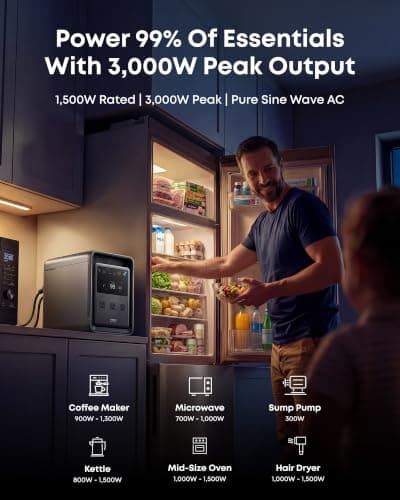
Comparison
Why LiFePO4 is the correct chemistry for backup power, with the published cycle claims that decide it.
Top pick · Anker SOLIX S2000
$679.99View on Amazon43% off
Guide
The four recharge routes during an outage, with published charge speeds and the realistic limits of each.
Top pick · EcoFlow DELTA 2 Max
$1,029.00View on Amazon26% offGuide
Battery backup for a furnace: easy for gas, impossible for electric, with the wiring question in between.
Top pick · Jackery Explorer 2000 v2
$898.99View on Amazon10% offYes, if its surge rating covers the compressor's start-up — around 2,200 watts on published charts. A 2 kWh unit typically carries a modern fridge for roughly a day and a half because the compressor cycles rather than running continuously. Check the surge figure, not just the continuous output.
Divide usable watt-hours by the fridge's average draw and take off 10-15% for inverter loss. A cycling modern refrigerator averages well under its running watts, so a 2,042 Wh unit works out at roughly 30 to 40 hours. Several manufacturers publish their own figures, and the ones with very low idle draw claim longest.
For home backup, yes. LiFePO4 (LFP) cells tolerate far more charge cycles — published claims here run from 3,000 to 10,000 against a few hundred for older chemistries — and are more thermally stable. Nearly every unit worth buying for backup now uses it.
Generally no. A well pump needs around 2,000 extra watts to start and most portable batteries cannot supply that surge; air conditioning needs both a large surge and a sustained load. A soft starter can bring a pump or AC compressor within reach of a large unit, but a generator is the straightforward answer for these loads.
Not for short outages — a battery charged from the wall before the storm is enough. Panels matter when outages run for days, because they turn a fixed quantity of energy into a daily trickle of replacement. Expect substantially less than the panels' rated output in real conditions.
The ones with very low idle draw are designed for it — 4 to 6 watts of standby is the figure to look for, and some units advertise storm alerts that top themselves up automatically before weather arrives. Units wasting 20-30 watts at idle are better charged before an outage than left connected.