Generator Sizing
What Size Generator Do I Need?
Three steps and about five minutes. The answer is almost always smaller than the search results suggest.
Written byMike M.
Published
Disclosure: we earn a commission on purchases made through links on this page, at no cost to you. It does not affect what we recommend or what we say about it — how we are funded.
The short answer
- 1Total the running watts of everything you need on at the same time.
- 2Add the single largest additional start-up surge on that list — not all of them. That gives your starting watts.
- 3Divide the running total by 0.8 for continuous-running headroom. That is the generator's minimum running-watt rating.
Most homes that work this through honestly land between 3,000 and 7,500 running watts. The 9,500- and 13,000-watt machines that dominate search results are the right answer for houses with central air, electric heat or a large well pump — and the wrong answer, expensively, for everyone else.
Step 1: list what runs at the same time
The phrase doing the work is at the same time. You do not need to power your microwave, your coffee maker, your toaster and your air fryer simultaneously — you need to power them one at a time, so only the largest of them counts. Same with the washing machine and the dryer.
For a realistic outage plan, the simultaneous list is usually short:
| Load | Running watts | Additional starting watts | Source |
|---|---|---|---|
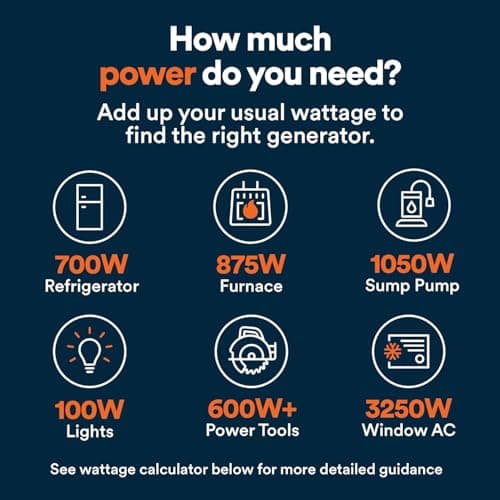
| Refrigerator / freezer | 700 | 2,200 | EWEB |
| Furnace fan blower, 1/3 HP | 700 | 1,400 | EWEB |
| Sump pump, 1/3 HP | 800 | 1,300 | EWEB |
| Water well pump, 1/3 HP | 1,000 | 2,000 | EWEB |
| Lighting (LED, 10 bulbs) | 150 | 0 | EWEB |
| Modem, router, phones, laptop | 150 | 0 | EWEB |
Step 2: add the largest surge, not every surge
This is where most DIY sizing goes wrong in the expensive direction. If you add every start-up surge in the table above — 2,200 plus 1,400 plus 1,300 plus 2,000 — you get 6,900 watts of surge on top of 3,500 running watts, and you conclude you need an 11,000-watt generator.
You do not, because those motors do not all start in the same instant. The method published by both charts we cite is to add only the single largest additional surge. Here that is the refrigerator's 2,200 watts.
The whole-essential-circuit house, worked
- Refrigerator
- 700 W
- Furnace blower
- 700 W
- Sump pump
- 800 W
- Well pump
- 1,000 W
- Lighting + electronics
- 300 W
- Total running
- 3,500 W
- Largest single surge (fridge)
- +2,200 W
- Starting watts needed
- 5,700 W
A house with a well pump AND a sump pump AND gas heat — a fairly demanding essential list — needs 3,500 running watts and 5,700 starting watts.
Step 3: derate for continuous running
A generator's running-watt rating is what it can sustain, but holding any engine at 100% of its rating for three days makes it run hot and wear fast. We divide the running total by 0.8, which leaves 20% headroom.
3,500 divided by 0.8 is 4,375, so round to 4,400 running watts minimum, with at least 5,700 starting watts. That derating is our adjustment rather than the charts', and we state it every time a result appears so you can disregard it if you disagree.
The three loads that change everything
Work the method and you will find your number is modest — unless one of these is on the list:
- Central air conditioning. Large surge, large sustained load. This is the single most common reason a sizing exercise ends above 11,000 watts. Neither chart we cite publishes central AC figures, so read the nameplate on your condenser and see generator size for air conditioner.
- A well pump bigger than 1/3 HP. EWEB's 1/3 HP figure is 1,000 running and 2,000 additional starting. Larger pumps surge much harder — one soft-starter manufacturer states deep well pumps typically draw 65-75 amps to start. Generator size for well pump covers it.
- Electric heat of any kind. No surge at all, but the full rating continuously. EWEB puts an electric water heater at 4,500 watts flat; a space heater at 1,500.
If one of these pushes your number up, check the soft-starter route before you buy a bigger machine. Halving a compressor's or pump's start-up draw can move you down a whole wattage class, and that saving is usually larger than the soft starter costs.
Then size the connection, which can cap everything
A 30 amp transfer switch passes roughly 7,200 watts at 240 V, full stop. Buy a 9,500 running-watt generator and feed it through a 30 amp switch and over 2,000 watts of what you paid for cannot reach the house. If your sizing lands above about 7,500 running watts, budget for a 50 amp transfer switch or an interlock kit at the same time.
Where each of the three common answers lands
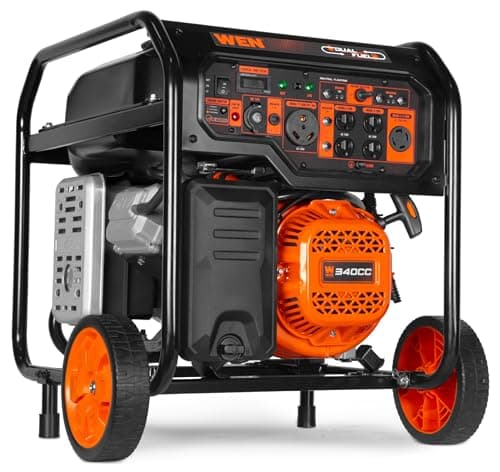
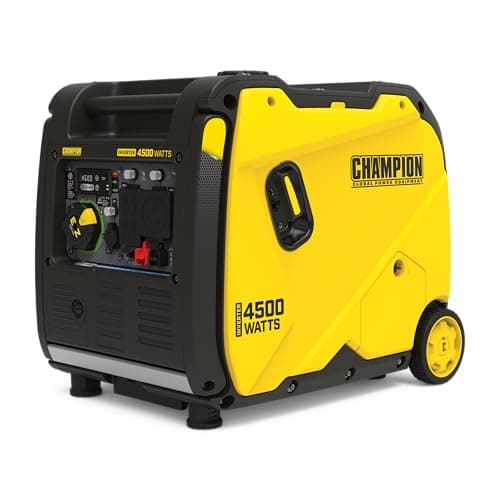
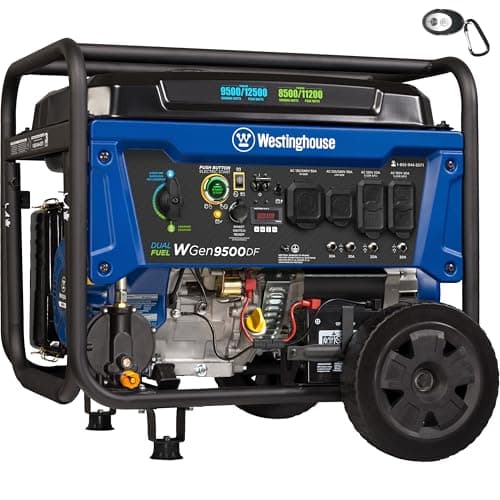
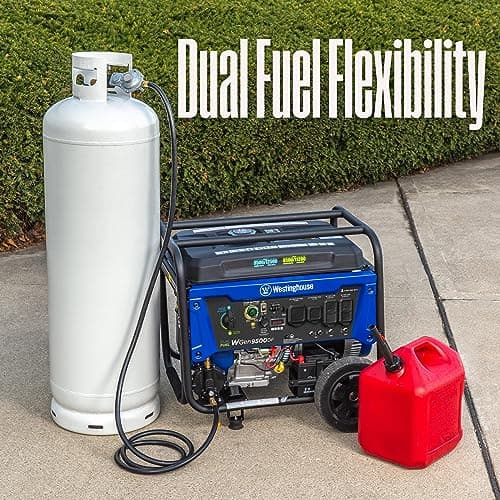
Left to right: the 6,500 running-watt dual fuel answer most essential-circuit houses need; the 3,500-watt quiet inverter answer for a house without a well pump; the 9,500-watt answer when a well pump and a window AC are both on the list.
Do it with your own numbers
The load calculator runs this method on your actual list, including a custom-watts row for anything the published charts do not cover, and gives you a wattage class with a current price on the matching pick. It takes about two minutes and it is the only part of this page you really need.
Questions people actually ask
What size generator do I need for a 2,000 square foot house?
Square footage does not determine it — simultaneous load does. Two 2,000 square foot houses can need 3,500 and 12,000 running watts depending on whether the heat is gas or electric, whether there is a well pump, and whether central air is on the list. Work from the appliance list instead.
Is 5,000 watts enough to run a house?
For the essentials in a house with gas heat and no central air, generally yes: a fridge, furnace blower, sump pump, lighting and electronics total roughly 2,500 running watts, leaving useful headroom. It is not enough if a well pump, central air or electric heat is on the list.
Do I need to add up all the starting watts?
No, and doing so is the most common sizing error. Both published charts specify adding only the single largest additional start-up surge to the running total, because motors do not all start in the same instant. Adding every surge can easily double the figure.
Why do you divide by 0.8?
To leave 20% headroom. A generator held at 100% of its running rating continuously runs hot and wears quickly, and a real outage is not a short test. The derating is our adjustment rather than the charts', and we state it wherever a result is shown.
What size generator do I need to run a refrigerator and a furnace?
Using EWEB's published figures, a refrigerator is 700 running watts and a 1/3 HP furnace blower another 700, so 1,400 running watts, with the fridge's 2,200 watt surge taking the starting requirement to 3,600. With the 80% derating that is about 1,750 running watts minimum — well inside a mid-sized inverter generator or a 2 kWh battery.
Should I size for peak watts or running watts?
Size from running watts and then confirm the generator's peak or starting rating covers your largest single surge. Peak is a figure a generator holds for a second or two to get a motor turning; it is not capacity, and a machine advertised at 13,000 watts may have 10,500 running watts.
Sources
- Eugene Water & Electric Board — Generator Sizing ConsiderationsPublic-utility wattage chart: the running and additional-starting figures quoted on this page, and the add-the-single-largest-surge method.
- Champion Power Equipment — Quick Reference WattageManufacturer wattage chart: the second published figure wherever it differs from EWEB's, and the kitchen and laundry loads EWEB does not list.
- US Consumer Product Safety Commission — Portable Generator Information CenterCarbon monoxide placement guidance referenced wherever this page tells a reader where to put the machine.
Read next
Reference
Appliance Wattage Chart
The site's reference wattage table, with each row's source named and both figures shown wherever the published charts disagree.
Guide
Starting Watts vs Running Watts
What the surge figure means, why motors need it, and how to read the peak-watt number on a generator box.
Guide
What Size Generator for a House?
Load tables for four realistic house types — gas heat, well pump, central air and electric heat — with the generator class each needs.
Best Dual Fuel
Best Dual Fuel Generators for Home Backup
Dual fuel generators ranked on both fuels' published running watts, with the brands that decline to publish propane figures named.
Top pick · Westinghouse WGen9500DF 12,500W Dual Fuel
$999.00View on Amazon
Guide
Transfer Switch Amp Rating Guide
Matching transfer switch amp rating to generator output, with the arithmetic and the whole-chain cost implications.