Comparisons
Portable Power Station vs Generator
The most consequential fork in backup power, and it is decided by two facts about your house rather than by preference.
Written byMike M.
Published
Disclosure: we earn a commission on purchases made through links on this page, at no cost to you. It does not affect what we recommend or what we say about it — how we are funded.
The short answer
| Battery power station | Generator | |
|---|---|---|
| Motor surge (well pump, AC) | No | Yes |
| Runs indoors | Yes | Never |
| Noise | Silent | 52-74 dBA published |
| Multi-day outages | Runs out | Runs on fuel |
| Installation | Plugs in | Transfer switch + electrician |
| 240 V / hard-wired loads | No (one exception) | Yes |
Published figures and capabilities. The one exception on 240 V is Anker's SOLIX F3800, which publishes 120 V and 240 V output and is priced accordingly.
Two facts about your house settle this, and neither is your budget.
- 1Do you have a motor load you must cover? A well pump needs about 2,000 additional watts to start on EWEB's published figures; an air conditioner compressor more. Almost no portable battery supplies that. If yes, generator.
- 2How long are your outages? Hours favors a battery; days favors fuel, because a battery holds a fixed quantity of energy and a generator runs as long as it is fed.
Answer those honestly and the decision usually makes itself. Everything below is the detail behind it.
Where the battery wins, and it is not a small list
It runs indoors. This is the biggest practical difference and it is absolute. CPSC guidance requires a generator to be outdoors, at least 20 feet from the house, exhaust pointed away from doors and windows, never in a garage even with the door open. A battery has no exhaust and sits in the kitchen.
It is silent, which matters at 3am in a suburb. Published generator figures run from as low as 52 dBA on the quietest enclosed inverters to about 74 dBA on a large open frame.
It needs no installation. No transfer switch, no inlet box, no electrician, no permit, no inspection — which on the generator side is commonly a meaningful fraction of the total cost.
It needs no fuel and no maintenance. No gasoline in the garage, no stabilizer, no oil, no filters, no spark plug, and no stale-fuel failure — which is the most common reason a stored generator will not start.
UPS switchover. Several units publish under 10 ms transfer, which means plugged-in equipment never notices the outage. A fridge compressor does not stop, so it never has to restart against its 2,200 watt surge. No generator can do this.
Where the generator wins, and it is decisive where it does
The loads batteries cannot serve
- Well pump, 1/3 HP
- +2,000 W surge (EWEB)
- Window AC, 12,000 BTU
- 3,250 W running, +3,950 W surge
- Electric water heater
- 4,500 W continuous
- Electric furnace
- Commonly 10-20 kW continuous
- Any hard-wired 240 V circuit
- No 240 V output on portables
EWEB published figures. Portable battery output ceilings in this registry are 1,500-2,400 watts, which is why these are not close calls.
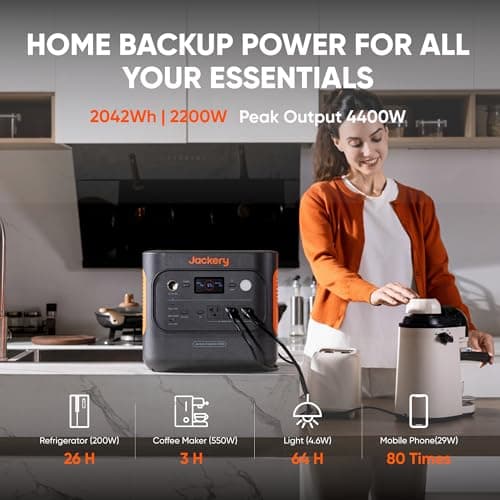
And the runtime asymmetry. A 2,042 Wh battery carries a cycling refrigerator for roughly 30-40 hours on our arithmetic. A generator with fuel runs indefinitely, and a generator plumbed to natural gas — Generac's tri-fuel listing describes virtually unlimited runtime — removes the question entirely.
The comparison nobody runs: capability per dollar
A 2 kWh battery costs roughly what a 9,500 running-watt dual fuel generator costs. The generator has about four times the output and will run for days. The battery runs indoors, silently, with no installation and no maintenance.
Neither of those is better value in the abstract. They are different products at a similar price, and which one is right depends entirely on the two questions at the top of this page.
The short answer
The best of each, at the two common price points
| # | Product | Best for | Score | Price |
|---|---|---|---|---|
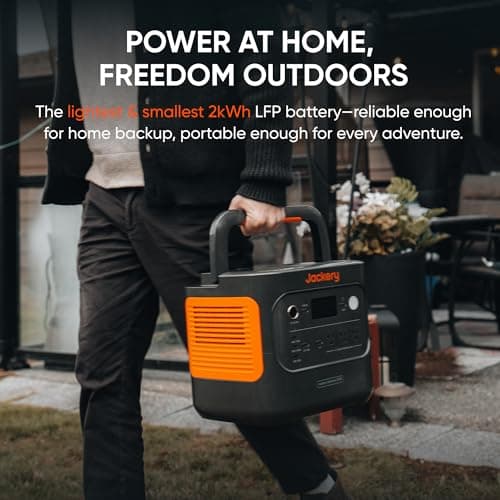
| 1 | 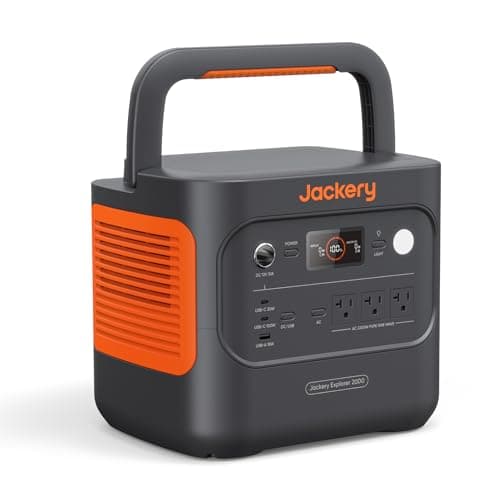 Jackery Explorer 2000 v2 The most sensible battery backup for most homes: enough capacity to carry a fridge and electronics through a typical outage, indoors, silently. | The default 2 kWh home backup battery | 8.9/10 | $898.99 |
| 2 | 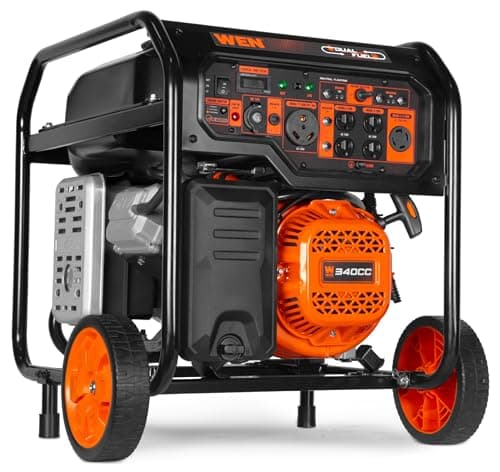 WEN DF8000X 8,000W Dual Fuel The best-value correctly-sized home backup generator here: enough for every essential circuit, dual fuel, CO shutoff, a real transfer-switch outlet, and no money spent on capacity you will not use. | Essential circuits, dual fuel, lowest cost | 8.5/10 | $623.17 |
| 3 | 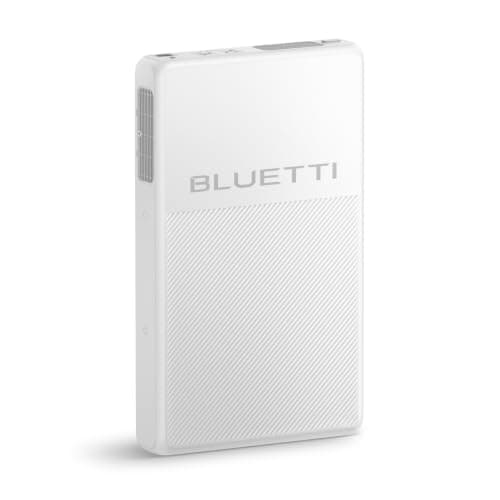 Bluetti FridgePower If the problem you are solving is specifically the refrigerator, this is the unit designed for that problem — the 4 W standby and storm auto-charge are genuine engineering answers to it. | Purpose-built refrigerator backup | 9.0/10 | $899.00 |
| 4 | 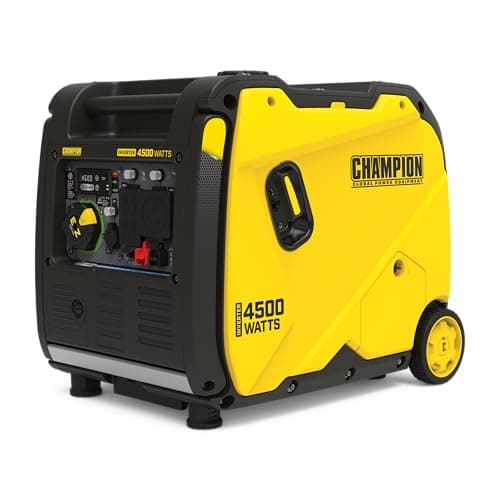 Champion 4,500W RV Ready Inverter The best balance of quiet, clean power and real output for cord-based backup: enough for the essentials, under 3% THD, half the price of the Honda equivalent. | Quiet backup at a sane price | 8.5/10 | $674.10 |
| 5 | 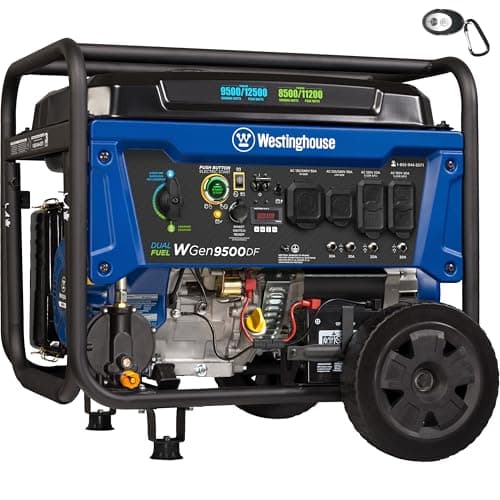 Westinghouse WGen9500DF 12,500W Dual Fuel The most broadly sensible home backup generator on the market: enough running watts for a whole essential-circuit panel, both transfer-switch outlets, and dual fuel — with the caveat that it has no CO shutoff. | The default whole-house pick | 8.8/10 | $999.00 |
| 6 | 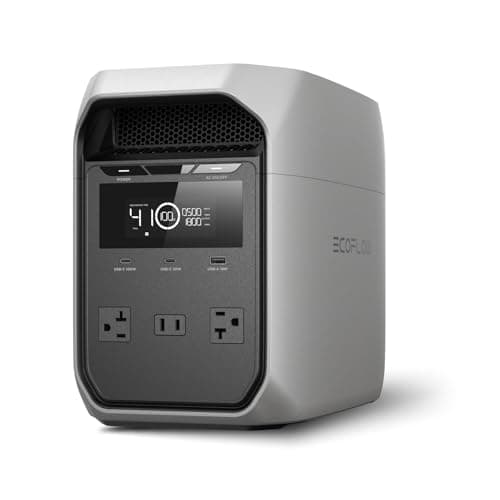 EcoFlow DELTA 3 Classic The best-value battery on the site: UPS-grade switchover, 1,800 W and a 45-minute recharge for roughly half what the 2 kWh units cost. | Best value 1 kWh with UPS | 8.6/10 | $499.00 |
#ad Prices as of October 5, 2026; they may have changed since. Scores are our editorial judgment from published specifications, not test results — how we pick. How we are funded.
The answer most households should actually reach
Buy both, smaller. This is underused and it is frequently the best total answer for a house with mixed needs.
The generator runs by day, covering motor loads and recharging the battery at full speed — several units here publish 0-80% in 43-49 minutes. At night the generator is off, and the battery runs the fridge and electronics silently indoors.
That solves the generator's worst problem (running next to a bedroom at 3am) and the battery's worst problem (running out) simultaneously, and it lets you buy a smaller machine of each. A 3,500 running-watt inverter generator plus a 2 kWh battery covers more than either alone at a similar total.
Cost detail: power station vs generator cost of ownership.
Questions people actually ask
Is a power station or a generator better for home backup?
A battery is better for small loads, short outages and anyone who needs to run indoors or quietly. A generator is better for motor loads like well pumps, for multi-day outages, and for feeding hard-wired circuits. The surge requirement of your largest load usually decides it.
Can a power station replace a generator?
For a fridge, lighting, a modem and devices over a short outage, yes, and it does the job better — indoors, silently, with no fuel. It cannot replace a generator for a well pump, air conditioning, electric heat or any hard-wired 240 volt circuit.
Why can't a battery run a well pump?
The surge. EWEB's chart puts a 1/3 HP well pump at 2,000 additional watts to start, and portable battery output ceilings in this registry are 1,500-2,400 watts. A soft starter can change that calculation, but a generator is the straightforward answer.
Is a battery cheaper than a generator?
Higher per watt to buy, far cheaper to own: no fuel, no oil, no filters, no stabilizer, no installation and no electrician. For small loads and short outages it often wins over five years. With a well pump or multi-day outages it does not come close.
Should I buy a generator and a battery?
For a house with mixed needs it is frequently the best answer. The generator runs by day covering motor loads and recharging the battery; the battery runs the fridge silently indoors overnight. You can buy a smaller machine of each than you otherwise would.
Can a generator run indoors if I open a window?
No, under any circumstances. CPSC guidance prohibits operating a portable generator in a house, garage, basement or any partly enclosed space even with doors and windows open, because carbon monoxide accumulates faster than an opening clears it. This is the battery's single biggest advantage.
Sources
- Eugene Water & Electric Board — Generator Sizing ConsiderationsPublished appliance running and additional-starting watt figures used in the load arithmetic on this page.
- US Consumer Product Safety Commission — Portable Generator Information CenterThe placement and carbon monoxide guidance referenced wherever this page compares indoor and outdoor operation.
Read next
Comparison
Power Station vs Generator: Total Cost
Five-year ownership cost compared between a battery and a generator, including the connection and maintenance lines.
Best Overall Power Station
The Best Home Backup Power Stations
Battery power stations ranked for home backup on surge, capacity, recharge speed and cycle life.
Top pick · Jackery Explorer 2000 v2
$898.99View on Amazon10% off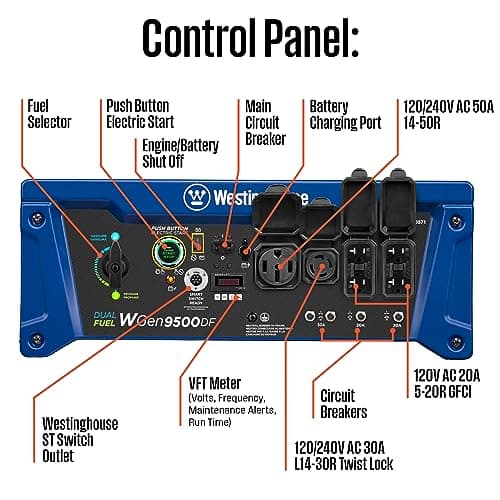
Best Overall Home Backup
The Best Home Backup Generators
Nine conventional-frame generators ranked for whole-house backup, with per-fuel running watts and transfer-switch fit.
Top pick · Westinghouse WGen9500DF 12,500W Dual Fuel
$999.00View on Amazon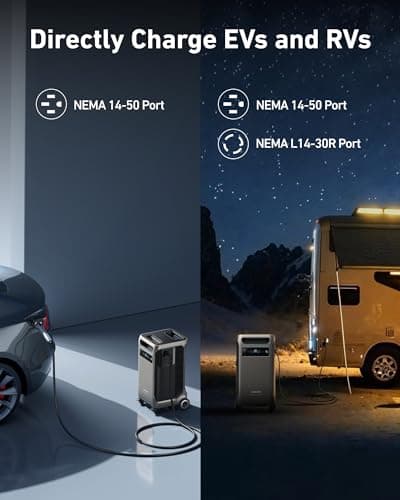
Comparison
Home Battery Backup vs Generator
Installed home battery systems against generators, and the expandable portable units that sit between them.
Guide
What Size Generator Do I Need?
The core sizing method: total running watts, add the single biggest surge, derate for continuous running, then match a wattage class.