Generators
Best Generator Brands
Judged on a criterion nobody uses: how much each brand tells you, and what each one consistently leaves out.
Written byMike M.
Published
Disclosure: we earn a commission on purchases made through links on this page, at no cost to you. It does not affect what we recommend or what we say about it — how we are funded.
The short answer
Champion publishes the most complete specifications — running and starting watts on every fuel, decibel figures with the measurement distance, THD — which makes honest sizing possible. Westinghouse offers the best output per dollar with good documentation. Generac has the widest service network. Honda is the most reliable and the worst value per watt. DuroMax builds the most robust frames and publishes the least per-fuel detail. WEN is the cheapest per watt and publishes no noise figures.
Brand comparisons in this category usually rank on reputation, which is circular. We have no test lab and cannot tell you which brand lasts longest. What we can assess precisely is what each brand publishes, because that determines whether you can size correctly — and a brand that withholds its propane running watts has made your decision harder for its own convenience.
What each brand publishes, and what it does not
| Brand | Per-fuel running watts | Noise figure | THD |
|---|---|---|---|
| Champion | All fuels, running + starting | Some models, with distance | Published |
| Westinghouse | Gasoline + propane + NG | 'As low as', no distance | Published on inverters |
| WEN | All fuels on tri-fuel | None, or a comparison | Not published |
| Generac | Gasoline only on most | Not published | Not published |
| DuroMax | Peak watts mainly | Not published | Not published |
| Honda | Single fuel | Range given | Not published |
| DeWalt | Starting watts | Not published | Not published |
Champion: the most honestly documented
Champion publishes running and starting watts on every fuel a machine supports, decibel figures with the measurement distance on several models, and THD on its inverters. Its 12,500 W tri-fuel ships with both the natural gas and propane hoses, and it offers lifetime technical support — which is a genuinely usable thing when you are troubleshooting at 2am in an outage.
It also publishes Intelligauge hour tracking on most machines, which makes a maintenance schedule something you can actually follow rather than estimate. If you want to size correctly from published data, Champion makes it easiest.
Westinghouse: the best output per dollar
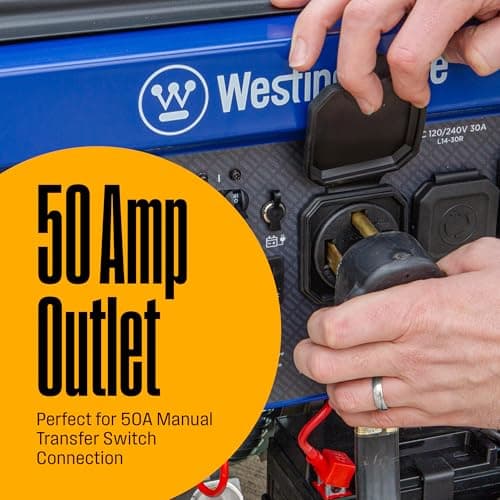
Consistently strong running watts for the price, good per-fuel documentation, remote start on most home backup machines, and the widest range of transfer-switch-ready outlet combinations. The iGen12000DFc is arguably the best-specified whole-house inverter available.
The inconsistency to watch: CO shutdown is present on some models and not others — the WGen9500DF lacks one while the WGen10500DFc has it — so check per machine rather than assuming by brand.
Generac: the service network
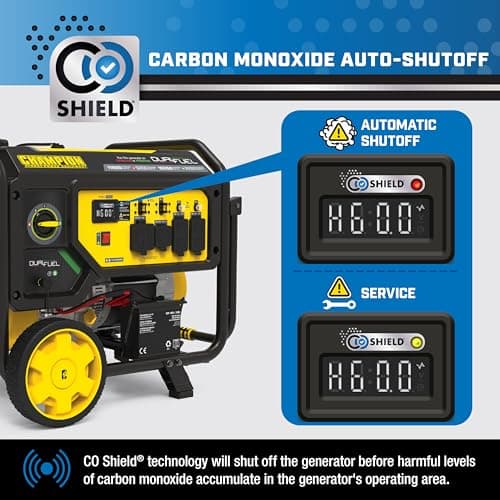
The largest dealer and parts network in the category, which is a real asset five years in when something needs a part. COsense is among the better-regarded CO shutdown implementations, and PowerRush genuinely adds surge capability — 6,500 running watts reaching 8,125 starting watts.
The weaknesses are documentation and fuel: most Generac portables are gasoline-only, and the listings frequently state starting watts without a running figure, which is the omission that most hampers sizing. Its tri-fuel machine is the exception and is excellent value.
Honda: reliability, at a price per watt that is hard to defend
Honda's small-engine reputation is deserved and its published noise figures hold up. The EU2200i at 48-57 dB(A) is the quietest machine in this registry.
For home backup specifically, it is poor value: an EU2200i costs roughly what a 6,500-running-watt dual fuel machine costs and delivers under 2,000 running watts, with no 240 V output and no propane option. Buy Honda for quiet, portability and longevity. Do not buy it for capacity.
DuroMax: the frames, not the paperwork
All-metal frames and power panels with no plastic parts, copper windings published on the HX line, front-facing fuel selectors that are the best-implemented in the category, and remote start on machines where rivals charge more for it.
The consistent weakness is documentation: DuroMax leads with peak watts and does not publish per-fuel running figures, THD or noise ratings on most machines. For a buyer planning to run on propane, that is a real gap, and it is why DuroMax machines rank below equivalently specified Westinghouse and Champion units here despite being well built.
WEN: cheapest per watt, least documented
The best watts-per-dollar in the registry — the DF1100T's 8,300 running watts is unmatched at its price — and the fuel shutoff feature on its inverters is the single best design choice for a machine that sits unused for a year.
Against that: no published noise figures despite marketing machines as quiet, no published THD, a thinner service network, and some models that omit CO shutdown. The DF1100T's L5-30R twist-lock is 120 V only, which catches out buyers expecting a transfer-switch connection.
The short answer
The best machine from each brand for home backup
| # | Product | Best for | Score | Price |
|---|---|---|---|---|
| 1 | 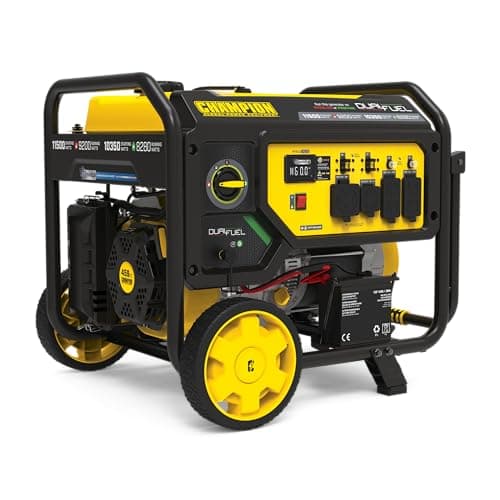 Champion 11,500W Dual Fuel Electric Start The most honestly specified generator in its class, with CO shutoff and the best after-sale support in the category. | Published propane numbers you can plan on | 8.7/10 | $989.99 |
| 2 | 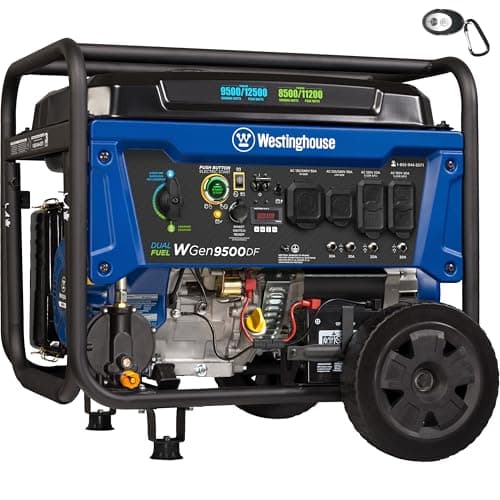 Westinghouse WGen9500DF 12,500W Dual Fuel The most broadly sensible home backup generator on the market: enough running watts for a whole essential-circuit panel, both transfer-switch outlets, and dual fuel — with the caveat that it has no CO shutoff. | The default whole-house pick | 8.8/10 | $999.00 |
| 3 | 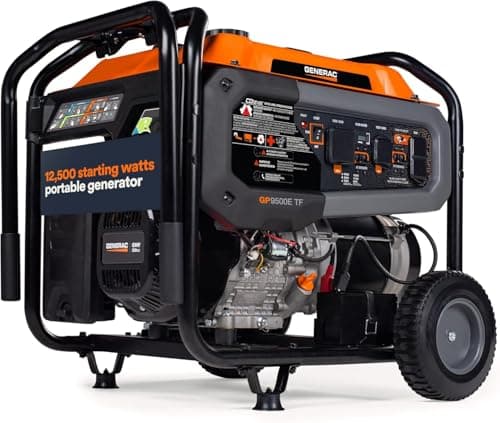 Generac 12,500W Starting Tri-Fuel The cheapest credible way to get a generator onto your home's natural gas line, which is the one fuel supply an outage usually does not interrupt. | Natural-gas hookup at the best price | 9.1/10 | $920.00 |
| 4 | 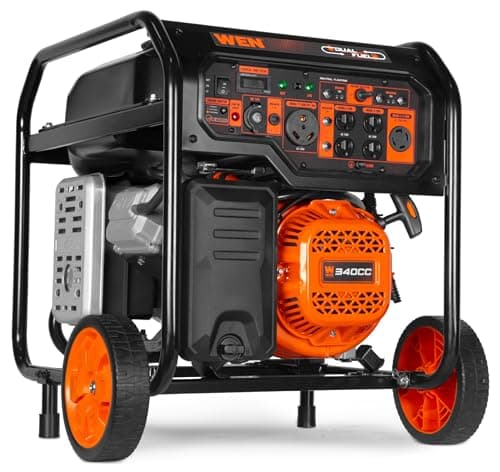 WEN DF8000X 8,000W Dual Fuel The best-value correctly-sized home backup generator here: enough for every essential circuit, dual fuel, CO shutoff, a real transfer-switch outlet, and no money spent on capacity you will not use. | Essential circuits, dual fuel, lowest cost | 8.5/10 | $623.17 |
| 5 | 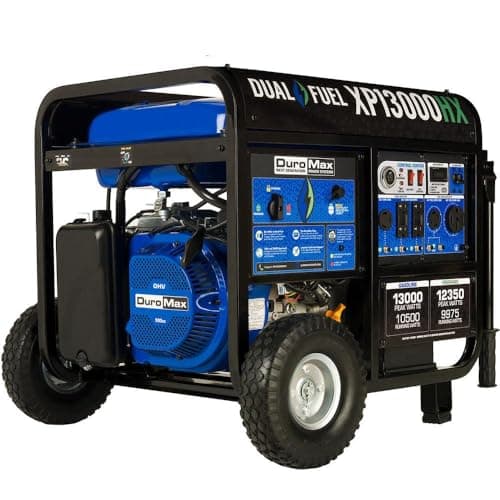 DuroMax XP13000HX 13,000W Dual Fuel The value pick in DuroMax's 13kW line: copper windings and CO shutoff for less than the older EH typically costs. | Best price per peak watt | 8.9/10 | $1,079.00 |
| 6 | 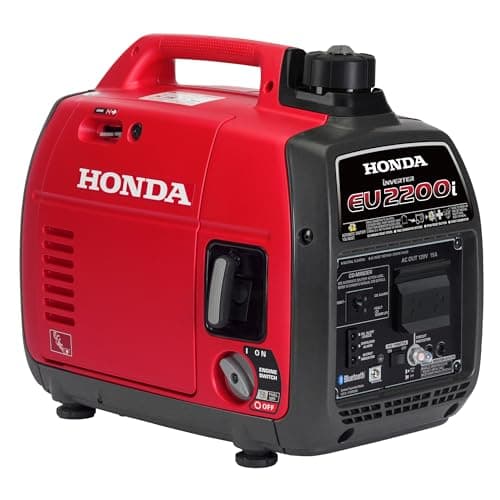 Honda EU2200i 2,200W Inverter The best small inverter generator made, and the wrong tool for whole-house backup — buy it for a fridge, a few lights and quiet, not for your panel. | The quietest credible option | 8.0/10 | $1,199.00 |
#ad Prices as of October 5, 2026; they may have changed since. Scores are our editorial judgment from published specifications, not test results — how we pick. How we are funded.
For a model-by-model version of this, see best generator brands compared.
Questions people actually ask
What is the best generator brand?
It depends on what you weight. Champion publishes the most complete specifications and offers lifetime technical support; Westinghouse gives the best output per dollar; Generac has the widest service network; Honda is the most reliable and the worst value per watt. We have no test lab and cannot rank longevity.
Is Westinghouse a good generator brand?
Yes, particularly for output per dollar and per-fuel documentation. The inconsistency to check is carbon monoxide shutdown, which is present on some models (WGen10500DFc) and absent on others (WGen9500DF), so verify per machine rather than assuming by brand.
Is Generac better than Champion?
Generac has the larger service network and well-regarded COsense and PowerRush technologies. Champion publishes considerably more complete specifications, supports more fuels, and offers lifetime technical support. For sizing from published data, Champion is easier to buy.
Are WEN generators any good?
They offer the best watts per dollar in this registry and the fuel shutoff on their inverters is genuinely the right feature for a machine that sits unused. The trade-offs are no published noise or THD figures, a thinner service network, and some models omitting CO shutdown.
Is a Honda generator worth the money?
For quiet, portability and long-term reliability, yes — the published 48-57 dB(A) on the EU2200i is the best in the class. For home backup value, no: it costs about what a 6,500-running-watt dual fuel machine costs and delivers under 2,000 running watts with no 240 V output.
Which brand publishes the most useful specifications?
Champion. It states running and starting watts for every fuel a machine supports, gives decibel figures with the measurement distance on several models, and publishes THD on its inverters. That combination is what makes honest sizing possible.
Sources
- US Consumer Product Safety Commission — Portable Generator Information CenterThe placement and carbon monoxide guidance every generator page on this site links to.
- Eugene Water & Electric Board — Generator Sizing ConsiderationsPublished appliance running and additional-starting watt figures used in the sizing arithmetic on this page.
Read next
Brand Comparison
Generator Brands Compared, Model by Model
Each major brand's best home backup generator compared on published specifications, with omissions marked.
Best Overall Home Backup
The Best Home Backup Generators
Nine conventional-frame generators ranked for whole-house backup, with per-fuel running watts and transfer-switch fit.
Top pick · Westinghouse WGen9500DF 12,500W Dual Fuel
$999.00View on Amazon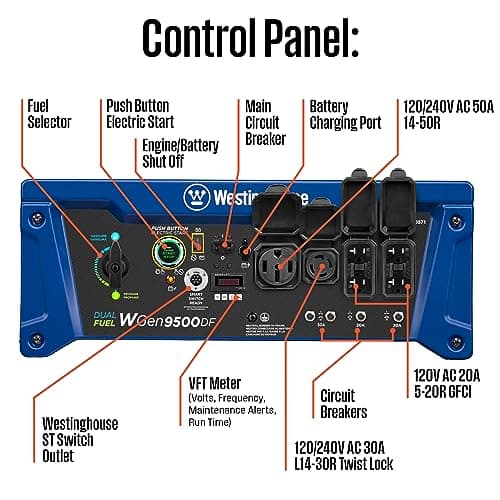
Best Dual Fuel
Best Dual Fuel Generators for Home Backup
Dual fuel generators ranked on both fuels' published running watts, with the brands that decline to publish propane figures named.
Top pick · Westinghouse WGen9500DF 12,500W Dual Fuel
$999.00View on Amazon
Guide
How Quiet Is a Quiet Generator?
Published decibel ratings side by side with their measurement conditions, and what a dB difference actually means.
Guide
What Size Generator Do I Need?
The core sizing method: total running watts, add the single biggest surge, derate for continuous running, then match a wattage class.