Model Reviews
Jackery for Home Backup
The lightest 2 kWh unit here, and an expandable system that grows to 12 kWh. Where each one fits.
Written byMike M.
Published
Disclosure: we earn a commission on purchases made through links on this page, at no cost to you. It does not affect what we recommend or what we say about it — how we are funded.
The short answer
Jackery's Explorer 2000 v2 publishes 2,042 Wh, 2,200 W across three AC ports, 0-80% in 66 minutes, LiFePO4 rated up to 10 years, a sub-30 dB silent charging mode and 39.5 lb — which Jackery states is the lightest 2 kWh unit on the market. The HomePower 2000 Plus v2 publishes 2,048 Wh expandable to 12 kWh, 2,400 W, 6,000+ LFP cycles with a 16-year design life, and Priority Routing to keep essential circuits running.
The range, published side by side
| Model | Capacity | AC output | Weight | Cycles |
|---|---|---|---|---|
| Explorer 300 | 292 Wh | 300 W / 600 W peak | 7.5 lb | 4,000+ to 70% |
| Explorer 1000 v2 | 1,070 Wh | 1,500 W / 3,000 W surge | 23.8 lb | Over 70% retained |
| Explorer 2000 v2 | 2,042 Wh | 2,200 W | 39.5 lb | Up to 10 years |
| HomePower 2000 Plus v2 | 2,048 Wh → 12 kWh | 2,400 W | 40.6 lb | 6,000+ |
What the weight figure actually buys you
39.5 lb for 2,042 Wh is the best weight-per-watt-hour in this registry. Bluetti's AC200PL holds slightly more at 2,304 Wh and weighs 72 lb — nearly double.
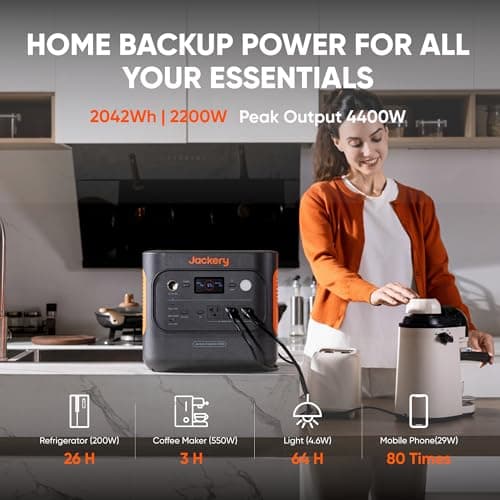
That matters more than it sounds for a backup unit, because weight decides whether it moves. A 40 lb box goes upstairs to a bedroom, out to the garage, into a car. A 72 lb box stays where you first put it. For a device whose job is to be wherever the problem is, that is a functional difference rather than a convenience.
The surge figure to check on the 1000 v2
Both published wattage charts put a refrigerator's start-up surge at 2,200 watts. The Explorer 1000 v2 publishes 1,500 W continuous with a 3,000 W surge peak, which clears it comfortably.
That makes it the cheapest Jackery that genuinely runs a fridge, and at 23.8 lb it is remarkably portable for that capability. Using our arithmetic — capacity divided by a cycling average of roughly 150 W, derated about 12% for inverter loss — 1,070 Wh works out at roughly 15-20 hours of fridge duty.
Jackery also publishes 0-100% in one hour with emergency charging on this model, which means a brief grid restoration refills it completely.
The HomePower line and what expansion really costs
The HomePower 2000 Plus v2 is the more serious backup product: 2,400 W output, 6,000+ LFP cycles with a stated 16-year design life, expansion to 12 kWh, and Smart Energy Management with Priority Routing to keep essential circuits running during shortages.
Priority Routing is the feature that distinguishes this from a large extension cord — it makes the unit behave like a backup system, allocating available power to what matters. And 6,000 cycles is double what most LiFePO4 power stations claim.
What none of them can do
Motor loads and 240 volts. Using EWEB's published figures, a 1/3 HP well pump needs 2,000 additional watts to start and a 12,000 BTU window air conditioner 3,250 running watts with a 3,950 watt surge. Neither is within 2,400 W.
And no Jackery unit here publishes a 240 volt output, so nothing hard-wired. For that you need a generator or Anker's SOLIX F3800, which publishes both voltages and is priced accordingly.
Where Jackery sits against its rivals
Honest positioning
- Lightest 2 kWh
- Jackery, clearly
- Fastest recharge
- EcoFlow (43 min) / Anker (49 min)
- Longest cycle life
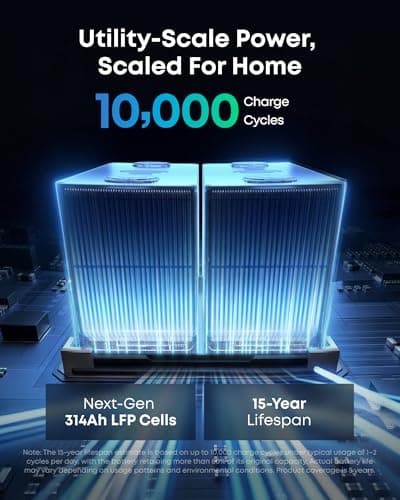
- Anker SOLIX S2000 (10,000)
- Lowest idle draw
- Bluetti FridgePower (4 W)
- UPS switchover
- EcoFlow and Bluetti publish under 10 ms
- Most capacity per dollar
- Bluetti AC200PL
Manufacturer published figures. Jackery wins on weight and is competitive everywhere else without leading — which is why the Explorer 2000 v2 is our all-round pick rather than our pick in any single category.
No Jackery unit here publishes a UPS switchover time, which is a gap: EcoFlow and Bluetti both publish under 10 ms, and for anyone wanting a fridge permanently behind the battery that is a meaningful advantage. Nor does Jackery publish an idle-draw figure, where Bluetti and Anker do.
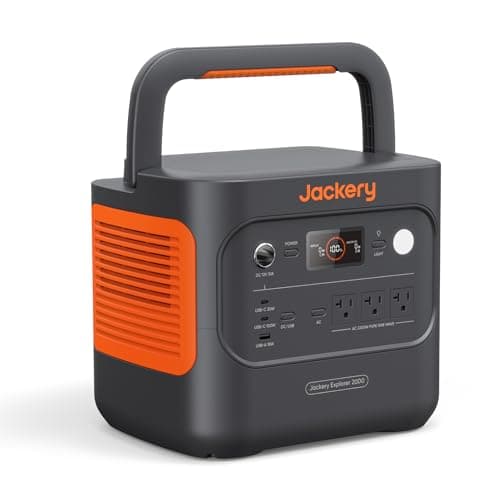
- Capacity
- 2,042 Wh
- AC output
- 2,200 W
- Weight
- 39.5 lb
#1 · The default 2 kWh home backup battery
Jackery Explorer 2000 v2
The most sensible battery backup for most homes: enough capacity to carry a fridge and electronics through a typical outage, indoors, silently.
#ad Price as of October 5, 2026; it may have changed since. How we are funded.
What is good
- 2,042 Wh runs a modern fridge for roughly a day and a half of cycling — the single most useful thing a battery does in an outage
- 39.5 lb for 2 kWh is genuinely carryable by one person, which no generator at equivalent usefulness is
- Zero exhaust means it runs indoors, which is the entire point versus a generator
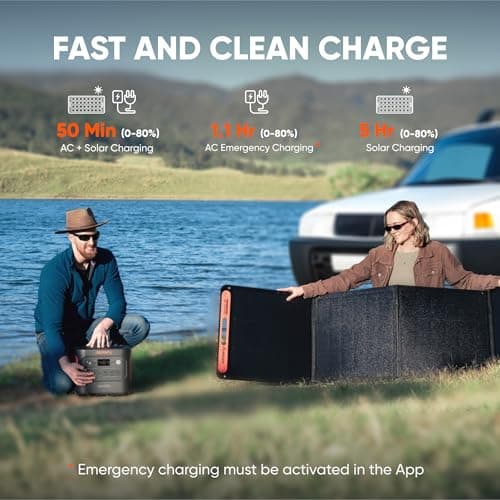
- 66 minutes to 80% means you can top it up fast from a generator or during a brief grid restoration
What is not
- 2,200 W will not start a well pump or run central air — motor loads are where batteries lose to generators
- Once it is empty it is empty: without solar or a generator to recharge it, a multi-day outage outlasts it
- Costs about the same as a 9,500-running-watt dual fuel generator with ten times the output
Published specification & our scoring
- 2,042 Wh capacity, 2,200 W total AC output across three AC ports (manufacturer)
- 0-80% in 66 minutes on AC fast charging (manufacturer)
- LiFePO4 battery rated for up to 10 years (manufacturer)
- Silent Charging Mode under 30 dB (manufacturer)
- Published weight 39.5 lb — manufacturer states it is the lightest 2 kWh unit
- App control
- Usable capacity
- 9
- Output ceiling
- 7
- Recharge speed
- 10
- Cycle life
- 9
- Portability
- 9
- Value
- 9
Specification figures are the manufacturer’s published values. Scores are our editorial judgment from those figures and are never published as structured review data — how we pick.
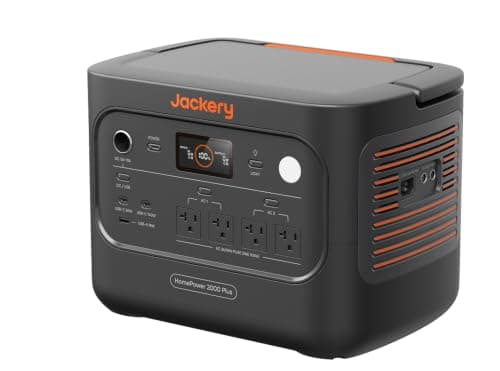
- Capacity
- 2,048 Wh (to 12 kWh)
- AC output
- 2,400 W
- Cycles
- 6,000+ LFP (mfr)
#2 · Expandable whole-circuit backup
Jackery HomePower 2000 Plus v2
The right battery if you intend to grow the system: start at 2 kWh, add capacity as budget allows, and keep the same hardware.
#ad Price as of October 5, 2026; it may have changed since. How we are funded.
What is good
- Expandable to 12 kWh means you can start at one battery and grow into genuine multi-day capacity
- 6,000 cycles is double what most LiFePO4 power stations claim
- Priority Routing is the feature that makes a battery behave like a backup system rather than a big extension cord
What is not
- Expansion batteries cost as much as a complete smaller unit each — the 12 kWh figure is an expensive destination
- 2,400 W still will not start a well pump
- A hard-wired installation to feed circuits needs an electrician and a compatible transfer setup
Published specification & our scoring
- 2,048 Wh expandable to 12 kWh, 2,400 W output (manufacturer)
- 6,000+ LFP cycles; manufacturer states a 16-year design life
- Smart Energy Management with Priority Routing to keep essential circuits running (manufacturer)
- Manufacturer states it is the lightest expandable 2 kWh system and 34% lighter than the previous generation
- Published weight 40.6 lb
- Usable capacity
- 9
- Expandability
- 10
- Output ceiling
- 7
- Cycle life
- 10
- Portability
- 9
- Value
- 7
Specification figures are the manufacturer’s published values. Scores are our editorial judgment from those figures and are never published as structured review data — how we pick.
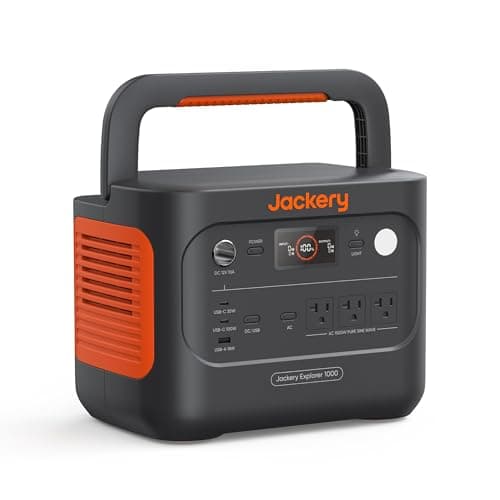
- Capacity
- 1,070 Wh
- AC output
- 1,500 W / 3,000 W surge
- Weight
- 23.8 lb
#3 · A fridge overnight, nothing heavier
Jackery Explorer 1000 v2
The right size if the goal is specifically keeping the refrigerator and your phones alive overnight — and honest about being nothing more than that.
#ad Price as of October 5, 2026; it may have changed since. How we are funded.
What is good
- The 3,000 W surge rating is what lets it start a fridge compressor — the figure that actually matters, and many rivals understate it
- 23.8 lb is carry-it-upstairs light
- One hour to full is faster than most units twice its price
What is not
- 1,070 Wh is roughly 15-20 hours of fridge cycling, not multiple days
- 1,500 W continuous rules out a microwave and a kettle at the same time
- No 240V output, so nothing hard-wired
Published specification & our scoring
- 1,070 Wh capacity, 1,500 W AC output with 3,000 W surge peak (manufacturer)
- 0-100% in one hour with emergency charging (manufacturer)
- LFP battery holding over 70% of original capacity after its rated life (manufacturer)
- Two USB-C, one USB-A, one DC car port, three pure sine wave AC ports, LED lights
- App control with a 30 dB quiet charging mode
- Published weight 23.8 lb
- Usable capacity
- 6
- Output ceiling
- 6
- Recharge speed
- 10
- Cycle life
- 9
- Portability
- 10
- Value
- 9
Specification figures are the manufacturer’s published values. Scores are our editorial judgment from those figures and are never published as structured review data — how we pick.
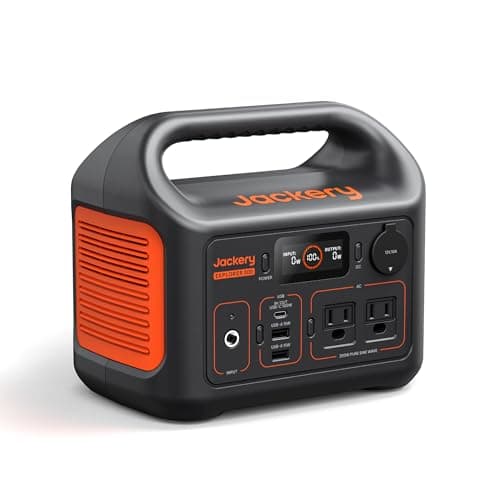
- Capacity
- 292 Wh
- AC output
- 300 W / 600 W peak
- Weight
- 7.5 lb
#4 · Phones, laptops, a CPAP
Jackery Explorer 300
Buy this for devices and medical equipment, not appliances — and at 7.5 lb and 4,000 cycles, it is the easiest preparedness purchase on the site.
#ad Price as of October 5, 2026; it may have changed since. How we are funded.
What is good
- 4,000 cycles at 7.5 lb — this will outlive several phones
- 292 Wh covers two nights of a CPAP without a humidifier, or a week of phone charging
- Small enough that it lives in a cupboard and gets used, rather than being a project
What is not
- 300 W will not start a refrigerator — do not buy it for that
- Solar panel sold separately
- No 240V, no high-draw appliances at all
Published specification & our scoring
- 292 Wh capacity, 300 W rated output with 600 W peak (manufacturer)
- Two AC outlets, a 100 W USB-C PD port, two USB-A, a 120 W car port
- LiFePO4 chemistry rated for over 4,000 charge cycles to 70% capacity (manufacturer)
- Published weight 7.5 lb
- Solar panel not included
- Usable capacity
- 3
- Output ceiling
- 3
- Cycle life
- 10
- Portability
- 10
- Recharge speed
- 7
- Value
- 9
Specification figures are the manufacturer’s published values. Scores are our editorial judgment from those figures and are never published as structured review data — how we pick.
The solar kit, and the rivals that beat it on specific figures
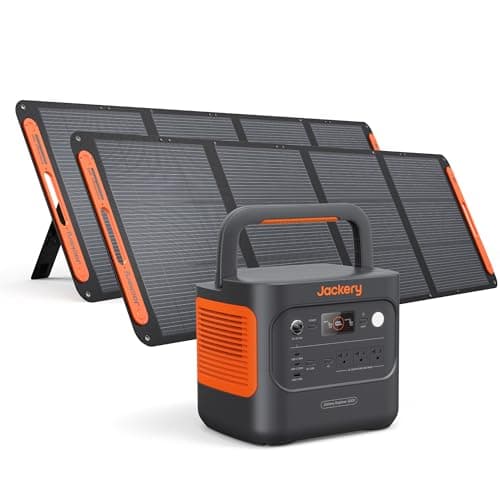
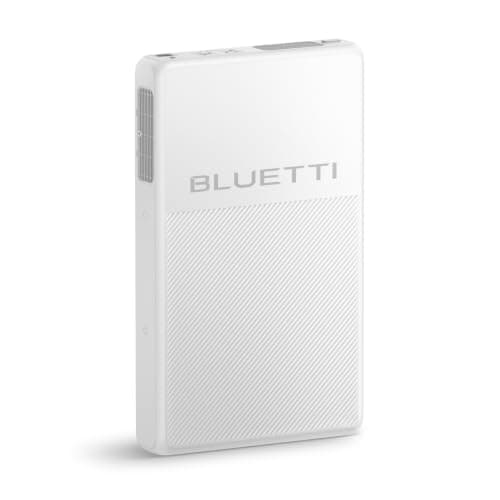
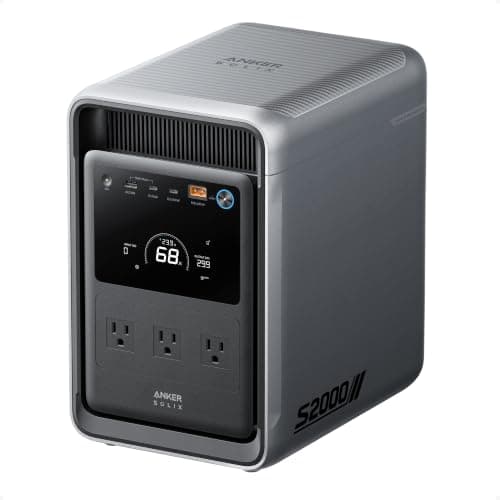
Jackery's 2 kWh solar kit adds 400 W of panels. Bluetti's FridgePower publishes a 4 W idle draw and 10 ms UPS. Anker's S2000 publishes 10,000 cycles and a 6 W idle draw.
Questions people actually ask
Is Jackery good for home backup?
Yes, particularly the Explorer 2000 v2: 2,042 Wh, 2,200 W, 0-80% in 66 minutes and 39.5 lb, which Jackery states is the lightest 2 kWh unit available. It wins clearly on weight and is competitive elsewhere without leading on any single figure.
Will a Jackery run a refrigerator?
The Explorer 1000 v2 and above will. Both published wattage charts put a fridge's start-up surge at 2,200 watts, and the 1000 v2 publishes a 3,000 W surge peak which clears it. On our arithmetic its 1,070 Wh gives roughly 15-20 hours of cycling fridge duty.
What is the difference between Jackery Explorer and HomePower?
HomePower is the backup-oriented line: the 2000 Plus v2 publishes 2,400 W output, 6,000+ cycles with a 16-year design life, expansion to 12 kWh, and Priority Routing to keep essential circuits running. Explorer units are fixed-capacity portable boxes.
Is the Jackery expansion to 12kWh worth it?
Each expansion battery costs about as much as a complete smaller unit, so 12 kWh is an expensive destination. The real value is spreading the spend across years without replacing hardware you already own, which beats buying a fixed-capacity unit twice.
Can a Jackery run a well pump or air conditioning?
No. A 1/3 HP well pump needs 2,000 additional watts to start and a 12,000 BTU window AC 3,250 running watts on published figures, both beyond the 2,400 W ceiling. No Jackery here publishes a 240 volt output either, so nothing hard-wired.
Does Jackery have UPS switchover?
No Jackery unit in this registry publishes a switchover time, which is a gap against EcoFlow and Bluetti, both of which publish under 10 milliseconds. If you want a fridge permanently behind the battery, that is a meaningful advantage for the rivals.
Sources
- Eugene Water & Electric Board — Generator Sizing ConsiderationsPublished appliance running and additional-starting watt figures used to judge what this machine's output actually covers.
- FoodSafety.gov — food safety during a power outageThe 4-hour refrigerator guidance that sets how much capacity a fridge plan actually needs.
Read next
Best Overall Power Station
The Best Home Backup Power Stations
Battery power stations ranked for home backup on surge, capacity, recharge speed and cycle life.
Top pick · Jackery Explorer 2000 v2
$898.99View on Amazon10% off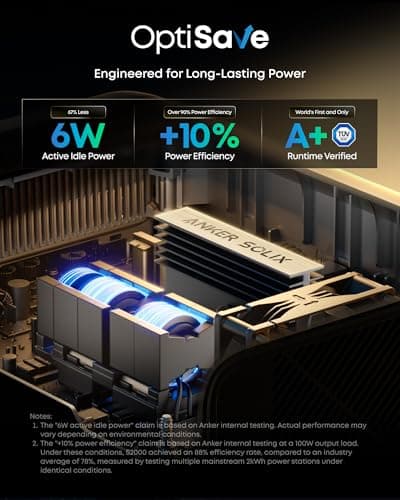
Guide
How Long Will a Power Station Run a Fridge?
The runtime calculation shown in full, the manufacturer claims, and why a cycling fridge lasts far longer than its running watts suggest.
Best Solar Kit
Best Solar Generators for Home Backup
Battery-plus-panel kits ranked on solar input ceiling and capacity, with honest expectations for real-world panel output.
Top pick · Jackery Explorer 2000 v2 + 2x200W Solar
$1,329.00View on Amazon19% off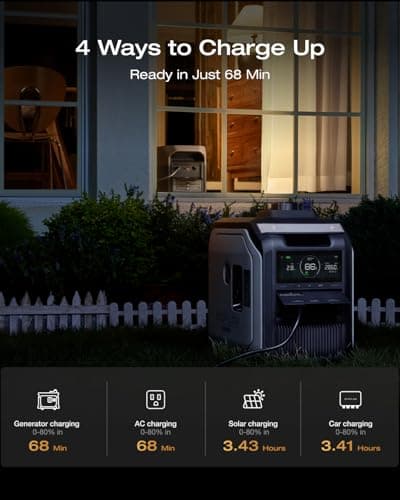
Review
EcoFlow DELTA for Home Backup
EcoFlow's DELTA 2 Max, DELTA 3 Max and DELTA 3 Classic compared, including what X-Boost can and cannot do.
Comparison
LiFePO4 vs Lithium-Ion
Why LiFePO4 is the correct chemistry for backup power, with the published cycle claims that decide it.