Generator Sizing
Appliance Wattage Chart
Every figure attributed to the chart it came from, including the places where two published sources disagree by a factor of three.
Written byMike M.
Published
Disclosure: we earn a commission on purchases made through links on this page, at no cost to you. It does not affect what we recommend or what we say about it — how we are funded.
The short answer
Running watts is the steady draw once a device is going. Additional starting watts is the extra surge a motor or compressor needs in the instant it starts. To size a generator, total the running watts of everything on at once and add only the single largest additional surge. The table below gives both figures for common household loads, with the published chart each one came from.
This page is the reference the rest of the site is built on, and the load calculator reads exactly this data — the chart and the calculator cannot disagree because they come from the same file.
Essential loads
| Appliance | Running watts | Additional starting watts | Source |
|---|---|---|---|
| Refrigerator / freezer | 700 | 2,200 | EWEB |
| Refrigerator | 400 | 2,200 | Champion |
| Furnace fan blower, 1/3 HP | 700 | 1,400 | EWEB |
| Sump pump, 1/3 HP | 800 | 1,300 | EWEB |
| Sump pump, 1/2 HP | 1,050 | 2,200 | EWEB |
| Water well pump, 1/3 HP | 1,000 | 2,000 | EWEB |
Heating, cooling and hot water
| Appliance | Running watts | Additional starting watts | Source |
|---|---|---|---|
| Electric water heater | 4,500 | 0 | EWEB |
| Space heater | 1,500 | 0 | EWEB + Champion |
| Window AC, 12,000 BTU | 3,250 | 3,950 | EWEB |
| Air conditioner, window unit | 1,200 | 2,000 | Champion |
Note that resistive heating — the water heater, the space heater — has no start-up surge at all, and draws its full rating continuously for as long as it runs. That combination makes electric heat the worst possible load for a generator and a hopeless one for a battery.
Kitchen
| Appliance | Running watts | Additional starting watts | Source |
|---|---|---|---|
| Microwave, 1,000 W rated | 1,000 | 0 | EWEB |
| Microwave | 800 | 0 | Champion |
| Microwave, 625 W rated | 625 | 0 | EWEB |
| Coffee maker | 1,000 | 0 | EWEB |
| Coffee maker | 800 | 0 | Champion |
| Toaster oven | 1,200 | 0 | EWEB |
| Toaster | 850 | 0 | EWEB |
| Toaster | 900 | 0 | Champion |
| Air fryer | 1,500 | 0 | Champion |
| Electric stove (element) | 2,000 | 0 | Champion |
| Dishwasher | 1,200 | 1,500 | Champion |
| Blender | 500 | 700 | Champion |
Almost nothing in this group belongs in a simultaneous-load calculation. You use one kitchen appliance at a time, for minutes, so count only the largest. Doing otherwise is the single most common way people talk themselves into a generator two classes too big.
Laundry
| Appliance | Running watts | Additional starting watts | Source |
|---|---|---|---|
| Washing machine | 500 | 1,200 | Champion |
| Electric dryer | 1,000 | 3,000 | Champion |
Lighting and electronics
| Appliance | Running watts | Additional starting watts | Source |
|---|---|---|---|
| LED bulb | 15 | 0 | EWEB |
| Incandescent bulb, 60 W | 60 | 0 | EWEB |
| Incandescent bulb, 75 W | 75 | 0 | EWEB |
| Desk lamp | 40 | 0 | Champion |
| Television, color (older) | 400 | 0 | EWEB |
| Television, LED | 80 | 0 | Champion |
| Desktop computer with monitor | 800 | 0 | EWEB |
| Desktop computer | 100 | 0 | Champion |
| Laptop | 60 | 0 | EWEB |
| Phone charger | 20 | 0 | EWEB |
| AM/FM radio | 100 | 0 | EWEB |
What is deliberately not in this chart
Central air conditioning. Well pumps above 1/3 HP. Full electric ranges. Heat pumps. Hot tubs. Electric vehicle charging.
Neither chart we cite publishes figures for any of them, and these are precisely the loads that decide which generator somebody buys. Printing an invented number for the most consequential load on the list would be the worst thing this page could do.
Find it yourself instead, in about a minute. The nameplate on the equipment gives volts and amps. Multiply them for running watts: 10 amps at 240 volts is 2,400 watts. For anything with a motor or compressor, the plate often also lists LRA — locked rotor amps — which is the start-up surge; multiply that by the voltage too. Then add it to the calculator as a custom load.
What each total actually needs
Three machines, one per common answer, so this page is useful rather than only informative. Add up your own rows above, derate by 80%, and one of these three is almost certainly your class.
The three answers this chart leads to
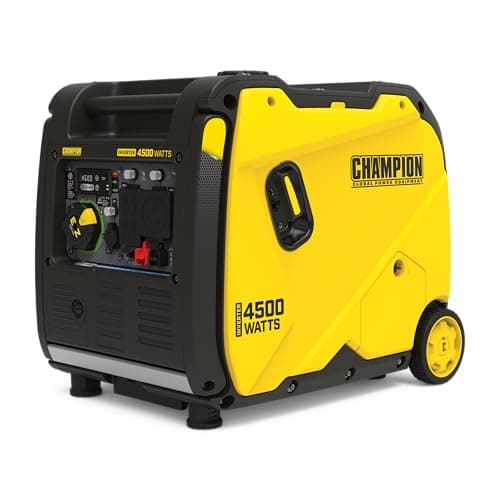
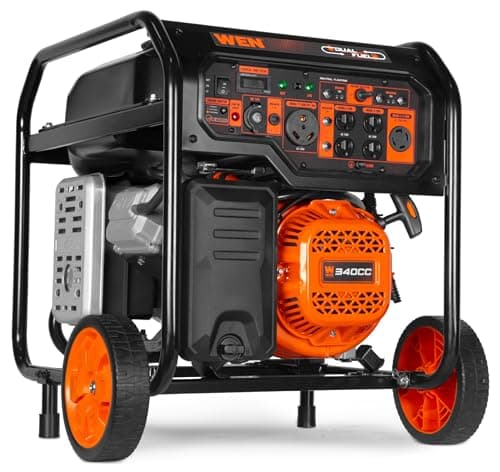
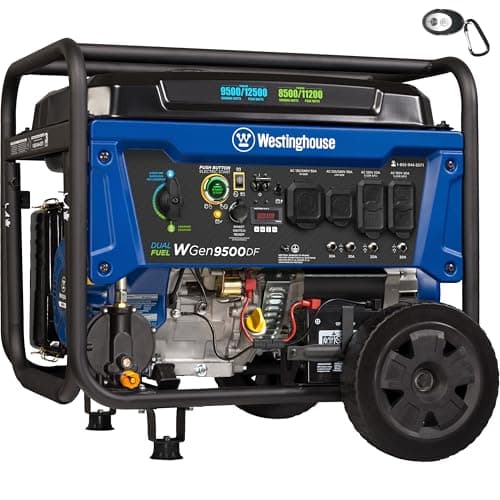
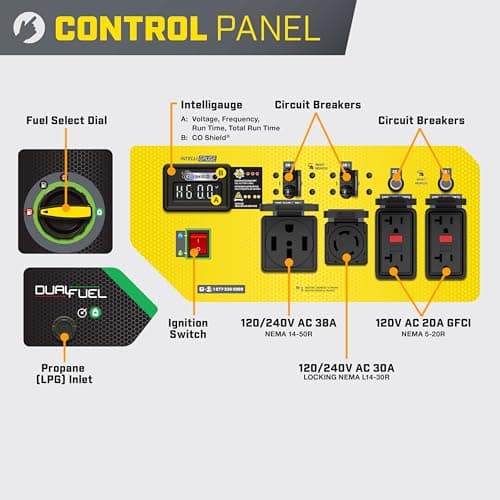
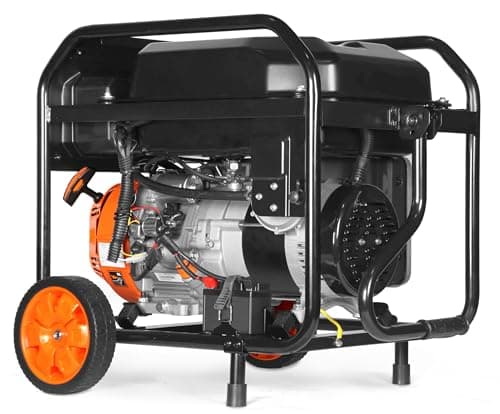
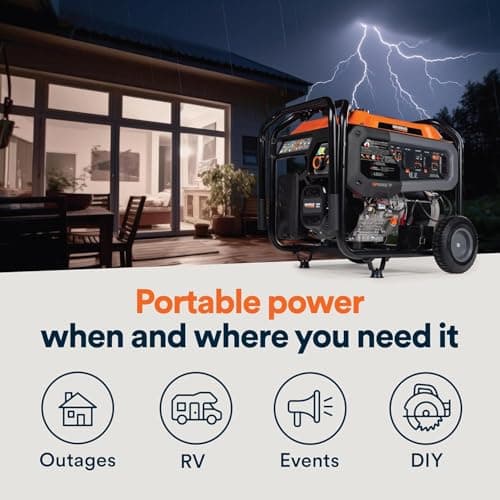
Left to right: around 1,650 running watts (fridge, furnace blower, lighting) wants a quiet 3,500-watt inverter; around 3,500 running watts (add a well pump and a sump pump) wants a 6,500-watt dual fuel machine; add a window air conditioner and you are at 6,750 running watts, which wants 9,500 and a 50 amp connection.
Next: starting watts vs running watts explains why the surge column exists, and the load calculator turns this table into an answer.
Questions people actually ask
How many watts does a refrigerator use?
EWEB's chart lists a refrigerator or freezer at 700 running watts; Champion lists a refrigerator at 400. Both agree it needs about 2,200 additional watts to start its compressor. Size from the higher running figure and plan for the 2,200 watt surge either way.
How many watts does a furnace use?
A gas furnace needs only its blower and controls: EWEB lists a 1/3 HP furnace fan blower at 700 running watts with a 1,400 watt additional surge. An electric furnace is an entirely different load and is not in either cited chart — read its nameplate.
How many watts does a well pump use?
EWEB lists a 1/3 HP water well pump at 1,000 running watts with a 2,000 watt additional surge. Larger pumps are not in the chart and surge considerably harder; one soft-starter manufacturer states deep well pumps typically need 65-75 amps to start. Read the nameplate on the pressure switch or control box.
Why do wattage charts disagree with each other?
Because they describe different appliances. A window air conditioner is 1,200 running watts to Champion and 3,250 to EWEB, which is a small bedroom unit against a 12,000 BTU one. Neither is wrong. That is why this page shows both figures and names the source of each.
How do I find the wattage of an appliance that is not listed?
Read its nameplate. Volts multiplied by amps gives running watts — 10 amps at 240 volts is 2,400 watts. For motors and compressors the plate may also show LRA (locked rotor amps), which multiplied by the voltage gives the start-up surge.
Should I use the higher or lower figure when charts disagree?
The higher one, unless you have read your own appliance's nameplate. Undersizing is the failure that stalls a generator and overheats appliance motors; oversizing only costs money. Our calculator uses the higher of the two published figures for this reason.
Sources
- Eugene Water & Electric Board — Generator Sizing ConsiderationsPublic-utility wattage chart: the running and additional-starting figures quoted on this page, and the add-the-single-largest-surge method.
- Champion Power Equipment — Quick Reference WattageManufacturer wattage chart: the second published figure wherever it differs from EWEB's, and the kitchen and laundry loads EWEB does not list.
Read next
Guide
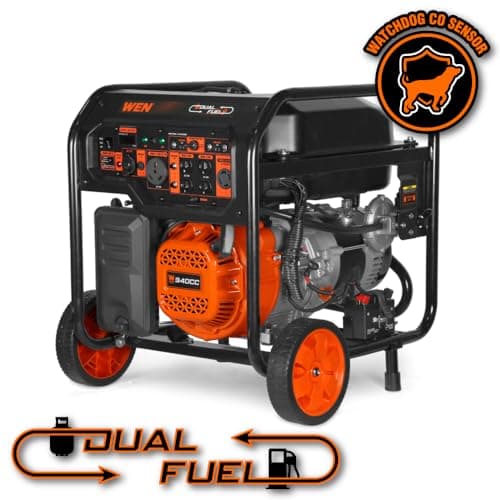
What Size Generator Do I Need?
The core sizing method: total running watts, add the single biggest surge, derate for continuous running, then match a wattage class.
Guide
Starting Watts vs Running Watts
What the surge figure means, why motors need it, and how to read the peak-watt number on a generator box.
Reference
How Many Watts to Run a House on a Generator?
The watts needed for survival, essential and comfortable circuit sets, totaled from published figures.

Guide
Generator Size for a Refrigerator and Deep Freezer
Sizing for a fridge plus a chest freezer, including why only one surge counts and when a battery beats a generator.
Guide
Generator Fuel Cost Calculator
An interactive running-cost calculator using your own fuel price and load, with the formula shown.