Model Reviews
Champion 4,500W Inverter Review
The best balance of quiet, clean power and real output on this site — with one limitation that rules it out for some houses.
Written byMike M.
Published
Disclosure: we earn a commission on purchases made through links on this page, at no cost to you. It does not affect what we recommend or what we say about it — how we are funded.
The short answer
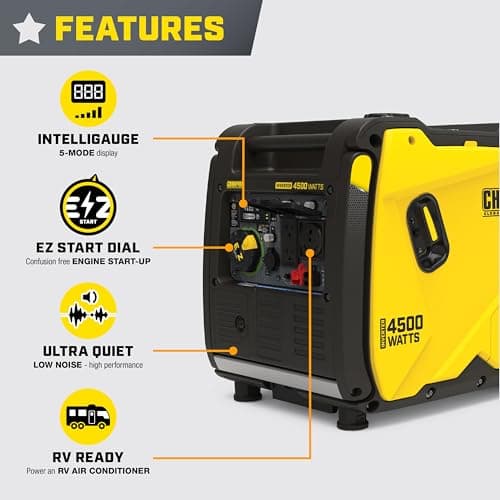
Champion publishes 4,500 starting and 3,500 running watts, 61 dBA, up to 14 hours of runtime, under 3% total harmonic distortion, CO Shield auto shutoff, Intelligauge power metering and a 92.2 lb weight, with a 3-year warranty and lifetime technical support. Its limitation is absolute: no 240 volt output, so no transfer switch, no interlock kit, no well pump and nothing hard-wired.
Published specification
- Starting watts
- 4,500 W
- Running watts
- 3,500 W
- Noise
- 61 dBA
- Runtime
- Up to 14 hours
- THD
- Under 3%
- Outlets
- 120V 29.2A RV + 120V 20A duplex
- 240 V output
- None
- CO shutdown
- CO Shield
- Weight
- 92.2 lb
- Warranty
- 3 years + lifetime tech support
Manufacturer published figures. Champion publishes more of them than most of its rivals, including THD and a decibel rating — several competitors publish neither.
What 3,500 running watts covers, exactly
This is the number that makes the machine interesting, because 3,500 running watts is genuinely a whole essential-circuit load rather than a fridge and a lamp.
A realistic plug-in load, EWEB published figures
- Refrigerator
- 700 W
- Furnace blower, 1/3 HP
- 700 W
- Sump pump, 1/3 HP
- 800 W
- Lighting, modem, devices
- 300 W
- Total running
- 2,500 W
- Largest surge (fridge)
- +2,200 W
- Starting watts needed
- 4,700 W
Note the last two rows: 4,700 starting watts is marginally above this machine's 4,500 peak. In practice the fridge starts first, while the generator is lightly loaded, which is why sequencing matters more than the arithmetic suggests.
That is a real outage plan running quietly on under 3% THD power, at 14 hours a tank. For a house on gas heat without a well pump, this machine does the whole job.
The limitation that decides it
If you need 240 V, the options within the inverter category are Westinghouse's iGen12000DFc or ecoGen10000, DuroMax's iH series, or WEN's DF680iX — though the DF680iX publishes a bonded neutral that many transfer switches will not accept. See best quiet inverter generators.
What Champion publishes that others do not
Three things, and they are the reason this machine tops our quiet-generator value ranking:
- Under 3% THD. The figure that matters for a modern furnace control board, which can lock out on a dirty waveform. Several machines marketed on power quality publish no THD figure at all.
- 61 dBA. A real number. WEN markets the 56235i as super quiet and publishes no decibel rating, comparing the noise to a conversation instead.
- 14 hour runtime and an Intelligauge power meter, so you can see the load rather than calculate it.
The honest caveat on the noise figure: Champion does not state a measurement distance for this model, though it does for some others (53 dBA at 23 feet on the 2,500 W ultralight). A dB figure without a distance is not strictly comparable to one with.
Parallel capability is the upgrade path
Champion publishes parallel readiness with another 2,800 W-or-higher Champion inverter via an optional kit. That matters because it means the machine is not a dead end: if 3,500 running watts turns out to be insufficient, a second unit plus a ParaLINK kit costs less than replacing with one large machine, and each unit stays one-person portable.
Parallel output is still 120 V, so it does not create a 240 V supply for a transfer switch. It buys more watts, not more voltage.
The dual fuel question
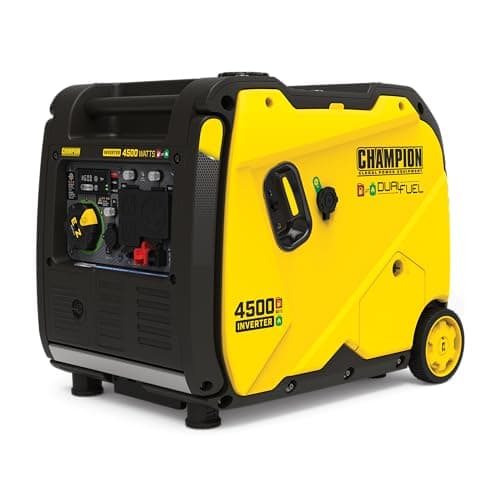
Champion makes a dual fuel version of this machine at the same 4,500 starting / 3,500 running watts, 61 dBA and 14 hour runtime, with electric start and an EZ Start dial, at 99.2 lb. It costs meaningfully more.
Worth it if your outage plan runs on propane tanks rather than trips to a gas station — propane stores indefinitely while gasoline degrades in months, which is the main real-world failure mode of a stored generator. For a machine you will use regularly and rotate the fuel in, the gas-only version is the better value.
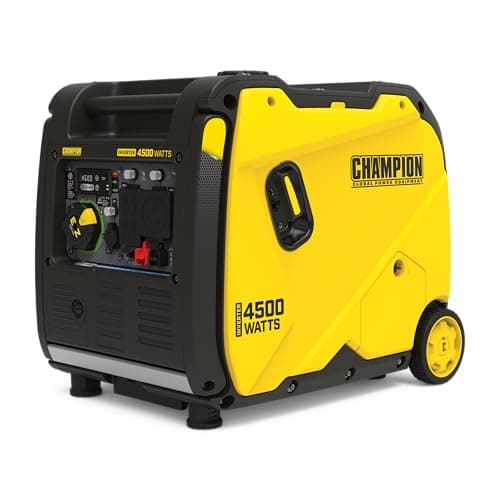
- Running watts
- 3,500 W
- Noise
- 61 dBA (mfr)
- Runtime
- Up to 14 h (mfr)
#1 · Quiet backup at a sane price
Champion 4,500W RV Ready Inverter
The best balance of quiet, clean power and real output for cord-based backup: enough for the essentials, under 3% THD, half the price of the Honda equivalent.
#ad Price as of October 5, 2026; it may have changed since. How we are funded.
What is good
- 3,500 running watts of clean power is enough for a fridge, furnace blower, lights and electronics — a real essential-circuit load, quietly
- 14-hour runtime is excellent for an inverter this size
- Parallel capability means you can double output later rather than replacing the unit
What is not
- No 240V output, so no transfer switch and no well pump
- 61 dBA is noticeably louder than the Honda units, though far quieter than an open-frame machine
- 92 lb is heavy for something you cannot connect to a panel
Published specification & our scoring
- 4,500 starting / 3,500 running watts (manufacturer)
- 61 dBA, up to 14 hours runtime (manufacturer)
- Under 3% THD — safe for sensitive electronics (manufacturer)
- CO Shield carbon monoxide auto shutoff
- 120V 29.2A RV outlet plus a 120V 20A household duplex
- Parallel ready with another 2,800W-or-higher Champion inverter
- Intelligauge with power meter; published weight 92.2 lb
- Noise
- 8
- Power quality
- 9
- Output
- 7
- Runtime
- 9
- Safety features
- 9
- Value
- 9
Specification figures are the manufacturer’s published values. Scores are our editorial judgment from those figures and are never published as structured review data — how we pick.
The dual fuel version, the quieter alternative, and the upgrade path
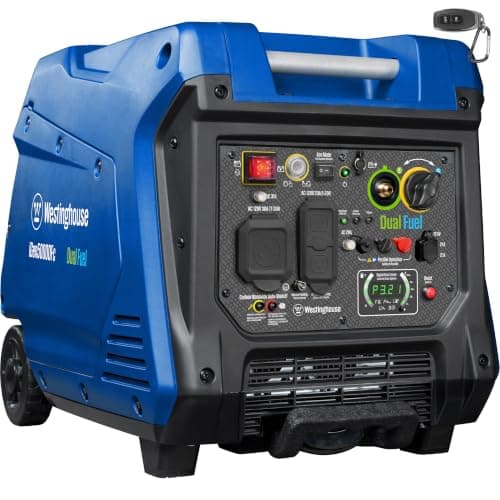
Quietest dual fuel at 4,000 running watts
Westinghouse iGen5000DFc 5,000W Dual Fuel Inverter
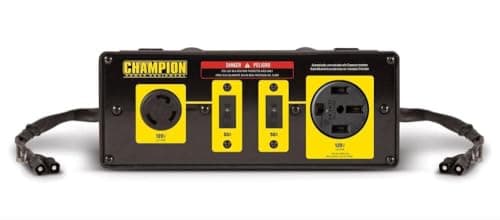
Champion's dual fuel version adds propane at the same output. Westinghouse's iGen5000DFc publishes as low as 52 dBA with dual fuel. The ParaLINK kit doubles output from two machines.
Questions people actually ask
What will a Champion 4500 watt inverter generator run?
3,500 running watts covers a refrigerator, a furnace blower, a sump pump and lighting — about 2,500 running watts on published appliance figures — with headroom. What it cannot reach is anything hard-wired, because it has no 240 volt output.
Does the Champion 4500W inverter have 240 volts?
No. It has a 120V 29.2A RV outlet and a 120V 20A household duplex only, which means no transfer switch, no interlock kit, no well pump and no hard-wired furnace. This is the single most important thing to know before buying it.
How loud is the Champion 4500 watt inverter?
Champion publishes 61 dBA. That is noticeably louder than the 52 dBA class but far quieter than a conventional open-frame machine at around 74 dBA. Champion does not state a measurement distance for this model, though it does for some others.
Is the Champion 4500W safe for electronics?
Champion publishes under 3% total harmonic distortion, which is the figure considered safe for sensitive electronics. That also matters for modern furnace control boards, which can lock out on a dirty waveform from a conventional generator.
Can I run two Champion 4500W inverters together?
Yes, with an optional parallel kit, linking to another 2,800 W-or-higher Champion inverter. That roughly doubles the output while keeping each unit one-person portable. The combined output is still 120 volts, so it does not create a 240 volt supply.
Should I buy the dual fuel version instead?
If your plan runs on propane tanks, yes — propane stores indefinitely while gasoline degrades within months, which is the main failure mode of a stored generator. Output, noise and runtime are identical, and the dual fuel version is 7 lb heavier and dearer.
Sources
- Eugene Water & Electric Board — Generator Sizing ConsiderationsPublished appliance running and additional-starting watt figures used to judge what this machine's output actually covers.
- US Consumer Product Safety Commission — Portable Generator Information CenterThe placement and carbon monoxide guidance referenced in the safety notes on this page.
Read next
Best Quiet Inverter
Best Quiet Inverter Generators for Home Backup
Inverter generators ranked on published noise and THD figures, with the brands that publish no measurable claim named.
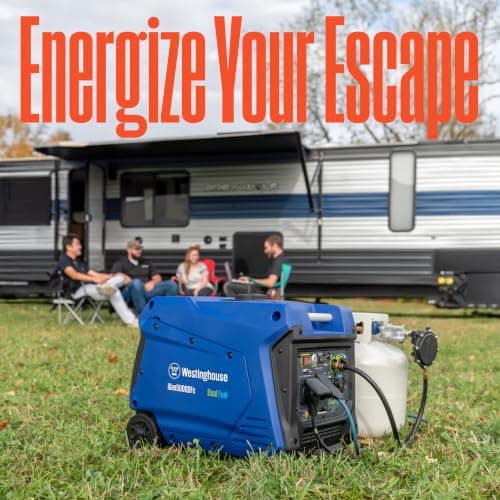
Top pick · Westinghouse iGen5000DFc 5,000W Dual Fuel Inverter
$999.00View on Amazon23% off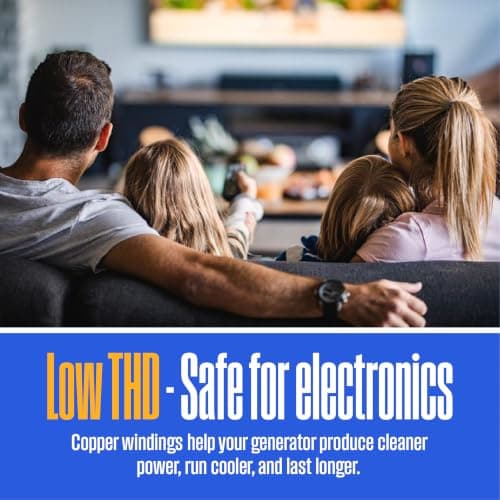
Guide
How Quiet Is a Quiet Generator?
Published decibel ratings side by side with their measurement conditions, and what a dB difference actually means.
Best for a Refrigerator
Best Portable Generator for a Refrigerator
Generators that reliably start a fridge compressor, with the honest case for a battery power station instead.
Top pick · Champion 4,500W RV Ready Inverter
$674.10View on Amazon10% off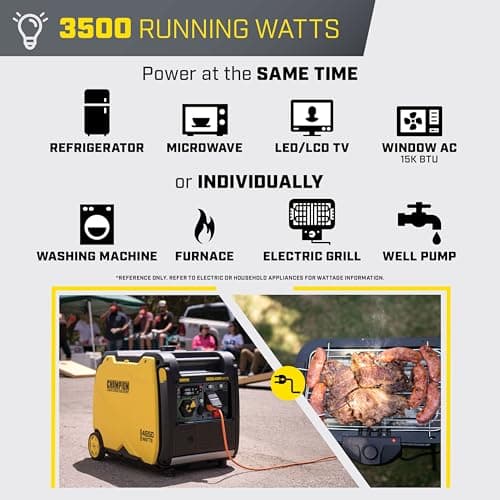
Guide
What Size Generator to Run a Furnace?
Furnace blower sizing from published figures, the gas-versus-electric divide, and why power quality matters for modern control boards.
Review
Honda EU2200i Review
The EU2200i's published figures and what they do and do not make it suitable for in home backup.