Transfer Switches & Connection
The Best Generator Extension Cords
Gauge and connector type decide whether a cord is safe and whether it fits. Length decides whether your generator can sit far enough away.
Written byMike M.
Published
Disclosure: we earn a commission on purchases made through links on this page, at no cost to you. It does not affect what we recommend or what we say about it — how we are funded.
The short answer
For a 30 amp connection you want 10 AWG four-conductor with L14-30 twist-locks at both ends — PlugSaf's 25-foot cord is the sensible default at IP65 weather resistance, and Kohree's 40-foot version is the best certified option with ETL listing and explicitly 100% copper conductors. For 50 amps, confirm both connector types against your hardware: PlugSaf's 25-foot 14-50P to SS2-50R is the common arrangement. 25 feet is the practical minimum because CPSC guidance puts the generator 20 feet from the house.
A generator cord carries the full output of your machine to your house, often in rain. Three things decide whether it is the right one, and only one of them is length.
The short answer
Quick picks
| # | Product | Best for | Score | Price |
|---|---|---|---|---|
| 1 | 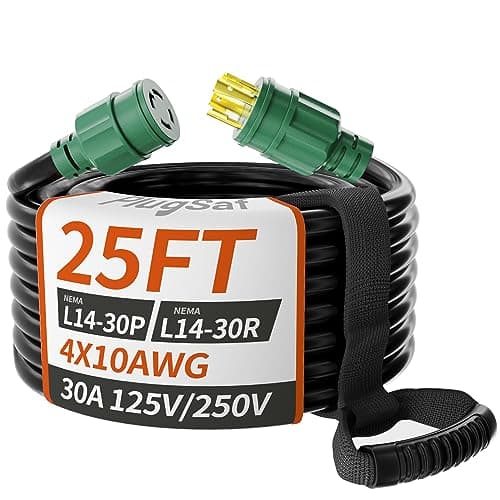 PlugSaf 25 ft 30A L14-30 Cord, 10 AWG The correct first cord for most installations: 25 feet of 10 AWG with L14-30 twist-locks at both ends. | The default generator cord | 9.0/10 | $58.99 |
| 2 | 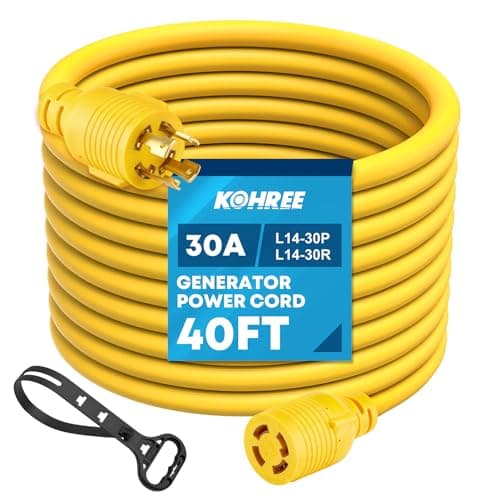 Kohree 40 ft 30A L14-30 Cord, ETL Listed The best-certified cord here: ETL listed and explicitly all-copper at a useful 40-foot length. | ETL listing and 100% copper | 9.0/10 | $79.99 |
| 3 | 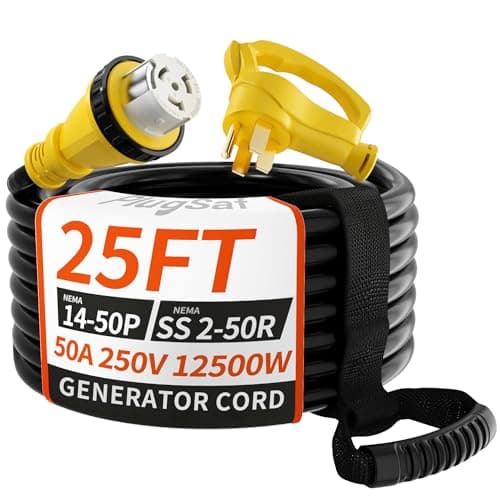 PlugSaf 25 ft 50A 14-50P to SS2-50R Cord The right 50 A cord for the common arrangement — just verify both connector types against your generator and your inlet before ordering. | 50A generators to a 50A inlet | 8.9/10 | $103.99 |
| 4 | 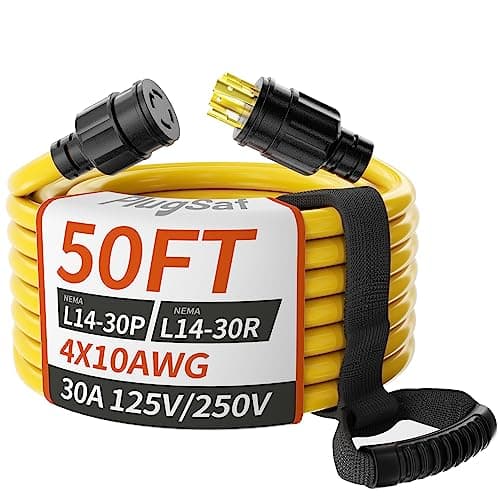 PlugSaf 50 ft 30A L14-30 Cord, 10 AWG Buy this length if your inlet is not near where the generator can safely sit — the extra distance from the house is worth the extra cost. | Reaching a distant inlet | 9.0/10 | $95.99 |
| 5 | 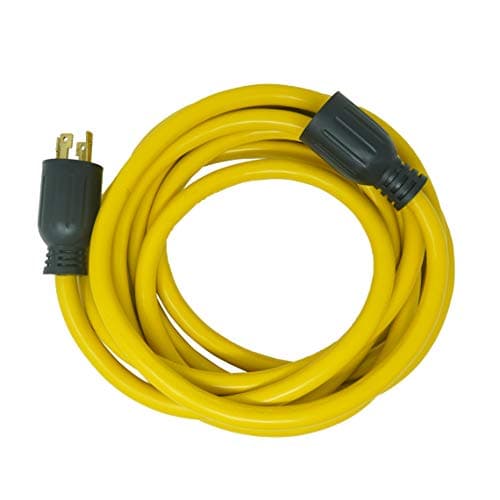 Southwire 20 ft 30A L14-30 Cord, 10 Gauge Choose this when brand provenance on the conductor matters more than a published IP rating — 20 feet of real Southwire 10 AWG. | A known-brand short cord | 8.8/10 | $53.62 |
| 6 | 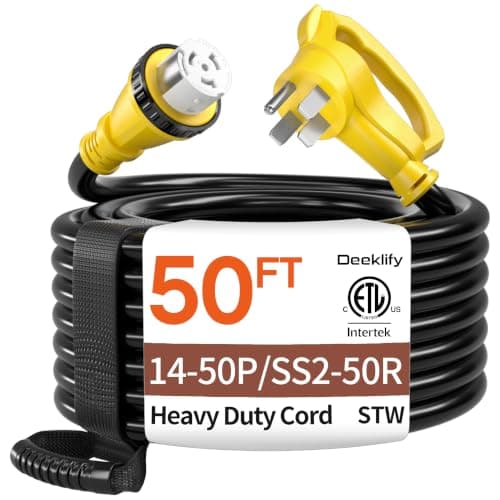 Deeklify 50 ft 50A 14-50P to SS2-50R Cord The long option for a 50 A setup: ETL certified, pure copper, and heavy enough that you will only uncoil it when you need it. | Long 50A runs | 8.6/10 | $189.99 |
| 7 | 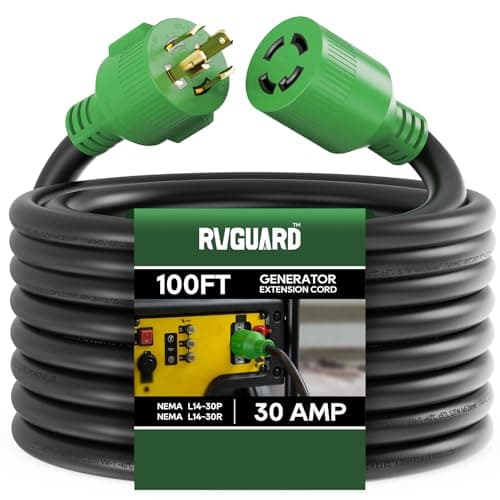 RVGUARD 100 ft 30A L14-30 Cord, ETL Listed Buy this only when the distance genuinely demands it, and plan to run well below 30 A — voltage drop at 100 feet is physics, not a product flaw. | Very long runs | 8.4/10 | $189.99 |
#ad Prices as of October 5, 2026; they may have changed since. Scores are our editorial judgment from published specifications, not test results — how we pick. How we are funded.
One: conductor gauge, which is not negotiable
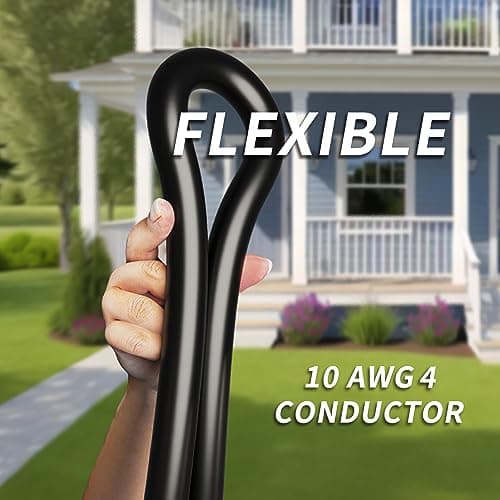
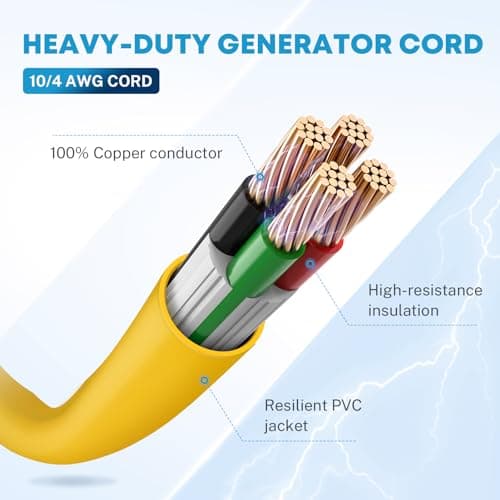
10 AWG is correct for 30 amps. Thinner conductor at that current overheats, and a cord that overheats inside its jacket is a fire rather than a bargain. Every 30 amp cord on this list publishes 10 AWG.
For 50 amps the conductors are substantially heavier. VEVOR publishes 6/3 plus 8/1 AWG on its 50 amp kit, which is the kind of specification worth looking for — many 50 amp cords do not state the gauge at all.
Also look for 100% copper rather than copper-clad aluminum, which is the corner cheap cords cut. Kohree states 100% copper wire explicitly; Deeklify states multi-strand pure copper cores.
Two: connector type, where the expensive mistakes happen
| Connector | Volts | Amps | Where it appears |
|---|---|---|---|
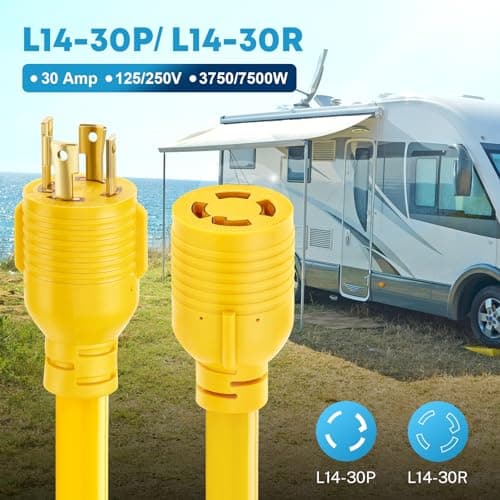
| L14-30P / L14-30R | 120/240 V | 30 A | Standard 30 A generator and transfer switch |
| L5-30R | 120 V only | 30 A | Some budget generators — NOT transfer-switch standard |
| 14-50P / 14-50R | 120/240 V | 50 A | Large generators, RV service |
| SS2-50P / SS2-50R | 120/240 V | 50 A | Common 50 A house inlet |
| CS6375 | 120/240 V | 50 A | Connecticut Electric inlet boxes |
| TT-30R | 120 V | 30 A | RV service |
The simplest way to avoid all of this is a matched kit: a cord and inlet box sold together cannot be mismatched. VEVOR's 30 and 50 amp kits are both ETL certified and include a pre-drilled flip-cover inlet box with the cord.
Three: length, which is a safety specification
CPSC guidance puts a generator at least 20 feet from the house with the exhaust pointed away from doors, windows and vents. That makes cord length a carbon monoxide specification, not a convenience one.
Choosing a length
- 10-20 ft
- Too short to achieve 20 ft safely
- 25 ft
- The practical minimum
- 40-50 ft
- Genuine freedom about siting
- 100 ft
- Detached garage, long driveway
Southwire's 20-foot cord is a good cord and only works if the inlet box is already 20-plus feet from where the generator sits — check the geometry before buying short.
Longer also means quieter, since sound falls off with distance. The trade is voltage drop: over 100 feet of 10 AWG at a sustained 30 amps you will lose measurable voltage at the panel. RVGUARD's 100-foot cord is the right product for a detached garage, with the caveat that you should not run it near the full 30 amps continuously.
Certification and weather rating
ETL listing is third-party safety certification and is what to look for on a cord carrying 30 or 50 amps to your panel. Kohree, RVGUARD, Deeklify and VEVOR all publish ETL listing on the cords here.
Weather rating matters because the cord lies on wet ground during a storm. PlugSaf publishes IP65 on its cords; RVGUARD publishes an all-weather jacket rated from -40 F to 221 F, which is the specification that matters in a winter outage — a cord that stiffens and cracks in a freeze is a failure at the worst possible time.
Twist-lock connectors at both ends are standard on all of these and are worth insisting on: they will not shake loose in wind, which matters when the cord is the only thing feeding your panel. PlugSaf's 50 amp cord adds a threaded locking ring, which is more secure still.
Or buy the cord and inlet matched
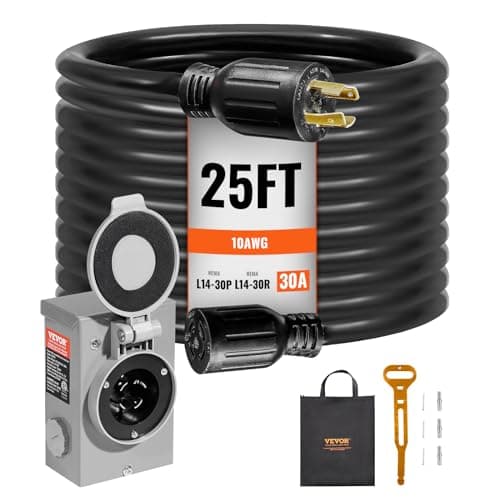
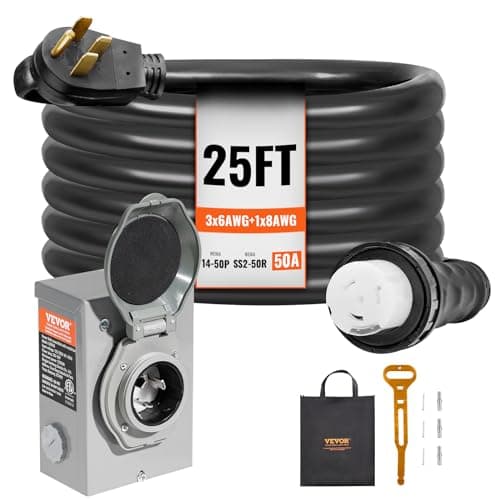
Both ETL certified, both include a pre-drilled inlet box. This removes the connector-mismatch risk entirely, which is the most common ordering error in this category.
- Length
- 25 ft
- Gauge
- 10 AWG, 4 conductor
- Ends
- L14-30P to L14-30R
#1 · The default generator cord
PlugSaf 25 ft 30A L14-30 Cord, 10 AWG
The correct first cord for most installations: 25 feet of 10 AWG with L14-30 twist-locks at both ends.
#ad Price as of October 5, 2026; it may have changed since. How we are funded.
What is good
- 25 feet is the right default: long enough to put the generator well clear of the house, short enough to avoid voltage drop
- 10 AWG is the correct gauge for 30 A at this length — thinner cord at this current is a fire risk, not a bargain
- The twist-lock ends will not shake loose in wind, which matters when the cord is the only thing feeding your panel
What is not
- L14-30 only — useless with a generator whose 30 A outlet is the 120 V-only L5-30R, which some budget models use
- 25 feet may not be enough if your inlet is on the far side of the house
- Heavy and stiff in cold weather, as all 10 AWG cord is
Published specification & our scoring
- 25 ft, 4-prong, 30 A, STW jacket, 125/250 V, 3,750/7,500 W (manufacturer)
- NEMA L14-30P to L14-30R
- 10 AWG conductors
- IP65 weather resistance (manufacturer)
- Twist-lock connectors at both ends
- Conductor gauge
- 10
- Weather sealing
- 9
- Connector quality
- 9
- Length suitability
- 9
- Value
- 9
Specification figures are the manufacturer’s published values. Scores are our editorial judgment from those figures and are never published as structured review data — how we pick.
- Length
- 40 ft
- Gauge
- 10 AWG, 100% copper
- Listing
- ETL
#2 · ETL listing and 100% copper
Kohree 40 ft 30A L14-30 Cord, ETL Listed
The best-certified cord here: ETL listed and explicitly all-copper at a useful 40-foot length.
#ad Price as of October 5, 2026; it may have changed since. How we are funded.
What is good
- ETL listing is third-party safety certification — the thing to look for on a cord carrying 30 A to your panel
- Explicitly 100% copper, not copper-clad aluminum, which is the corner cheap cords cut
- 40 feet splits the difference between 25 and 50
What is not
- Kohree is primarily an RV-accessory brand rather than an electrical manufacturer
- 40 feet of 10 AWG is heavy to handle
- No published IP rating
Published specification & our scoring
- 40 ft, 30 A, 4-prong, NEMA L14-30P to L14-30R, 125/250 V up to 7,500 W (manufacturer)
- 100% copper wire with a heavy-duty flame-retardant, heat-resistant jacket (manufacturer)
- ETL listed (manufacturer)
- Twist-lock male plug
- Conductor gauge
- 10
- Certification
- 10
- Connector quality
- 8
- Length suitability
- 9
- Value
- 9
Specification figures are the manufacturer’s published values. Scores are our editorial judgment from those figures and are never published as structured review data — how we pick.
- Length
- 25 ft
- Ends
- 14-50P to SS2-50R
- Rating
- 50 A, 250 V, 12,500 W
#3 · 50A generators to a 50A inlet
PlugSaf 25 ft 50A 14-50P to SS2-50R Cord
The right 50 A cord for the common arrangement — just verify both connector types against your generator and your inlet before ordering.
#ad Price as of October 5, 2026; it may have changed since. How we are funded.
What is good
- This is the specific connector combination a 50 A portable generator and a standard 50 A house inlet actually need — the mismatch people most often buy wrong
- 12,500 W pass-through uses a big generator's full output
- The threaded locking ring is a more secure connection than a plain twist-lock
What is not
- 14-50P on the generator end and SS2-50R on the house end — confirm BOTH ends against your actual hardware; a 14-50R house inlet needs a different cord
- Heavy: 50 A conductors are substantially thicker than 30 A
- Expensive relative to 30 A cords
Published specification & our scoring
- Connects a 50 A portable generator to a house SS2-50P or CS6375 power inlet box (manufacturer)
- Male plug NEMA 14-50P, 50 A, 250 V, 12,500 W (manufacturer)
- Female receptacle NEMA SS2-50R, 50 A, 250 V, 12,500 W (manufacturer)
- Weatherproof twist-locking female connector with a threaded ring (manufacturer)
- Conductor gauge
- 10
- Connector match
- 9
- Weather sealing
- 10
- Length suitability
- 9
- Value
- 8
Specification figures are the manufacturer’s published values. Scores are our editorial judgment from those figures and are never published as structured review data — how we pick.
- Length
- 50 ft
- Gauge
- 10 AWG, 4 conductor
- Rating
- 125/250 V, 7,500 W
#4 · Reaching a distant inlet
PlugSaf 50 ft 30A L14-30 Cord, 10 AWG
Buy this length if your inlet is not near where the generator can safely sit — the extra distance from the house is worth the extra cost.
#ad Price as of October 5, 2026; it may have changed since. How we are funded.
What is good
- 50 feet lets you site the generator genuinely far from windows and doors, which is the single most important carbon monoxide precaution
- Still 10 AWG at 50 feet, so the voltage drop stays acceptable at 30 A
- Same IP65 jacket and twist-locks as the 25 ft version
What is not
- Twice the weight and bulk to store and uncoil
- Voltage drop at 50 feet is real; at a sustained full 30 A you will lose a little voltage at the panel
- Costs noticeably more than the 25 ft cord
Published specification & our scoring
- 50 ft, 4-prong, 30 A, STW jacket, 125/250 V, 3,750/7,500 W (manufacturer)
- NEMA L14-30P to L14-30R, 10 AWG
- IP65 weather resistance (manufacturer)
- Twist-lock design
- Conductor gauge
- 10
- Weather sealing
- 9
- Connector quality
- 9
- Length suitability
- 10
- Value
- 8
Specification figures are the manufacturer’s published values. Scores are our editorial judgment from those figures and are never published as structured review data — how we pick.
- Length
- 20 ft
- Gauge
- 10 AWG
- Ends
- L14-30 twist-lock
#5 · A known-brand short cord
Southwire 20 ft 30A L14-30 Cord, 10 Gauge
Choose this when brand provenance on the conductor matters more than a published IP rating — 20 feet of real Southwire 10 AWG.
#ad Price as of October 5, 2026; it may have changed since. How we are funded.
What is good
- Southwire is a mainstream US wire manufacturer rather than a marketplace brand — the conductor is what it says it is
- 20 feet is enough for a garage-mounted inlet with the generator on the driveway
- Molded ends are more durable than assembled ones
What is not
- 20 feet is the shortest safe working length — check it genuinely puts the generator far enough from the house
- No published IP rating, unlike the PlugSaf cords
- Fewer length options in this line
Published specification & our scoring
- 20 feet of 10-gauge cord with L14-30 twist-locking plug and receptacle (manufacturer)
- Dual voltage 125 V / 250 V, 30 A (manufacturer)
- Molded ends
- Conductor gauge
- 10
- Brand provenance
- 10
- Connector quality
- 9
- Length suitability
- 7
- Value
- 9
Specification figures are the manufacturer’s published values. Scores are our editorial judgment from those figures and are never published as structured review data — how we pick.
- Length
- 50 ft
- Ends
- 14-50P to SS2-50R
- Listing
- ETL
#6 · Long 50A runs
Deeklify 50 ft 50A 14-50P to SS2-50R Cord
The long option for a 50 A setup: ETL certified, pure copper, and heavy enough that you will only uncoil it when you need it.
#ad Price as of October 5, 2026; it may have changed since. How we are funded.
What is good
- 50 feet at 50 A lets a large generator sit well away from the house without throttling it
- ETL certified with explicitly pure copper conductors
- Sealed twist-lock interface
What is not
- Very heavy — 50 feet of 50 A cord is a two-handed job to deploy
- Expensive
- Deeklify is a marketplace brand; the ETL listing is the main assurance
Published specification & our scoring
- 50 ft, NEMA 14-50P to SS2-50R with twist lock (manufacturer)
- Multi-strand pure copper cores (manufacturer)
- ETL certified; aging-resistant PVC insulation (manufacturer)
- Custom twist-lock seals the interface against wind and rain (manufacturer)
- Conductor gauge
- 10
- Certification
- 9
- Weather sealing
- 9
- Length suitability
- 10
- Value
- 7
Specification figures are the manufacturer’s published values. Scores are our editorial judgment from those figures and are never published as structured review data — how we pick.
- Length
- 100 ft
- Gauge
- 10 AWG SJTW
- Temp range
- -40 to 221 F (mfr)
#7 · Very long runs
RVGUARD 100 ft 30A L14-30 Cord, ETL Listed
Buy this only when the distance genuinely demands it, and plan to run well below 30 A — voltage drop at 100 feet is physics, not a product flaw.
#ad Price as of October 5, 2026; it may have changed since. How we are funded.
What is good
- 100 feet solves the genuinely awkward case: a detached garage, a long driveway, or an inlet on the opposite side of the house
- The -40 F jacket rating matters for a cord deployed in a winter storm
- ETL listed
What is not
- Voltage drop over 100 feet of 10 AWG at 30 A is significant — expect reduced voltage at the panel and avoid running near the full 30 A continuously
- Very heavy and awkward to coil and store
- Expensive
Published specification & our scoring
- 100 ft, NEMA L14-30P to L14-30R, SJTW 10-gauge, 4-prong, 125/250 V (manufacturer)
- ETL listed (manufacturer)
- All-weather jacket rated from -40 F to 221 F without cracking or deforming (manufacturer)
- Twist-lock plug with strain relief
- Conductor gauge
- 8
- Certification
- 10
- Cold-weather rating
- 10
- Length suitability
- 10
- Value
- 7
Specification figures are the manufacturer’s published values. Scores are our editorial judgment from those figures and are never published as structured review data — how we pick.
Questions people actually ask
What size extension cord do I need for a generator?
For a 30 amp connection, 10 AWG four-conductor with L14-30 twist-locks at both ends. For 50 amps, substantially heavier — one kit here publishes 6/3 plus 8/1 AWG. Thinner conductor at these currents overheats and is a fire risk rather than a saving.
How long should a generator cord be?
At least 25 feet, because CPSC guidance puts the generator 20 feet from the house with the exhaust pointed away. 40 to 50 feet gives genuine freedom about siting and is quieter. Past about 50 feet, voltage drop becomes a real consideration at full current.
What is the difference between L14-30 and L5-30?
L14-30 is 120/240 volts and is what a standard residential transfer switch expects. L5-30 is 120 volts only. They look similar and are not interchangeable — some budget generators publish an L5-30R, which will not serve a 240 volt transfer switch.
Can I use a regular extension cord with a generator?
Not for a 240 volt connection and not at 30 amps. A household extension cord is 120 volts with much thinner conductors; running 30 amps through one overheats the jacket. Use a purpose-made generator cord of the correct gauge and connector type.
Does cord length affect generator output?
Yes, through voltage drop. Over 100 feet of 10 AWG at a sustained 30 amps you will lose measurable voltage at the panel. A 100-foot cord is the right answer for a detached garage, with the caveat that you should not run near the full 30 amps continuously.
Should I buy a cord and inlet box together?
It is the simplest way to avoid the most common ordering mistake in this category, especially at 50 amps where 14-50, SS2-50 and CS6375 connectors are easy to confuse. VEVOR's matched 30 and 50 amp kits are both ETL certified.
Sources
- US Consumer Product Safety Commission — Portable Generator Information CenterThe 20-foot placement guidance that sets the minimum practical cord length referenced on this page.
Read next
Reference
Generator Cord Gauge Guide
Conductor gauge requirements by amperage, the copper-versus-copper-clad question, and how length affects voltage drop.
Reference
Can You Use a Regular Extension Cord With a Generator?
When a household extension cord is acceptable with a generator and when it is not, with the gauge and voltage reasons.
Comparison
Generator Cord vs Extension Cord
The four construction differences between a generator cord and a household extension cord, and when each is correct.
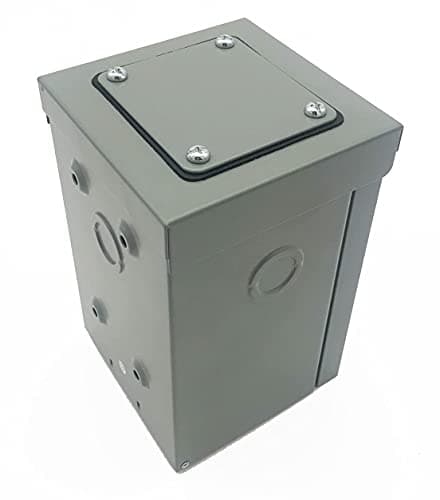
Best Inlet Box
The Best Generator Power Inlet Boxes
Power inlet boxes ranked on enclosure rating, wiring room and connector match, for 30A and 50A installations.
Top pick · Connecticut Electric EGSPI50 50A Power Inlet Box
$62.95View on Amazon
Guide
Generator Carbon Monoxide Safety
The CPSC placement rules, why a garage with the door open is still unsafe, and the battery CO alarm that should be your first purchase.