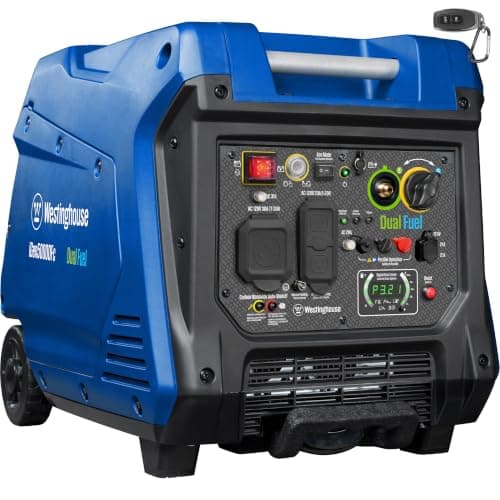
Variable engine speed buys you much less noise, better fuel economy at light load and clean power — at a real cost per watt.
Disclosure: we earn a commission on purchases made through links on this page, at no cost to you. It does not affect what we recommend or what we say about it — how we are funded.
A conventional generator holds its engine at a fixed speed whether it is powering a whole house or a single light bulb. An inverter generator generates AC, rectifies it to DC and inverts it back to a clean sine wave, which lets the engine throttle down to match actual demand. Three things follow from that, and all three are real.
1It is much quieter at light load. Honda publishes 48-57 dB(A) for the EU2200i; Champion publishes 53 dBA at 23 feet for its 2,500 W ultralight. Conventional machines of similar output are in a different acoustic category entirely.
2It uses less fuel at light load. Westinghouse states inverter technology halves fuel consumption versus a conventional generator, and an 18-hour runtime on a 3.4-gallon tank is the kind of figure that follows from it.
3The power is cleaner. Published total harmonic distortion below 3% on most of these machines, versus unspecified on many conventional ones. It matters for electronics and for some modern furnace control boards.
What it costs you
Watts per dollar, mostly. A Honda EU2200i costs roughly what a 6,500-running-watt dual fuel conventional generator costs, and delivers under 2,000 running watts. There is also an engineering cost: inverter electronics are a failure mode a plain alternator does not have, and an enclosed inverter machine is harder to service in a driveway than an open frame.
The strongest value case in this category is the mid-size enclosed machines — a 3,500 running-watt inverter covers a fridge, a furnace blower, a sump pump and lighting cleanly and quietly for a fraction of the Honda's price. The main roundup is built around that bracket.
Read the decibel figures carefully
Noise claims in this category are not comparable unless the measurement distance is stated, and many manufacturers do not state it. Honda and Champion publish figures with conditions. Several brands market a machine as "super quiet" and publish no number at all, or compare it to a conversation rather than giving a rating. Where that is the case our product entries note it rather than repeating the marketing claim as if it were data. How quiet is a quiet generator sets out what is actually published, side by side.
The 240V question — the one that catches people out
Most inverter generators have no 240 V output, which means no transfer switch, no interlock kit, no well pump and no hard-wired furnace. If your plan is to feed a panel, you need one of the minority of inverter machines with an L14-30R or a 14-50R: the Westinghouse iGen12000DFc, the ecoGen10000, the DuroMax iH series and WEN's DF680iX.
If you do not need 240 V — if the plan is cords to a fridge, a furnace with a plug, lights and devices — then the whole category opens up, and the quiet and the fuel economy are worth having.
Picks
Inverter Generators picks
Each tile carries the top pick from that page with a live price, so you can act from here rather than having to read a review first.
It can vary engine speed to match load rather than running at a fixed 3,600 rpm. At light load the engine idles down, and most inverter machines are also enclosed with insulation and a larger muffler. The result on published figures is roughly 52 to 64 dBA depending on model and load, against about 74 dBA and up for conventional frames.
Can an inverter generator run my whole house?+
Some can. The Westinghouse iGen12000DFc publishes 12,000 peak watts with both an L14-30R and a 14-50R, both transfer-switch ready, and under 3% THD. Most inverter generators cannot, because they have no 240 V output at all — which rules out a transfer switch and every hard-wired load.
What is THD and does it matter for home backup?+
Total harmonic distortion measures how clean the AC waveform is. Under 3% is the figure most inverter generators publish and is considered safe for sensitive electronics. It does not matter for heaters, pumps or incandescent lighting, but it can matter for modern furnace control boards and anything with a circuit board, which is why it is worth checking.
Is a Honda inverter generator worth the price?+
For noise and long-term reliability, it is the best in the class and Honda's published figures hold up. For home backup value it is hard to justify: an EU2200i costs about what a 6,500-running-watt dual fuel machine costs and delivers under 2,000 running watts. Buy it for quiet, portability and longevity, not for capacity.
Do inverter generators run on propane?+
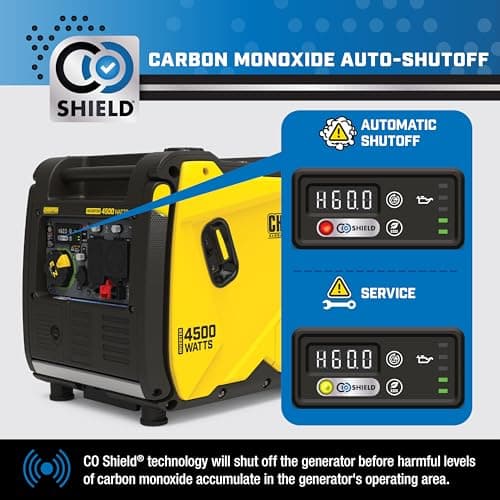
Several do. Westinghouse's iGen5000DFc and iGen12000DFc, Champion's 4,500 W dual fuel inverter, WEN's DF680iX and DuroMax's iH series all publish dual fuel operation, which combines propane's indefinite storage with the inverter's quiet running.