Outage Prep
How Long Will a Generator Run?
Published tank figures run from 8.5 to 19 hours. The one that matters is whether you have to refuel at 3am in a storm.
Written byMike M.
Published
Disclosure: we earn a commission on purchases made through links on this page, at no cost to you. It does not affect what we recommend or what we say about it — how we are funded.
The short answer
| Machine | Published runtime | Condition |
|---|---|---|
| Westinghouse iGen5000c | Up to 18 h | 3.4 gal tank, economy mode |
| Westinghouse WGen11500TFc | Up to 19 h | 9.5 gal tank |
| Generac 12,500 W tri-fuel | 9.5 h / 14 h | 50% / 25% load, 7.5 gal |
| WEN DF8000X | Up to 10.5 h | Half load, 6.7 gal |
| WEN DF1100T | 8.5 h | Half load, 6.6 gal |
Manufacturer published figures. Note the Generac row: the same machine, same tank, 9.5 hours or 14 hours depending only on load. That is the whole point.
Runtime is not a property of a generator. It is a property of a generator at a given load, and the figures on the box are usually quoted at the load that flatters them.
Load is the variable, not tank size
The Generac tri-fuel figures above are the cleanest illustration in our registry: 7.5 gallon tank, 9.5 hours at 50% load, 14 hours at 25% load. Nearly 50% more runtime from nothing but running it less hard.
This has a direct purchasing consequence that cuts against instinct. A correctly sized generator at 50% load runs longer per tank than an oversized one at 25% — no, in fact the oversized one runs longer per tank, but it carries a larger engine burning more fuel to deliver the same watts, so it costs more per useful hour. The reason to size correctly is cost per hour and noise, not raw hours.
What genuinely extends runtime is an inverter generator with an economy mode, because it throttles the engine down to match a light load rather than running at fixed speed. Westinghouse states inverter technology cuts fuel use by up to half versus a conventional generator, and the iGen5000c's 18 hours on 3.4 gallons is what that looks like in practice.
The real question: the 3am refuel
An 8.5-hour runtime does not mean you get 8.5 hours of sleep. It means that at some point in the night, someone goes outside, in the weather, in the dark, and refuels a hot engine. That is the most hazardous routine moment in generator ownership, and it is the thing runtime planning should actually be about.
How each fuel changes the problem
Fuel versus the refueling problem
- Gasoline
- Jerry cans, cooling cycle, degrades in months
- Propane
- Tank swap, no spill risk, stores indefinitely
- Natural gas
- No refueling at all
- Battery
- No refueling, but a fixed quantity
Propane's advantage is procedural as much as chemical: swapping a tank is cleaner and safer than pouring gasoline, and a second tank means a changeover rather than a trip.
Natural gas removes the problem entirely. A plumbed line does not run out, so runtime stops being a planning variable. Generac's tri-fuel listing puts it directly: connect to a natural gas line for virtually unlimited runtime. The cost is a 15-25% output derating and a licensed gas connection on the house side.
If you expect multi-day outages, this is the single most consequential decision on the whole site — more consequential than which brand of generator. See best tri-fuel generators.
How to actually plan a long outage
- 1Work out your real load with the calculator, because runtime claims are load-dependent and you cannot use them without knowing yours.
- 2Read the manufacturer's half-load figure, not the best-case one, and assume you will do slightly worse.
- 3Decide your refueling plan before the outage. How many gallons or tanks do you hold? Where? Rotated how often?
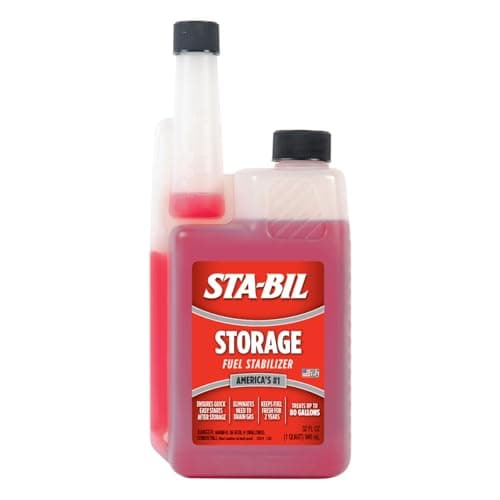
- 4Use fuel stabilizer in anything stored. STA-BIL states its storage product keeps gasoline fresh up to 24 months, and stale fuel is the most common reason a stored generator will not start.
- 5Shed load at night. Turning off everything but the fridge and the furnace can push a tank from 9 hours to 14.
The refueling kit
Running a dual fuel generator on a tank
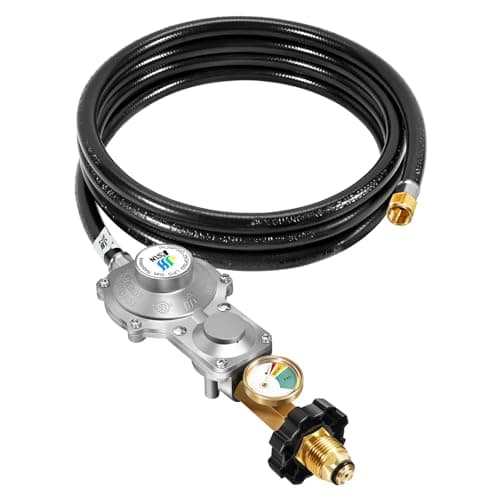
GasSaf 10 ft Two-Stage Propane Regulator + Hose
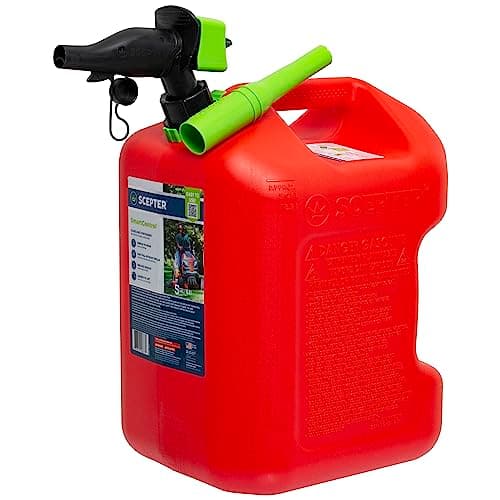
Stabilizer so stored fuel still works; a vented controllable can so pouring in the dark is not a spill; a two-stage propane hose so the tank sits well away from the hot machine.
Related: propane vs gasoline cost for the economics, and fuel storage and stabilizer for storing it safely.
Questions people actually ask
How long can a generator run continuously?
Mechanically, most portable generators are built for continuous operation as long as they have fuel and oil. Practically you are limited by the tank — published figures range from about 8.5 to 19 hours — and by the fact that you cannot refuel a hot or running machine, so every tank means a shutdown and cooling period.
How long will a generator run on propane versus gasoline?
Propane carries fewer BTU per gallon, so a generator burns through propane faster in volume terms for the same work. Its advantage is not runtime per gallon but storage: propane keeps indefinitely while gasoline degrades in months, and a tank swap is cleaner and safer than pouring gasoline near a hot engine.
Can I leave a generator running overnight?
If it has the fuel for it, yes — but it must be sited correctly, at least 20 feet from the house with the exhaust pointed away, and you must have battery CO alarms indoors. The risk overnight is not the generator running; it is nobody being awake to notice a problem.
Why does my generator use more fuel than the published figure?
Almost always because you are running it at a higher load than the figure assumed. Published runtimes are usually quoted at 25% or 50% load; the Generac tri-fuel, for example, publishes 14 hours at 25% and 9.5 hours at 50% from the same tank.
Does a natural gas generator run indefinitely?
Effectively, as long as the gas supply holds — Generac's tri-fuel listing describes connecting to a natural gas line for virtually unlimited runtime. You still need to stop it periodically for oil checks, and the trade is a 15-25% output derating versus gasoline.
How do I make my generator run longer on a tank?
Shed load. The same machine will run roughly 50% longer at 25% load than at 50%. An inverter generator with an economy mode does this automatically by throttling the engine to match demand, which is why Westinghouse's iGen5000c manages 18 hours on 3.4 gallons.
Sources
- STA-BIL Storage Fuel Stabilizer — manufacturer listingThe 24-month stored-fuel claim quoted in the planning section.
- US Consumer Product Safety Commission — Portable Generator Information CenterThe placement, never-indoors and CO-alarm guidance this site repeats on every generator page.
Read next
Guide
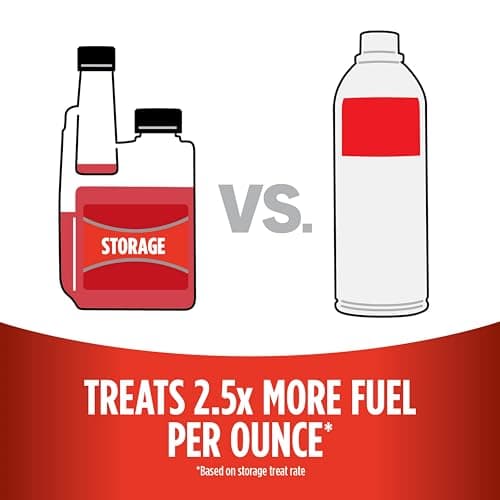
Generator Fuel Storage and Stabilizer
Fuel degradation, stabilizer shelf-life claims, safe storage quantities and containers, and the propane alternative.

Comparison
Propane vs Gasoline for a Generator
The honest propane-versus-gasoline comparison: energy density, output penalty, storage life and refueling safety.
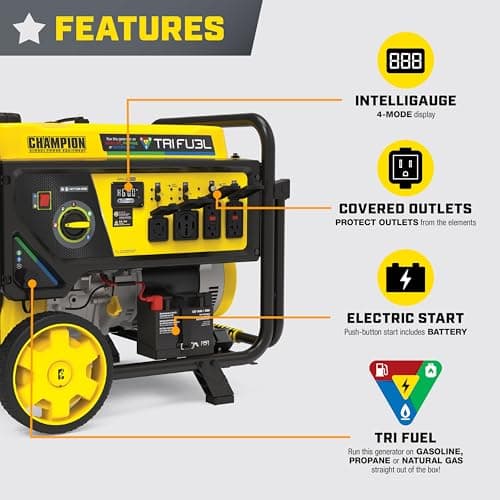
Best Tri-Fuel
Best Tri-Fuel Generators
Tri-fuel generators with all three fuels' published running watts, and the natural gas derating stated plainly.
Top pick · Champion 12,500W Tri-Fuel Home Backup
$1,259.99View on Amazon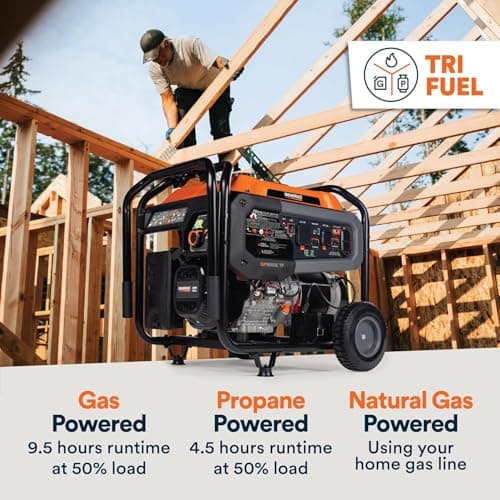
Guide
Generator Fuel Cost Calculator
An interactive running-cost calculator using your own fuel price and load, with the formula shown.
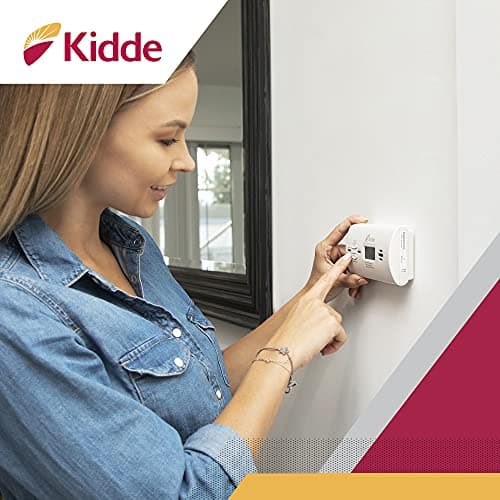
Guide
Generator Carbon Monoxide Safety
The CPSC placement rules, why a garage with the door open is still unsafe, and the battery CO alarm that should be your first purchase.