If you are buying one generator to keep a house running, this is almost certainly the category. Open-frame conventional generators give you more running watts per dollar than anything else, they are simple enough to service in a driveway, and the 8,000-to-10,000 running-watt machines here will carry an entire essential-circuit panel.
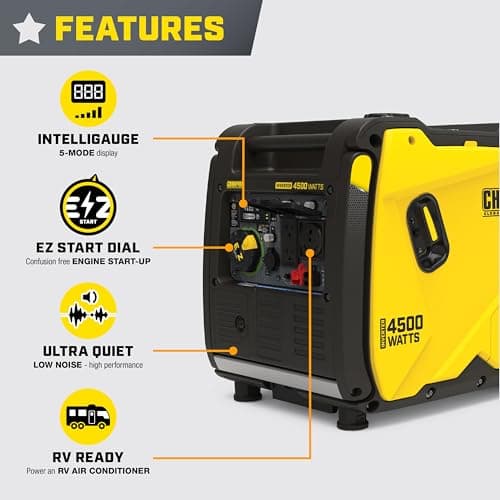
What you give up is noise and refinement. These machines run their engines at a fixed 3,600 rpm whatever the load, so a portable generator at 20% load sounds much the same as one at 90%. If that matters — close neighbors, a long outage, a bedroom near the driveway — look at inverter generators instead and accept fewer watts for the money.
How this category divides
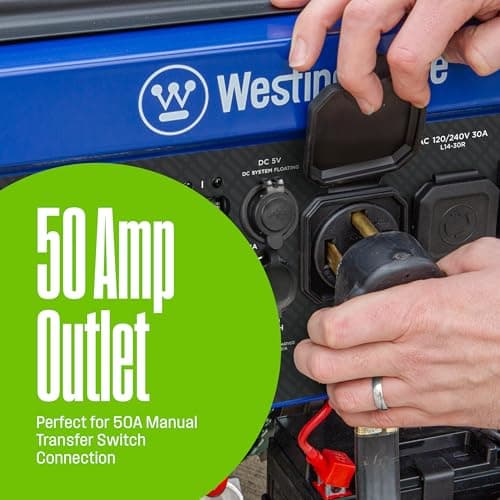
- 8,000 - 11,500 running watts. Whole essential panel, usually plus a well pump. Needs a 50 A transfer switch or an interlock kit to deliver its full output. This is where the main roundup sits.
- 5,000 - 6,500 running watts. Every essential circuit through a 30 A switch, no central air. The size most people actually need, and the value roundup covers it.
- Under 4,000 running watts. Cord-based backup for a fridge and a few lights. Reasonable, but at this size a battery power station is often the better machine.
What decides the price inside this class
Four things, roughly in order of how much they add:
Where the money goes
- Running watts
- The dominant factor
- Fuel count
- Dual fuel, then tri-fuel
- Start method
- Recoil, electric, then remote
- CO shutdown
- Increasingly standard, not universal
Remote start sounds like a luxury and is not: it means starting the generator without going out into the weather that caused the outage.
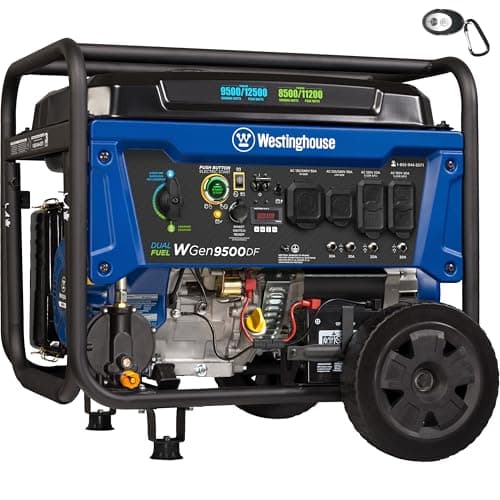
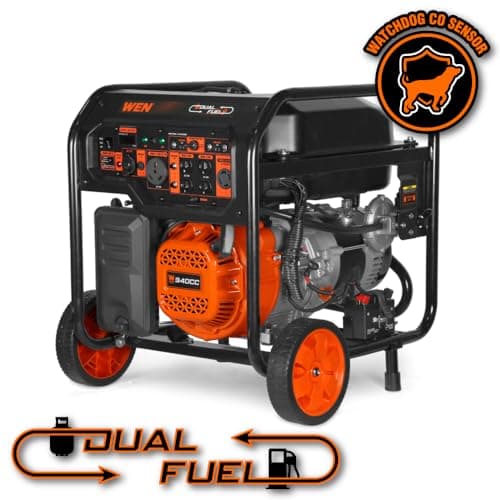
The carbon monoxide shutdown deserves a specific note. Several machines in this class still ship without one, including some otherwise excellent units — the Westinghouse WGen9500DF and the DuroMax XP13000EH among them. A CO shutdown is a worthwhile backstop, but it is not a substitute for placement: it protects the generator's operating area, not your bedroom. You still need a battery-powered CO alarm indoors.
The mistake buyers make here
They compare peak watts. Peak is a figure a generator can hold for a second or two to get a motor turning — it is not capacity. A machine sold as 13,000 watts may have 10,500 running watts, and a machine sold as 12,500 may have 9,500. The honest brands publish both on both fuels; where a manufacturer only shouts the peak figure, our product entries say so.
The second mistake is weight. These machines run from roughly 130 lb to 345 lb, and the wheel kits are designed for flat, dry ground. A 245 lb generator that has to cross a lawn in a storm is a two-person job every single time. If the generator will live where it runs, weight does not matter. If it has to be moved, it matters enormously.
Start with the main home backup roundup, and if you have a well pump read best generator for a well pump first — the surge demand there changes the answer.