Comparisons
Inverter vs Conventional Generator
Noise, fuel economy and power quality against watts per dollar. Both answers are defensible and the published figures show why.
Written byMike M.
Published
Disclosure: we earn a commission on purchases made through links on this page, at no cost to you. It does not affect what we recommend or what we say about it — how we are funded.
The short answer
| Inverter | Conventional frame | |
|---|---|---|
| Noise (published) | 52-64 dBA | ~74 dBA where published |
| Fuel at light load | Halved (Westinghouse claim) | Fixed engine speed |
| Total harmonic distortion | Under 3% typical | Often unpublished |
| Watts per dollar | Lower | Higher |
| 240 V output | Minority of models | Nearly all |
| Home serviceability | Enclosed, harder | Open frame, easier |
Manufacturer published figures. The 'often unpublished' entry is itself informative: most conventional machines state no THD figure, while Westinghouse publishes under 5% on its WGen11500TFc and under 3% on the open-frame ecoGen10000.
A conventional generator runs its engine at a fixed speed whatever the load. An inverter generator generates AC, rectifies it to DC and inverts it back to a clean sine wave, which lets the engine throttle to match demand. Three real consequences follow, and one real cost.
Consequence one: noise, and it is not marginal
Published figures: Honda's EU2200i at 48-57 dB(A), Westinghouse's iGen5000DFc at as low as 52 dBA, Champion's 2,500 W ultralight at 53 dBA from a stated 23 feet. Against about 74 dBA on Westinghouse's WGen14500TFc — which it publishes precisely because 74 dBA is quiet for an 18,000 peak watt machine.
The decibel scale is logarithmic, so a 22 dB gap is a different category of sound rather than an increment. It is the difference between a machine you can hold a conversation beside and one your neighbor will mention.
Two caveats, both honest. "As low as" means at light load — an inverter's whole mechanism is varying engine speed, so the figure rises as you load it, and nobody publishes a full-load rating. And most manufacturers do not state a measurement distance, which makes the figures not strictly comparable. Detail in how quiet is a quiet generator.
Consequence two: fuel economy at light load
Westinghouse states that inverter technology cuts fuel consumption up to half versus a conventional generator, by matching engine speed to power demand. The iGen5000c's published 18 hours on a 3.4 gallon tank — about 0.19 gallons per hour — is what that looks like.
This matters specifically because a backup generator spends most of its time at light load. Your essential circuits might draw 3,500 watts from a machine rated for 6,500, and a conventional engine at that load burns fuel as though it were working hard.
Consequence three: power quality, and the case where it bites
Total harmonic distortion measures how clean the waveform is. Under 3% is what most inverter machines publish and is considered safe for sensitive electronics. It is irrelevant for heaters, pumps and incandescent lighting.
The practical case in home backup is a modern furnace control board. A furnace that refuses to run on generator power despite plenty of watts being available is usually a power-quality problem rather than a capacity one. That is the single most common real-world argument for inverter power.
Worth knowing: the gap is narrowing. Westinghouse publishes under 5% THD on its conventional WGen11500TFc and WGen14500TFc, and under 3% on the open-frame ecoGen10000 — so clean power is no longer exclusively an inverter feature.
The cost: watts per dollar, and electronics
Honda's EU2200i costs roughly what a 6,500-running-watt dual fuel conventional machine costs and delivers under 2,000 running watts. That is the clearest illustration of the premium.
There is also an engineering cost people underweight. Inverter electronics are a failure mode a plain alternator does not have, and an enclosed machine is harder to service in a driveway than an open frame. For a machine expected to work in fifteen years' time, simplicity has value.
The constraint that decides it for many houses
The inverter machines that do qualify: Westinghouse's iGen12000DFc (12,000 peak watts, 3% or less THD, both an L14-30R and a 14-50R) and ecoGen10000 (7,600 running watts, under 3% THD, both outlets); DuroMax's iH series; and WEN's DF680iX — though the DF680iX publishes a bonded neutral, which many transfer switches will not accept. Confirm that with your electrician.
The short answer
The best of each, at comparable output
| # | Product | Best for | Score | Price |
|---|---|---|---|---|
| 1 | 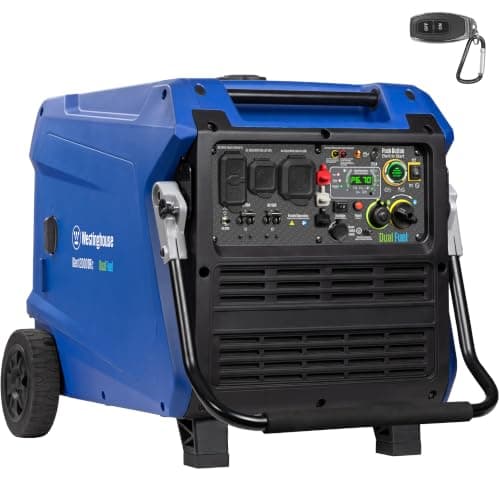 Westinghouse iGen12000DFc 12,000W Dual Fuel Inverter The best technical answer for whole-house backup if the budget allows: transfer-switch-ready output, inverter-clean power, and far less noise than the conventional alternative. | Whole-house backup with clean power | 9.0/10 | $1,899.00 |
| 2 | 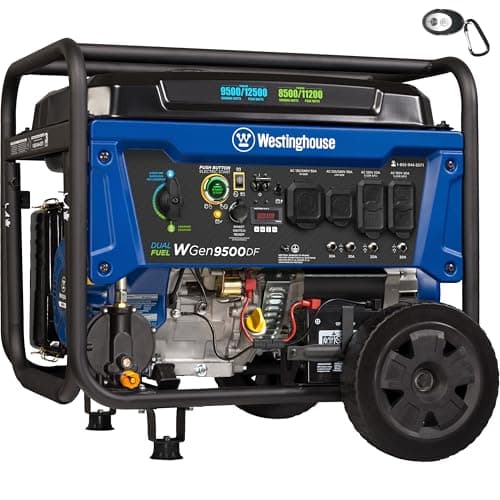 Westinghouse WGen9500DF 12,500W Dual Fuel The most broadly sensible home backup generator on the market: enough running watts for a whole essential-circuit panel, both transfer-switch outlets, and dual fuel — with the caveat that it has no CO shutoff. | The default whole-house pick | 8.8/10 | $999.00 |
| 3 | 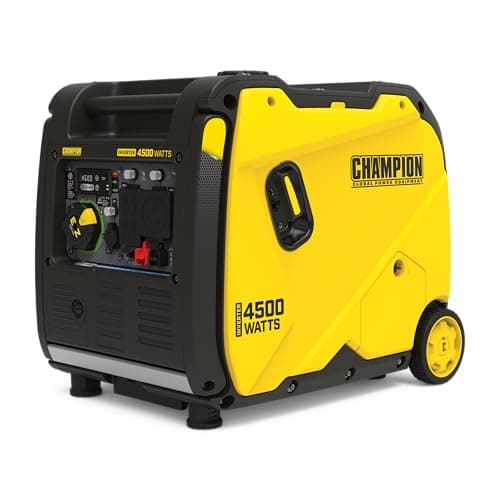 Champion 4,500W RV Ready Inverter The best balance of quiet, clean power and real output for cord-based backup: enough for the essentials, under 3% THD, half the price of the Honda equivalent. | Quiet backup at a sane price | 8.5/10 | $674.10 |
| 4 | 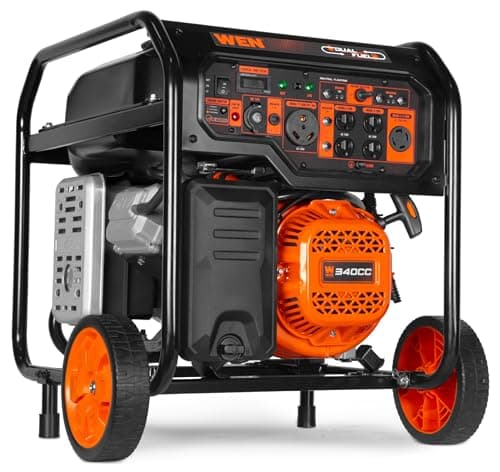 WEN DF8000X 8,000W Dual Fuel The best-value correctly-sized home backup generator here: enough for every essential circuit, dual fuel, CO shutoff, a real transfer-switch outlet, and no money spent on capacity you will not use. | Essential circuits, dual fuel, lowest cost | 8.5/10 | $623.17 |
| 5 | 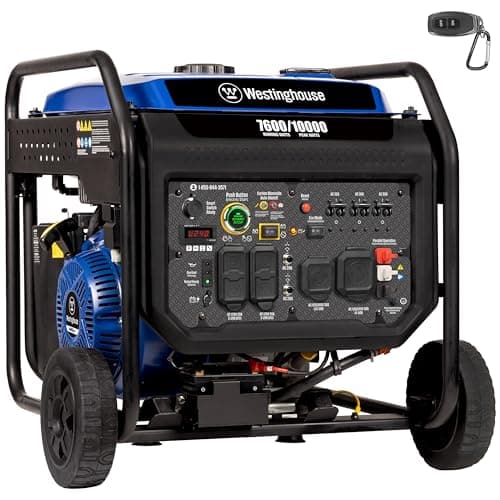 Westinghouse ecoGen10000 10,000W Open-Frame Inverter The value route to inverter-clean power at whole-essential-circuit output, at the cost of the acoustic enclosure and the propane option. | Clean power at 7,600 running watts | 8.3/10 | $1,149.00 |
| 6 | 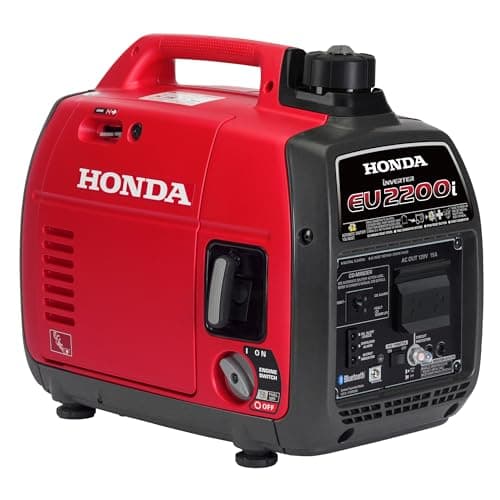 Honda EU2200i 2,200W Inverter The best small inverter generator made, and the wrong tool for whole-house backup — buy it for a fridge, a few lights and quiet, not for your panel. | The quietest credible option | 8.0/10 | $1,199.00 |
#ad Prices as of October 5, 2026; they may have changed since. Scores are our editorial judgment from published specifications, not test results — how we pick. How we are funded.
So which should you buy?
Our view, by situation
- Close neighbors, suburban
- Inverter — the noise gap is real
- Feeding a panel on a budget
- Conventional with published THD
- Fussy furnace control board
- Inverter, or a sub-5% THD conventional
- Cords to a fridge and lights
- Inverter — quiet and efficient
- Well pump, maximum watts
- Conventional, nearly always
- Expecting multi-day outages
- Conventional tri-fuel, for the fuel
Our editorial judgment from the published specifications. The genuinely interesting middle case is Westinghouse's ecoGen10000: inverter-clean power on an open frame with both 240 V outlets, which gets most of the benefit at a conventional-ish price.
Questions people actually ask
Is an inverter generator better than a conventional one?
It is quieter, more fuel-efficient at light load and produces cleaner power, and it costs significantly more per watt. For a machine run a few days a year where noise is not an issue, a conventional frame is often the rational buy — particularly one that publishes a low THD figure.
How much quieter is an inverter generator?
Published figures run from 48-57 dB(A) on Honda's EU2200i and as low as 52 dBA on Westinghouse's iGen5000DFc, against about 74 dBA on a large conventional frame. The decibel scale is logarithmic, so a 22 dB gap is a different category of sound rather than an increment.
Do I need an inverter generator for my furnace?
Sometimes. Modern furnace control boards can lock out on a conventional generator's higher harmonic distortion, which presents as a furnace that will not run despite plenty of watts available. Several conventional machines now publish under 5% THD, which addresses it too.
Can an inverter generator run a well pump?
Only the minority with 240 volt output — Westinghouse's iGen12000DFc and ecoGen10000, DuroMax's iH series, WEN's DF680iX. Most inverter generators have no 240 volt outlet at all, which rules out a transfer switch and every hard-wired load.
Are inverter generators more reliable?
They add electronics that a plain alternator does not have, which is an additional failure mode, and an enclosed machine is harder to service at home than an open frame. Against that, they generally run less hard at a given load. Neither claim is testable by us.
Is the fuel saving on an inverter generator real?
At light load, yes, and that is where a backup generator spends most of its time. Westinghouse states inverter technology halves consumption versus a conventional machine, and its iGen5000c's 18 hours on 3.4 gallons works out at about 0.19 gallons per hour.
Sources
- Eugene Water & Electric Board — Generator Sizing ConsiderationsPublished appliance running and additional-starting watt figures used in the load arithmetic on this page.
- US Consumer Product Safety Commission — Portable Generator Information CenterThe placement and carbon monoxide guidance referenced wherever this page compares indoor and outdoor operation.
Read next
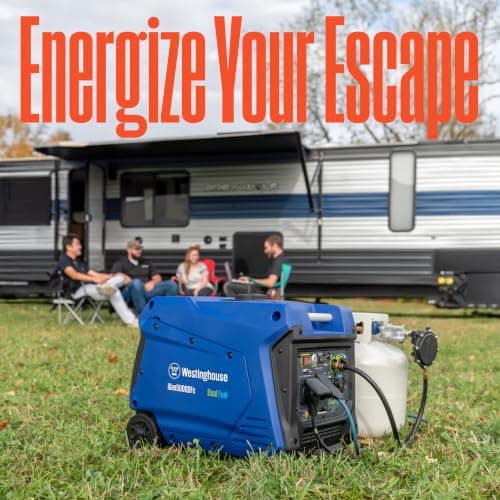
Best Quiet Inverter
Best Quiet Inverter Generators for Home Backup
Inverter generators ranked on published noise and THD figures, with the brands that publish no measurable claim named.
Top pick · Westinghouse iGen5000DFc 5,000W Dual Fuel Inverter
$999.00View on Amazon23% off
Guide
How Quiet Is a Quiet Generator?
Published decibel ratings side by side with their measurement conditions, and what a dB difference actually means.
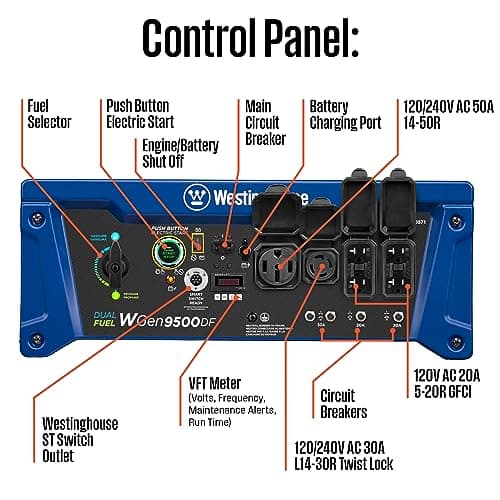
Best Overall Home Backup
The Best Home Backup Generators
Nine conventional-frame generators ranked for whole-house backup, with per-fuel running watts and transfer-switch fit.
Top pick · Westinghouse WGen9500DF 12,500W Dual Fuel
$999.00View on Amazon
Guide
What Size Generator to Run a Furnace?
Furnace blower sizing from published figures, the gas-versus-electric divide, and why power quality matters for modern control boards.
Guide
Generator Fuel Cost Calculator
An interactive running-cost calculator using your own fuel price and load, with the formula shown.