Costs
What Transfer Switch Installation Costs
The switch is often the smallest line on the invoice. Here is what the rest of it is, and how to reduce it.
Written byMike M.
Published
Disclosure: we earn a commission on purchases made through links on this page, at no cost to you. It does not affect what we recommend or what we say about it — how we are funded.
The short answer
- Labor dominates, and it scales with the number of circuits moved into the switch.
- 30 to 50 amps raises every line — switch, inlet, cord, feeder conductors and labor.
- Hardware choices reduce labor: a pre-attached conduit whip, prewired labeled conductors, a pigtailed inlet box, an integrated inlet.
- Get more than one quote. The labor component varies widely between electricians.
We do not quote prices in prose anywhere on this site, and that applies doubly to labor, which varies by region, by electrician and by what your panel looks like. What we can do usefully is tell you what the quote is made of, so you can read one and reduce it.
What the quote consists of
The line items, roughly largest first
- Labor
- Usually the biggest line
- The transfer switch
- Hardware
- Inlet box
- Hardware, unless integrated
- Feeder conductors + conduit
- Scales with distance and amps
- Generator cord
- Hardware, sometimes included
- Permit and inspection
- Local fee
Our assessment of the structure from what the work involves. The ordering surprises people: the switch is frequently not the largest number on the invoice.
The main labor driver: circuits moved
Installing a transfer switch means moving your chosen circuits out of the main panel and into the switch, one at a time. That is careful, repetitive work, and it is where the hours go.
A six-circuit install is therefore cheaper than a ten-circuit one — but with an important caveat. Going back later to add circuits means paying for a second visit, so the marginal cost of the last four circuits is far lower now than it will be in two years. That is the main argument for ten circuits over six, and it is a labor argument rather than a hardware one.
What six circuits actually covers, using EWEB's published figures: fridge (700 W), furnace blower (700 W), well pump (1,000 W), sump pump (800-1,050 W) and two lighting circuits (~150 W each). That is the genuine essential set with nothing spare.
The 30-to-50 amp step raises everything
| Line | At 30 A | At 50 A |
|---|---|---|
| Transfer switch | Lower | Higher |
| Inlet box | Lower | Higher |
| Cord conductors | 10 AWG | 6/3 + 8/1 AWG (VEVOR published) |
| Feeder conductors | Smaller | Larger, stiffer, more labor |
| Conduit and fittings | Smaller | Larger |
| Labor | Less | More — heavier cable is slower to work |
So the amp rating decision is a whole-chain decision, not a switch decision. Make it from your generator's running watts: under about 7,500, 30 amp; over, 50 amp. See transfer switch amp rating guide.
And note the corollary: sizing the generator correctly can save you twice, once on the machine and once on an entire 50 amp installation you did not need.
Hardware choices that reduce labor
This is the actionable part. Several products publish features whose entire purpose is removing a step from the install:
| Feature | Step removed | Product |
|---|---|---|
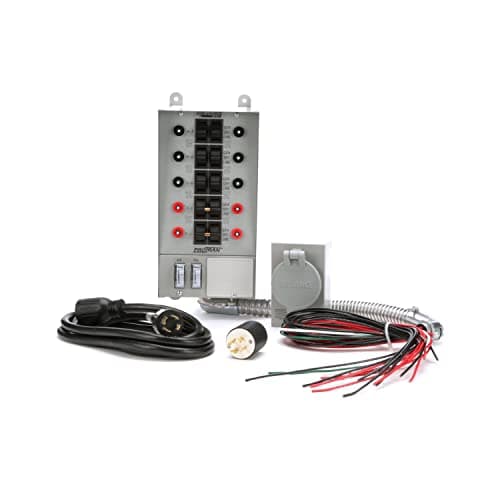
| 18-inch flexible conduit whip | The fiddliest part of the panel hookup | Reliance 31410CRK |
| Prewired labeled conductors | Identifying and terminating | Champion 201193 |
| 6-inch pigtails on the inlet box | Terminating inside a cramped enclosure | Connecticut EGSPI50 |
| Integrated inlet in the switch | A second wall penetration entirely | Reliance 306A, A510A |
| Pre-drilled inlet box | Drilling on site | VEVOR kits, SURAIELEC |
| Matched cord + inlet kit | A mismatch, a return and a second visit | VEVOR 30 A and 50 A |
| Cord included with switch | A separate purchase and a fit question | Champion 201193 (30 ft), Connecticut EGS1012KG2 |
That last row has a second benefit worth naming: Champion's bundled cord is 30 feet, which matters because CPSC guidance puts the generator at least 20 feet from the house. A bundled 25-foot cord is adequate; a bundled 10-foot cord would be useless.
The short answer
Hardware that keeps the labor down
| # | Product | Best for | Score | Price |
|---|---|---|---|---|
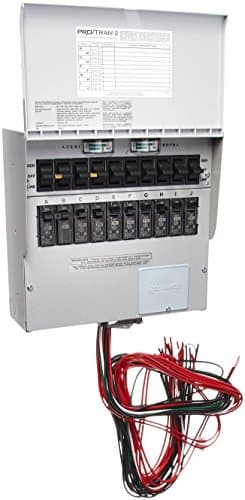
| 1 | 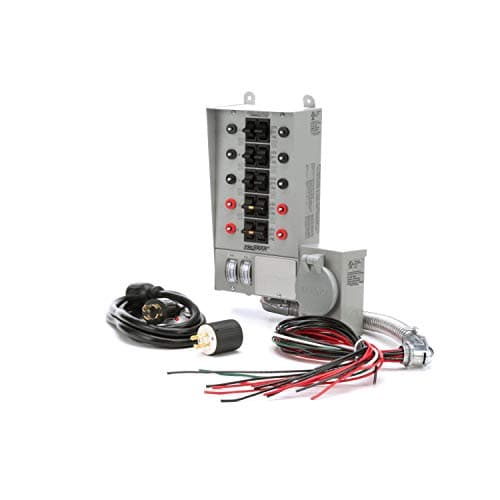 Reliance Controls 31410CRK Pro/Tran 10-Circuit 30A The right pick when your generator genuinely is 7,500 running watts or less — the included whip is a real labor saving. | Pro/Tran with a conduit whip | 8.5/10 | $462.11 |
| 2 | 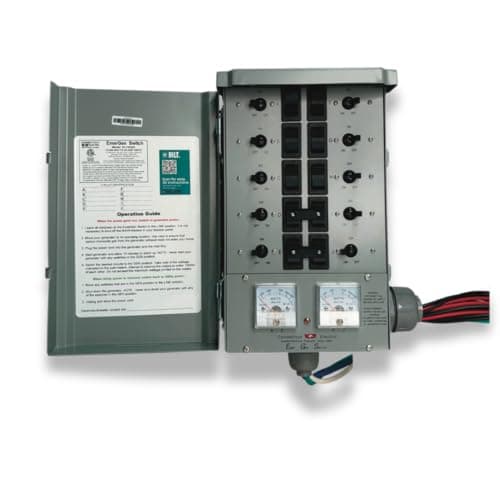 Connecticut Electric EmerGen EGS1012KG2 50A 10-Circuit The simplest way to do a 50 A installation correctly: everything matched in one box, including the cord people most often get wrong. | 50A kit with inlet and cord | 9.0/10 | $379.99 |
| 3 | 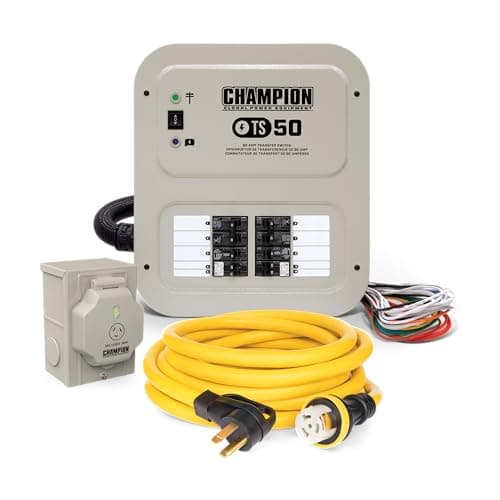 Champion 201193 50A 10-Circuit with Cord The most completely specified 50 A package: UL 1008, prewired, with a cord long enough to site the generator safely. | UL 1008 certified with a 30 ft cord | 9.0/10 | $610.72 |
| 4 | 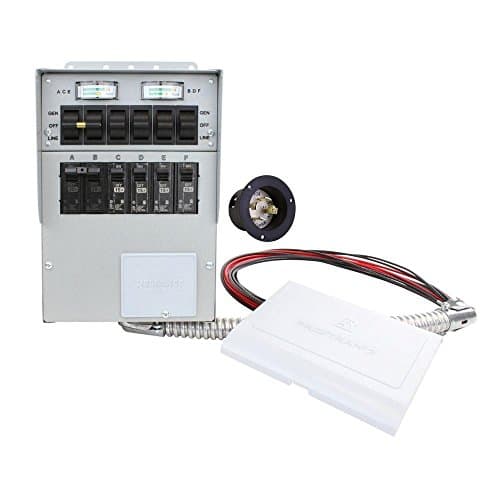 Reliance Controls 306A Pro/Tran2 6-Circuit 30A Worth choosing over the 310CRK specifically if a garage-mounted switch with an integral inlet suits your layout — one install instead of two. | Six circuits, optional inlet | 7.6/10 | $299.00 |
| 5 | 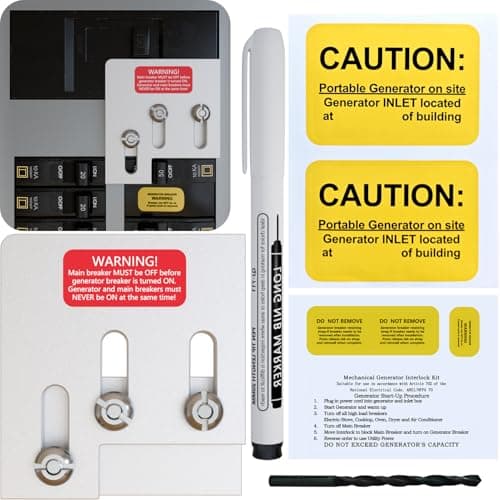 SPZOCE Interlock Kit — Square D QO/Homeline 150/200A The cheapest correct way to connect a generator to the whole panel, provided your panel is a Square D QO or Homeline with the exact spacing stated — measure first. | Square D QO and Homeline, 150-200A | 8.5/10 | $26.99 |
#ad Prices as of October 5, 2026; they may have changed since. Scores are our editorial judgment from published specifications, not test results — how we pick. How we are funded.
The interlock alternative, and what it actually saves
An interlock plate costs a small fraction of a transfer switch. But be clear about what that saves, because the saving is smaller than the hardware price difference suggests.
Interlock versus transfer switch, by line
- The plate vs the switch
- Large saving
- Generator inlet breaker
- Needed either way
- Inlet box
- Needed either way
- Feeder conductors
- Needed either way
- Permit and inspection
- Needed either way
- Circuit relocation labor
- SAVED — no circuits move
Our analysis of the two jobs. The real saving is twofold: the hardware, and not having to move circuits out of the main panel — which is the biggest labor line. That makes an interlock a genuinely cheaper install, not just cheaper hardware.
The trade-off is load management, which becomes entirely manual with an interlock. See interlock kit vs transfer switch.
How to compare quotes
- 1Get at least two, ideally three. Labor dominates and varies widely.
- 2Ask for hardware and labor separately, so you can see which is which and whether supplying your own hardware helps.
- 3Confirm the circuit list is the same in each quote. Six circuits versus ten is not a like-for-like comparison.
- 4Confirm the amp rating is the same, for the same reason.
- 5Ask whether the permit and inspection fee is included, because it is sometimes quoted separately.
- 6Ask where they will put the inlet box, and check it lets the generator sit 20 feet from the house with the exhaust pointed away.
That last item is the one most worth your attention: it is a safety decision disguised as a logistics decision, and you are better placed to judge it than the electrician because you know where the generator will actually live.
Questions people actually ask
How much does it cost to install a transfer switch?
We do not quote figures, because labor varies by region, by electrician and by your panel's condition. The quote is made of labor (usually the largest line), the switch, an inlet box, feeder conductors, a cord, and a permit and inspection fee.
What makes a transfer switch installation expensive?
Mainly the number of circuits moved into the switch, which is careful repetitive work. Then the amp rating — 50 amps means heavier conductors throughout and slower work — plus the distance from panel to inlet box and how accessible your panel is.
Is an interlock kit cheaper to install than a transfer switch?
Yes, and on two counts: the plate costs a fraction of a switch, and no circuits have to be relocated, which is the biggest labor line. You still need a generator inlet breaker, an inlet box, a feeder, a permit and an inspection either way.
Can I supply my own transfer switch to save money?
Often, and it is worth asking. Ask for hardware and labor quoted separately so you can see which is which. Choose hardware that removes install steps — a pre-attached conduit whip, prewired labeled conductors, a pigtailed inlet box — because those reduce the labor line too.
Do I need a permit to install a transfer switch?
In most US jurisdictions, yes, with an inspection. Ask whether the fee is included in your quote, because it is sometimes listed separately. The inspector checks that generator and utility supplies cannot be connected simultaneously and that conductors are correctly sized.
Should I get multiple quotes?
Yes. Labor dominates the cost and varies widely between electricians. Make sure each quote covers the same circuit list and the same amp rating, or you are not comparing like for like.
Sources
- Eugene Water & Electric Board — Generator Sizing ConsiderationsPublished appliance running-watt figures used in the load arithmetic on this page.
- US Consumer Product Safety Commission — Portable Generator Information CenterThe 20-foot placement guidance that constrains where the inlet box can usefully go.
Read next
Guide
How Transfer Switch Installation Works
What a transfer switch installation involves, what drives the quote, and the decisions to make before the electrician arrives.
Best Transfer Switch
The Best Generator Transfer Switches
Transfer switches ranked on circuit count, amp rating and kit completeness, from 6-circuit 30A to 10-circuit 50A.
Top pick · Reliance Controls 310CRK 10-Circuit 30A Kit
$474.76View on Amazon
Connection Comparison
Interlock Kit vs Transfer Switch
Interlock kit against transfer switch on cost, circuit access, load management, panel fit and inspection risk.
Guide
Transfer Switch Amp Rating Guide
Matching transfer switch amp rating to generator output, with the arithmetic and the whole-chain cost implications.
Guide
What a Home Backup Generator Costs
The variables that drive generator price, the connection cost people forget, and where the money is best spent.