Generator Sizing
How Many Watts to Run a House on a Generator?
Three circuit sets — survival, essential and comfortable — with the watts each one actually totals.
Written byMike M.
Published
Disclosure: we earn a commission on purchases made through links on this page, at no cost to you. It does not affect what we recommend or what we say about it — how we are funded.
The short answer
| Circuit set | Running watts | Starting watts |
|---|---|---|
| Survival — fridge, lights, phones | 970 | 3,170 |
| Essential — add heat, water, sump | 3,500 | 5,700 |
| Comfortable — add kitchen, laundry, one AC | 8,000 | 11,950 |
Totaled from the published figures on our appliance wattage chart. Starting watts = running total plus the single largest additional surge, the method both cited charts specify.
The reason "how many watts to run a house" gets answered badly is that it conflates three very different ambitions. Deciding which one you are actually buying is most of the work.
Survival: 970 running watts
What is on
- Refrigerator
- 700 W
- LED lighting, 10 bulbs
- 150 W
- Phone chargers x3
- 60 W
- Modem and router
- 60 W
- Total running
- 970 W
- Largest surge (fridge)
- +2,200 W
- Starting watts
- 3,170 W
Food stays safe, you can see, and you can reach people. After derating that is about 1,250 running watts — and the surge requirement of 3,170 watts is the binding constraint, not the running load.
This set is a battery power station job, not a generator job. A 2 kWh unit with a 3,000 watt surge rating covers it for a day and a half, indoors, silently, with no fuel. If you are at this level and still shopping for generators, you are about to spend more money for a worse experience.
Essential: 3,500 running watts
Add the loads whose failure costs real money — heat, water, and keeping the basement dry.
What is added
- Survival set
- 970 W
- Furnace blower, 1/3 HP
- 700 W
- Well pump, 1/3 HP
- 1,000 W
- Sump pump, 1/3 HP
- 800 W
- Total running
- 3,470 W
- Largest surge (fridge)
- +2,200 W
- Starting watts
- 5,670 W
About 4,400 running watts after derating. This is the set most people mean when they say "run my house", it needs a generator rather than a battery because of the pump surges, and a 5,000-6,500 running-watt dual fuel machine through a 30 amp transfer switch is the standard answer.
Comfortable: 8,000 running watts
Now you are adding things you want rather than things you need: kitchen outlets so the microwave and coffee maker work, a laundry circuit, and one window air conditioner.
What is added
- Essential set
- 3,470 W
- Microwave, 1,000 W rated
- 1,000 W
- Coffee maker
- 1,000 W
- Washing machine
- 500 W
- Window AC, 12,000 BTU
- 3,250 W
- Total running
- 9,220 W
- Largest surge (window AC)
- +3,950 W
- Starting watts
- 13,170 W
Note what happened: the window AC took over as the largest surge, and the running total nearly tripled the survival set. Comfort is expensive in watts.
That is 11,500 running watts after derating, which is a tri-fuel machine and a 50 amp connection. And the honest observation is that you can get most of the comfort for a fraction of that by simply not running the microwave and the coffee maker at the same time as everything else — appliances used for a few minutes do not need to be in a simultaneous-load calculation at all.
The short answer
The machine for each circuit set
| # | Product | Best for | Score | Price |
|---|---|---|---|---|
| 1 | 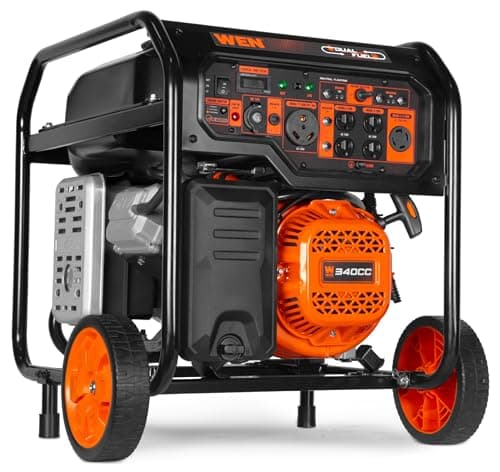 WEN DF8000X 8,000W Dual Fuel The best-value correctly-sized home backup generator here: enough for every essential circuit, dual fuel, CO shutoff, a real transfer-switch outlet, and no money spent on capacity you will not use. | Essential circuits, dual fuel, lowest cost | 8.5/10 | $623.17 |
| 2 | 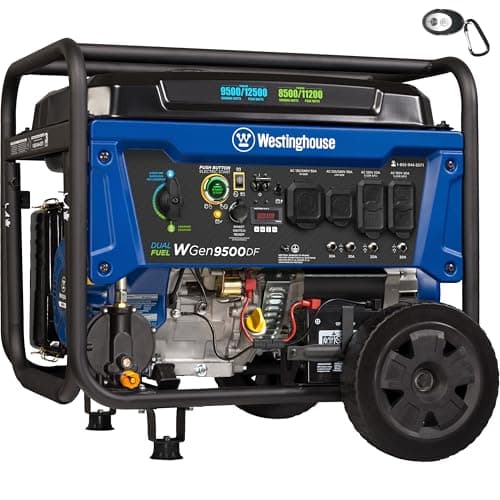 Westinghouse WGen9500DF 12,500W Dual Fuel The most broadly sensible home backup generator on the market: enough running watts for a whole essential-circuit panel, both transfer-switch outlets, and dual fuel — with the caveat that it has no CO shutoff. | The default whole-house pick | 8.8/10 | $999.00 |
| 3 | 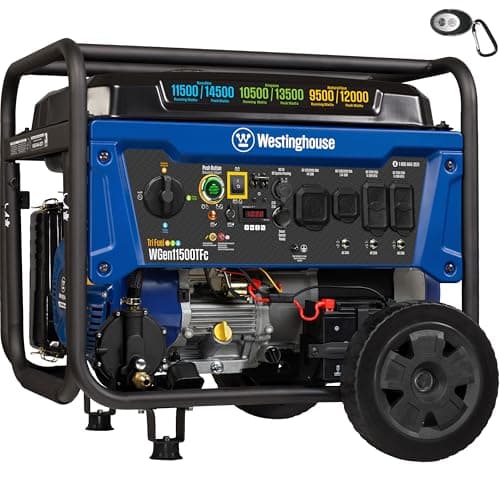 Westinghouse WGen11500TFc 14,500W Tri-Fuel Buy this when the sizing math genuinely lands above 10,000 running watts — not because bigger feels safer. | Larger homes with real 240V loads | 8.9/10 | $1,499.00 |
#ad Prices as of October 5, 2026; they may have changed since. Scores are our editorial judgment from published specifications, not test results — how we pick. How we are funded.
Work your own version with the load calculator, which does this arithmetic on your actual appliance list and tells you which wattage class you land in.
Questions people actually ask
How many watts does an average house use?
For backup purposes the question is what runs simultaneously, not average consumption. A survival set totals about 970 running watts, an essential set with heat and water about 3,500, and a comfortable set with a window AC about 9,200 before you apply any discipline about which appliances genuinely run at once.
Will 10,000 watts run a whole house?
It will run an essential circuit set plus a window air conditioner in most homes. Central air or electric heat will take you past it. Remember too that a 30 amp transfer switch caps delivery at roughly 7,200 watts regardless of generator size, so 10,000 watts needs a 50 amp connection to be fully usable.
How many watts to run a refrigerator and a freezer?
EWEB's chart lists refrigerator and freezer together at 700 running watts with a 2,200 watt additional surge. For two separate appliances, double the running figure to 1,400 but add only one 2,200 watt surge — they will not start in the same instant.
Can 2000 watts run a house?
It can run a survival set — a refrigerator, LED lighting and devices — provided its surge rating covers the fridge's 2,200 watt start-up, which many 2,000 watt machines do not. Check the peak or surge figure, not the running rating.
Sources
- Eugene Water & Electric Board — Generator Sizing ConsiderationsPublic-utility wattage chart: the running and additional-starting figures quoted on this page, and the add-the-single-largest-surge method.
- Champion Power Equipment — Quick Reference WattageManufacturer wattage chart: the second published figure wherever it differs from EWEB's, and the kitchen and laundry loads EWEB does not list.
Read next
Guide
What Size Generator Do I Need?
The core sizing method: total running watts, add the single biggest surge, derate for continuous running, then match a wattage class.
Reference
Appliance Wattage Chart
The site's reference wattage table, with each row's source named and both figures shown wherever the published charts disagree.
Guide
What Size Generator for a House?
Load tables for four realistic house types — gas heat, well pump, central air and electric heat — with the generator class each needs.
Best Overall Power Station
The Best Home Backup Power Stations
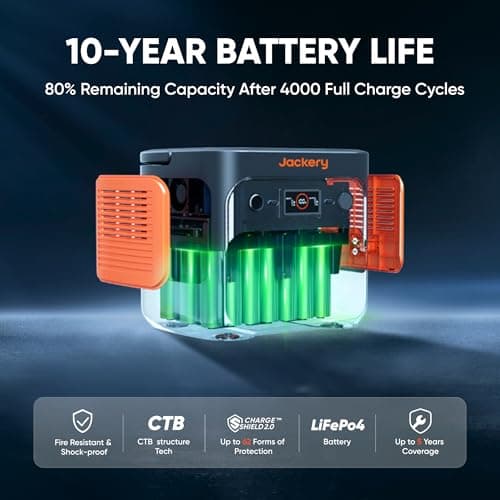
Battery power stations ranked for home backup on surge, capacity, recharge speed and cycle life.
Top pick · Jackery Explorer 2000 v2
$898.99View on Amazon10% off
Guide
How to Run Your House on a Generator
Connection options ranked, the correct start-up sequence, load management, and the back-feeding practice to never attempt.