Comparisons
Solar Generator vs Gas Generator
A solar generator is a battery with panels, not a generator. Knowing that is most of the comparison.
Written byMike M.
Published
Disclosure: we earn a commission on purchases made through links on this page, at no cost to you. It does not affect what we recommend or what we say about it — how we are funded.
The short answer
A "solar generator" is a battery power station bundled with solar panels. It generates nothing on its own and cannot start a well pump or run air conditioning — portable output ceilings are 1,500-2,400 watts. What it does uniquely is refuel without a trip, which in a prolonged regional outage is genuinely valuable. A gas generator has four to five times the output, runs indefinitely on fuel, and must be run outdoors at least 20 feet from the house.
The word "generator" in "solar generator" is marketing. Nothing in the box generates electricity except the panels, and the panels produce far less than their rating in real conditions. Starting from an accurate picture makes the comparison much more useful.
The comparison, on the axes that matter
| Solar kit | Gas generator | |
|---|---|---|
| Output ceiling | 1,500-2,400 W | 1,900-13,000 W running |
| Motor surge | No | Yes |
| Runs indoors | Yes | Never |
| Noise | Silent | 52-74 dBA published |
| Refueling | None needed | Fuel, trips, 3am shutdowns |
| Runtime | Capacity + whatever sun gives | As long as fuel lasts |
| Maintenance | None | Oil, filters, plugs, stabilizer |
| 240 V / hard-wired | No | Yes |
What solar genuinely wins
It needs no fuel deliveries. In a regional outage gas station pumps are electric and do not work; the stations with backup power have queues measured in hours; roads may not be passable. Solar is the only backup fuel that arrives on its own.
It runs indoors, silently, with no maintenance, and no carbon monoxide risk at all — which also means no 20-foot placement rule, no running cover, and no CO alarms required for it.
It is still useful between outages: camping, a job site, an RV. A generator mostly sits.
What solar cannot do, and the honest expectations
So solar does not make a battery infinite. It turns a one-day battery into a several-day one by putting some energy back each day — which is a genuinely valuable transformation, just a more modest one than the marketing suggests.
And the output ceiling is hard. Using EWEB's published figures, a 1/3 HP well pump needs 2,000 additional watts to start and a 12,000 BTU window air conditioner 3,250 running watts with a 3,950 watt surge. Neither is within a portable battery's 1,500-2,400 watt output.
The specification that decides a solar kit's usefulness
Not the panels — the unit's solar input ceiling, which caps how much panel you can ever usefully add:
Published solar input limits
- Bluetti AC200PL
- 1,200 W
- EcoFlow DELTA 2 Max
- 1,000 W
- Bluetti AC180
- 500 W
A 500 W ceiling means the unit can never be refilled quickly from sun no matter how many panels you buy. A 1,000-1,200 W ceiling means adding panels later actually helps.
Buy for the ceiling rather than for the panels in the box. Panels are easy to add later; the input limit is fixed in the hardware.
The short answer
Solar kits, and the generators they compete against
| # | Product | Best for | Score | Price |
|---|---|---|---|---|
| 1 | 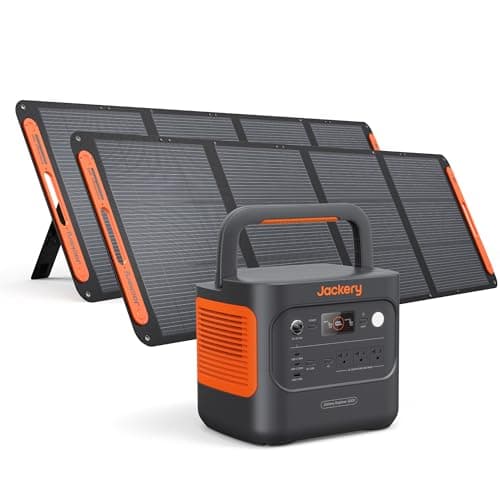 Jackery Explorer 2000 v2 + 2x200W Solar The most complete solar backup package here: enough capacity for a fridge and enough panel area to put something back each day. | The complete 2 kWh solar kit | 8.7/10 | $1,329.00 |
| 2 | 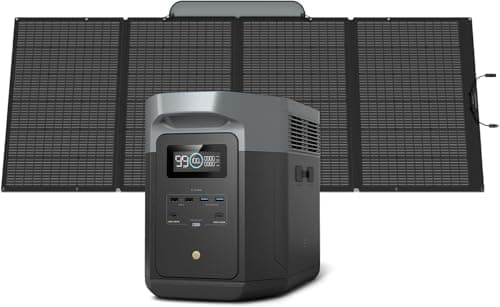 EcoFlow DELTA 2 Max + 400W Solar The right solar kit if you intend to expand: 1,000 W of solar headroom and 6 kWh of battery headroom from the same hardware. | Fastest solar recharge | 8.6/10 | $1,529.00 |
| 3 | 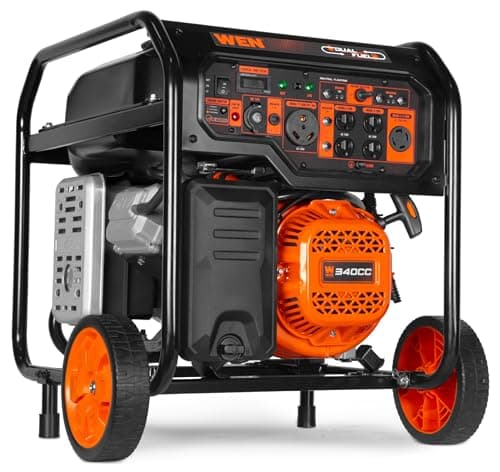 WEN DF8000X 8,000W Dual Fuel The best-value correctly-sized home backup generator here: enough for every essential circuit, dual fuel, CO shutoff, a real transfer-switch outlet, and no money spent on capacity you will not use. | Essential circuits, dual fuel, lowest cost | 8.5/10 | $623.17 |
| 4 | 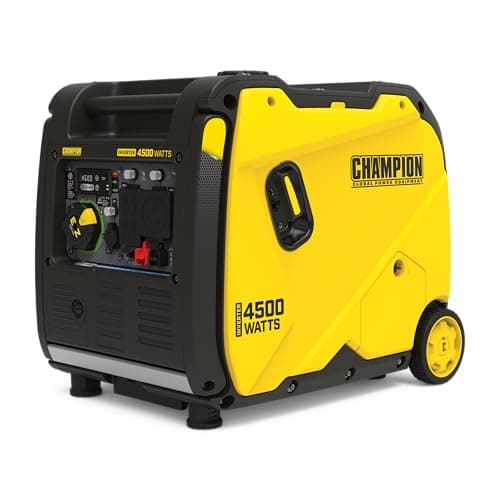 Champion 4,500W RV Ready Inverter The best balance of quiet, clean power and real output for cord-based backup: enough for the essentials, under 3% THD, half the price of the Honda equivalent. | Quiet backup at a sane price | 8.5/10 | $674.10 |
| 5 | 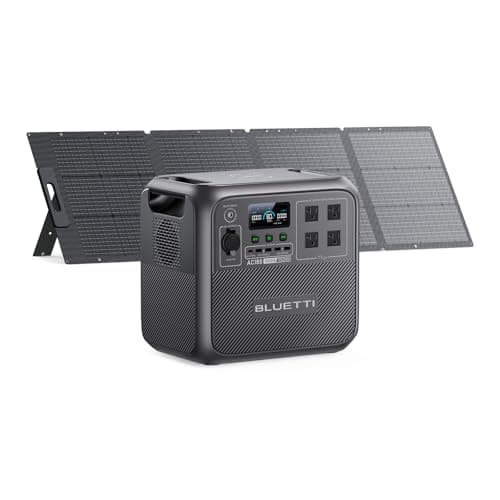 Bluetti AC180 + 200W Solar The budget entry into solar backup with enough output for a refrigerator — limited mainly by its 500 W solar input ceiling. | Cheapest solar kit that runs a fridge | 7.7/10 | $729.00 |
#ad Prices as of October 5, 2026; they may have changed since. Scores are our editorial judgment from published specifications, not test results — how we pick. How we are funded.
Which to buy
Our view, by situation
- Short outages, small loads
- Solar kit, or just a battery
- Multi-day outages, no fuel access
- Solar kit — nothing else refuels
- Well pump or sump pump
- Generator
- Air conditioning or electric heat
- Generator
- Apartment or no outdoor space
- Solar kit — a generator is unusable
- Tight budget, needs capability
- Generator — cheapest watts
Our editorial judgment. The second row is the case most often underweighted, and it is the one where solar is genuinely irreplaceable.
The combination that usually wins
A dual fuel generator and a battery, with solar optional. The generator covers motor loads and recharges the battery quickly — several units publish 0-80% in 43-49 minutes. The battery covers the fridge and electronics silently indoors overnight. Panels extend the battery when fuel runs short.
That is more capability than either alone, at a cost that is often lower than a large solar kit, and it is what most households with mixed needs should actually buy. See portable power station vs generator.
Questions people actually ask
Is a solar generator better than a gas generator?
They are different products. A solar generator is a battery with panels: it needs no fuel and runs indoors silently, and it cannot start a well pump or run air conditioning. A gas generator has four to five times the output and runs as long as it is fed.
Can a solar generator run a house?
Not a portable one. Output ceilings are 1,500-2,400 watts with no 240 volt output, so no hard-wired circuits, no well pump and no central air. It can run a refrigerator, lighting, a modem and devices, which for short outages is often what people actually need.
How much do solar panels really produce?
Considerably less than their rating in real conditions. A 400 W figure is measured under standard test conditions — full perpendicular sun, specified temperature — and actual output depends on angle, season, cloud and heat. Plan on a partial daily recharge.
Is solar worth it for backup power?
For outages lasting days, yes, because it is the only backup fuel that needs no trip — gas station pumps are electric and do not work in a regional outage. For outages of a few hours, a battery charged from the wall beforehand covers it and the panels are expensive luggage.
What should I look for in a solar generator?
The unit's solar input ceiling rather than the panels in the box. Bluetti's AC200PL accepts 1,200 W and EcoFlow's DELTA 2 Max 1,000 W, so adding panels later helps. Bluetti's AC180 caps at 500 W, which limits it permanently however many panels you own.
Can I use solar and a generator together?
Yes, and it is often the best arrangement. The generator covers motor loads and recharges the battery fast — several units publish 0-80% in 43-49 minutes — while panels extend the battery when fuel runs short and the battery runs the fridge silently overnight.
Sources
- Eugene Water & Electric Board — Generator Sizing ConsiderationsPublished appliance running and additional-starting watt figures used in the load arithmetic on this page.
- US Consumer Product Safety Commission — Portable Generator Information CenterThe placement and carbon monoxide guidance referenced wherever this page compares indoor and outdoor operation.
Read next
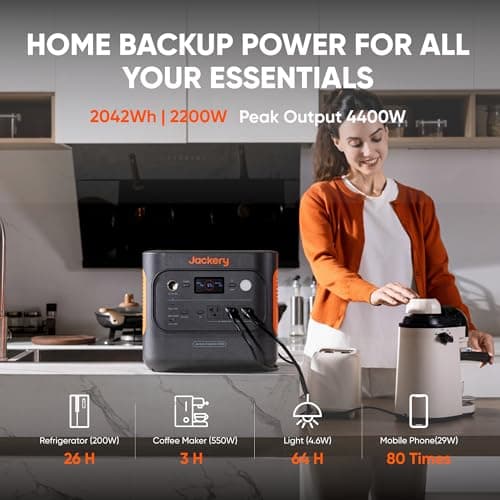
Best Solar Kit
Best Solar Generators for Home Backup
Battery-plus-panel kits ranked on solar input ceiling and capacity, with honest expectations for real-world panel output.
Top pick · Jackery Explorer 2000 v2 + 2x200W Solar
$1,329.00View on Amazon19% off
Battery vs Engine
Portable Power Station vs Generator
Battery against generator on surge capability, runtime, placement and cost, with the two facts that decide it.

Guide
How to Recharge a Power Station in an Outage
The four recharge routes during an outage, with published charge speeds and the realistic limits of each.
Guide
Hurricane Season Power Preparation
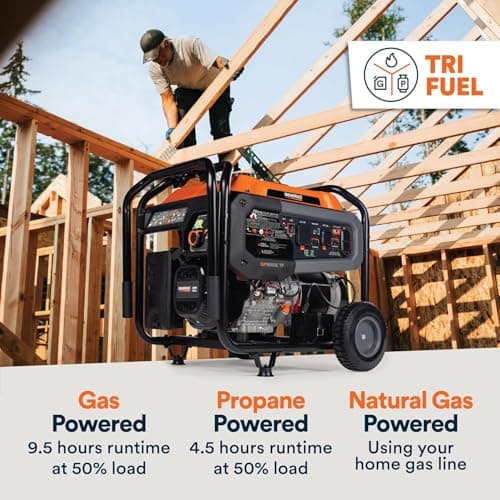
Preparing for long outages: the fuel logistics problem, why natural gas or propane wins, and a week-before checklist.
Comparison
Power Station vs Generator: Total Cost
Five-year ownership cost compared between a battery and a generator, including the connection and maintenance lines.