Generators
Best Portable Generator for a Refrigerator
The surge rating decides this, not the running rating. And for this load specifically, a battery usually wins.
Written byMike M.
Published
Disclosure: we earn a commission on purchases made through links on this page, at no cost to you. It does not affect what we recommend or what we say about it — how we are funded.
The short answer
A refrigerator needs about 700 running watts and 2,200 additional watts to start its compressor, per EWEB's published chart. The surge is the binding constraint: any generator with 3,500 running watts and a 4,500 watt peak starts it easily, which makes the Champion 4,500 W inverter the pick — quiet, clean power, under 3% THD and a published 14 hour runtime. For this load specifically, however, a battery power station is usually the better purchase, because it runs indoors and silently.
We are going to make the case against our own category first, because on this one load it is the honest answer.
Why a battery beats a generator for a fridge
- It runs indoors. No carbon monoxide risk, no 20-foot placement rule, no cord through a window.
- It is silent. The fridge needs covering at 3am as much as at 3pm.
- No fuel. Nothing stored in the garage, nothing to go stale, no refueling a hot engine in a storm.
- UPS switchover. Units transferring in under 10 ms mean the compressor never stops and never has to restart — the surge problem disappears entirely.
A 2 kWh battery carries a modern refrigerator for roughly 30-40 hours on our arithmetic. If your outages are measured in hours, that is simply the better machine. See best power station for a refrigerator.
When a generator is right anyway
Two cases. If your outages run for days, a battery empties and a generator does not. And if you also want a furnace blower, a well pump or a sump pump covered, you are buying a generator regardless and the fridge comes along nearly free.
The short answer
Quick picks
| # | Product | Best for | Score | Price |
|---|---|---|---|---|
| 1 | 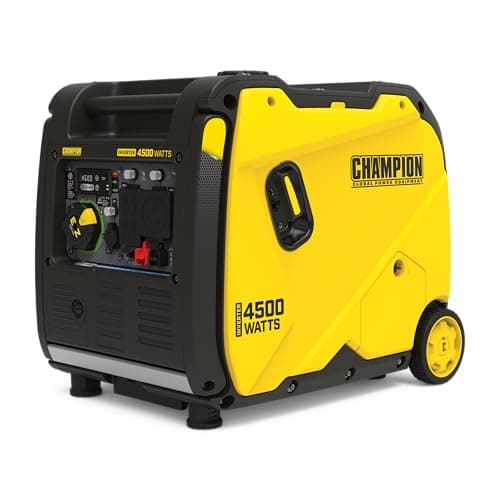 Champion 4,500W RV Ready Inverter The best balance of quiet, clean power and real output for cord-based backup: enough for the essentials, under 3% THD, half the price of the Honda equivalent. | Quiet backup at a sane price | 8.5/10 | $674.10 |
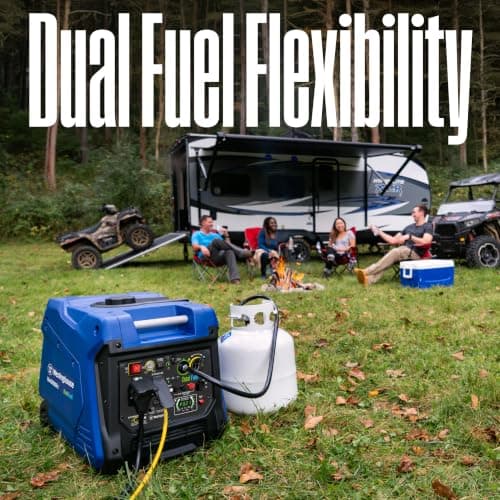
| 2 | 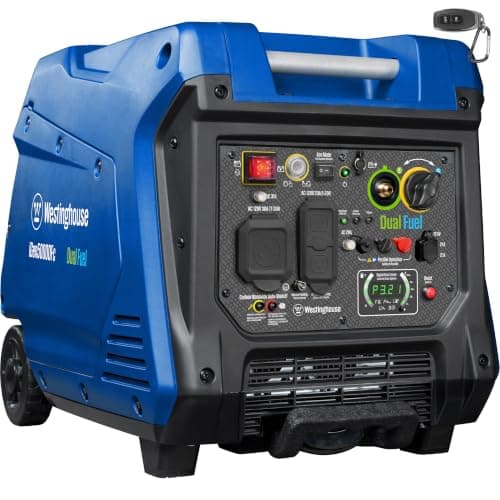 Westinghouse iGen5000DFc 5,000W Dual Fuel Inverter The quietest way to get around 4,000 running watts on either fuel, provided you are running cords rather than a transfer switch. | Quietest dual fuel at 4,000 running watts | 8.6/10 | $999.00 |
| 3 | 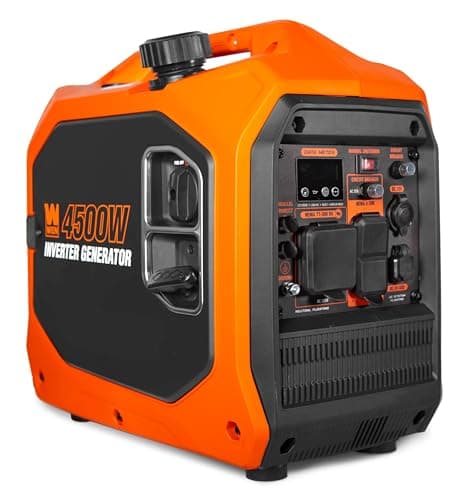 WEN 56432i 4,500W Inverter The cheapest honest route to 3,600 watts of clean power at a weight one person can move — accepting no CO shutoff and pull-start only. | Cheapest clean 3,600 running watts | 7.7/10 | $471.74 |
| 4 | 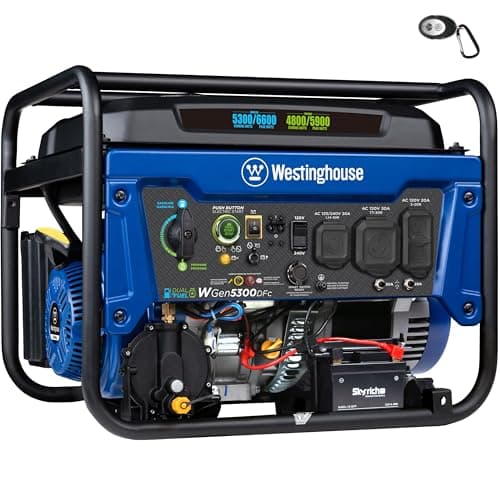 Westinghouse WGen5300DFc 6,600W Dual Fuel The right generator for a house without a well pump or central air: light enough to actually move, with CO shutoff and remote start included. | Light essential circuits, easy to move | 8.2/10 | $649.00 |
| 5 | 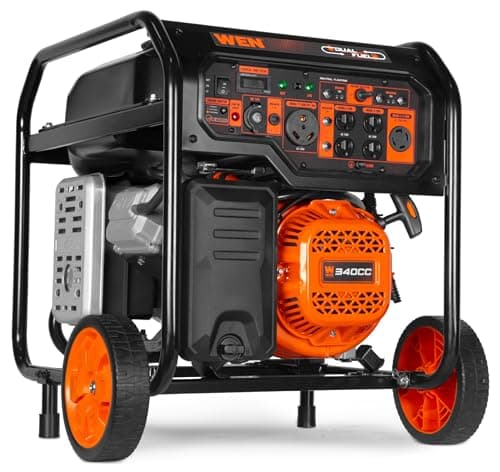 WEN DF8000X 8,000W Dual Fuel The best-value correctly-sized home backup generator here: enough for every essential circuit, dual fuel, CO shutoff, a real transfer-switch outlet, and no money spent on capacity you will not use. | Essential circuits, dual fuel, lowest cost | 8.5/10 | $623.17 |
| 6 | 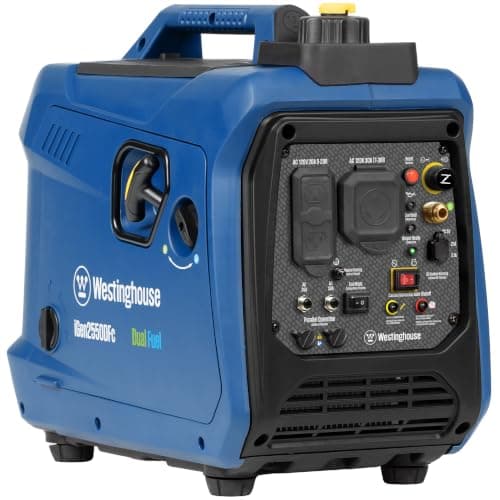 Westinghouse iGen2550DFc 2,550W Dual Fuel Inverter The right small dual fuel inverter if you have a genuinely safe outdoor place to run it — and for most apartment dwellers, a battery power station is the better answer. | Apartments and balconies | 8.0/10 | $529.00 |
#ad Prices as of October 5, 2026; they may have changed since. Scores are our editorial judgment from published specifications, not test results — how we pick. How we are funded.
What the generator actually has to do
The refrigerator's demand, published
- Running watts
- 700 W (EWEB) / 400 W (Champion)
- Additional starting watts
- 2,200 W (both charts)
- Minimum generator running
- ~900 W after derating
- Minimum generator peak
- ~2,900 W
The surge is three times the running load, which is why peak rating decides this rather than running rating. Both published charts agree on the 2,200 watt figure.
Why the Champion 4,500 W inverter wins among generators
3,500 running watts and 4,500 starting watts means the fridge's surge is a non-event even with other things running. Champion publishes 61 dBA and a 14 hour runtime, and under 3% THD, which matters if the fridge shares a cord with anything electronic. It also has an Intelligauge power meter so you can see the load.
Its limitation is the one shared across most of its class: no 240 V output, so no transfer switch and no hard-wired loads. For a fridge on a cord that is irrelevant. For a longer list of loads, look at the dual fuel machines lower down.
- Running watts
- 3,500 W
- Noise
- 61 dBA (mfr)
- Runtime
- Up to 14 h (mfr)
#1 · Quiet backup at a sane price
Champion 4,500W RV Ready Inverter
The best balance of quiet, clean power and real output for cord-based backup: enough for the essentials, under 3% THD, half the price of the Honda equivalent.
#ad Price as of October 5, 2026; it may have changed since. How we are funded.
What is good
- 3,500 running watts of clean power is enough for a fridge, furnace blower, lights and electronics — a real essential-circuit load, quietly
- 14-hour runtime is excellent for an inverter this size
- Parallel capability means you can double output later rather than replacing the unit
What is not
- No 240V output, so no transfer switch and no well pump
- 61 dBA is noticeably louder than the Honda units, though far quieter than an open-frame machine
- 92 lb is heavy for something you cannot connect to a panel
Published specification & our scoring
- 4,500 starting / 3,500 running watts (manufacturer)
- 61 dBA, up to 14 hours runtime (manufacturer)
- Under 3% THD — safe for sensitive electronics (manufacturer)
- CO Shield carbon monoxide auto shutoff
- 120V 29.2A RV outlet plus a 120V 20A household duplex
- Parallel ready with another 2,800W-or-higher Champion inverter
- Intelligauge with power meter; published weight 92.2 lb
- Noise
- 8
- Power quality
- 9
- Output
- 7
- Runtime
- 9
- Safety features
- 9
- Value
- 9
Specification figures are the manufacturer’s published values. Scores are our editorial judgment from those figures and are never published as structured review data — how we pick.
- Output
- 5,000 W peak gas
- Noise
- As low as 52 dBA (mfr)
- Fuel
- Gas / propane
#2 · Quietest dual fuel at 4,000 running watts
Westinghouse iGen5000DFc 5,000W Dual Fuel Inverter
The quietest way to get around 4,000 running watts on either fuel, provided you are running cords rather than a transfer switch.
#ad Price as of October 5, 2026; it may have changed since. How we are funded.
What is good
- 52 dBA at 5,000 peak watts is the best noise-per-watt figure of any dual fuel machine here
- Dual fuel plus remote start plus CO sensor at a mid-range price
- The double-insulated cover is also weather protection the open-frame machines do not have
What is not
- No 240V outlet, so still no transfer switch
- 106 lb and enclosed — awkward to carry despite the telescoping handle
- The 52 dBA figure is at low load; it climbs as you load it
Published specification & our scoring
- 5,000 peak watts on gasoline (manufacturer)
- As low as 52 dBA with a double-insulated cover, muffler and variable-speed engine (manufacturer)
- Manufacturer states inverter technology cuts fuel use up to 50% versus a conventional generator
- 224cc Westinghouse 4-stroke OHV engine
- RV-ready TT-30R 30A, 5-20R 120V 20A duplex, two USB
- Remote electric start, CO sensor; parallel capable
- Published weight 105.8 lb
- Noise
- 10
- Power quality
- 9
- Fuel flexibility
- 9
- Output
- 7
- Safety features
- 9
- Value
- 8
Specification figures are the manufacturer’s published values. Scores are our editorial judgment from those figures and are never published as structured review data — how we pick.
- Running watts
- 3,600 W
- Peak watts
- 4,500 W
- Weight
- 53 lb
#3 · Cheapest clean 3,600 running watts
WEN 56432i 4,500W Inverter
The cheapest honest route to 3,600 watts of clean power at a weight one person can move — accepting no CO shutoff and pull-start only.
#ad Price as of October 5, 2026; it may have changed since. How we are funded.
What is good
- 3,600 rated watts at 53 lb is the best output-to-weight ratio in this roundup
- The fuel shutoff feature genuinely extends life on a machine that sits unused for months
- Costs a fraction of the Honda and Champion equivalents
What is not
- No CO shutdown on this model
- No electric start, no remote start
- WEN publishes no dBA figure for this unit despite marketing it as quiet
Published specification & our scoring
- 181cc engine, 4,500 surge / 3,600 rated watts (manufacturer)
- Clean power to prevent damage to sensitive electronics (manufacturer)
- Two 120V three-prong receptacles, one TT-30R RV receptacle, one 12V DC, two USB
- Intelligent data meter
- Fuel shutoff to clear the carburetor before storage
- Published weight 53 lb; three-year warranty
- Output headroom
- 7
- Power quality
- 8
- Portability
- 10
- Safety features
- 4
- Runtime
- 7
- Value
- 10
Specification figures are the manufacturer’s published values. Scores are our editorial judgment from those figures and are never published as structured review data — how we pick.
- Running watts
- 5,300 W gas / 4,800 W LP
- Starting watts
- 6,600 W gas
- Weight
- 136 lb
#4 · Light essential circuits, easy to move
Westinghouse WGen5300DFc 6,600W Dual Fuel
The right generator for a house without a well pump or central air: light enough to actually move, with CO shutoff and remote start included.
#ad Price as of October 5, 2026; it may have changed since. How we are funded.
What is good
- 136 lb is genuinely one-person movable on a flat driveway, which changes how practical a generator is
- CO shutdown, remote start and a propane hose all included at the bottom of the dual-fuel range
- 5,300 running watts covers a fridge, furnace blower, sump pump and lighting with headroom
What is not
- Not enough for a well pump plus a furnace plus a fridge simultaneously — run the sizing math first
- 4.7-gallon tank means more refueling than the big machines
- No 50A outlet, so a 50A transfer switch is out
Published specification & our scoring
- Gasoline: 6,600 peak / 5,300 running watts (manufacturer)
- Propane: 5,900 peak / 4,800 running watts (manufacturer)
- 274cc Westinghouse 4-stroke OHV engine, cast-iron sleeve
- Automatic low-oil AND carbon monoxide shutdown
- Push-button electric start with remote key fob
- 4.7-gallon tank; one 5-20R duplex, one TT-30R RV, one L14-30R transfer-switch ready
- Propane hose included; published weight 135.6 lb
- Output headroom
- 6
- Fuel flexibility
- 9
- Transfer-switch fit
- 8
- Portability
- 9
- Safety features
- 9
- Value
- 9
Specification figures are the manufacturer’s published values. Scores are our editorial judgment from those figures and are never published as structured review data — how we pick.
- Running watts
- 6,500 W gas / 5,850 W LP
- Starting watts
- 8,000 W gas
- CO shutdown
- Watchdog
#5 · Essential circuits, dual fuel, lowest cost
WEN DF8000X 8,000W Dual Fuel
The best-value correctly-sized home backup generator here: enough for every essential circuit, dual fuel, CO shutoff, a real transfer-switch outlet, and no money spent on capacity you will not use.
#ad Price as of October 5, 2026; it may have changed since. How we are funded.
What is good
- 6,500 running watts with CO shutdown, dual fuel and a proper L14-30R, for the price of a gasoline-only machine
- 10.5 hours at half load is better runtime than WEN's larger DF1100T
- The TT-30R makes it an RV generator as well, which widens its usefulness between outages
What is not
- 6,500 running watts rules out central air
- 340cc working near its rating will be audible — WEN does not publish a dB figure for this model
- No remote start
Published specification & our scoring
- Gasoline: 8,000 surge / 6,500 rated watts (manufacturer)
- Propane: 7,200 surge / 5,850 rated watts (manufacturer)
- 340cc engine, electric start
- WEN Watchdog CO shutdown sensor
- 6.7-gallon tank, up to 10.5 hours at half load (manufacturer)
- Wheel kit included; four 120V 5-20R, one TT-30R RV outlet, one L14-30R transfer-switch-ready twist-lock
- Output headroom
- 7
- Fuel flexibility
- 9
- Transfer-switch fit
- 9
- Runtime
- 9
- Safety features
- 8
- Value
- 10
Specification figures are the manufacturer’s published values. Scores are our editorial judgment from those figures and are never published as structured review data — how we pick.
- Running watts
- 1,900 W
- Noise
- As low as 52 dBA (mfr)
- Weight
- 42 lb
#6 · Apartments and balconies
Westinghouse iGen2550DFc 2,550W Dual Fuel Inverter
The right small dual fuel inverter if you have a genuinely safe outdoor place to run it — and for most apartment dwellers, a battery power station is the better answer.
#ad Price as of October 5, 2026; it may have changed since. How we are funded.
What is good
- 42 lb, 52 dBA, dual fuel and a CO sensor — the most complete small inverter package here
- 1,900 running watts runs a fridge and a few lights, which is the realistic apartment-scale plan
- Propane means no gasoline stored in a small living space
What is not
- 1,900 running watts is not a house — set expectations accordingly
- Still a combustion engine: it must run outdoors, well away from windows, which is exactly what makes apartment use hard
- Many apartment leases and local rules prohibit running a generator on a balcony — check before buying
Published specification & our scoring
- 2,550 peak / 1,900 rated watts at under 3% THD (manufacturer)
- As low as 52 dBA; up to 11 hours on a 1.16-gallon tank at 25% load (manufacturer)
- Dual fuel: gasoline or propane
- CO sensor with automatic shutdown
- One RV-ready TT-30R, two 120V 20A outlets
- Parallel capable; published weight 42 lb (manufacturer states 43.2 lb shipping)
- Noise
- 10
- Power quality
- 9
- Portability
- 10
- Fuel flexibility
- 9
- Output
- 4
- Value
- 8
Specification figures are the manufacturer’s published values. Scores are our editorial judgment from those figures and are never published as structured review data — how we pick.
Questions people actually ask
What size generator do I need to run a refrigerator?
About 900 running watts after derating, with at least 2,900 peak watts to cover the compressor's 2,200 watt start-up surge. The peak figure is what decides it — a 2,000 running-watt machine with only a 2,500 watt peak is marginal.
Will a 2000 watt generator run a refrigerator?
Only if its peak rating exceeds the fridge's 2,200 watt surge, and many 2,000 watt machines do not — Westinghouse's iGen1500c publishes only 1,500 peak watts. Check the peak figure and your fridge's nameplate before relying on it.
Is a generator or a battery better for a refrigerator?
For a fridge specifically, a battery, in most cases: it runs indoors, makes no noise, needs no fuel, and units with UPS switchover mean the compressor never stops at all. A generator wins for multi-day outages or when you also need a well pump or furnace covered.
Can I run a fridge on a generator with an extension cord?
Yes — a refrigerator is a plug-in appliance so no electrician is needed. The constraint is placement: the generator must still be at least 20 feet from the house per CPSC guidance, so you need a cord long enough to manage that.
Does a generator damage a refrigerator?
A correctly sized generator does not. Risks come from undersizing — a sagging voltage while the compressor tries to start is what overheats motor windings — and from high total harmonic distortion on sensitive electronics. An inverter generator publishing under 3% THD removes both concerns.
Sources
- Eugene Water & Electric Board — Generator Sizing ConsiderationsPublished appliance running and additional-starting watt figures used in the sizing arithmetic on this page.
- US Consumer Product Safety Commission — Portable Generator Information CenterThe placement and carbon monoxide guidance every generator page on this site links to.
Read next
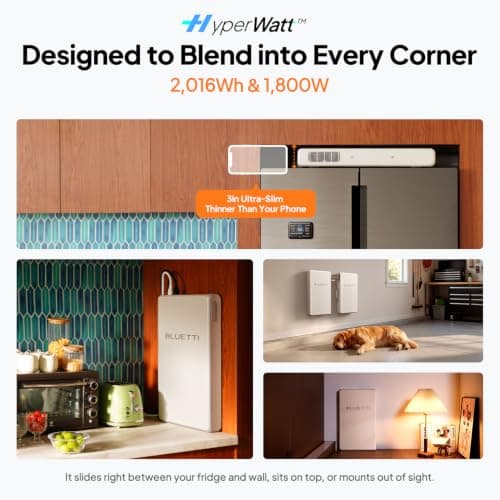
Best for a Refrigerator
Best Power Station for a Refrigerator
Power stations that reliably start a fridge compressor, ranked on surge, idle draw and UPS switchover.
Top pick · Bluetti FridgePower
$899.00View on Amazon40% off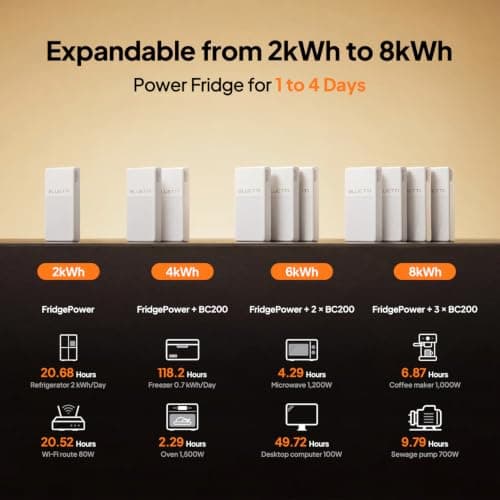
Guide
Keep Your Refrigerator Running Through an Outage
The free measures first, then battery and generator options for a refrigerator, with published wattage and food-safety figures.

Guide
Generator Size for a Refrigerator and Deep Freezer
Sizing for a fridge plus a chest freezer, including why only one surge counts and when a battery beats a generator.
Best Quiet Inverter
Best Quiet Inverter Generators for Home Backup
Inverter generators ranked on published noise and THD figures, with the brands that publish no measurable claim named.
Top pick · Westinghouse iGen5000DFc 5,000W Dual Fuel Inverter
$999.00View on Amazon23% off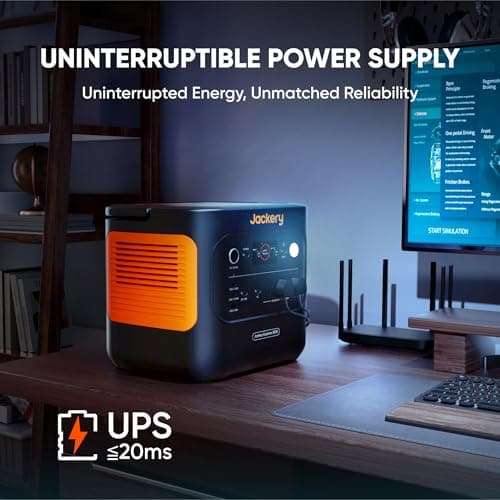
Battery vs Engine
Portable Power Station vs Generator
Battery against generator on surge capability, runtime, placement and cost, with the two facts that decide it.