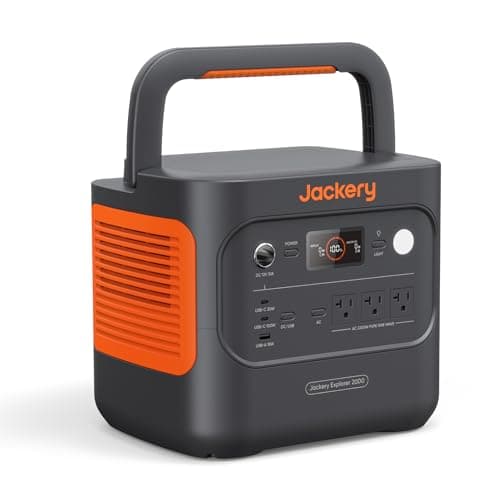
Battery power station
- Best for
- Short outages, small loads, apartments
- Cannot do
- Motor loads, 240 V, multi-day outages
Our pick · Jackery Explorer 2000 v2
$898.99View on Amazon10% offPillar
Five genuinely different ways to keep a house running when the grid stops. Which one is right is decided by two facts about your house, not by budget.
Disclosure: we earn a commission on purchases made through links on this page, at no cost to you. It does not affect what we recommend or what we say about it — how we are funded.
The short answer
Because a 2 kWh battery and a 9,500 running-watt dual fuel generator cost roughly the same, and they are not competing products. The generator has about four times the output and runs for days. The battery runs indoors, silently, with no installation and no maintenance. Neither is better value in the abstract.
What settles it is whether you have a load a battery cannot start, and whether your outages outlast a fixed quantity of energy. Using the published figures our wattage chart cites: a 1/3 HP well pump needs 2,000 additional watts to start, and portable battery output ceilings are 1,500 to 2,400 watts. That is not a close call.
The options
Our pick · Jackery Explorer 2000 v2
$898.99View on Amazon10% off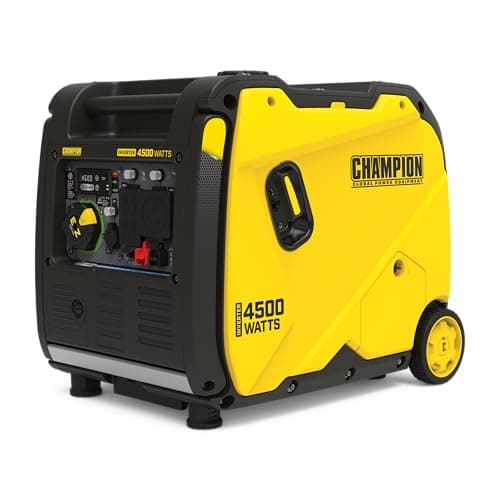
Our pick · Champion 4,500W RV Ready Inverter
$674.10View on Amazon10% off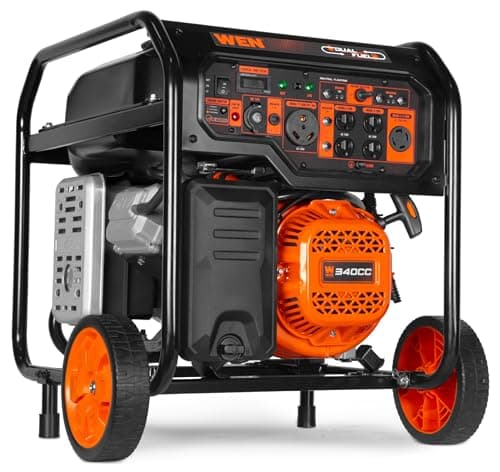
Our pick · WEN DF8000X 8,000W Dual Fuel
$623.17View on Amazon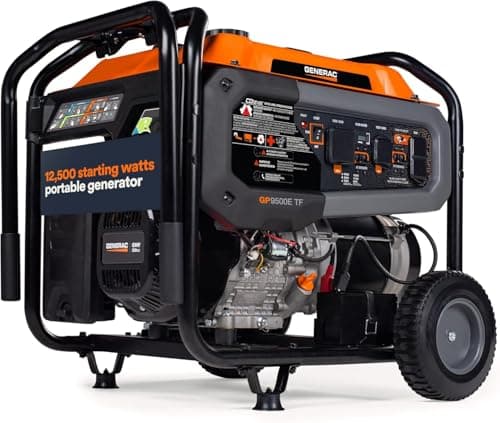
Our pick · Generac 12,500W Starting Tri-Fuel
$920.00View on Amazon21% offEverything above requires someone to start it. A standby generator does not — it is plumbed to natural gas or propane, monitors the utility, and starts itself when the power fails. Generac’s automatic transfer switch, which a standby system uses, publishes continuous utility monitoring with automatic transfer of the entire 200 amp load.
It costs a great deal more, installed, and the honest question that decides it is simple: does anyone need to be home for your backup power to work? If no — medical equipment, a sump pump in a storm, a property you are not always at — then automation is the feature you are buying and nothing portable provides it. Worked through in portable vs standby.
The five options, ranked by what they remove from your plan
Each step up removes one more thing you would otherwise have to manage, and costs more. Which removal is worth paying for depends entirely on your house.
A modest generator and a modest battery. The generator runs by day, covering the motor loads and recharging the battery at full speed — several units publish 0-80% in 43 to 49 minutes. At night the generator is off, so no noise and no carbon monoxide risk, and the battery runs the fridge and electronics silently indoors.
That solves the generator’s worst problem and the battery’s worst problem at once, and it lets you buy a smaller machine of each. It is underused and it is frequently the best total answer.
Five genuinely different ones: a battery power station, a quiet inverter generator, a dual fuel generator, a tri-fuel generator on a natural gas line, and a permanently installed standby generator. Each removes one more thing you would otherwise have to manage, and costs more.
Cords from a modest generator or battery to plug-in appliances — a refrigerator, lamps, a modem, a plug-in heater. It needs no electrician and no permit. What it cannot reach is anything hard-wired, which is why transfer switches exist.
A battery if your loads are small, your outages are short, and you need to run indoors or quietly. A generator if you have a motor load a battery cannot start — a 1/3 HP well pump needs 2,000 additional watts on published figures, against battery ceilings of 1,500-2,400 watts.
If nobody can be relied on to be home when an outage happens, yes — automatic operation is the feature you are buying and nothing portable provides it. Otherwise a correctly sized portable with a transfer switch does the same job for a fraction of the cost.
Yes, and it is frequently the best total answer. The generator runs by day covering motor loads and recharging the battery; the battery runs the fridge silently indoors overnight. You can buy a smaller machine of each than you otherwise would.
A battery-powered carbon monoxide alarm, before any power equipment. It costs about twenty dollars, it works during the outage when a plug-in alarm does not, and it addresses the way generators actually kill people.