Outage Prep
How Long Does Food Last in a Power Outage?
Published federal guidance, the temperature rule that decides everything, and the free preparation that buys you more time.
Written byMike M.
Published
Disclosure: we earn a commission on purchases made through links on this page, at no cost to you. It does not affect what we recommend or what we say about it — how we are funded.
The short answer
| Appliance | Safe for | Condition |
|---|---|---|
| Refrigerator | About 4 hours | Door kept closed |
| Freezer, full | About 48 hours | Door kept closed |
| Freezer, half full | About 24 hours | Door kept closed |
FoodSafety.gov published guidance. Food is safe below 40 F; discard refrigerated food held above 40 F for more than 2 hours.
Those three numbers are the whole answer, and they are worth knowing before you spend anything on backup power, because they tell you whether you have a problem.
Why a full freezer lasts twelve times longer than a fridge
Thermal mass. A full freezer is a solid block of frozen material at 0 F, and it takes an enormous amount of heat to warm that to 40 F. A refrigerator is mostly air and a few bottles, so it warms quickly.
The practical consequence is the single best free trick in outage preparation: keep your freezer full. If it is half empty, fill the space with sealed jugs of water and freeze them. That turns a 24-hour freezer into a 48-hour one, gives you frozen blocks to move into the refrigerator compartment, and leaves you with drinking water when they melt.
The rule that decides keep or throw
40 F. FoodSafety.gov's guidance is to discard refrigerated perishables — meat, poultry, fish, eggs, dairy, cut fruit, leftovers — held above 40 F for more than two hours. Judging by smell or appearance is not reliable, because the bacteria that make food unsafe do not necessarily change how it looks or smells.
For frozen food the test is different and more generous: anything still containing ice crystals, or at 40 F or below, can be safely refrozen. The quality may suffer; the safety does not.
A realistic timeline
What to do, when
- 0-1 hour
- Doors shut. Nothing else needed.
- 1-4 hours
- Still safe. Decide if backup is needed.
- 4+ hours
- Fridge at risk. Move items to freezer.
- 24 hours
- Half-full freezer at risk. Add ice.
- 48 hours
- Full freezer at risk. Backup or dry ice.
Based on FoodSafety.gov's published timings. Every one of them assumes the doors stay closed, which is the variable you control.
What this timeline shows is that the first four hours need no equipment at all, and the first 48 need none if your freezer is full. If your outages fit inside that, the honest answer is that you do not have a food problem and should spend your money on heat, water or a carbon monoxide alarm instead.
If your outages run longer than that
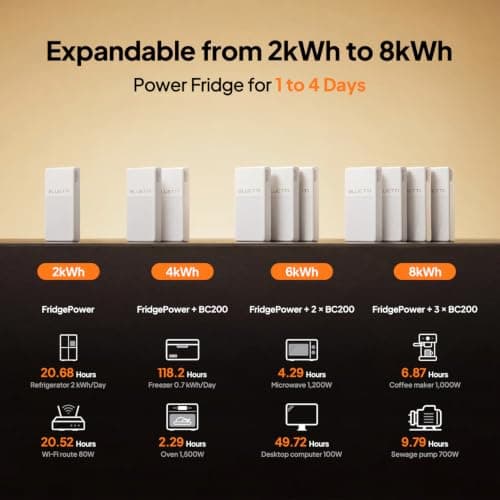
Then a battery power station is the proportionate answer: it runs indoors, silently, needs no fuel, and a 2 kWh unit carries a refrigerator for well over a day on our arithmetic. Anker's SOLIX S2000 publishes a particularly relevant specification for this use — a 6 watt idle draw and a manufacturer claim of up to 35 hours of fridge backup, which is the longest claim of any 2 kWh unit we list.
The short answer
Batteries built for long fridge runtime
| # | Product | Best for | Score | Price |
|---|---|---|---|---|
| 1 | 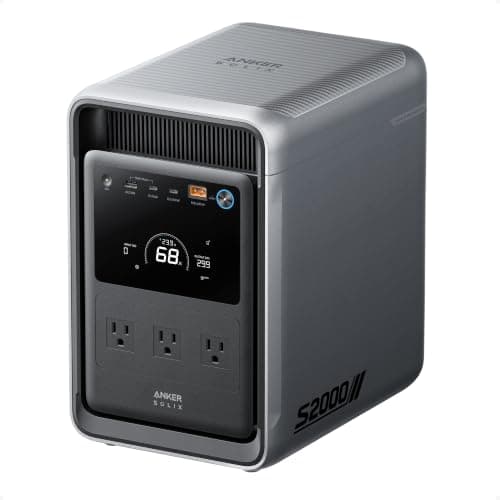 Anker SOLIX S2000 The endurance choice: the lowest idle draw and the longest cycle life here, with an output ceiling deliberately traded away to get them. | Longest fridge runtime per watt-hour | 8.7/10 | $679.99 |
| 2 | 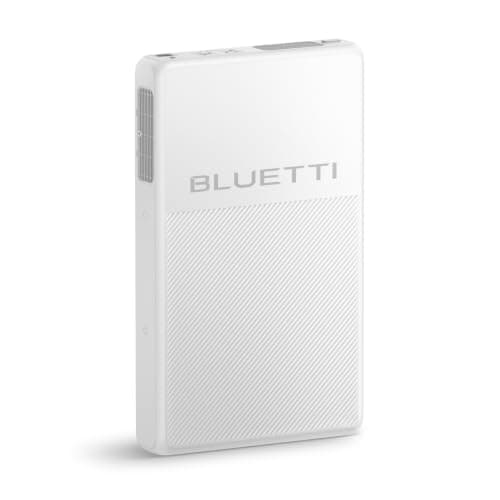 Bluetti FridgePower If the problem you are solving is specifically the refrigerator, this is the unit designed for that problem — the 4 W standby and storm auto-charge are genuine engineering answers to it. | Purpose-built refrigerator backup | 9.0/10 | $899.00 |
| 3 | 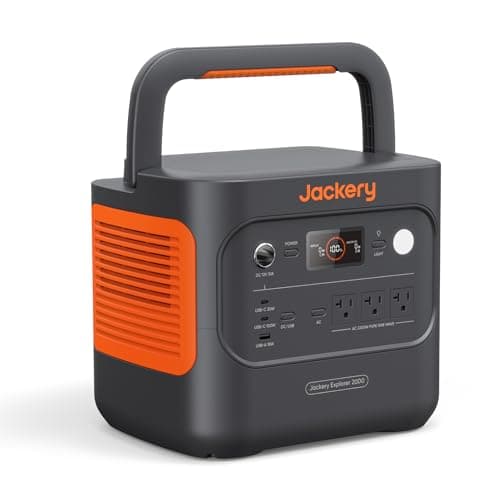 Jackery Explorer 2000 v2 The most sensible battery backup for most homes: enough capacity to carry a fridge and electronics through a typical outage, indoors, silently. | The default 2 kWh home backup battery | 8.9/10 | $898.99 |
#ad Prices as of October 5, 2026; they may have changed since. Scores are our editorial judgment from published specifications, not test results — how we pick. How we are funded.
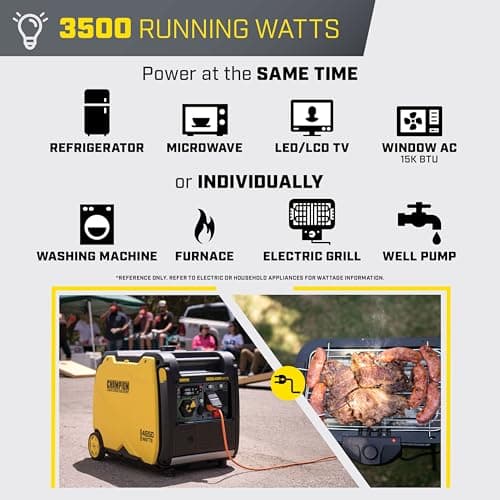
For multi-day outages a generator is the answer, because it runs as long as it has fuel. But note that the food problem specifically is a battery-shaped problem — small load, long duration — and a generator bought for food alone is usually more machine than the job needs.
Questions people actually ask
How long will a freezer stay cold without power?
About 48 hours if it is full and the door stays closed, or about 24 hours if it is half full, per FoodSafety.gov. Filling empty space with sealed frozen water jugs is the cheapest way to move from the 24-hour figure to the 48-hour one.
Is food safe after 6 hours without power?
Refrigerated perishables held above 40 F for more than two hours should be discarded, so after six hours a refrigerator's contents are likely unsafe unless it stayed cold. Frozen food is almost certainly still fine at six hours. The test is temperature, not time alone.
Can I refreeze food that thawed in an outage?
Yes, if it still contains ice crystals or is at 40 F or below, per FoodSafety.gov. Quality may be reduced but safety is not. Food that thawed completely and warmed above 40 F for more than two hours should be discarded.
Should I open the fridge during a power outage?
As little as possible — every opening exchanges cold air for warm and shortens the clock materially. Decide what you need before you open it, and if the outage looks long, move refrigerated items into the freezer in one trip rather than several.
Does dry ice help in a power outage?
Yes, and it is the standard answer for a freezer past the 48-hour mark. Handle it with gloves, never in a sealed space or an enclosed vehicle cabin, and allow for ventilation since it sublimates to carbon dioxide gas.
Sources
- FoodSafety.gov — food safety during a power outageThe 4-hour refrigerator and 48-hour full-freezer guidance, and the 40 F / 140 F safe-temperature thresholds.
- Ready.gov — Power OutagesFederal preparedness guidance on outage planning referenced in the checklist sections.
Read next
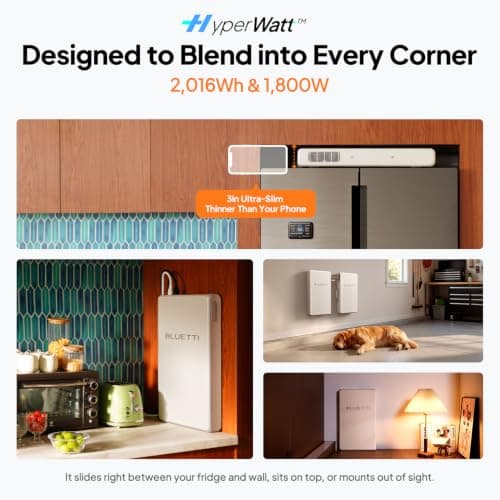
Guide
Keep Your Refrigerator Running Through an Outage
The free measures first, then battery and generator options for a refrigerator, with published wattage and food-safety figures.
Best for a Refrigerator
Best Power Station for a Refrigerator
Power stations that reliably start a fridge compressor, ranked on surge, idle draw and UPS switchover.
Top pick · Bluetti FridgePower
$899.00View on Amazon40% off
Guide
How Long Will a Power Station Run a Fridge?
The runtime calculation shown in full, the manufacturer claims, and why a cycling fridge lasts far longer than its running watts suggest.
Guide
Winter Storm Power Outage Checklist
Before-the-storm and during-the-storm checklists for a winter outage, with the pipe-freeze risk front and center.
Guide
Generator Size for a Refrigerator and Deep Freezer
Sizing for a fridge plus a chest freezer, including why only one surge counts and when a battery beats a generator.