Model Reviews
Westinghouse iGen5000DFc Review
The best noise-per-watt figure of any dual fuel generator here. And still no 240 volt outlet.
Written byMike M.
Published
Disclosure: we earn a commission on purchases made through links on this page, at no cost to you. It does not affect what we recommend or what we say about it — how we are funded.
The short answer
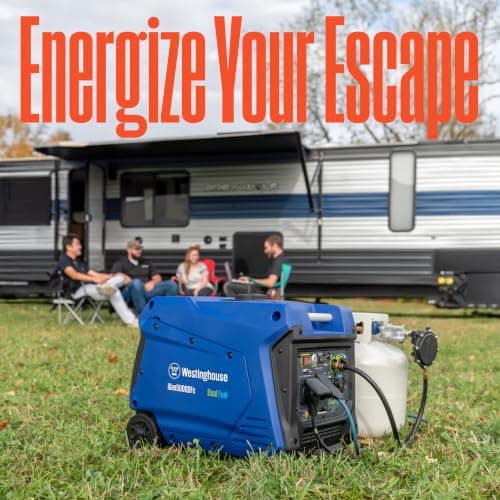
Westinghouse publishes 5,000 peak watts on gasoline, operation as low as 52 dBA from a double-insulated cover and variable-speed engine, dual fuel operation, remote key-fob electric start, a CO sensor, a 224cc OHV engine and 105.8 lb. It also states inverter technology cuts fuel use up to 50% versus a conventional generator. There is no 240 volt output, so no transfer switch and nothing hard-wired.
Published specification
- Peak watts, gasoline
- 5,000 W
- Noise
- As low as 52 dBA
- Fuel
- Gasoline or propane
- Engine
- 224cc 4-stroke OHV
- Start
- Remote key fob + electric
- Outlets
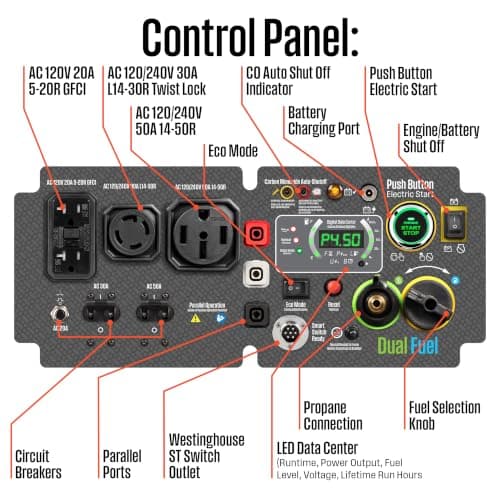
- TT-30R RV, 5-20R duplex, 2 USB
- 240 V output
- None
- CO sensor
- Yes
- Weight
- 105.8 lb
- Parallel capable
- Yes, with a second iGen5000DFc
Manufacturer published figures. Westinghouse publishes 'as low as' noise figures without a measurement distance, which makes them not strictly comparable to Champion's stated-distance ratings.
Why 52 dBA at 5,000 peak watts is the headline
This is the best noise-per-watt figure of any dual fuel machine in this registry. Honda's EU2200i is quieter at 48-57 dB(A) and delivers under half the output with no propane option; Champion's 4,500 W publishes 61 dBA.
Westinghouse attributes it to a double-insulated cover, a muffler and a variable-speed engine. That cover has a second benefit nobody markets: it is weather protection as well as acoustic, which matters on a machine that must run outdoors in the storm that caused the outage.
The honest caveat on any "as low as" figure: an inverter generator's mechanism is varying engine speed with load, so 52 dBA is a light-load number and it rises as you load the machine. Nobody publishes a full-load rating. See how quiet is a quiet generator.
Dual fuel on a quiet machine is the real combination
Propane in a sealed tank does not degrade, while gasoline with ethanol deteriorates within months — and a gummed carburetor is the most common reason a stored generator will not start. On a backup machine that runs perhaps ten hours a year, that is the dominant real-world failure mode.
Getting that and 52 dBA and remote start and a CO sensor at this price is what makes this our top quiet-generator pick. Most machines offer two of the four.
Westinghouse does not publish a propane running-watt figure for this model, which is a gap — its conventional machines all do. Expect roughly 10% below the gasoline figure, which is the consistent pattern across every manufacturer that publishes both.
What 5,000 peak watts actually covers
Using EWEB's published figures, a plug-in essential load — refrigerator 700 W, furnace blower 700 W, sump pump 800 W, lighting and devices 300 W — is 2,500 running watts with a 2,200 watt largest surge, so 4,700 starting watts.
That fits inside 5,000 peak watts, with the usual proviso that you start the fridge first while the machine is lightly loaded. So this covers a genuine essential-circuit list — quietly, on either fuel, for a long time.
The limitation
If you need 240 V and want to stay with an inverter, Westinghouse's own iGen12000DFc publishes 12,000 peak watts at 3% or less THD, as low as 64 dBA, dual fuel, and both an L14-30R and a 14-50R — both transfer-switch ready. It is the better machine for panel backup and costs appreciably more.
The ecoGen10000 is the value route to the same thing: 7,600 running watts at under 3% THD on an open frame with both 240 V outlets, 40 lb lighter, gasoline only and with no published noise figure.
The gasoline-only sibling, and why we rank it lower
The iGen5000c publishes 5,000 peak / 3,900 rated watts at under 3% THD, as low as 52 dBA, up to 18 hours on a 3.4 gallon tank with economy mode, and a rotating LED data center showing fuel level, output, remaining runtime, voltage and lifetime hours.
That 18-hour runtime and the live remaining-runtime display are genuinely excellent, and it publishes a rated-watt figure the DFc does not. But it is gasoline only, which for a stored machine is the weaker proposition. Buy the dual fuel version unless the price gap decides it.
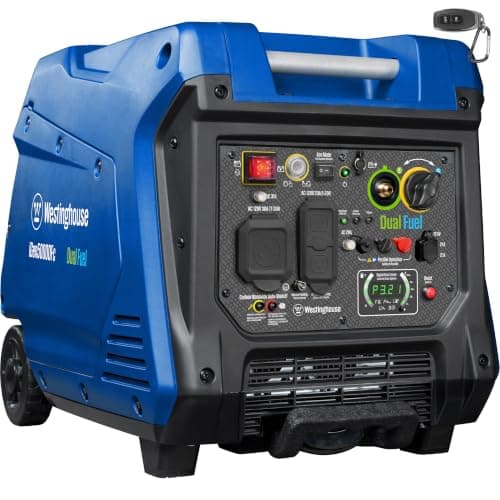
- Output
- 5,000 W peak gas
- Noise
- As low as 52 dBA (mfr)
- Fuel
- Gas / propane
#1 · Quietest dual fuel at 4,000 running watts
Westinghouse iGen5000DFc 5,000W Dual Fuel Inverter
The quietest way to get around 4,000 running watts on either fuel, provided you are running cords rather than a transfer switch.
#ad Price as of October 5, 2026; it may have changed since. How we are funded.
What is good
- 52 dBA at 5,000 peak watts is the best noise-per-watt figure of any dual fuel machine here
- Dual fuel plus remote start plus CO sensor at a mid-range price
- The double-insulated cover is also weather protection the open-frame machines do not have
What is not
- No 240V outlet, so still no transfer switch
- 106 lb and enclosed — awkward to carry despite the telescoping handle
- The 52 dBA figure is at low load; it climbs as you load it
Published specification & our scoring
- 5,000 peak watts on gasoline (manufacturer)
- As low as 52 dBA with a double-insulated cover, muffler and variable-speed engine (manufacturer)
- Manufacturer states inverter technology cuts fuel use up to 50% versus a conventional generator
- 224cc Westinghouse 4-stroke OHV engine
- RV-ready TT-30R 30A, 5-20R 120V 20A duplex, two USB
- Remote electric start, CO sensor; parallel capable
- Published weight 105.8 lb
- Noise
- 10
- Power quality
- 9
- Fuel flexibility
- 9
- Output
- 7
- Safety features
- 9
- Value
- 8
Specification figures are the manufacturer’s published values. Scores are our editorial judgment from those figures and are never published as structured review data — how we pick.
If you need 240 volts, or 18 hours
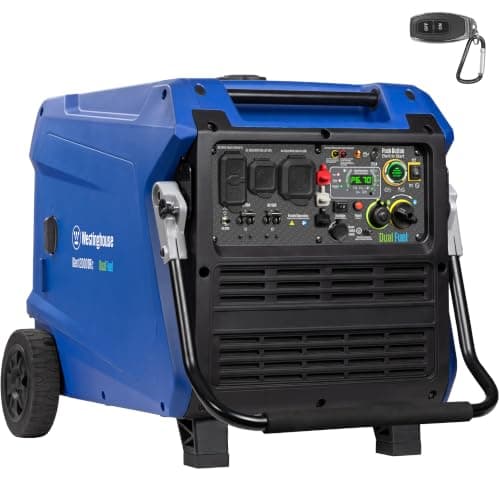
Whole-house backup with clean power
Westinghouse iGen12000DFc 12,000W Dual Fuel Inverter
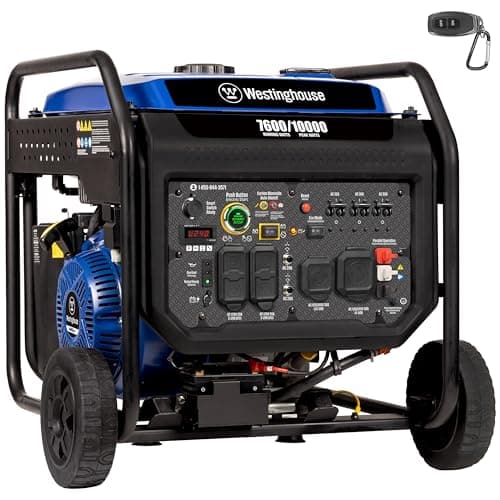
Clean power at 7,600 running watts
Westinghouse ecoGen10000 10,000W Open-Frame Inverter
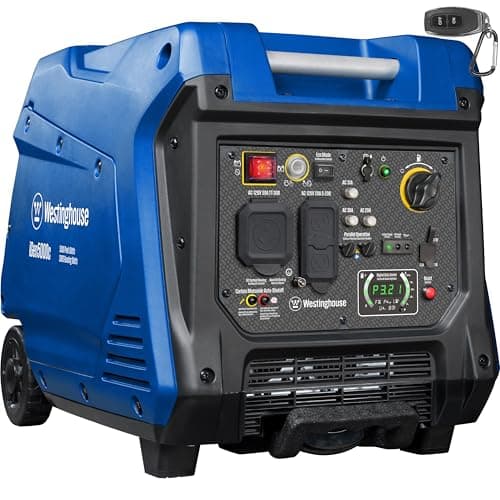
The iGen12000DFc is the whole-house inverter with both transfer-switch outlets. The ecoGen10000 is the value route to 240 V inverter power. The iGen5000c publishes 18 hours and a live runtime display, gasoline only.
Questions people actually ask
How quiet is the Westinghouse iGen5000DFc?
Westinghouse publishes as low as 52 dBA, attributed to a double-insulated cover, a muffler and a variable-speed engine. That is the best noise-per-watt figure of any dual fuel machine here. Note 'as low as' means at light load, and Westinghouse does not state a measurement distance.
Does the iGen5000DFc have a 240 volt outlet?
No. It has an RV-ready TT-30R, a 120V 5-20R duplex and two USB ports. That means no transfer switch, no interlock kit, no well pump and no hard-wired furnace. Check whether your furnace is plugged in or hard-wired before buying.
What will the iGen5000DFc run?
5,000 peak watts covers a plug-in essential load — refrigerator, furnace blower if it is plugged in, sump pump, lighting and devices, about 2,500 running watts on published figures — quietly and on either fuel. Not a well pump or anything hard-wired.
How much power does the iGen5000DFc make on propane?
Westinghouse does not publish a propane running figure for this model, which is a gap given its conventional machines all do. Expect roughly 10% below the gasoline figure, which is the consistent pattern across manufacturers that publish both.
iGen5000DFc or iGen5000c?
The DFc, in most cases, because propane stores indefinitely while gasoline degrades in months — the main failure mode of a stored generator. The gasoline-only iGen5000c's advantages are an 18 hour published runtime and a live remaining-runtime display.
Can I run two iGen5000DFc units in parallel?
Yes, Westinghouse publishes parallel capability with a second iGen5000DFc using its parallel kit, which doubles the available wattage. The combined output is still 120 volts, so it does not create a 240 volt supply for a transfer switch.
Sources
- Eugene Water & Electric Board — Generator Sizing ConsiderationsPublished appliance running and additional-starting watt figures used to judge what this machine's output actually covers.
- US Consumer Product Safety Commission — Portable Generator Information CenterThe placement and carbon monoxide guidance referenced in the safety notes on this page.
Read next
Best Quiet Inverter
Best Quiet Inverter Generators for Home Backup
Inverter generators ranked on published noise and THD figures, with the brands that publish no measurable claim named.
Top pick · Westinghouse iGen5000DFc 5,000W Dual Fuel Inverter
$999.00View on Amazon23% off
Guide
How Quiet Is a Quiet Generator?
Published decibel ratings side by side with their measurement conditions, and what a dB difference actually means.
Inverter vs Conventional
Inverter vs Conventional Generator
Inverter against conventional generators on published noise, THD, fuel economy and output per dollar.
Guide
Is a Dual Fuel Generator Worth It?
The real argument for dual fuel — fuel storage, not running cost — plus the honest case against it.
Review
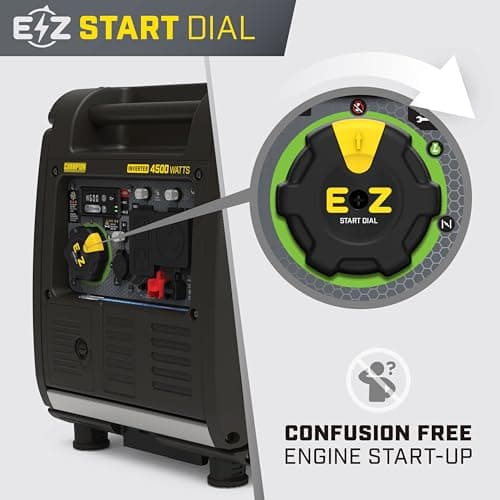
Champion 4,500W Inverter Review
Champion's 4,500W inverter read against real household loads, including the no-240V limitation.