Transfer Switches & Connection
Can You Use a Regular Extension Cord With a Generator?
For a lamp, yes. For your panel, no — and the difference is not about caution, it is about amps and volts.
Written byMike M.
Published
Disclosure: we earn a commission on purchases made through links on this page, at no cost to you. It does not affect what we recommend or what we say about it — how we are funded.
The short answer
For a single 120 volt plug-in appliance on a heavy-duty outdoor-rated cord of adequate gauge, yes — that is how most people run a refrigerator from a generator. For a 30 amp or 240 volt connection to your house, no: a household cord is 120 volts with far thinner conductors, and running 30 amps through one overheats the jacket. Use a purpose-made generator cord with the correct gauge and connector type.
When a regular cord is fine
Running one 120 volt appliance — a refrigerator, a lamp, a modem, a plug-in space heater — from a generator's household outlet. That is a legitimate and common use, and it needs no special hardware beyond a decent cord.
What "decent" means in practice:
- Outdoor rated, because it will lie on wet ground. A W in the jacket designation (SJTW, STW) indicates it.
- Heavy enough gauge for the load and the length. A 12 or 14 AWG cord is appropriate for appliance loads; a thin 16 AWG lamp cord is not.
- Three-conductor with a ground. Not a two-prong cord.
- Undamaged. No nicks, no cracked jacket, no missing ground pin.
A refrigerator at EWEB's published 700 running watts draws under 6 amps at 120 volts, which a 12 AWG outdoor cord handles comfortably. That is why the cord-to-the-fridge approach works.
When it absolutely is not fine
| Use | Household cord? | Why |
|---|---|---|
| One 120 V appliance | Yes, if heavy duty and outdoor rated | Load is within its rating |
| Several appliances via a strip | No | Combined load exceeds the cord |
| 30 A to a transfer switch | No | Wrong connector, wrong gauge, wrong voltage |
| 240 V well pump or furnace | No | Hard-wired, and 240 V needs two hot legs |
| Into a generator inlet box | No | Requires L14-30 or 50 A connectors |
The thing that actually catches people out
Daisy-chaining. Running one cord to a power strip and plugging four things into it. The individual appliances each seem modest and the combined load exceeds the cord, which is then heating up under a rug or behind furniture where nobody notices.
Using EWEB's published figures: a fridge at 700 W, a space heater at 1,500 W and a coffee maker at 1,000 W is 3,200 watts, which is over 26 amps at 120 volts — far beyond any household extension cord. One cord, one appliance.
What you actually need for a panel connection
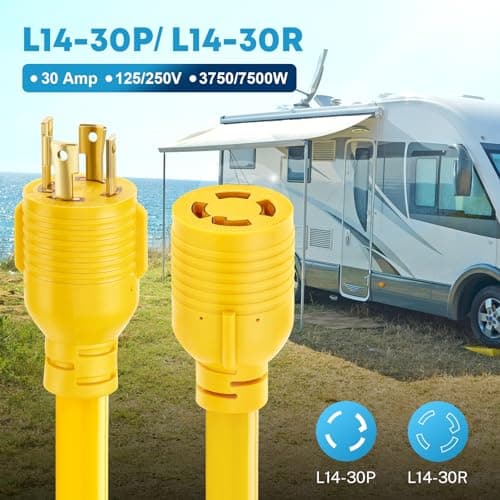
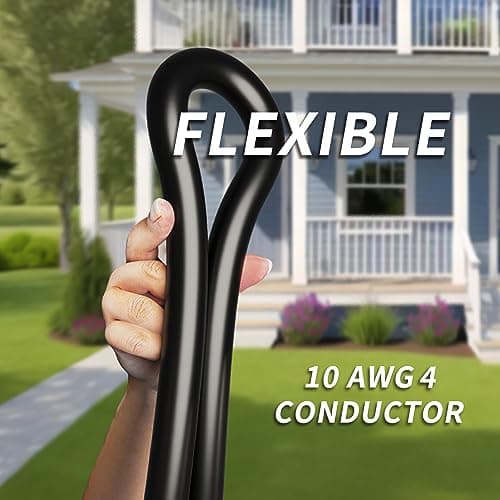
A purpose-made generator cord: 10 AWG four-conductor with L14-30 twist-locks for a 30 amp connection, or substantially heavier conductors with 14-50 or SS2-50 connectors for 50 amps.
These exist precisely because a household cord cannot do the job. The twist-lock connectors will not shake loose in wind; the gauge handles the current; the four conductors carry 240 volts. See best generator extension cords and the gauge guide.
The short answer
Quick picks
| # | Product | Best for | Score | Price |
|---|---|---|---|---|
| 1 | 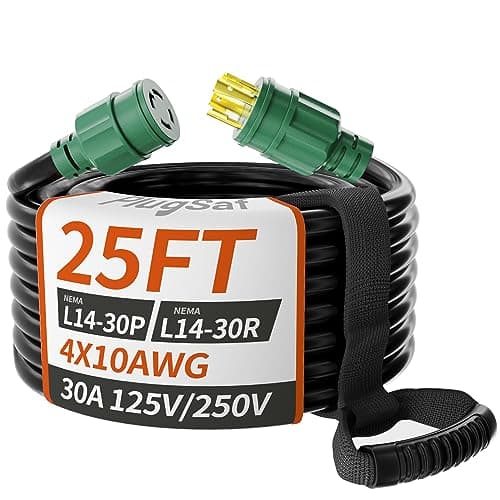 PlugSaf 25 ft 30A L14-30 Cord, 10 AWG The correct first cord for most installations: 25 feet of 10 AWG with L14-30 twist-locks at both ends. | The default generator cord | 9.0/10 | $58.99 |
| 2 | 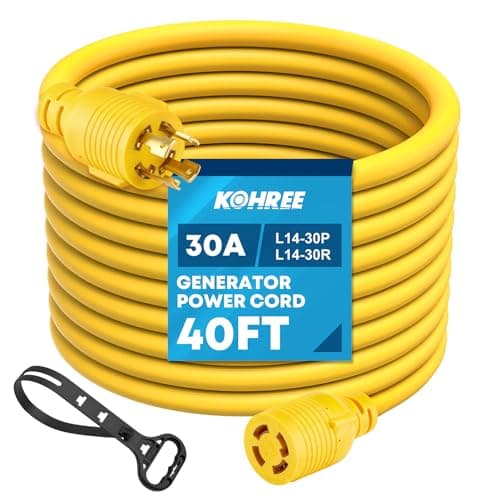 Kohree 40 ft 30A L14-30 Cord, ETL Listed The best-certified cord here: ETL listed and explicitly all-copper at a useful 40-foot length. | ETL listing and 100% copper | 9.0/10 | $79.99 |
| 3 | 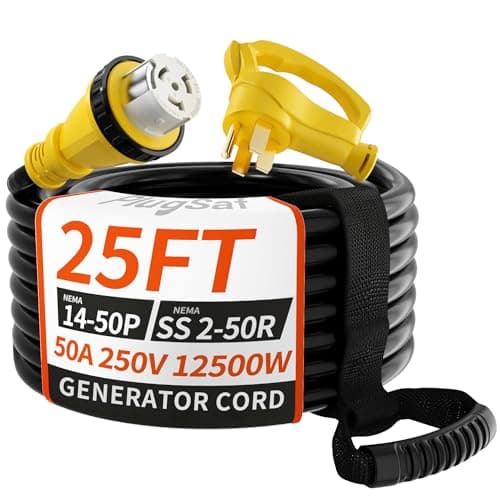 PlugSaf 25 ft 50A 14-50P to SS2-50R Cord The right 50 A cord for the common arrangement — just verify both connector types against your generator and your inlet before ordering. | 50A generators to a 50A inlet | 8.9/10 | $103.99 |
| 4 | 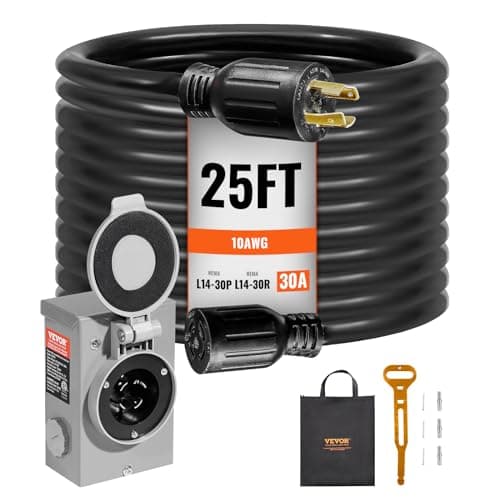 VEVOR 30A Cord + Inlet Box Kit, 25 ft The simplest way to buy the 30 A connection parts correctly: matched ETL-certified cord and inlet in one order. | Matched 30A cord and inlet | 8.6/10 | $78.90 |
#ad Prices as of October 5, 2026; they may have changed since. Scores are our editorial judgment from published specifications, not test results — how we pick. How we are funded.
And the one thing never to improvise
A double-male cord — a plug on both ends — to back-feed a dryer or range outlet. It energizes your entire panel including the utility feed, which can kill a line worker; it leaves live exposed pins at one end; and it bypasses every protection in your panel.
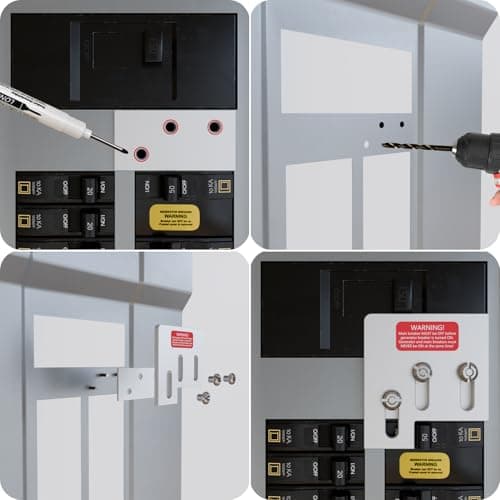
If the motivation is cost, an interlock kit costs tens of dollars and is the compliant answer to the same problem. See backfeeding dangers.
Questions people actually ask
Can I use a regular extension cord with a generator?
For a single 120 volt appliance on a heavy-duty outdoor-rated cord of adequate gauge, yes — that is how most people run a refrigerator from a generator. For a 30 amp or 240 volt panel connection, no: the voltage, current and connectors are all wrong.
What kind of extension cord should I use with a generator?
For one appliance: outdoor rated (look for a W in SJTW or STW), 12 or 14 AWG for appliance loads, three-conductor with a ground, and undamaged. For a panel connection: a purpose-made generator cord, 10 AWG with L14-30 twist-locks for 30 amps.
Can I plug a power strip into a generator extension cord?
It is the most common mistake. Individual appliances each seem modest and the combined load exceeds the cord — a fridge, a space heater and a coffee maker together is over 26 amps at 120 volts on published figures. One cord, one appliance.
Why can't I use a household cord for a 240 volt connection?
A household cord has one hot conductor, a neutral and a ground, and is not rated for 240 volts. A 240 volt connection needs two hot conductors. That is why generator cords are four-conductor with L14-30 or 14-50 connectors.
Can I make an adapter to use my own cord?
No. The connectors on generator cords exist to match specific voltage and current ratings, and adapting around them defeats the purpose. The worst version — a double-male cord into an appliance outlet — energizes your whole panel including the utility feed and can kill a line worker.
How many appliances can I run on one extension cord from a generator?
One. The cord is rated for a current, not a number of devices, and the combined draw of several appliances will exceed a household cord's rating quickly. For multiple circuits you need a transfer switch or interlock kit, not a longer cord.
Sources
- Eugene Water & Electric Board — Generator Sizing ConsiderationsPublished appliance running-watt figures used when working out how many circuits a household actually needs.
- US Consumer Product Safety Commission — Portable Generator Information CenterThe 20-foot placement guidance that sets the minimum practical cord length referenced on this page.
Read next
Reference
Generator Cord Gauge Guide
Conductor gauge requirements by amperage, the copper-versus-copper-clad question, and how length affects voltage drop.
Best Generator Cord
The Best Generator Extension Cords
Generator cords by gauge, length and connector type, with the certification and connector-match checks that matter.
Top pick · PlugSaf 25 ft 30A L14-30 Cord, 10 AWG
$58.99View on Amazon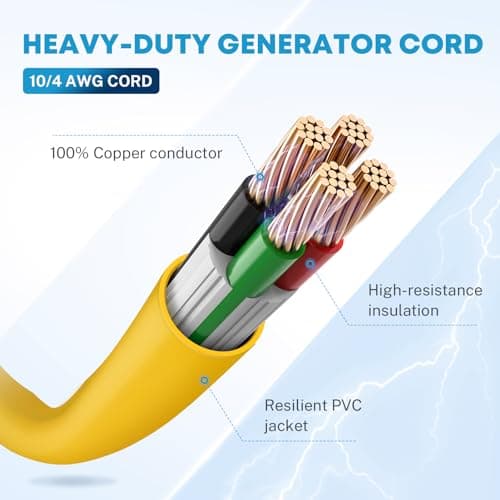
Comparison
Generator Cord vs Extension Cord
The four construction differences between a generator cord and a household extension cord, and when each is correct.
Guide
The Dangers of Back-Feeding a Generator
What back-feeding does electrically, why it is lethal to line workers, and the inexpensive compliant alternatives.
Guide
How to Run Your House on a Generator
Connection options ranked, the correct start-up sequence, load management, and the back-feeding practice to never attempt.