Generators
Best Generator for a Sump Pump
A sump pump cycles when it wants to, not when you are watching. That one fact decides which generator is right.
Written byMike M.
Published
Disclosure: we earn a commission on purchases made through links on this page, at no cost to you. It does not affect what we recommend or what we say about it — how we are funded.
The short answer
The best generator for a sump pump is the Westinghouse WGen5300DFc: 5,300 running and 6,600 starting watts on gasoline is enough to hold a 1/2 HP pump's 2,200 watt surge in permanent reserve while also carrying a refrigerator, a furnace blower and lights. It is dual fuel, it has CO shutdown, and it starts from a key fob — which matters at 2 a.m. in a storm.
Backing up a sump pump is not a sizing problem. The watts are small: EWEB publishes 800 running and 1,300 additional starting watts for a 1/3 HP pump, and 1,050 running with 2,200 starting for a 1/2 HP. What size generator for a sump pump works that arithmetic out in full. The buying problem is different, and it comes down to one property of the load: a sump pump decides on its own when to draw its surge, and if the headroom is not there at that exact moment, the basement floods anyway.
The short answer
Quick picks
| # | Product | Best for | Score | Price |
|---|---|---|---|---|
| 1 | 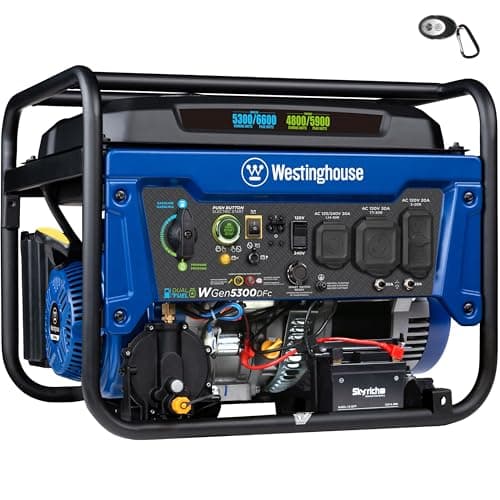 Westinghouse WGen5300DFc 6,600W Dual Fuel The right generator for a house without a well pump or central air: light enough to actually move, with CO shutoff and remote start included. | Light essential circuits, easy to move | 9.0/10 | $649.00 |
| 2 | 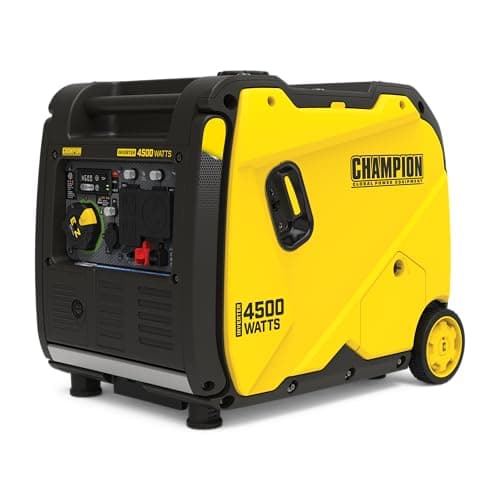 Champion 4,500W RV Ready Inverter The best balance of quiet, clean power and real output for cord-based backup: enough for the essentials, under 3% THD, half the price of the Honda equivalent. | Quiet backup at a sane price | 9.2/10 | $749.00 |
| 3 | 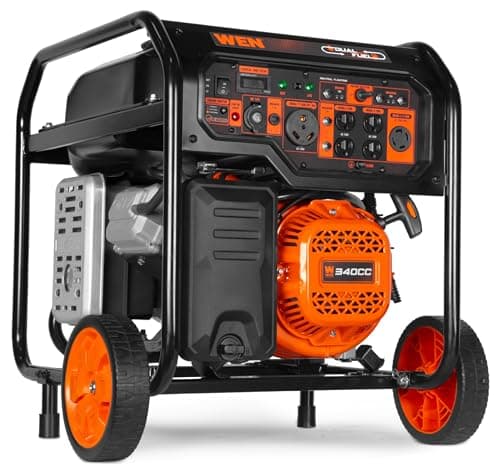 WEN DF8000X 8,000W Dual Fuel The best-value correctly-sized home backup generator here: enough for every essential circuit, dual fuel, CO shutoff, a real transfer-switch outlet, and no money spent on capacity you will not use. | Essential circuits, dual fuel, lowest cost | 9.2/10 | $658.41 |
| 4 | 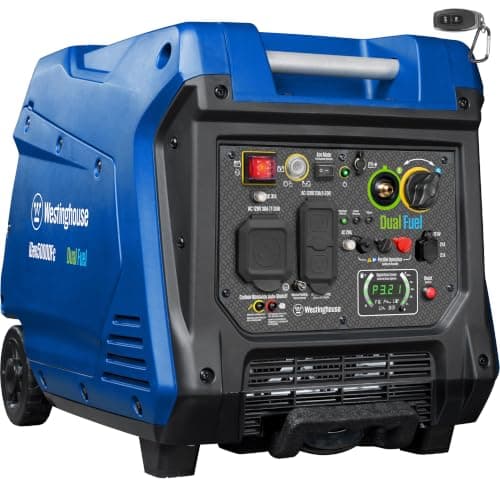 Westinghouse iGen5000DFc 5,000W Dual Fuel Inverter The quietest way to get around 4,000 running watts on either fuel, provided you are running cords rather than a transfer switch. | Quietest dual fuel at 4,000 running watts | 9.3/10 | $999.00 |
| 5 | 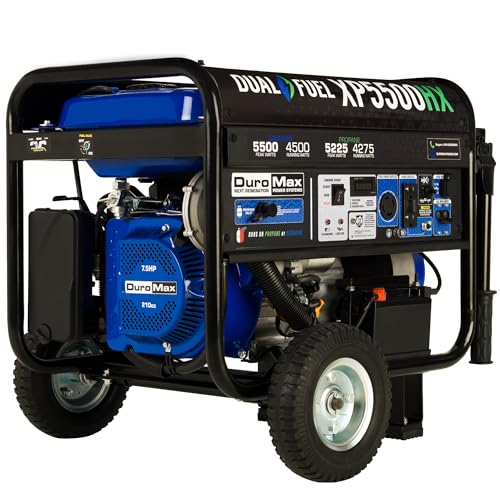 DuroMax XP5500HX 5,500W Dual Fuel A compact dual-fuel generator whose 120V-doubling switch makes it more useful than its peak rating suggests, for cord-based backup. | Small backup plus 120V doubling | 8.6/10 | $629.00 |
| 6 | 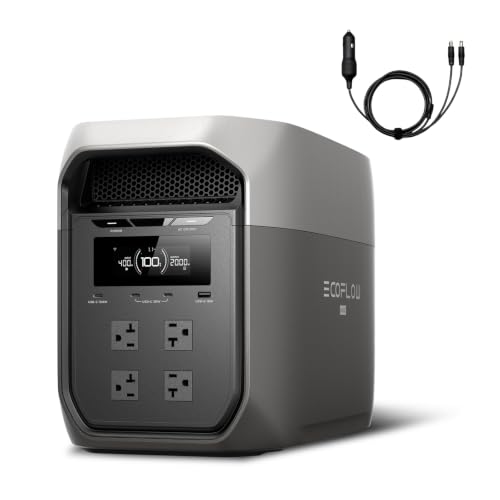 EcoFlow DELTA 3 Max The best battery here for keeping specific things running without interruption — the sub-10 ms transfer is a real functional difference, not a spec-sheet flourish. | UPS-grade switchover for a fridge | 9.4/10 | $999.00 |
#ad Amazon prices as of November 19, 2026; they may have changed since. Scores are our editorial judgment from published specifications, not test results — how we pick. How we are funded.
Published output against what a pump plus the essentials needs
| Machine | Running watts | Starting watts | Fuel | Reserve after 3,450 W of load |
|---|---|---|---|---|
| Westinghouse WGen5300DFc | 5,300 W gas / 4,800 LP | 6,600 W gas | Gas / propane | 1,850 W |
| Champion 4,500 W inverter | 3,500 W | 4,500 W | Gasoline | 50 W |
| WEN DF8000X | 6,500 W gas / 5,850 LP | 8,000 W gas | Gas / propane | 3,050 W |
| Westinghouse iGen5000DFc | Not published | 5,000 W peak gas | Gas / propane | Not calculable |
| DuroMax XP5500HX | Not published | 5,500 W peak | Gas / propane | Not calculable |
| EcoFlow DELTA 3 Max | 2,400 W | 3,400 W boost | Battery | Battery sizing, see below |
The reserve column is the one to read. The Champion 4,500 W inverter technically covers the load and has effectively nothing left, which means every time the pump cycles you are at the machine's limit. It is a fine choice if the pump is the only thing you are running. It is a poor choice if you also want a microwave.
Why unattended operation is the real requirement
Most generator buying advice assumes you are present, managing load — turning the kettle off before the well pump starts. A sump pump breaks that assumption completely. In a serious storm it may cycle every few minutes, at night, while you sleep, and the consequence of a trip is not inconvenience but water.
What unattended running actually demands
- Reserved surge headroom
- 2,200 W, always available
- Runtime without refueling
- Through the night, minimum
- Restart after a trip
- Electric or remote, not a pull cord
- Weather tolerance
- A cover, or a sheltered placement
Requirements derived from the load's behavior, not from any manufacturer's claim. The pump's surge figure is EWEB's published 1/2 HP number.
The WGen5300DFc answers all four reasonably: 1,850 watts of reserve above a full essential load, a 4.7-gallon tank, push-button electric start with a remote key fob, and dual fuel so a propane tank can carry it overnight without a refueling trip. The key fob is not a gimmick on this specific load — it is the difference between going outside in a storm and pressing a button.
The one case for a battery here
A sump pump has a low duty cycle: it draws almost nothing between cycles and a lot for a few seconds at a time. That profile suits a battery better than its raw watt-hour figure suggests, and a battery has the property no generator has — it is already running. There is nothing to start, no fuel to carry, and nobody has to be awake.
The EcoFlow DELTA 3 Max is the pick for that: 2,048 Wh, a published 2,400 W continuous output and, critically, a transfer time the manufacturer states is under 10 milliseconds, so a pump wired through it never knows the grid went away. The honest limits: EcoFlow is explicit that the 3,400 W X-Boost figure works by reducing voltage to resistive loads and should not be relied on for motors, so a 1/2 HP pump's 2,200 W surge has to fit inside the real 2,400 W rating — which it does, with very little room. A 3/4 HP pump does not fit at all.
There is also a whole product category of purpose-built sump pump battery backups — a deep-cycle battery and a DC pump wired into the pit. We do not sell or cover those here, and if the pump is your only backup concern, that is the category to research rather than this one. A generator earns its place when the pump is one of several things you need alive.
Connecting it, which is where this gets decided
A sump pump is usually on its own dedicated circuit, hard-wired or on a receptacle in the pit area. Running it from a generator therefore means either a long cord to that receptacle, or a panel connection. A transfer switch with the pump circuit on it is the version that works while you sleep; an interlock kit does the same job for less if your panel is compatible. A cord through a window works and is honest, as long as the generator still sits at least 20 feet from the house.
- Running watts
- 5,300 W gas / 4,800 W LP
- Starting watts
- 6,600 W gas
- Weight
- 136 lb
#1 · Light essential circuits, easy to move
Westinghouse WGen5300DFc 6,600W Dual Fuel
The right generator for a house without a well pump or central air: light enough to actually move, with CO shutoff and remote start included.
#ad Price as of November 19, 2026; it may have changed since. How we are funded.
Why we picked it
- 136 lb is genuinely one-person movable on a flat driveway, which changes how practical a generator is
- CO shutdown, remote start and a propane hose all included at the bottom of the dual-fuel range
- 5,300 running watts covers a fridge, furnace blower, sump pump and lighting with headroom
Good to know
- Good to know: sized for an essential-circuit load — run the sizing math before counting on a well pump, a furnace and a fridge together
Published specification & our scoring
- Gasoline: 6,600 peak / 5,300 running watts (manufacturer)
- Propane: 5,900 peak / 4,800 running watts (manufacturer)
- 274cc Westinghouse 4-stroke OHV engine, cast-iron sleeve
- Automatic low-oil AND carbon monoxide shutdown
- Push-button electric start with remote key fob
- 4.7-gallon tank; one 5-20R duplex, one TT-30R RV, one L14-30R transfer-switch ready
- Propane hose included; published weight 135.6 lb
- Output headroom
- 6
- Fuel flexibility
- 9
- Transfer-switch fit
- 8
- Portability
- 9
- Safety features
- 9
- Value
- 9
Specification figures are the manufacturer’s published values. Scores are our editorial judgment from those figures and are never published as structured review data — how we pick.
- Running watts
- 3,500 W
- Noise
- 61 dBA (mfr)
- Runtime
- Up to 14 h (mfr)
#2 · Quiet backup at a sane price
Champion 4,500W RV Ready Inverter
The best balance of quiet, clean power and real output for cord-based backup: enough for the essentials, under 3% THD, half the price of the Honda equivalent.
#ad Price as of November 19, 2026; it may have changed since. How we are funded.
Why we picked it
- 3,500 running watts of clean power is enough for a fridge, furnace blower, lights and electronics — a real essential-circuit load, quietly
- 14-hour runtime is excellent for an inverter this size
- Parallel capability means you can double output later rather than replacing the unit
Good to know
- 92 lb is heavy for something you cannot connect to a panel
Published specification & our scoring
- 4,500 starting / 3,500 running watts (manufacturer)
- 61 dBA, up to 14 hours runtime (manufacturer)
- Under 3% THD — safe for sensitive electronics (manufacturer)
- CO Shield carbon monoxide auto shutoff
- 120V 29.2A RV outlet plus a 120V 20A household duplex
- Parallel ready with another 2,800W-or-higher Champion inverter
- Intelligauge with power meter; published weight 92.2 lb
- Noise
- 8
- Power quality
- 9
- Output
- 7
- Runtime
- 9
- Safety features
- 9
- Value
- 9
Specification figures are the manufacturer’s published values. Scores are our editorial judgment from those figures and are never published as structured review data — how we pick.
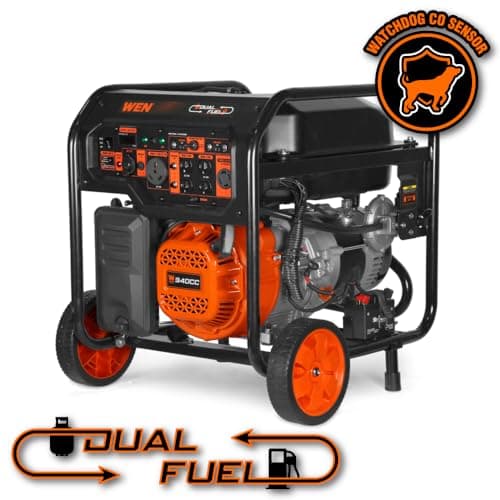
- Running watts
- 6,500 W gas / 5,850 W LP
- Starting watts
- 8,000 W gas
- CO shutdown
- Watchdog
#3 · Essential circuits, dual fuel, lowest cost
WEN DF8000X 8,000W Dual Fuel
The best-value correctly-sized home backup generator here: enough for every essential circuit, dual fuel, CO shutoff, a real transfer-switch outlet, and no money spent on capacity you will not use.
#ad Price as of November 19, 2026; it may have changed since. How we are funded.
Why we picked it
- 6,500 running watts with CO shutdown, dual fuel and a proper L14-30R, for the price of a gasoline-only machine
- 10.5 hours at half load is better runtime than WEN's larger DF1100X
- The TT-30R makes it an RV generator as well, which widens its usefulness between outages
Good to know
- Good to know: 6,500 running watts covers the essentials; central air needs a larger machine
Published specification & our scoring
- Gasoline: 8,000 surge / 6,500 rated watts (manufacturer)
- Propane: 7,200 surge / 5,850 rated watts (manufacturer)
- 340cc engine, electric start
- WEN Watchdog CO shutdown sensor
- 6.7-gallon tank, up to 10.5 hours at half load (manufacturer)
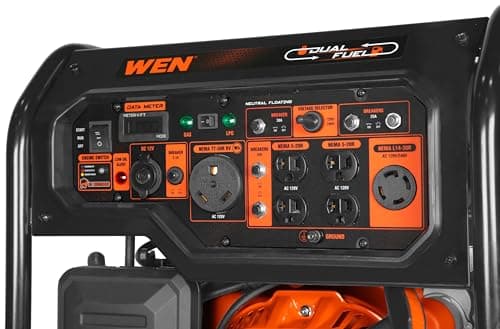
- Wheel kit included; four 120V 5-20R, one TT-30R RV outlet, one L14-30R transfer-switch-ready twist-lock
- Output headroom
- 7
- Fuel flexibility
- 9
- Transfer-switch fit
- 9
- Runtime
- 9
- Safety features
- 8
- Value
- 10
Specification figures are the manufacturer’s published values. Scores are our editorial judgment from those figures and are never published as structured review data — how we pick.
- Output
- 5,000 W peak gas
- Noise
- As low as 52 dBA (mfr)
- Fuel
- Gas / propane
#4 · Quietest dual fuel at 4,000 running watts
Westinghouse iGen5000DFc 5,000W Dual Fuel Inverter
The quietest way to get around 4,000 running watts on either fuel, provided you are running cords rather than a transfer switch.
#ad Price as of November 19, 2026; it may have changed since. How we are funded.
Why we picked it
- 52 dBA at 5,000 peak watts is the best noise-per-watt figure of any dual fuel machine here
- Dual fuel plus remote start plus CO sensor at a mid-range price
- The double-insulated cover is also weather protection the open-frame machines do not have
Good to know
- 106 lb and enclosed — awkward to carry despite the telescoping handle
Published specification & our scoring
- 5,000 peak watts on gasoline (manufacturer)
- As low as 52 dBA with a double-insulated cover, muffler and variable-speed engine (manufacturer)
- Manufacturer states inverter technology cuts fuel use up to 50% versus a conventional generator
- 224cc Westinghouse 4-stroke OHV engine
- RV-ready TT-30R 30A, 5-20R 120V 20A duplex, two USB
- Remote electric start, CO sensor; parallel capable
- Published weight 105.8 lb
- Noise
- 10
- Power quality
- 9
- Fuel flexibility
- 9
- Output
- 7
- Safety features
- 9
- Value
- 8
Specification figures are the manufacturer’s published values. Scores are our editorial judgment from those figures and are never published as structured review data — how we pick.
- Peak watts
- 5,500 W
- Engine
- 210cc OHV-V, copper windings
- Weight
- 131 lb
#5 · Small backup plus 120V doubling
DuroMax XP5500HX 5,500W Dual Fuel
A compact dual-fuel generator whose 120V-doubling switch makes it more useful than its peak rating suggests, for cord-based backup.
#ad Price as of November 19, 2026; it may have changed since. How we are funded.
Why we picked it
- The MX2 switch is genuinely useful: if you are only running 120V loads, it puts the full output on the 120V side
- 131 lb and copper windings at the bottom of the range
- CO Alert included
Good to know
- Good to know: 5,500 peak is roughly 4,500 running, which suits a modest essential-circuit load
Published specification & our scoring
- 5,500 peak watts (manufacturer)
- 210cc OHV-V DuroMax engine with all-copper windings
- CO Alert shutdown
- MX2 switch doubles available 120V amperage (manufacturer)
- Two 120V GFCI household outlets, one 120/240V 30A twist-lock
- Published weight 131 lb
- Output headroom
- 5
- Fuel flexibility
- 9
- Transfer-switch fit
- 6
- Portability
- 9
- Safety features
- 8
- Value
- 8
Specification figures are the manufacturer’s published values. Scores are our editorial judgment from those figures and are never published as structured review data — how we pick.
- Capacity
- 2,048 Wh
- AC output
- 2,400 W / 3,400 W boost
- Switchover
- Under 10 ms (mfr)
#6 · UPS-grade switchover for a fridge
EcoFlow DELTA 3 Max
The best battery here for keeping specific things running without interruption — the sub-10 ms transfer is a real functional difference, not a spec-sheet flourish.
#ad Price as of November 19, 2026; it may have changed since. How we are funded.
Why we picked it
- A sub-10 ms switchover means plugged-in equipment never notices the outage — this is what makes it genuinely usable for a fridge, a modem or a home office
- 3,400 W in X-Boost handles appliances the 2,400 W rating would reject
- Usually cheaper than the DELTA 2 Max it replaces
Good to know
- EcoFlow states this version takes no expansion batteries, so 2,048 Wh is the ceiling — the older DELTA 2 Max reaches 6 kWh
Published specification & our scoring
- 2,048 Wh LFP battery, 2,400 W output (manufacturer)
- Up to 3,400 W continuous in X-Boost mode (manufacturer)
- Under 10 ms transfer time for home backup (manufacturer)
- 0-80% in 1.13 hours with X-Stream charging (manufacturer)
- Manufacturer states a decade of daily use and a 5-year service commitment
- Published weight 45 lb; 19.44 x 12 x 9.4 in. Current listing adds a cigarette-to-DC5521 adapter cable
- Usable capacity
- 9
- Output ceiling
- 8
- UPS behavior
- 10
- Recharge speed
- 8
- Cycle life
- 9
- Value
- 9
Specification figures are the manufacturer’s published values. Scores are our editorial judgment from those figures and are never published as structured review data — how we pick.
In short
Our recommendation
Best for a Sump Pump
9.0/10Westinghouse WGen5300DFc 6,600W Dual Fuel
The right generator for a house without a well pump or central air: light enough to actually move, with CO shutoff and remote start included.
Runner-up
9.2/10Champion 4,500W RV Ready Inverter
The best balance of quiet, clean power and real output for cord-based backup: enough for the essentials, under 3% THD, half the price of the Honda equivalent.
#ad Price as of November 19, 2026; it may have changed since. How we are funded.
Brands: want your product tested? For Brands.
Questions people actually ask
What size generator do I need to run a sump pump?
For the pump alone, EWEB's published figures work out to about 1,350 running and 3,250 starting watts for a 1/2 HP pump with derating. For a realistic set including a refrigerator, a furnace blower and lights, plan on about 3,450 running and 4,950 starting watts.
Will a 2000 watt generator run a sump pump?
A 1/3 HP pump, usually — EWEB publishes 800 running and 1,300 additional starting watts for that size, which a 2,000 watt machine covers. A 1/2 HP pump needs about 2,200 watts of surge on top of its 1,050 running watts, which most 2,000 watt generators cannot supply.
Can a battery run a sump pump during a power outage?
Yes, if its continuous output covers the surge. A 1/2 HP pump's published 2,200 watt surge fits inside the EcoFlow DELTA 3 Max's 2,400 W rating with little room to spare. The advantage over a generator is that a battery is already running and needs nobody awake; the limit is capacity on a multi-day outage.
Does a sump pump need a dedicated circuit on the transfer switch?
It should have one, and the headroom behind it should stay reserved. The pump cycles on its own schedule, so if its surge capacity has been borrowed for a microwave at the moment the pit fills, the pump trips the generator instead of emptying the pit.
How long will a generator run a sump pump?
Far longer than it will run anything else, because the duty cycle is low — the pump draws its full load for seconds at a time. Fuel capacity is the real limit: WEN publishes up to 10.5 hours at half load for the DF8000X's 6.7-gallon tank, and a propane tank on a dual fuel machine extends that further without a refueling trip.
Is an inverter generator better for a sump pump?
Not for the pump itself — a pump motor does not care about harmonic distortion. An inverter generator is quieter and more fuel-efficient at light load, which genuinely helps on an overnight run, but a conventional dual fuel machine of the same size usually gives you more surge headroom for the money.
Sources
- Eugene Water & Electric Board — Generator Sizing ConsiderationsPublished appliance running and additional-starting watt figures used in the sizing arithmetic on this page.
- US Consumer Product Safety Commission — Portable Generator Information CenterThe placement and carbon monoxide guidance every generator page on this site links to.
Read next
Guide
What Size Generator for a Sump Pump?
Sump pump sizing from EWEB's published 1/3 and 1/2 HP figures, plus why battery backup and a generator serve different parts of this problem.
Best for a Well Pump
Best Generator for a Well Pump
Generators with the 240V outlets and surge headroom a well pump needs, plus the soft-starter alternative.
Top pick · WEN DF8000X 8,000W Dual Fuel
$658.41See the DF8000X 8,000W Dual Fuel on Amazon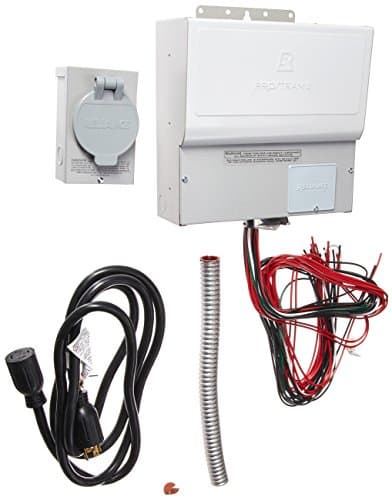
Best Transfer Switch
The Best Generator Transfer Switches
Transfer switches ranked on circuit count, amp rating and kit completeness, from 6-circuit 30A to 10-circuit 50A.
Top pick · Reliance Controls 310CRK 10-Circuit 30A Kit
$474.86See the 310CRK 10-Circuit 30A Kit on Amazon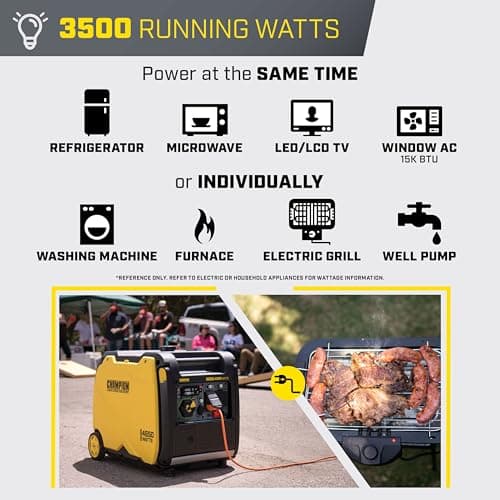
Guide
Winter Storm Power Outage Checklist
Before-the-storm and during-the-storm checklists for a winter outage, with the pipe-freeze risk front and center.
Best Value
Best Portable Generators for the Money
Value-ranked portable generators with each one's specific compromise stated — CO shutdown, outlet type, support network.
Top pick · WEN DF8000X 8,000W Dual Fuel
$658.41See the DF8000X 8,000W Dual Fuel on Amazon