Generators
The Best Whole-House Generators
Portable machines big enough to carry a whole panel — ranked on published running watts, not the peak number, and on having a 14-50R to deliver them through.
Written byMike M.
Published
Disclosure: we earn a commission on purchases made through links on this page, at no cost to you. It does not affect what we recommend or what we say about it — how we are funded.
The short answer
The best whole-house generator you can buy as a portable machine is the Westinghouse WGen11500TFc: 11,500 running watts on gasoline, 10,500 on propane and 9,500 on natural gas — all three published — with low THD and up to 19 hours on its 9.5-gallon tank. It is the right pick because it publishes a running figure for every fuel, which almost nothing else in this class does. If you want inverter-clean power for the same job, the Westinghouse iGen12000DFc has both a 14-50R and an L14-30R at under 3% THD.
"Whole house" is two different purchases wearing one search term, and the distinction decides everything that follows. One is a permanently installed standby generator: bolted to a pad, wired to an automatic transfer switch, fed from your gas line, starting itself when the power drops. The other is a large portable generator connected through a manual transfer switch or an interlock kit, which you start and connect yourself. This page is the second one — the machines on it cost a fraction of an installed system and ask you to walk outside in the storm.
If you have not yet decided which of the two you want, portable versus standby generators settles it, and can a generator power a whole house answers the yes-or-no question before you spend anything. This is the commercial ranking for people who have already decided on a portable.
What "whole house" actually requires in watts
The reason most homes do not need the biggest machine on this page is that household loads are not simultaneous. The honest definition of whole-house capability is the one that includes what an essential-circuits plan leaves out: central air conditioning, electric water heating, an electric range, and a well pump that starts while all of that is already running.
Where the whole-house threshold sits
- Essential circuits only
- 5,000-7,500 running watts
- Essentials + well pump
- 7,500-9,500 running watts
- Add central air
- 10,000-13,000 running watts
- Add electric water heating or range
- 13,000+ running watts
Bands assembled from the published appliance running and additional-starting figures in the utility chart linked below, plus the 20% derating this site applies everywhere. Your house is the authority on which row you are in: size from your own load list before you buy from this page.
Most people who search for a whole-house generator are in the first two rows and will be better served — and several hundred dollars better off — by the best home backup generators. The machines below exist for the bottom two rows.
The selection criteria, in the order they decided the ranking
- 1A published running-watt figure, per fuel. Peak watts are a two-second capability. A house is a three-day continuous load. Machines that publish only a peak figure ranked below machines that publish both.
- 2A 50 amp 120/240 V outlet. Above about 7,500 running watts a 30 amp connection physically cannot deliver what you bought. Most picks here publish one; where a manufacturer does not state its outlets, the table says so and you should confirm before buying.
- 3A fuel supply that survives the outage. A natural-gas capable machine never runs out. Propane does not go stale. Gasoline-only at this size means hundreds of dollars of fuel stored somewhere and rotated annually.
- 4Clean power, where it is published. A modern furnace control board and an inverter-driven air conditioner both care about total harmonic distortion. Two picks publish a THD figure; the rest do not, and we say so.
- 5Weight, honestly. This class runs from 187 lb to 368 lb. Above roughly 250 lb, "portable" means you position it once and it stays there.
The short answer
Quick picks
| # | Product | Best for | Score | Price |
|---|---|---|---|---|
| 1 | 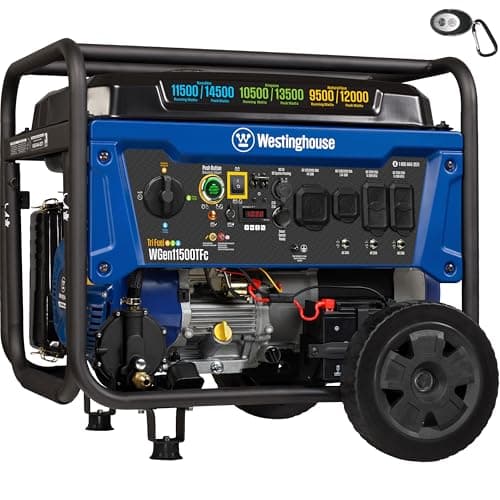 Westinghouse WGen11500TFc 14,500W Tri-Fuel Buy this when the sizing math genuinely lands above 10,000 running watts — not because bigger feels safer. | Larger homes with real 240V loads | 9.4/10 | $1,499.00 |
| 2 | 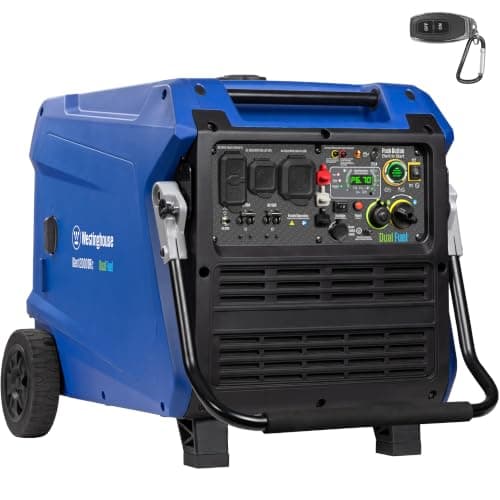 Westinghouse iGen12000DFc 12,000W Dual Fuel Inverter The best technical answer for whole-house backup if the budget allows: transfer-switch-ready output, inverter-clean power, and far less noise than the conventional alternative. | Whole-house backup with clean power | 9.5/10 | $1,899.00 |
| 3 | 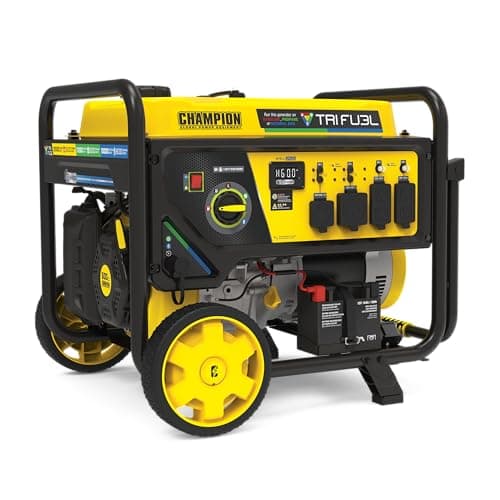 Champion 12,500W Tri-Fuel Home Backup The most complete tri-fuel package on the shelf: three fuels, both hoses, every output figure published, CO shutdown included. | Tri-fuel with both hoses in the box | 9.5/10 | $1,259.99 |
| 4 | 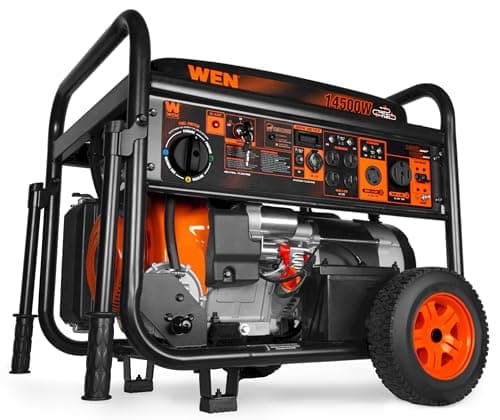 WEN TF-1450X 14,500W Tri-Fuel The value play in the 11,500-running-watt tri-fuel bracket, as long as you are comfortable with a thinner support network. | Tri-fuel value at high output | 9.4/10 | $1,054.75 |
| 5 | 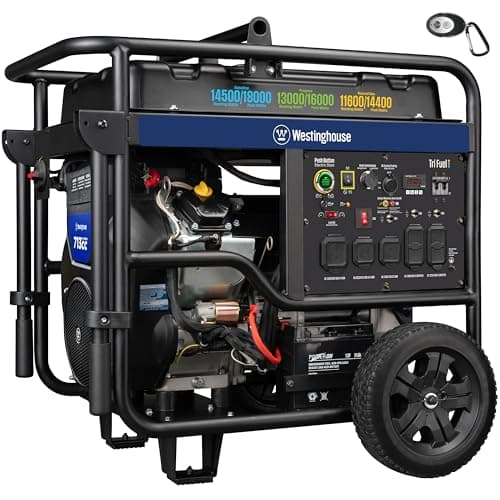 Westinghouse WGen14500TFc 18,000W Tri-Fuel The top of the portable range: V-twin, tri-fuel, clean power, and far more capacity than a correctly-sized essential-circuit plan requires. | Large homes, everything at once | 9.3/10 | $2,699.00 |
| 6 | 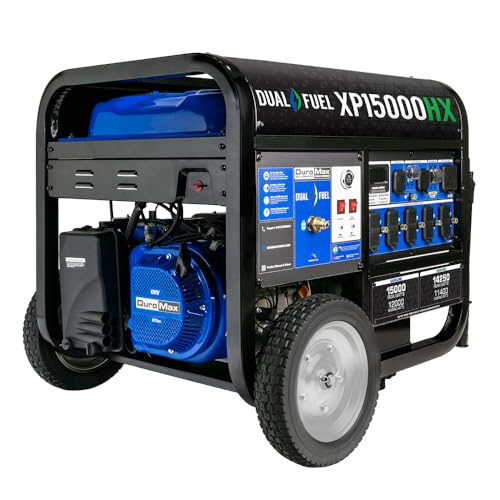 DuroMax XP15000HX 15,000W Dual Fuel Only buy this if your sizing math genuinely includes central air or a large well pump alongside everything else. | Whole-house with central air | 8.9/10 | Check price |
| 7 | 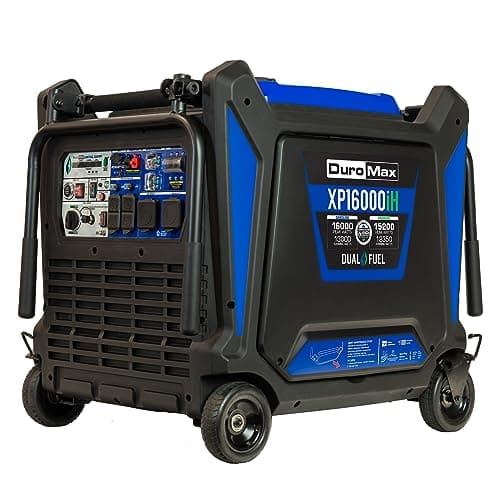 DuroMax XP16000iH 16,000W Dual Fuel Inverter At this price and weight, compare it honestly against a permanently installed automatic standby generator rather than against other portables. | Maximum inverter output | 8.7/10 | $4,866.00 |
#ad Amazon prices as of November 19, 2026; they may have changed since. Scores are our editorial judgment from published specifications, not test results — how we pick. How we are funded.
Published output, every fuel, side by side
| Machine | Running (gas) | Running (LP) | Running (NG) | 50 A outlet | Weight |
|---|---|---|---|---|---|
| Westinghouse WGen11500TFc | 11,500 W | 10,500 W | 9,500 W | Yes | 230 lb |
| Westinghouse iGen12000DFc | Not published | Not published | Not applicable | 14-50R | 187.4 lb |
| Champion 12,500 W Tri-Fuel | 10,000 W | 9,000 W | 8,000 W | Not published | 231 lb |
| WEN TF-1450X | 11,500 W | 10,300 W | 8,750 W | 14-50R | Not published |
| Westinghouse WGen14500TFc | Not published | Not published | Not published | 14-50R | Not published |
| DuroMax XP15000HX | Not published | Not published | Not applicable | 120/240 V 50 A | 345 lb |
| DuroMax XP16000iH | 13,000 W | Not published | Not applicable | Transfer-switch ready | 368 lb |
Read the first row against the fourth. The WGen11500TFc and the WEN TF-1450X publish the same 11,500 running watts on gasoline, and the Westinghouse holds its advantage where it matters most: 9,500 running watts on natural gas against WEN's 8,750. If your plan is a plumbed gas line — the one fuel supply an outage usually leaves alone — that 750 watt gap is a well pump.
Why the top pick is a tri-fuel machine
At this size, fuel logistics stop being a detail and become the whole problem. A 10,000-running-watt machine at half load drinks several gallons an hour, and three days of that is more gasoline than most people can safely store or legally transport. Westinghouse publishes 11,500 / 10,500 / 9,500 running watts on gasoline, propane and natural gas from a 550cc cast-iron-sleeved engine, up to 19 hours on the 9.5-gallon tank, and states the output is low-THD and safe for sensitive electronics.
The cost of that flexibility is worth stating plainly: natural gas takes 2,000 running watts off the gasoline figure, a gas quick-connect is licensed work on your supply line, and at 230 lb this is not a machine you move after the first time you position it. Dual fuel versus tri-fuel versus gas covers the fuel decision properly, and the best natural gas generators ranks this class on the natural-gas figure alone.
The inverter alternative, and what it buys
The Westinghouse iGen12000DFc is the technically better machine and the harder one to size. It publishes 12,000 peak watts at 3% THD or less, dual fuel, as low as 64 dBA with Eco Mode, both a 14-50R and an L14-30R, an LED data center showing fuel level and remaining runtime, remote electric start, and 187.4 lb — the lightest machine on this page by 43 lb.
What you pay for is distortion and noise: under 3% THD protects a furnace control board and a variable-speed air handler, and 64 dBA is a conversation rather than a lawnmower. What you give up is a published continuous figure, and the fact that inverter electronics are a failure point an open-frame alternator does not have. Inverter versus conventional generators weighs that trade in full.
The rest of the list, and who each one suits
- Champion 12,500 W Tri-Fuel — the most complete package on the shelf: three fuels, both the LP and NG hoses in the box, every output figure published, CO Shield shutdown and Intelligauge. Lower output than the Westinghouse, and natural gas drops it to 8,000 running watts.
- WEN TF-1450X — the value route to 11,500 running watts on gasoline, with four 120 V outlets plus both an L14-30R and a 14-50R and Watchdog CO shutdown. No remote start, and a thinner service network than Generac or Champion.
- Westinghouse WGen14500TFc — the top of the portable range: 18,000 peak watts from a 713cc V-twin, under 5% THD, as low as 74 dBA, both 240 V outlets, up to 16 hours at a quarter load. Buy it only if your math genuinely needs it; it publishes no continuous figure.
- DuroMax XP15000HX — 15,000 peak watts from a 670cc engine with remote start, five GFCI outlets and a 50 amp outlet, at 345 lb. Peak-watt marketing and the second-heaviest machine here.
- DuroMax XP16000iH — 13,000 running and 16,000 peak watts, dual fuel, remote start, battery tender, 368 lb. At this price compare it honestly against an installed standby system rather than against other portables.
- Running watts
- 11,500 W gas / 9,500 W NG
- Starting watts
- 14,500 W gas
- Runtime
- Up to 19 h (mfr)
#1 · Larger homes with real 240V loads
Westinghouse WGen11500TFc 14,500W Tri-Fuel
Buy this when the sizing math genuinely lands above 10,000 running watts — not because bigger feels safer.
#ad Price as of November 19, 2026; it may have changed since. How we are funded.
Why we picked it
- 11,500 running watts is enough to add central air to the essential-circuit list in many homes
- 19-hour runtime means one overnight refuel instead of three
- Low THD on a conventional frame is unusual and genuinely useful if you are running computers and a modern furnace board
Good to know
- 230 lb, and at this output you are firmly in permanent-location territory
Published specification & our scoring
- Gasoline: 14,500 peak / 11,500 running watts (manufacturer)
- Propane: 13,500 peak / 10,500 running watts (manufacturer)
- Natural gas: 12,000 peak / 9,500 running watts (manufacturer)
- 550cc 4-stroke OHV Westinghouse engine with cast-iron sleeve
- Up to 19 hours on the 9.5-gallon tank (manufacturer)
- Low THD — manufacturer states it is safe for sensitive electronics
- Published weight 230 lb
- Output headroom
- 10
- Fuel flexibility
- 10
- Transfer-switch fit
- 10
- Runtime
- 10
- Power quality
- 9
- Value
- 7
Specification figures are the manufacturer’s published values. Scores are our editorial judgment from those figures and are never published as structured review data — how we pick.
- Output
- 12,000 W peak
- THD
- Under 3% (mfr)
- Outlets
- 14-50R + L14-30R
#2 · Whole-house backup with clean power
Westinghouse iGen12000DFc 12,000W Dual Fuel Inverter
The best technical answer for whole-house backup if the budget allows: transfer-switch-ready output, inverter-clean power, and far less noise than the conventional alternative.
#ad Price as of November 19, 2026; it may have changed since. How we are funded.
Why we picked it
- Whole-house output AND under 3% THD — this is the combination most homes with modern furnace boards and electronics actually want
- 64 dBA at 12,000 peak watts is dramatically quieter than any open-frame machine of similar output
- Both 240V outlets are transfer-switch ready, so it works with a 30A interlock or a 50A switch
Good to know
- 187 lb and enclosed — harder to service at home than an open frame
Published specification & our scoring
- 12,000 peak watts at 3% THD or less (manufacturer)
- As low as 64 dBA with Eco Mode, insulation and mufflers (manufacturer)
- Dual fuel: gasoline or propane
- Manufacturer states inverter technology halves fuel consumption versus a conventional generator
- One 120/240V 14-50R 50A and one L14-30R 30A — both transfer-switch and interlock ready
- LED data center with fuel level, output, remaining runtime, voltage and lifetime hours
- Remote electric start; published weight 187.4 lb
- Output headroom
- 10
- Power quality
- 10
- Noise
- 9
- Transfer-switch fit
- 10
- Fuel flexibility
- 9
- Value
- 6
Specification figures are the manufacturer’s published values. Scores are our editorial judgment from those figures and are never published as structured review data — how we pick.
- Running watts
- 10,000 W gas / 8,000 W NG
- Starting watts
- 12,500 W gas
- Hoses
- LP + NG included
#3 · Tri-fuel with both hoses in the box
Champion 12,500W Tri-Fuel Home Backup
The most complete tri-fuel package on the shelf: three fuels, both hoses, every output figure published, CO shutdown included.
#ad Price as of November 19, 2026; it may have changed since. How we are funded.
Why we picked it
- Both fuel hoses are included — on most tri-fuel machines you buy them separately and discover that on delivery day
- Publishes all three fuels' running and starting watts, so you can size against your actual fuel plan
- 10,000 running watts on gasoline is top of this class
Good to know
- 231 lb
Published specification & our scoring
- Gasoline: 12,500 starting / 10,000 running watts (manufacturer)
- Propane: 11,250 starting / 9,000 running watts (manufacturer)
- Natural gas: 10,000 starting / 8,000 running watts (manufacturer)
- Natural gas AND propane hoses included in the box (manufacturer)
- 500cc Champion engine, electric start, battery included
- Intelligauge plus CO Shield auto shutoff
- Published weight 231 lb
- Output headroom
- 10
- Fuel flexibility
- 10
- Transfer-switch fit
- 9
- Runtime
- 10
- Safety features
- 9
- Value
- 8
Specification figures are the manufacturer’s published values. Scores are our editorial judgment from those figures and are never published as structured review data — how we pick.
- Running watts
- 11,500 W gas / 8,750 W NG
- Starting watts
- 14,500 W gas
- Outlets
- L14-30R + 14-50R
#4 · Tri-fuel value at high output
WEN TF-1450X 14,500W Tri-Fuel
The value play in the 11,500-running-watt tri-fuel bracket, as long as you are comfortable with a thinner support network.
#ad Price as of November 19, 2026; it may have changed since. How we are funded.
Why we picked it
- Matches the Westinghouse WGen11500TFc's 11,500 running watts for appreciably less money
- Both 240V outlets are transfer-switch ready, which is what you want at this output
- WEN publishes all three fuels fully, including the awkward natural-gas numbers
Good to know
- No remote start at this price point
Published specification & our scoring
- Gasoline: 14,500 surge / 11,500 running watts (manufacturer)
- Propane: 12,500 surge / 10,300 running watts (manufacturer)
- Natural gas: 10,500 surge / 8,750 running watts (manufacturer)
- 500cc 4-stroke OHV engine, electric start
- 8.2-gallon tank, up to 12 hours at half load (manufacturer)
- WEN Watchdog CO shutdown sensor
- Four 120V 5-20R, one L14-30R, one 14-50R, one 12V DC — both 240V outlets transfer-switch ready
- Output headroom
- 10
- Fuel flexibility
- 10
- Transfer-switch fit
- 10
- Runtime
- 9
- Safety features
- 8
- Value
- 10
Specification figures are the manufacturer’s published values. Scores are our editorial judgment from those figures and are never published as structured review data — how we pick.
- Running watts
- 13,000 W
- Peak watts
- 16,000 W
- Weight
- 368 lb
#5 · Maximum inverter output
DuroMax XP16000iH 16,000W Dual Fuel Inverter
At this price and weight, compare it honestly against a permanently installed automatic standby generator rather than against other portables.
#ad Price as of November 19, 2026; it may have changed since. How we are funded.
Why we picked it
- 13,000 running watts of inverter-grade power is as much as any portable machine offers
- Covers central air, a well pump and the whole panel simultaneously
- Battery tender keeps it start-ready between outages
Good to know
- 368 lb — permanently positioned, realistically
Published specification & our scoring
- 16,000 peak / 13,000 running watts (manufacturer)
- Dual fuel: gasoline or propane
- Inverter technology for sensitive electronics (manufacturer)
- Remote start, battery tender
- Whole-home backup, transfer-switch ready
- Published weight 368 lb
- Output headroom
- 10
- Power quality
- 8
- Fuel flexibility
- 9
- Transfer-switch fit
- 10
- Portability
- 2
- Value
- 4
Specification figures are the manufacturer’s published values. Scores are our editorial judgment from those figures and are never published as structured review data — how we pick.
The connection is the other half of the purchase
A 50 amp outlet on the generator is worth nothing without a 50 amp path into the panel, and that path costs real money: heavier feeder conductors, a 50 amp inlet, and a cord whose conductors are substantially thicker than a 30 amp cord's. Budget for it at the same time as the machine, not afterwards.
A 50 amp connection, end to end
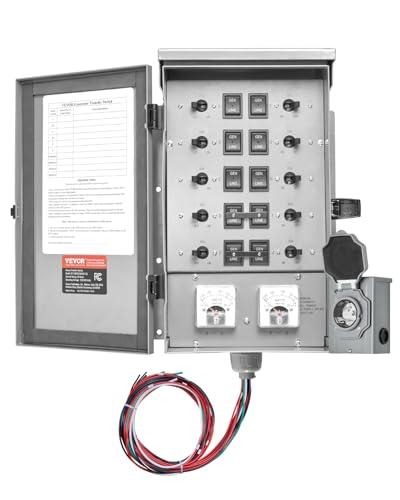
Cheapest complete 50A switch and inlet
VEVOR 50A 10-Circuit Transfer Switch Kit with Inlet Box
Prewired 50A inlet
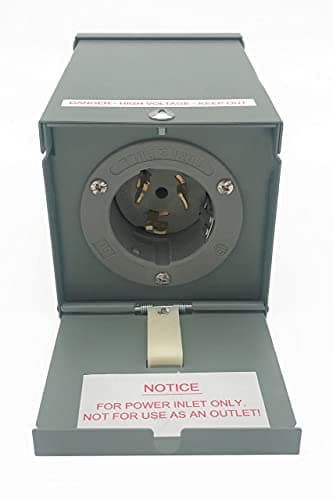
Connecticut Electric EGSPI50 50A Power Inlet Box
50A generators to a 50A inlet
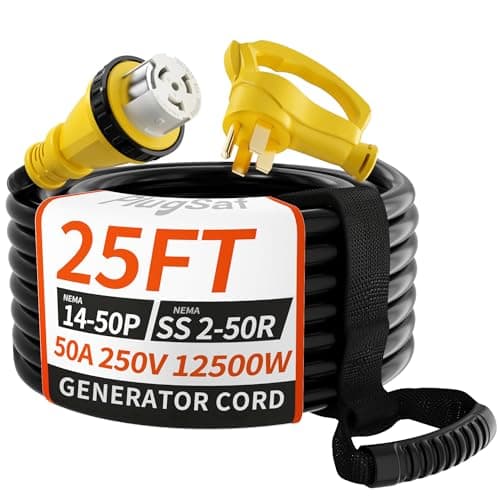
PlugSaf 25 ft 50A 14-50P to SS2-50R Cord
A 50 A 10-circuit switch rated 12,500 W with its inlet box and cord included, a prewired NEMA 3R 50 A inlet with a spring-loaded weather door, and a 25 ft 14-50P to SS2-50R cord. Verify both connector types against your own hardware before ordering — a 14-50R house inlet needs a different cord.
The best 50 amp transfer switches and the best whole house transfer switches rank the switch side, and the best 50 amp generators is the companion list for people choosing a machine around an existing 50 amp connection. If an interlock kit suits your panel better than a switch, the best generator interlock kits energizes the whole panel for less money and asks you to manage the load yourself.
In short
Our recommendation
Best Whole-House
9.4/10Westinghouse WGen11500TFc 14,500W Tri-Fuel
Buy this when the sizing math genuinely lands above 10,000 running watts — not because bigger feels safer.
Runner-up
9.5/10Westinghouse iGen12000DFc 12,000W Dual Fuel Inverter
The best technical answer for whole-house backup if the budget allows: transfer-switch-ready output, inverter-clean power, and far less noise than the conventional alternative.
#ad Price as of November 19, 2026; it may have changed since. How we are funded.
Brands: want your product tested? For Brands.
Questions people actually ask
What size generator do I need to run a whole house?
For a house with central air, electric water heating or a large well pump, plan on 10,000 to 13,000 running watts and a 50 amp connection. Below central air, 7,500 to 9,500 running watts covers essentials plus a well pump. Work from your own load list rather than from square footage — the appliance mix decides it, not the size of the building.
What is the best whole house generator?
Among portable machines, the Westinghouse WGen11500TFc: 11,500 running watts on gasoline, 10,500 on propane and 9,500 on natural gas, all published, with low THD and up to 19 hours per tank. The Westinghouse iGen12000DFc is the better choice if clean power and noise matter more than a published continuous figure.
Can a portable generator really run a whole house?
It can energize the whole panel through an interlock kit or a large transfer switch, but you still manage what runs at once. A 10,000-running-watt machine will not carry central air, an electric water heater, an electric range and a well pump simultaneously no matter how it is connected. The difference between portable and standby is automation and capacity, not whether the wiring reaches.
Do I need a 50 amp transfer switch for a whole house generator?
If the generator exceeds roughly 7,500 running watts, yes — a 30 amp connection passes about 7,200 watts regardless of what the machine can make, so the surplus you paid for never reaches the house. A 50 amp installation needs heavier conductors and a matched inlet and cord, which is a meaningful addition to the budget.
Is a portable whole-house generator cheaper than a standby generator?
Substantially, on hardware and on installation. A large portable plus a manual transfer switch and a 50 amp inlet is a fraction of an installed automatic standby system with a gas line and a service-entrance switch. What you buy with the difference is automation: a standby unit starts itself, and a portable needs you outside in the weather.
Which fuel should a whole-house generator run on?
Natural gas if you have a line, because it is the only supply that does not run out and does not need rotating — accepting that it costs output, 9,500 running watts instead of 11,500 on the top pick here. Propane second, because it does not go stale in storage. Gasoline-only at this output means storing and rotating a great deal of fuel.
Sources
- Eugene Water & Electric Board — Generator Sizing ConsiderationsPublished appliance running and additional-starting watt figures used in the sizing arithmetic on this page.
- US Consumer Product Safety Commission — Portable Generator Information CenterThe placement and carbon monoxide guidance every generator page on this site links to.
Read next
Reference
Can a Generator Power a Whole House?
Whether a portable generator can run a whole house, the three things that have to line up, and why the connection is usually the real ceiling.
Comparison
Portable vs Standby Generator
Portable against permanently installed standby generators, and where the top of the portable range starts to overlap.
Best 50A Match
The Best 50 Amp Generators for Home Backup
Six generators with a published 50 amp outlet, ranked on how much of a 50 amp connection's 12,000 watt capacity their running watts actually use.
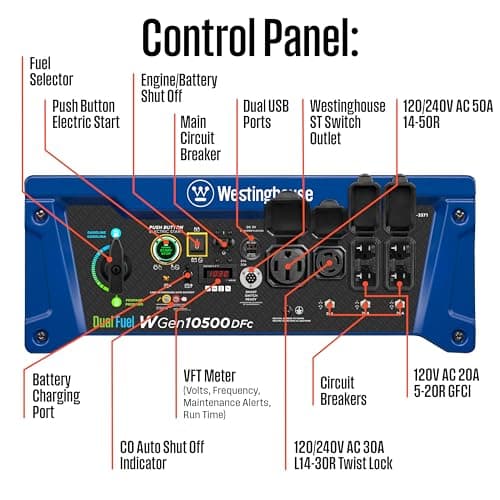
Top pick · Westinghouse WGen10500DFc 13,500W Dual Fuel
$1,099.00See the WGen10500DFc 13,500W Dual Fuel on Amazon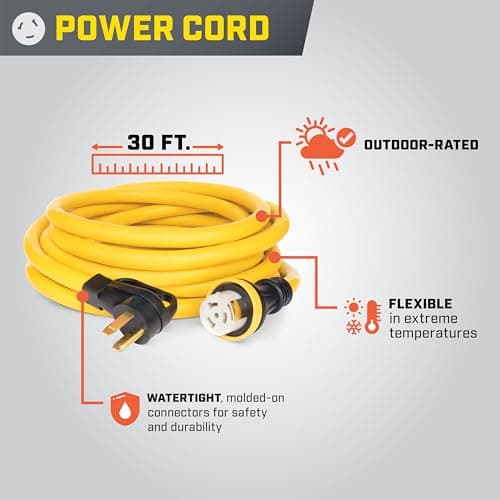
Best 50A Switch
The Best 50 Amp Transfer Switches
50 amp transfer switches, which generators need one, and the whole-chain cost of the 50 amp upgrade.
Top pick · Champion 201193 50A 10-Circuit with Cord
$580.50See the 201193 50A 10-Circuit with Cord on Amazon5% off
Guide
What Size Generator for a House?
Load tables for four realistic house types — gas heat, well pump, central air and electric heat — with the generator class each needs.