Outage Prep
Can a Generator Power a Whole House?
Yes. The honest follow-up is that almost nobody needs to, and the connection limits you before the engine does.
Written byMike M.
Published
Disclosure: we earn a commission on purchases made through links on this page, at no cost to you. It does not affect what we recommend or what we say about it — how we are funded.
The short answer
Yes — a portable generator can power a whole house if three things line up: enough running watts for everything you intend to run at once, a 50 amp connection to get that power into the panel, and no electric heat or electric water heating in the load. In practice a 9,500 to 11,500 running-watt machine covers a typical home's realistic simultaneous load, and the limiting factor is more often the transfer switch than the generator — a 30 amp switch passes only about 7,200 watts at 240 volts regardless of what the engine can make.
"Whole house" means two different things and the question gets answered badly because of it. One meaning is *every circuit in the panel is live*, which is achievable. The other is *unrestricted use — run anything, all at once, like the grid is on*, which is not, on a portable machine, in most homes with electric appliances. Separating those is the whole answer.
The three things that have to line up
What whole-house actually requires
- Generator output
- 9,500-11,500 W running, typically
- Connection
- 50 A switch or an interlock kit
- Load composition
- No electric heat, no electric water heater
- Fuel supply
- Enough for days, not hours
Our arithmetic and reasoning from published appliance figures and amp ratings, not a manufacturer claim. Each row can independently stop the project, which is why all four are listed.
The reason the output figure is a range rather than a number is that houses differ enormously in what is electric. A home with gas heat, a gas water heater and a gas range has a small simultaneous load even if it is large; an all-electric home of the same size can draw several times as much. What size generator for a house and how many watts to run a house work the arithmetic from published appliance figures.
The connection is usually the real ceiling
This is the part that catches people who have already bought the generator. A transfer switch has an amp rating, and that rating caps the power that can reach the panel no matter what the engine produces.
| Connection | Ceiling at 240 V | What that covers |
|---|---|---|
| 30 A transfer switch | ~7,200 W | Essential circuits, comfortably |
| 50 A transfer switch | ~12,000 W | Genuine whole-house territory |
| Interlock kit | Limited by the generator breaker | Whole panel, manually managed |
Which means the honest sequence for a whole-house plan is backwards from how people do it: decide the connection first, then buy the generator that matches it. Buying a 14,500 watt machine and connecting it through a 30 amp switch is paying for roughly 7,000 watts that physically cannot enter your house.
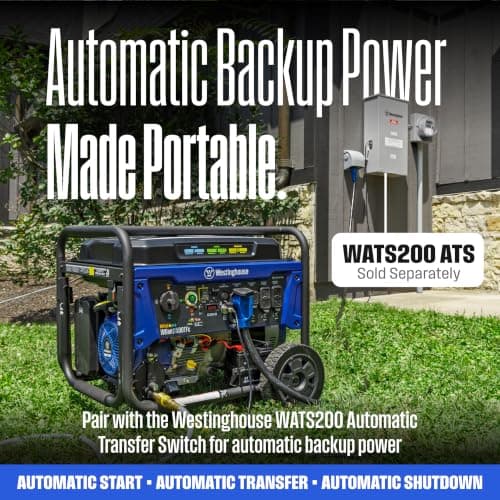
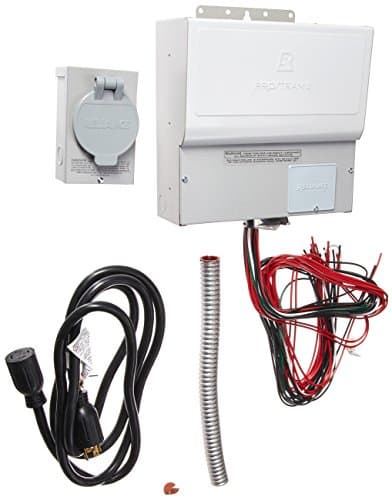
The interlock kit is the interesting third option: it energizes the whole panel from a generator breaker, so every circuit is live and the generator's own breaker sets the limit. The trade is that nothing manages the load for you — you turn breakers off to stay inside the generator's capacity. Interlock kit vs transfer switch compares the two properly.
The loads that end the conversation
Three categories of appliance are what make unrestricted whole-house use impractical on a portable generator, and they are all resistive electric heating or large motors.
- Electric furnace or electric resistance heat. This draws kilowatts as heat rather than hundreds of watts as air movement, and it routinely exceeds everything a portable generator can supply. A gas furnace, by contrast, needs only its blower — about 700 running watts on EWEB's published 1/3 HP figure.
- Electric water heater. A large continuous resistive load with no interest in being shared. The usual plan is simply not to run it, and to accept cooler showers for a few days.
- Central air conditioning. A large compressor with a large starting surge. What size generator to run an air conditioner covers what it actually takes and the soft-start option that lowers the surge.
Leave those three out and the picture changes completely. Heat (gas), hot water (gas), refrigeration, the well pump, the sump pump, lighting, cooking and every outlet in the house is a load most 9,500 running-watt machines carry without strain.
What the machines capable of it look like
Whole-house capability has a recognizable specification: a 14-50R outlet so it can feed a 50 amp connection, output in the five figures, a large tank, and — in practice — more than one fuel so you are not making refueling trips in a storm.
The short answer
Machines with a 50 amp outlet and whole-house output
| # | Product | Best for | Score | Price |
|---|---|---|---|---|
| 1 | 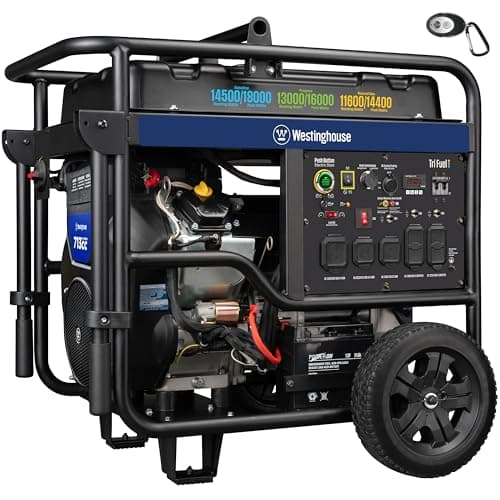 Westinghouse WGen14500TFc 18,000W Tri-Fuel The top of the portable range: V-twin, tri-fuel, clean power, and far more capacity than a correctly-sized essential-circuit plan requires. | Large homes, everything at once | 9.3/10 | $2,699.00 |
| 2 | 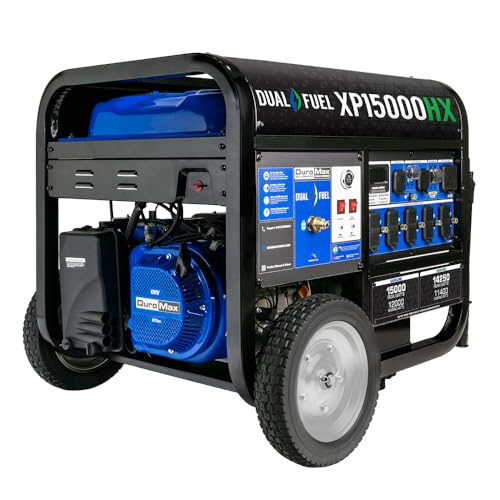 DuroMax XP15000HX 15,000W Dual Fuel Only buy this if your sizing math genuinely includes central air or a large well pump alongside everything else. | Whole-house with central air | 8.9/10 | Check price |
| 3 | 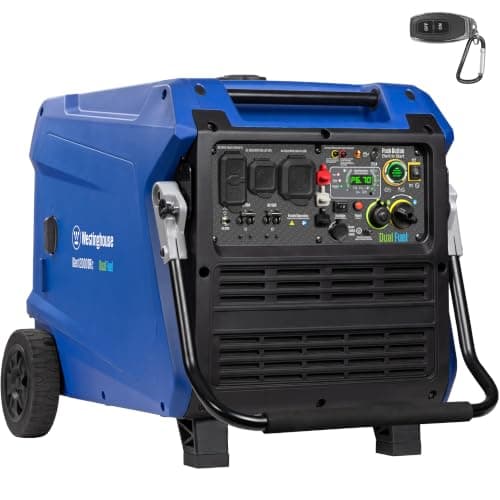 Westinghouse iGen12000DFc 12,000W Dual Fuel Inverter The best technical answer for whole-house backup if the budget allows: transfer-switch-ready output, inverter-clean power, and far less noise than the conventional alternative. | Whole-house backup with clean power | 9.5/10 | $1,899.00 |
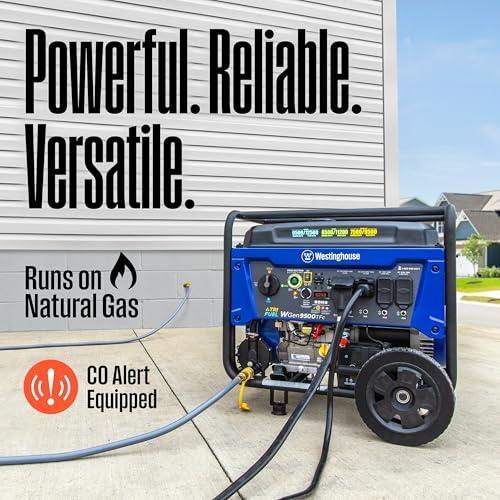
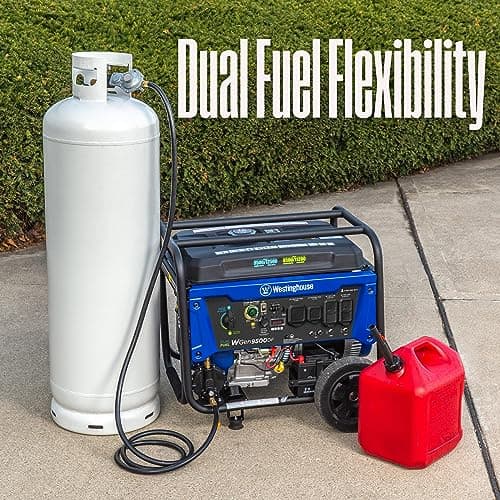
| 4 | 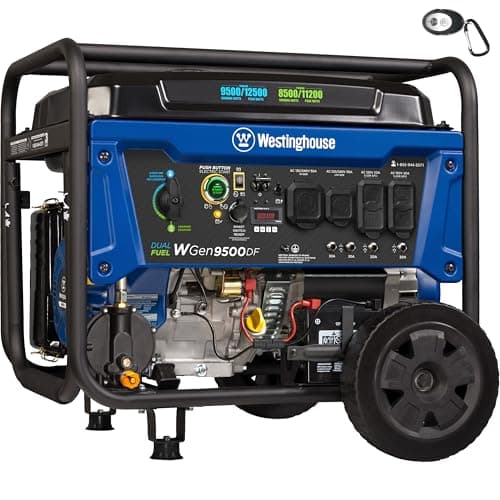 Westinghouse WGen9500DF 12,500W Dual Fuel The most broadly sensible home backup generator on the market: enough running watts for a whole essential-circuit panel, both transfer-switch outlets, and dual fuel — with the caveat that it has no CO shutoff. | The default whole-house pick | 9.4/10 | $999.00 |
#ad Amazon prices as of November 19, 2026; they may have changed since. Scores are our editorial judgment from published specifications, not test results — how we pick. How we are funded.
Westinghouse publishes 18,000 peak watts for the WGen14500TFc from a 713cc V-twin, with a 14-50R and an L14-30R both transfer-switch and interlock ready, up to 16 hours at 25% load on its 10.5-gallon tank, and tri-fuel operation. DuroMax publishes 15,000 peak watts for the XP15000HX with a 120/240V 50 A outlet, at a published 345 lb — which is the honest cost of this class and worth noticing before you buy. The iGen12000DFc is the inverter route: 12,000 peak watts at 3% THD or less, dual fuel, with both a 14-50R and an L14-30R. The WGen9500DF is the sensible floor at 9,500 running watts on gasoline and 8,500 on propane, with the same two outlets.
Note what the weights tell you. A machine in this class is not carried, it is wheeled, and where it lives is a real decision. The best home backup generators ranks the field for household use, and portable vs standby generator is the comparison worth reading if you are genuinely after unattended whole-house coverage — because that is what a standby installation is for.
The answer most households should actually take
Almost nobody needs whole-house. What people need is heat, refrigeration, water, a sump pump if they have one, lighting and the ability to charge things — which is 3,500 to 7,500 running watts, a 30 amp connection, and a far smaller machine, less fuel per day, and less noise. How to run your house on a generator is the practical version of that plan.
The reason to go whole-house anyway is not usually capability — it is that selecting circuits requires decisions and whole-house does not. If you value never thinking about which breakers are on, that is a legitimate reason to buy the bigger machine and the 50 amp switch. Just buy them together.
If the answer for your house is yes and you are ready to choose a machine, the best whole-house generators ranks the 12,000-18,000 watt portable class on published running watts per fuel and on having a 50 amp outlet to deliver them through.
Questions people actually ask
Can a generator power a whole house?
Yes, if three things line up: enough running watts for your simultaneous load, a 50 amp connection to get that power into the panel, and no electric heat or electric water heating in the mix. Typically that means a 9,500 to 11,500 running-watt machine with a 14-50R outlet.
What size generator do I need to run a whole house?
Usually 9,500 to 11,500 running watts for a home with gas heat and a gas water heater. An all-electric home can need far more and often cannot be covered by a portable generator at all. Work it from your own appliance list rather than from square footage.
Can a portable generator run a whole house?
Yes, through a 50 amp transfer switch or an interlock kit, with the same caveats about electric heat and water heating. What a portable cannot do is run unattended — it needs starting, refueling and in most cases manual load management, which is the actual difference between portable and standby.
Why can't my generator run everything even though it has enough watts?
Almost always the connection. A 30 amp transfer switch passes about 7,200 watts at 240 volts regardless of engine output, so a 14,500 peak-watt generator on a 30 amp switch delivers the same power as a much cheaper machine. Decide the connection before buying the generator.
Can a generator run central air conditioning?
Sometimes, and it depends on the compressor's starting surge rather than its running load. It is the single largest load most households consider backing up, and a soft starter can bring the surge within reach of a smaller machine. Our air conditioner sizing guide works through the numbers.
How long can a generator run a whole house?
As long as the fuel lasts, with cool-down and oil checks along the way. Westinghouse publishes up to 16 hours at 25% load on the WGen14500TFc's 10.5-gallon tank; at a genuine whole-house load, consumption is far higher. This is where a dual or tri-fuel machine on a large propane tank or a natural gas hookup changes the arithmetic entirely.
Sources
- Eugene Water & Electric Board — Generator Sizing ConsiderationsPublished running and additional-starting watt figures quoted on this page.
- US Consumer Product Safety Commission — Portable Generator Information CenterThe placement, never-indoors and CO-alarm guidance this site repeats on every generator page.
Read next
Guide
What Size Generator for a House?
Load tables for four realistic house types — gas heat, well pump, central air and electric heat — with the generator class each needs.
Comparison
Portable vs Standby Generator
Portable against permanently installed standby generators, and where the top of the portable range starts to overlap.
Guide
Transfer Switch Amp Rating Guide
Matching transfer switch amp rating to generator output, with the arithmetic and the whole-chain cost implications.
Best Overall Home Backup
The Best Home Backup Generators
Nine conventional-frame generators ranked for whole-house backup, with per-fuel running watts and transfer-switch fit.
Top pick · Westinghouse WGen9500DF 12,500W Dual Fuel
$999.00See the WGen9500DF 12,500W Dual Fuel on Amazon
Guide
How to Run Your House on a Generator
Connection options ranked, the correct start-up sequence, load management, and the back-feeding practice to never attempt.