Generators
The Best Natural Gas Generators for Home Backup
Natural gas is the only backup fuel that cannot run out mid-outage. It also costs you up to 2,000 running watts, and the hookup is licensed work.
Written byMike M.
Published
Disclosure: we earn a commission on purchases made through links on this page, at no cost to you. It does not affect what we recommend or what we say about it — how we are funded.
The short answer
The best natural gas generator for home backup is the Westinghouse WGen11500TFc: 9,500 running and 12,000 peak watts on natural gas — the highest published NG running figure here — from a 550cc engine with low THD. The Champion 12,500 W tri-fuel is the better buy if you want both hoses in the box, publishing 8,000 running watts on natural gas. The Westinghouse WGen9500TFc is the cheapest credible route onto a gas line, publishing 7,500 running watts on natural gas with CO shutdown and a 14-50R.
Natural gas solves the problem no other fuel solves. A propane cylinder empties, a gasoline can empties, and the stations are shut because they have no power either — but the gas line into your house keeps delivering through the storm that took the wires down. A generator plumbed to it runs until you turn it off.
What that buys comes at two prices, and both are easy to underestimate: output and installation. Every machine below makes meaningfully less power on natural gas than on gasoline, and the house side of the connection is work for someone licensed to touch your gas supply.
No portable generator sold runs ONLY on natural gas
This is the first thing to understand about the category. The machines that run on natural gas are tri-fuel generators: gasoline, propane or natural gas, selected by a dial or a valve. That is good news — you keep the gasoline option for a gas-supply interruption — but it means every spec sheet carries three sets of numbers and the natural gas set is always the lowest.
The alternative is a conversion kit for a dual fuel machine you already own, which is cheaper and carries a real caveat covered at the bottom of this page.
The selection criteria
- 1A published natural gas running-watt figure. Every machine on this page states running watts for all three fuels, so the table below is manufacturer data rather than estimate.
- 2NG running watts above 8,000. Below that the derating has eaten the reason you bought a machine this size.
- 3The natural gas hose in the box. One machine here states both the LP and NG hoses are included. For the others, budget for the hose on top.
- 4CO shutdown. Natural gas combustion produces carbon monoxide exactly as gasoline does.
- 5Transfer-switch outlets, and a 50 amp outlet at this output. What size breaker for a generator covers why the connection decides the usable output.
The short answer
Quick picks
| # | Product | Best for | Score | Price |
|---|---|---|---|---|
| 1 | 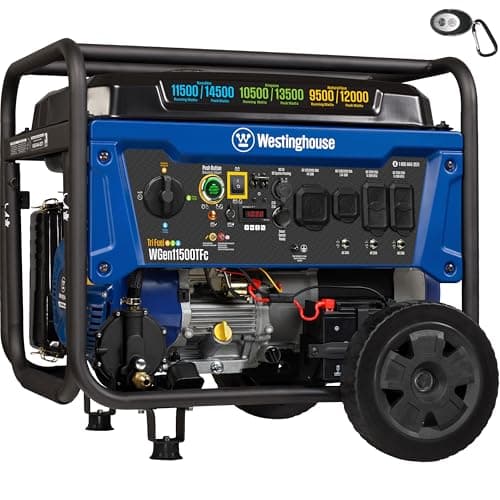 Westinghouse WGen11500TFc 14,500W Tri-Fuel Buy this when the sizing math genuinely lands above 10,000 running watts — not because bigger feels safer. | Larger homes with real 240V loads | 9.4/10 | $1,499.00 |
| 2 | 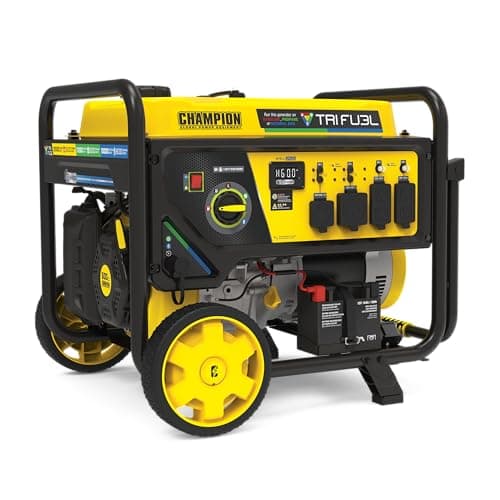 Champion 12,500W Tri-Fuel Home Backup The most complete tri-fuel package on the shelf: three fuels, both hoses, every output figure published, CO shutdown included. | Tri-fuel with both hoses in the box | 9.5/10 | $1,259.99 |
| 3 | 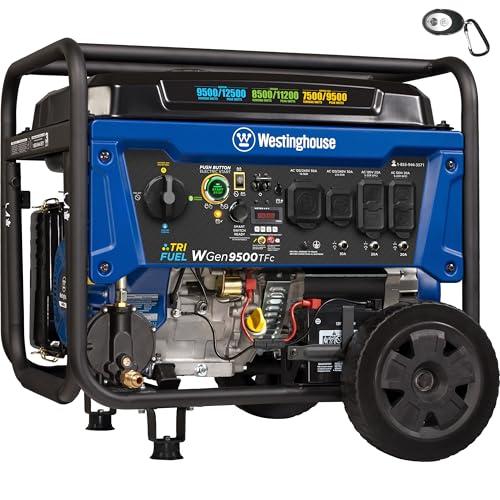 Westinghouse WGen9500TFc 12,500W Tri-Fuel The cheapest credible way to get a generator onto your home's natural gas line, and the only machine at this price that publishes what it makes on all three fuels. | Natural-gas hookup at the lowest cost | 9.4/10 | $1,149.00 |
| 4 | 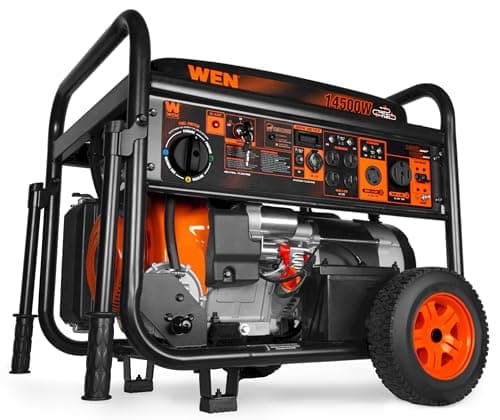 WEN TF-1450X 14,500W Tri-Fuel The value play in the 11,500-running-watt tri-fuel bracket, as long as you are comfortable with a thinner support network. | Tri-fuel value at high output | 9.4/10 | $1,054.75 |
| 5 | 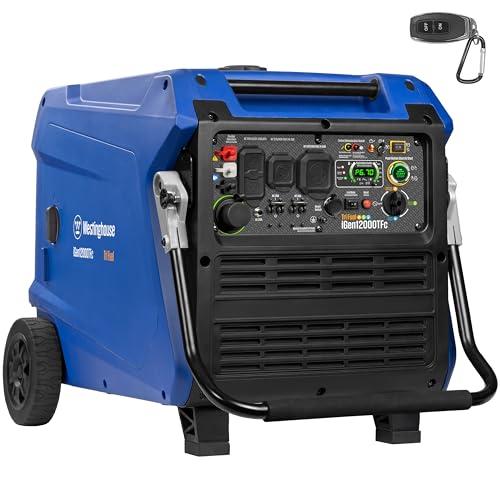 Westinghouse iGen12000TFc 12,000W Tri-Fuel Inverter The tri-fuel to buy when power quality matters as much as fuel flexibility — and unlike most of this class it states what it makes on every fuel, natural gas included. | Tri-fuel with inverter-clean power | 9.2/10 | $1,949.00 |
#ad Amazon prices as of November 19, 2026; they may have changed since. Scores are our editorial judgment from published specifications, not test results — how we pick. How we are funded.
What natural gas costs you in watts
| Machine | Running (NG) | Peak (NG) | Running (gas) | NG penalty | Hoses included |
|---|---|---|---|---|---|
| Westinghouse WGen11500TFc | 9,500 W | 12,000 W | 11,500 W | -17% | Not stated |
| Champion 12,500 W Tri-Fuel | 8,000 W | 10,000 W | 10,000 W | -20% | LP + NG |
| Westinghouse WGen9500TFc | 7,500 W | 9,500 W | 9,500 W | -21% | Not stated |
| WEN TF-1450X | 8,750 W | 10,500 W | 11,500 W | -24% | Not stated |
| Westinghouse iGen12000TFc | 7,200 W | 9,800 W | 9,000 W | -20% | LP regulator only |
The penalty is much larger than propane's. Where switching to propane costs about 10%, switching to natural gas costs 17% to 24% — WEN's TF-1450X drops from 11,500 running watts to 8,750, which is the difference between carrying a well pump alongside the furnace and not. That is the single most overlooked number in this category, and it is why the Westinghouse wins: 9,500 running watts on gas is the most natural-gas power published by any portable here.
What the hookup actually involves
This is where natural gas stops being a spec-sheet comparison and becomes a project. You need a gas quick-connect on your supply line, outdoors, sized for the generator's demand, with a shutoff — and that is licensed gas work in essentially every jurisdiction. It is not a weekend job and it is not optional.
- A licensed gas fitter or plumber installs the outdoor quick-connect and verifies the supply can deliver the volume the generator needs at the required pressure. An undersized line starves the engine and you will see it as low output or stalling under load.
- A permit and an inspection in most places, for the gas work and often for the electrical connection separately.
- A fixed generator location. The quick-connect is where it is; your machine now lives within a hose length of it, which must still satisfy every carbon monoxide clearance.
- The electrical side is a separate project. A transfer switch or interlock kit is its own licensed install. How transfer switch installation works covers that half.
Budget for the gas work and the electrical work together before you buy the machine. People routinely spend carefully on the generator and then discover the connection costs as much again. Transfer switch installation cost has the electrical half, and home backup generator cost puts the whole project in one place.
Who each one is for
- Westinghouse WGen11500TFc — the most natural-gas output published here at 9,500 running watts, with low THD and up to 19 hours per gasoline tank. The best choice if the gas line is the primary plan rather than a backup to the backup.
- Champion 12,500 W Tri-Fuel — the only machine here that states both the propane and natural gas hoses are in the box, with every output figure published, CO Shield and Intelligauge. 8,000 running watts on NG is a 20% haircut.
- Westinghouse WGen9500TFc — the cheapest way onto a gas line, with every fuel's running watts published: 9,500 on gasoline, 8,500 on propane, 7,500 on natural gas, plus CO shutdown, remote start and both 240 V outlets.
- WEN TF-1450X — the value tri-fuel: 11,500 running watts on gasoline and the full outlet complement, but the largest proportional NG penalty here at 24%.
- Westinghouse iGen12000TFc — the only tri-fuel here with inverter-clean output at 3% THD or less, plus a remote start key fob and a 50 amp outlet. 7,200 running watts on natural gas is the lowest NG figure on this page, so it suits a smaller essential-circuit plan rather than a whole house.
- Running watts
- 11,500 W gas / 9,500 W NG
- Starting watts
- 14,500 W gas
- Runtime
- Up to 19 h (mfr)
#1 · Larger homes with real 240V loads
Westinghouse WGen11500TFc 14,500W Tri-Fuel
Buy this when the sizing math genuinely lands above 10,000 running watts — not because bigger feels safer.
#ad Price as of November 19, 2026; it may have changed since. How we are funded.
Why we picked it
- 11,500 running watts is enough to add central air to the essential-circuit list in many homes
- 19-hour runtime means one overnight refuel instead of three
- Low THD on a conventional frame is unusual and genuinely useful if you are running computers and a modern furnace board
Good to know
- 230 lb, and at this output you are firmly in permanent-location territory
Published specification & our scoring
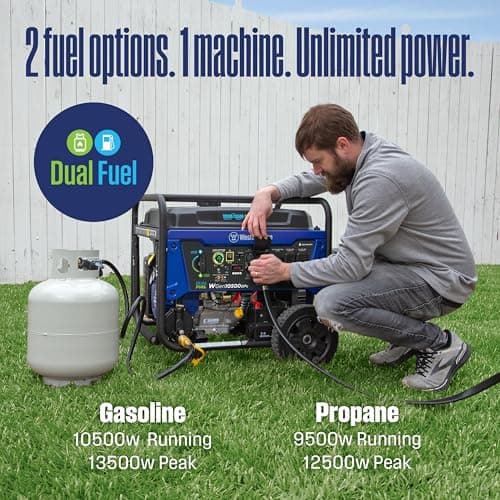
- Gasoline: 14,500 peak / 11,500 running watts (manufacturer)
- Propane: 13,500 peak / 10,500 running watts (manufacturer)
- Natural gas: 12,000 peak / 9,500 running watts (manufacturer)
- 550cc 4-stroke OHV Westinghouse engine with cast-iron sleeve
- Up to 19 hours on the 9.5-gallon tank (manufacturer)
- Low THD — manufacturer states it is safe for sensitive electronics
- Published weight 230 lb
- Output headroom
- 10
- Fuel flexibility
- 10
- Transfer-switch fit
- 10
- Runtime
- 10
- Power quality
- 9
- Value
- 7
Specification figures are the manufacturer’s published values. Scores are our editorial judgment from those figures and are never published as structured review data — how we pick.
- Running watts
- 10,000 W gas / 8,000 W NG
- Starting watts
- 12,500 W gas
- Hoses
- LP + NG included
#2 · Tri-fuel with both hoses in the box
Champion 12,500W Tri-Fuel Home Backup
The most complete tri-fuel package on the shelf: three fuels, both hoses, every output figure published, CO shutdown included.
#ad Price as of November 19, 2026; it may have changed since. How we are funded.
Why we picked it
- Both fuel hoses are included — on most tri-fuel machines you buy them separately and discover that on delivery day
- Publishes all three fuels' running and starting watts, so you can size against your actual fuel plan
- 10,000 running watts on gasoline is top of this class
Good to know
- 231 lb
Published specification & our scoring
- Gasoline: 12,500 starting / 10,000 running watts (manufacturer)
- Propane: 11,250 starting / 9,000 running watts (manufacturer)
- Natural gas: 10,000 starting / 8,000 running watts (manufacturer)
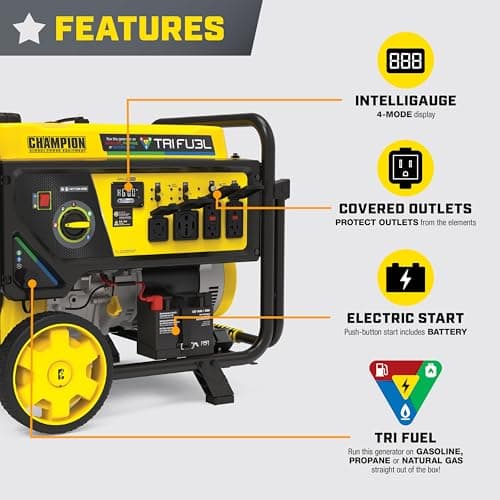
- Natural gas AND propane hoses included in the box (manufacturer)
- 500cc Champion engine, electric start, battery included
- Intelligauge plus CO Shield auto shutoff
- Published weight 231 lb
- Output headroom
- 10
- Fuel flexibility
- 10
- Transfer-switch fit
- 9
- Runtime
- 10
- Safety features
- 9
- Value
- 8
Specification figures are the manufacturer’s published values. Scores are our editorial judgment from those figures and are never published as structured review data — how we pick.
- Running watts
- 9,500 W gas / 7,500 W NG
- Starting watts
- 12,500 W gas
- Fuels
- Gas / LP / natural gas
#3 · Natural-gas hookup at the lowest cost
Westinghouse WGen9500TFc 12,500W Tri-Fuel
The cheapest credible way to get a generator onto your home's natural gas line, and the only machine at this price that publishes what it makes on all three fuels.
#ad Price as of November 19, 2026; it may have changed since. How we are funded.
Why we picked it
- Natural gas capability is the single biggest runtime upgrade available — a plumbed line does not run out
- It publishes running watts on all three fuels, including the natural gas figure most tri-fuel listings leave out, so you can size honestly before buying
- Both 240V outlets are here: the L14-30R a transfer switch expects and a 14-50R for a 50A connection or an RV
Good to know
- 7,500 running watts on natural gas is 2,000 less than on gasoline — size from the fuel you will actually run
- 215 lb open-frame, and the 6.6-gallon tank is smaller than the 9.5-gallon tanks on the bigger tri-fuel machines
Published specification & our scoring
- Gasoline: 12,500 peak / 9,500 running watts (manufacturer)
- Propane: 11,200 peak / 8,500 running watts (manufacturer)
- Natural gas: 9,500 peak / 7,500 running watts (manufacturer)
- 457cc Westinghouse 4-stroke OHV engine with cast-iron sleeve
- Up to 12 hours on the 6.6-gallon tank, with a fuel gauge (manufacturer)
- Two 120V 5-20R GFCI, one transfer-switch-ready L14-30R, one RV-ready 120/240V 14-50R
- Automatic low-oil AND carbon monoxide shutdown, digital hour meter
- Remote key-fob start plus electric and recoil start; published weight 215 lb
- 3-year limited service, labor and parts coverage (manufacturer)
- Output headroom
- 9
- Fuel flexibility
- 10
- Transfer-switch fit
- 10
- Runtime
- 8
- Safety features
- 9
- Value
- 10
Specification figures are the manufacturer’s published values. Scores are our editorial judgment from those figures and are never published as structured review data — how we pick.
- Running watts
- 11,500 W gas / 8,750 W NG
- Starting watts
- 14,500 W gas
- Outlets
- L14-30R + 14-50R
#4 · Tri-fuel value at high output
WEN TF-1450X 14,500W Tri-Fuel
The value play in the 11,500-running-watt tri-fuel bracket, as long as you are comfortable with a thinner support network.
#ad Price as of November 19, 2026; it may have changed since. How we are funded.
Why we picked it
- Matches the Westinghouse WGen11500TFc's 11,500 running watts for appreciably less money
- Both 240V outlets are transfer-switch ready, which is what you want at this output
- WEN publishes all three fuels fully, including the awkward natural-gas numbers
Good to know
- No remote start at this price point
Published specification & our scoring
- Gasoline: 14,500 surge / 11,500 running watts (manufacturer)
- Propane: 12,500 surge / 10,300 running watts (manufacturer)
- Natural gas: 10,500 surge / 8,750 running watts (manufacturer)
- 500cc 4-stroke OHV engine, electric start
- 8.2-gallon tank, up to 12 hours at half load (manufacturer)
- WEN Watchdog CO shutdown sensor
- Four 120V 5-20R, one L14-30R, one 14-50R, one 12V DC — both 240V outlets transfer-switch ready
- Output headroom
- 10
- Fuel flexibility
- 10
- Transfer-switch fit
- 10
- Runtime
- 9
- Safety features
- 8
- Value
- 10
Specification figures are the manufacturer’s published values. Scores are our editorial judgment from those figures and are never published as structured review data — how we pick.
- Running watts
- 9,000 W gas / 7,200 W NG
- Peak watts
- 12,000 W gas
- Fuels
- Gas / LP / natural gas
#5 · Tri-fuel with inverter-clean power
Westinghouse iGen12000TFc 12,000W Tri-Fuel Inverter
The tri-fuel to buy when power quality matters as much as fuel flexibility — and unlike most of this class it states what it makes on every fuel, natural gas included.
#ad Price as of November 19, 2026; it may have changed since. How we are funded.
Why we picked it
- The only tri-fuel machine in this registry with inverter-clean output — and it still publishes running watts on all three fuels, including the natural gas figure most brands leave blank
- Remote start key fob plus a 50 amp outlet, so it connects straight to a transfer switch and starts from indoors
- 64 dBA and 19 hours at 25% load are both published, which is unusual at this output and is the whole reason to pay an inverter premium
Good to know
- 7,200 running watts on natural gas is a 20% haircut off the gasoline rating — if the gas line is the plan, that is your sizing figure
- Only one 120V household duplex outlet, so cord-based use off the panel connection needs a power strip
Published specification & our scoring
- Gasoline: 12,000 peak / 9,000 running watts (manufacturer)
- Propane: 11,000 peak / 8,100 running watts (manufacturer)
- Natural gas: 9,800 peak / 7,200 running watts (manufacturer)
- Inverter output at 3% THD or less — manufacturer states it is safe for sensitive electronics
- 457cc Westinghouse 4-stroke OHV engine, up to 19 hours at 25% load on the 7.9-gallon tank (manufacturer)
- Eco Mode with a published noise figure as low as 64 dBA (manufacturer)
- One 120/240V 14-50R 50A outlet and one 120/240V L14-30R 30A twist-lock, both transfer-switch or interlock ready, plus one GFCI 120V 5-20R duplex
- CO sensor and low-oil shutdown; remote start key fob, battery, 12V battery charger and propane regulator kit included (manufacturer)
- Published weight 191 lb; parallel capable to double the output
- Output headroom
- 9
- Fuel flexibility
- 10
- Transfer-switch fit
- 10
- Power quality
- 10
- Safety features
- 9
- Value
- 8
Specification figures are the manufacturer’s published values. Scores are our editorial judgment from those figures and are never published as structured review data — how we pick.
The conversion-kit route, and its one honest problem
If you already own a dual fuel generator, a model-specific natural gas conversion kit is far cheaper than a new machine. The kit we rank for the Westinghouse WGen9500DF covers both high and low pressure supply and publishes an overcurrent cutoff that shuts the gas off automatically if airflow goes abnormal.
The problem is that these kits do not publish a derating figure. Natural gas has lower energy density than gasoline, so output drops — but by how much, for your machine, is not stated anywhere. You are buying an unknown reduction from a known starting point. And the house-side quick-connect is still licensed gas work, which is the expensive half either way.
The conversion route
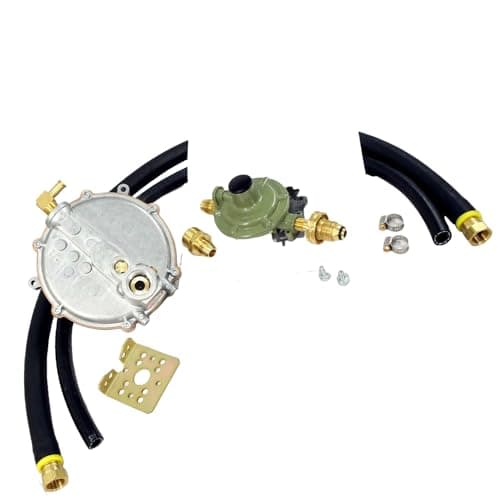
Adding natural gas to a dual fuel unit
Generic (unbranded) Tri-Fuel Conversion Kit — WGen9500DF
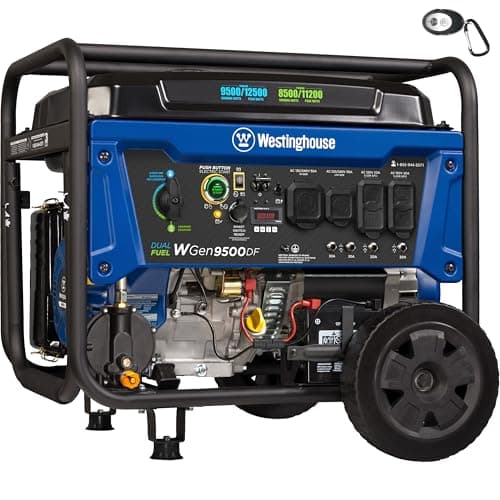
The default whole-house pick
Westinghouse WGen9500DF 12,500W Dual Fuel
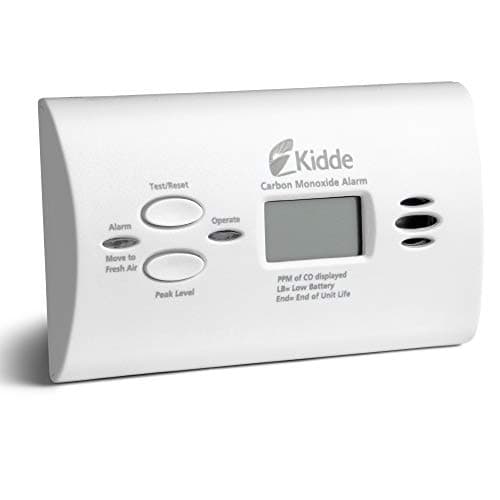
The one accessory nobody should skip
Kidde KN-COPP-B-LPM Battery CO Alarm
A reversible WGen9500DF-specific kit that retains gasoline operation, the machine it fits, and the battery CO alarm every combustion fuel requires. The kit is model-specific: it fits the WGen9500DF and nothing else.
A gas line is also the reason this page is the usual destination for people pricing an installed standby unit. If that quote came from a Generac dealer, Generac alternatives sets the tri-fuel route against the brand's own portables and against the battery option.
In short
Our recommendation
Best on Natural Gas
9.4/10Westinghouse WGen11500TFc 14,500W Tri-Fuel
Buy this when the sizing math genuinely lands above 10,000 running watts — not because bigger feels safer.
Runner-up
9.5/10Champion 12,500W Tri-Fuel Home Backup
The most complete tri-fuel package on the shelf: three fuels, both hoses, every output figure published, CO shutdown included.
#ad Price as of November 19, 2026; it may have changed since. How we are funded.
Brands: want your product tested? For Brands.
Questions people actually ask
What is the best natural gas generator for home backup?
The Westinghouse WGen11500TFc, which publishes 9,500 running and 12,000 peak watts on natural gas — more NG output than any other portable here — with low THD and a 550cc cast-iron-sleeved engine. The Champion 12,500 W tri-fuel is the better package if you want both fuel hoses included.
How much power do you lose running a generator on natural gas?
Between 17% and 24% on the machines here that publish both figures, which is roughly double the propane penalty. The Westinghouse drops from 11,500 running watts to 9,500, Champion from 10,000 to 8,000 and WEN from 11,500 to 8,750. Size from the natural gas number, not the gasoline one.
Can a portable generator run on natural gas?
Only a tri-fuel machine, or a dual fuel machine with a model-specific conversion kit. No portable generator sold runs exclusively on natural gas. Either way the house side of the connection — an outdoor quick-connect on your gas supply — is licensed work that needs a permit in most places.
Is a natural gas generator worth it?
If you have a gas line and you want a generator that cannot run out of fuel mid-outage, yes — that is a capability no other portable has. The honest costs are 17-24% less output than gasoline, a licensed gas install, and a machine that now has a fixed location within a hose length of the connection.
How much does a natural gas generator hookup cost?
It varies too much by region, line length and supply sizing for a national figure to be useful, and we will not invent one. Get a quote from a licensed gas fitter for the outdoor quick-connect before you buy the generator, and get the electrician's quote for the transfer switch at the same time — the two together routinely approach the cost of the machine.
Does a natural gas generator still produce carbon monoxide?
Yes. Every combustion engine does, and the cleaner fuel does not change a single placement rule: outdoors only, well away from windows, doors and vents, exhaust pointed away from the house, with battery CO alarms on every sleeping level indoors.
Sources
- Eugene Water & Electric Board — Generator Sizing ConsiderationsPublished appliance running and additional-starting watt figures used in the sizing arithmetic on this page.
- US Consumer Product Safety Commission — Portable Generator Information CenterThe placement and carbon monoxide guidance every generator page on this site links to.
Read next
Best on Propane
The Best Propane Generators for Home Backup
Six dual and tri fuel generators ranked on their published propane running watts, with the tank runtime arithmetic that decides how many cylinders you need.
Top pick · Westinghouse WGen10500DFc 13,500W Dual Fuel
$1,099.00See the WGen10500DFc 13,500W Dual Fuel on Amazon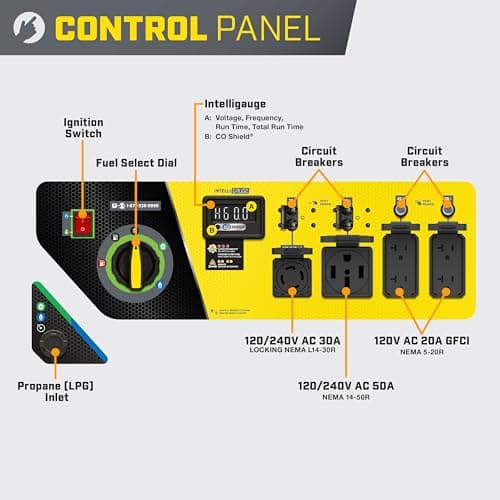
Fuel Comparison
Dual Fuel vs Tri-Fuel vs Gasoline
Gasoline, dual fuel and tri-fuel compared on published per-fuel output, storage life and what survives a long outage.
Best Tri-Fuel
Best Tri-Fuel Generators
Tri-fuel generators with all three fuels' published running watts, and the natural gas derating stated plainly.
Top pick · Champion 12,500W Tri-Fuel Home Backup
$1,259.99See the 12,500W Tri-Fuel Home Backup on Amazon
Best Whole-House
The Best Whole-House Generators
Seven portable generators in the 12,000-18,000 watt class ranked for whole-house duty, with published running watts on every fuel and the 50 amp outlet that delivers them.
Top pick · Westinghouse WGen11500TFc 14,500W Tri-Fuel
$1,499.00See the WGen11500TFc 14,500W Tri-Fuel on Amazon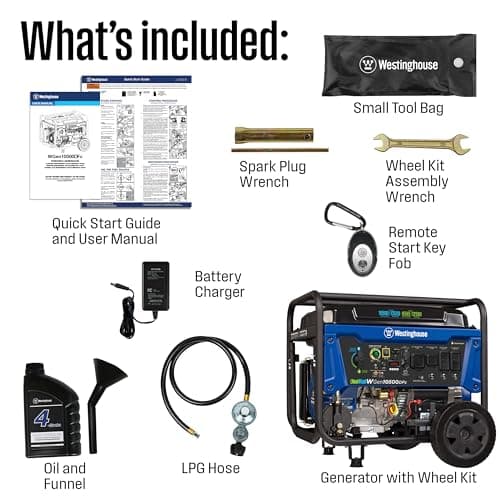
Generac Alternative
Generac Alternatives for Home Backup
The honest read on what Generac does well, then four different routes away from it — big dual fuel, tri-fuel, inverter and battery.
Top pick · Westinghouse WGen10500DFc 13,500W Dual Fuel
$1,099.00See the WGen10500DFc 13,500W Dual Fuel on Amazon
Guide
What Transfer Switch Installation Costs
What a transfer switch installation quote consists of, the hardware choices that reduce labor, and how to compare quotes.