Transfer Switches & Connection
What Size Breaker for a Generator?
The outlet on your generator decides this, not its wattage. Everything else follows from that one fact.
Written byMike M.
Published
Disclosure: we earn a commission on purchases made through links on this page, at no cost to you. It does not affect what we recommend or what we say about it — how we are funded.
The short answer
| Generator outlet | Connection | Breaker | Power at 240 V |
|---|---|---|---|
| NEMA L14-30R | 30 A, 120/240 V | 2-pole 30 A | ~7,200 W |
| NEMA 14-50R | 50 A, 120/240 V | 2-pole 50 A | ~12,000 W |
| TT-30R only | RV, 120 V single leg | Not a house connection | 3,600 W |
The outlet on the generator sets the connection, the connection sets the breaker. Power figures are arithmetic from the amp rating, not a quoted specification. The final breaker specification for your installation is your electrician's call against your local adopted code — this table is what to expect, not a substitute for it.
People approach this backwards, which is why the answer feels elusive. The instinct is to work from engine output: "I have a 12,500 watt generator, what breaker does that need?" But the generator's own 240 V outlet already has a fixed rating — typically 30 amps on an L14-30R or 50 amps on a 14-50R — and that outlet, the cord and the inlet all have to match each other. The breaker protects the conductors in that chain. The engine's peak wattage does not enter into it.
Which produces a useful simplification: there are really only two answers, and your generator's outlet tells you which one you are getting.
Why the connection rather than the engine
A breaker exists to protect wire from carrying more current than it can safely dissipate as heat. It is sized to the conductor, and the conductor is sized to the connection. That ordering is the whole answer, and it explains the thing that surprises people most: a 14,500 peak-watt generator connected through a 30 amp L14-30 chain gets a 30 amp breaker and delivers about 7,200 watts at 240 volts, the same as a far smaller machine.
The chain, and what each link is rated for
- Generator outlet
- L14-30R (30 A) or 14-50R (50 A)
- Cord
- Matched to the outlet, 10 AWG at 30 A
- Inlet box
- Published 7,500 W or 12,000 W
- Conductors to the panel
- Sized by your electrician
- Breaker
- Protects those conductors
Published product ratings plus the sizing logic. Suraielec publishes 7,500 W for its 30 A L14-30 inlet box and 12,000 W for its 50 A SS2-50P inlet, and states the 50 A unit is compatible with 4-6 AWG wire — which is the clearest published example of the conductor-to-connection relationship in this registry.
The weakest link governs. There is no benefit to running heavier conductors into a 30 amp inlet, and no safe way to pass 50 amps through a 30 amp chain by fitting a larger breaker. Transfer switch amp rating guide covers the 30-versus-50 decision at the switch, and generator cord gauge guide covers the cord end — every 30 amp cord in this registry publishes 10 AWG.
The interlock kit case, which is where this question usually comes from
An interlock kit does not come with a breaker. It is a metal plate that makes it physically impossible to have the main breaker and a designated generator breaker on at the same time, and you supply the generator breaker separately — which is exactly why "what size breaker for a generator interlock" is such a common question.
Three things have to be true of that breaker, and only the first is about amps:
- 1Rated for the connection, so a 2-pole 30 A for an L14-30 chain or a 2-pole 50 A for a 14-50 chain.
- 2The right breaker for your panel brand and type — a Square D QO breaker does not go in an Eaton BR panel. Interlock kits are sold per panel family for the same reason.
- 3In the physical position the kit requires. The kits specify where the generator breaker sits relative to the main, because the plate's geometry depends on it. The Square D QO/Homeline kit's manufacturer specifies the required spacing between the main breaker and the branch breakers and tells you to verify yours matches before buying — which is the single most common reason an interlock kit purchase fails.
That third point is worth repeating because it is a buying decision, not an installation detail. Check the spacing in your panel against the kit's published requirement before ordering. Interlock kit panel compatibility is the reference for which kit fits which panel, and the best generator interlock kits ranks them.
The hardware this applies to
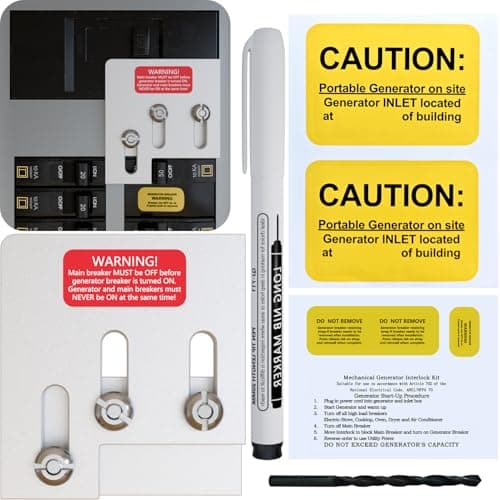
Square D QO and Homeline, 150-200A
SPZOCE Interlock Kit — Square D QO/Homeline 150/200A
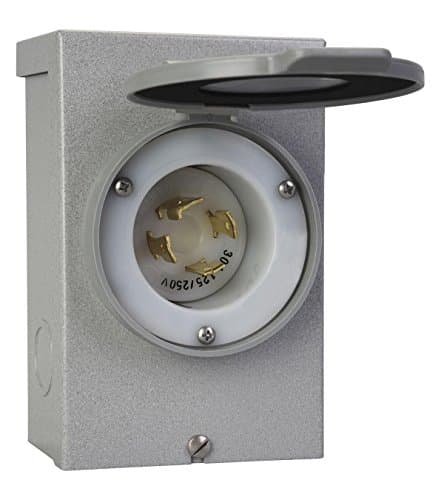
The standard 30A inlet
Reliance Controls PB30 30A Power Inlet Box
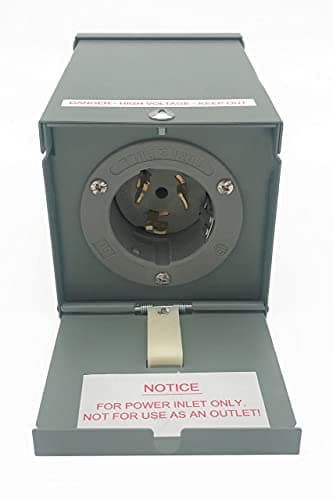
Prewired 50A inlet
Connecticut Electric EGSPI50 50A Power Inlet Box
An interlock kit for Square D QO and Homeline 150-200 A panels, a 30 A NEMA 3R inlet box the manufacturer rates for generators up to 7,500 running watts, and a prewired 50 A inlet with a spring-loaded weather door.
The inlet box end
The inlet box is where the cord plugs into the house, and its rating has to match the rest of the chain. The published figures make the two tiers obvious: Reliance's PB30 is a 30 A NEMA 3R box the manufacturer states is for generators up to 7,500 running watts; Suraielec publishes 7,500 W for its 30 A box and 12,000 W for its 50 A SS2-50P unit; Connecticut Electric's EGSPI50 is a 50 A, 120/240 V box prewired with 6-inch pigtails and a spring-loaded door for weather protection when the cable is out.
Two practical notes. The enclosure rating matters — these boxes live outdoors permanently, and NEMA 3R is the rainproof specification to look for. And a prewired box saves installation time, which is billed time, so the slightly more expensive unit can be the cheaper installation. The best generator power inlet boxes covers the field.
What about wire size?
This is the companion question, and the honest answer is that it is not a homeowner decision. Conductor sizing depends on the current, the run length, the installation method, the ambient temperature and the conductor's insulation type, and it is specified by your local adopted code — which is exactly the kind of multi-variable determination the licensed-work requirement exists for.
What you can usefully know is the order of magnitude, from the products' own published compatibility: Suraielec states its 50 A inlet is compatible with 4-6 AWG wire, and every 30 amp cord in this registry publishes 10 AWG conductors. If a quote or a plan you are looking at is far away from those figures, that is worth a question. It is not a figure to pick yourself.
Questions people actually ask
What size breaker do I need for a generator?
It follows the connection, not the engine. A generator connected through an L14-30 chain takes a 2-pole 30 A breaker and delivers about 7,200 watts at 240 volts; a 14-50 chain takes a 2-pole 50 A breaker and about 12,000 watts. Your electrician specifies the final breaker against your local adopted code.
What size breaker for a generator interlock kit?
A 2-pole breaker matching your connection — 30 A for an L14-30 chain, 50 A for a 14-50 — in the correct breaker type for your panel brand, installed in the position the kit requires. Interlock kits do not include the breaker, which is why this question comes up so often.
Does a bigger generator need a bigger breaker?
Not unless it has a bigger outlet. A 14,500 peak-watt machine connected through a 30 amp L14-30 chain still gets a 30 amp breaker and still delivers about 7,200 watts. If you want the extra output to reach the panel, you need a 50 amp outlet, cord, inlet and breaker — all four.
What size wire for a generator inlet box?
Not a figure to choose yourself — conductor sizing depends on current, run length, installation method, temperature and insulation type, and is specified by your local adopted code. For scale, Suraielec publishes 4-6 AWG compatibility for its 50 A inlet, and every 30 amp cord in this registry publishes 10 AWG.
Can I use a single-pole breaker for a generator?
Not for a 120/240 V generator connection. An L14-30 or 14-50 chain carries two hot legs and needs a 2-pole breaker so both are protected and both disconnect together. A TT-30 RV outlet is a single 120 V leg and is not a house connection at all.
Why won't my interlock kit fit my panel?
Almost always breaker spacing. The kits specify the required distance between the main breaker and the branch breakers because the plate's geometry depends on it — the Square D QO/Homeline kit's manufacturer tells you to verify your spacing before buying. Check it against the published requirement before ordering, not after.
Sources
- Eaton BRMIKBR Type BR mechanical interlock kit — manufacturer listingManufacturer statement that the kit meets National Electrical Code Article 702 requirements, quoted wherever this page discusses code basis.
- US Consumer Product Safety Commission — Portable Generator Information CenterThe 20-foot placement guidance that sets the minimum practical cord length referenced on this page.
Read next
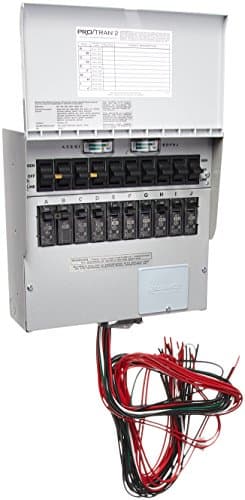
Guide
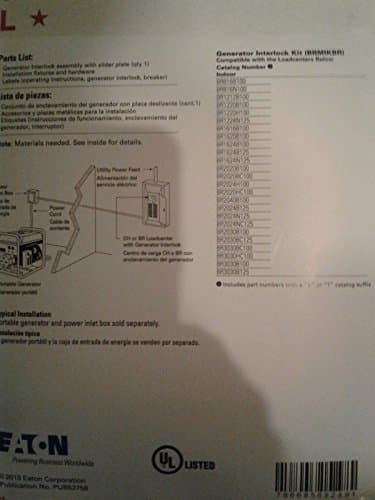
Transfer Switch Amp Rating Guide
Matching transfer switch amp rating to generator output, with the arithmetic and the whole-chain cost implications.
Reference
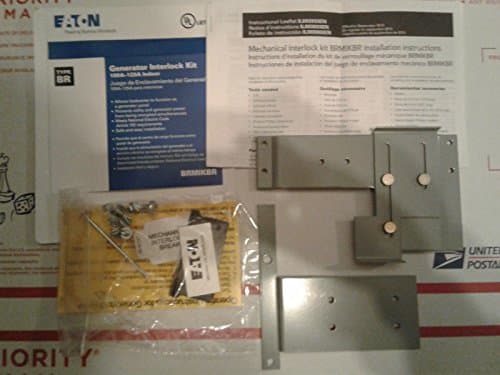
Interlock Kit Panel Compatibility
A reference table of published interlock breaker-spacing figures by panel brand and amperage, plus how to identify your panel.
Best Interlock Kit
The Best Generator Interlock Kits
Interlock kits by panel brand with the published breaker-spacing figures, and the factory kit that removes fit risk.
Top pick · Eaton BRMIKBR Factory Interlock Kit 100-125A
$98.21See the BRMIKBR Factory Interlock Kit 100-125A on Amazon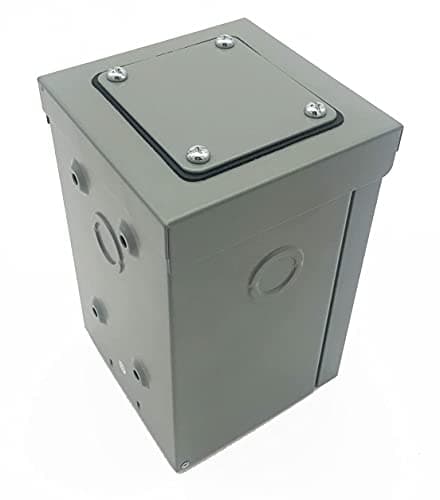
Best Inlet Box
The Best Generator Power Inlet Boxes
Power inlet boxes ranked on enclosure rating, wiring room and connector match, for 30A and 50A installations.
Top pick · Connecticut Electric EGSPI50 50A Power Inlet Box
$62.95See the EGSPI50 50A Power Inlet Box on Amazon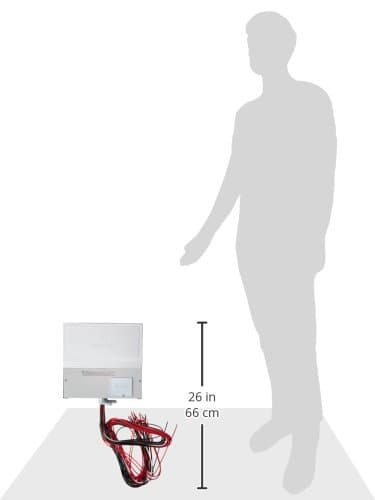
Guide
Do I Need to Ground My Generator?
Generator grounding resolved from OSHA's published guidance: when the frame suffices, when a ground rod is required, and what a transfer switch changes.