Outage Prep
How to Quiet a Generator
Distance is the only free lever that works, and it is the one most people have not used yet.
Written byMike M.
Published
Disclosure: we earn a commission on purchases made through links on this page, at no cost to you. It does not affect what we recommend or what we say about it — how we are funded.
The short answer
- 1Move it further away. Sound falls off with distance, and this is both the biggest single improvement and free.
- 2Point the exhaust at open ground, away from walls and fences that reflect noise back.
- 3Put it on grass or soil rather than concrete, and keep it level so it does not drum against its own frame.
- 4Reduce the load if you can — an inverter generator throttles back and gets measurably quieter.
- 5Replace the machine, eventually. An inverter generator is 10 dBA quieter than a conventional one on published figures, which is the only change that is permanent.
There is an honest hierarchy here, and it is worth stating up front because most of the advice circulating online is in the wrong order. Nothing you can bolt on to a conventional open-frame generator makes it quiet. What you can do is reduce how much of its noise reaches you, and the lever that dominates everything else is distance.
Why distance beats every other technique
Sound spreads out as it travels, so the energy reaching any one point falls off with the square of the distance. The practical consequence is counter-intuitively large: moving a generator from 10 feet away to 20 feet away cuts the sound energy reaching you to roughly a quarter. Moving it to 40 feet cuts it again. No muffler modification, mat or enclosure comes close to that, and it costs the price of a longer cord.
Published decibel figures, for scale
- Honda EU2200i
- 48-57 dB(A) (mfr)
- Honda EU3000iS
- 50-57 dB(A) (mfr)
- Westinghouse iGen5000DFc
- As low as 52 dBA (mfr)
- Champion 4,500 W inverter
- 61 dBA (mfr)
- Westinghouse WGen14500TFc
- As low as 74 dBA (mfr)
Each manufacturer's own published claim. The stated measuring distance and load differ between brands, so these are not strictly comparable — we report them rather than normalize them. The decibel scale is logarithmic: a 10 dBA difference is roughly a halving of perceived loudness.
Look at the spread between the top and bottom rows. The gap between a small inverter and a large open-frame machine is more than 20 dBA on published figures — which is why the real answer to "how do I quiet my generator" is sometimes "you bought a loud one," and the honest fix is a different machine rather than a modification. How quiet is a quiet generator explains what these numbers mean and why they are hard to compare.
Placement: free, and underused
Where you put the machine changes what reaches your windows and your neighbors', independent of distance.
- Point the exhaust and the open side at open ground. A wall, a fence or the corner of the house behind the generator reflects sound straight back at you — and corners are worse than flat walls because they concentrate it.
- Use the house's own geometry. A generator around the corner from your bedroom is quieter in that bedroom than one the same distance away in line of sight, because the structure blocks the direct path.
- Grass or soil, not concrete. Hard surfaces reflect; soft ground absorbs some of what hits it. A driveway is the most reflective surface available.
- Level and stable. A machine rocking on uneven ground adds mechanical rattle to engine noise, and rattle is the part that carries into a house as a buzz.
- Away from the neighbor's wall too. The best position for you may be the worst for them. This is worth five minutes of thought before an outage rather than an argument during one.
All of this only works if you have a cord long enough to put the machine where you want it, which is the same constraint as correct placement for safety. A 50-foot 10 AWG cord with a published IP65 rating covers most houses; a 100-foot ETL-listed cord with a jacket rated from -40 F to 221 F covers a long driveway in a hard winter. The quiet and the safe positions are usually the same position, which is convenient.
Load, and the thing an inverter does that a conventional machine cannot
A conventional generator runs its engine at a fixed speed — typically 3,600 rpm — whatever the load, because the engine speed sets the output frequency. It is therefore exactly as loud running a phone charger as running your whole essential load.
An inverter generator decouples the two: it generates at whatever speed it likes and synthesizes clean 60 Hz output electronically, so it can throttle down when demand falls. Westinghouse publishes as low as 52 dBA for the iGen5000DFc from a double-insulated cover, muffler and variable-speed engine, and states the inverter technology cuts fuel use up to 50% versus a conventional generator. The noise and the fuel savings come from the same mechanism.
Which gives you a usable lever: on an inverter machine, turning off what you do not need actually makes it quieter, not just cheaper to run. On a conventional machine it does neither.
The two permanent fixes
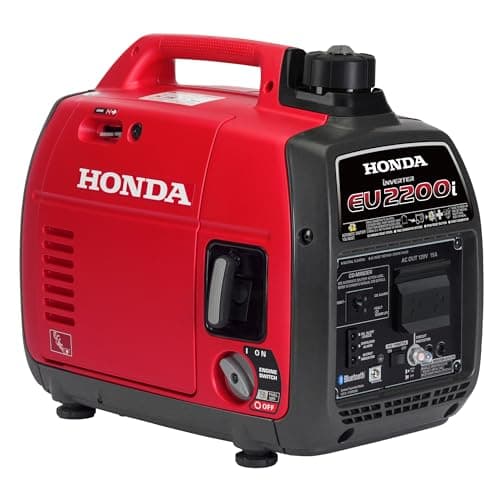
The quietest credible option
Honda EU2200i 2,200W Inverter
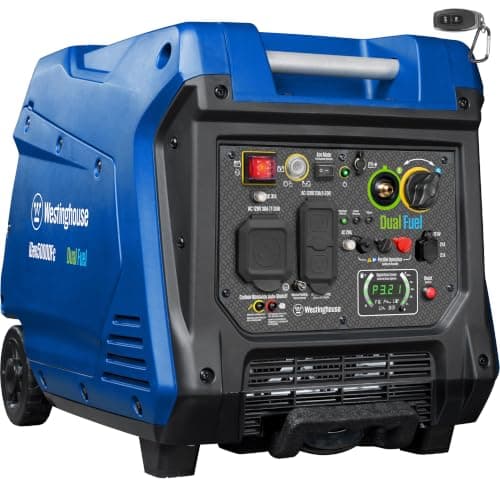
Quietest dual fuel at 4,000 running watts
Westinghouse iGen5000DFc 5,000W Dual Fuel Inverter
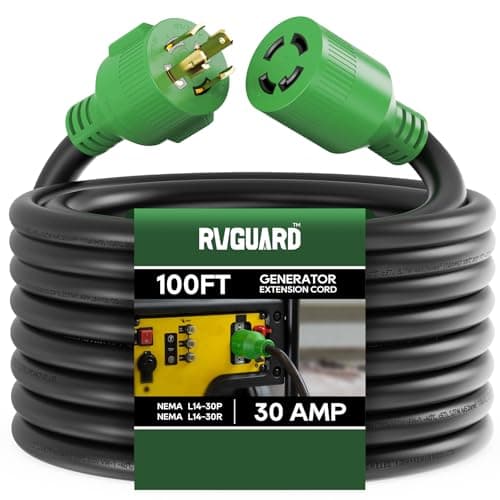
Very long runs
RVGUARD 100 ft 30A L14-30 Cord, ETL Listed
The quietest credible option at a published 48-57 dB(A), a dual fuel inverter at a published 52 dBA that will carry real household loads, and the 100-foot cord that lets any machine sit far enough away to stop being the problem.
The ideas that do not work, and the one that is dangerous
Two more to set aside. Exhaust modifications — aftermarket mufflers, extensions into buckets of water, improvised silencers — alter exhaust back-pressure in ways the engine was not designed for, can void your warranty, and move the exhaust outlet somewhere the manufacturer did not intend. The potential gain is a few decibels; the risk includes redirecting carbon monoxide somewhere worse.
Anti-vibration mats do a small, real job: they stop the frame drumming against a hard surface, which is worth doing if your generator sits on concrete. They do nothing about engine and exhaust noise, which is most of what you are hearing. Treat them as a finishing touch after distance and placement, not as a solution.
A running cover is not an enclosure
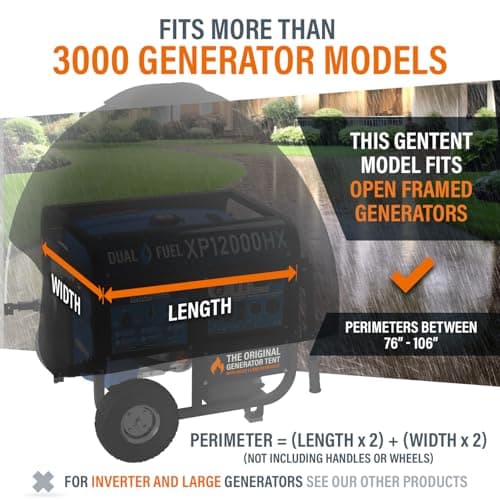
Worth separating these, because they look superficially similar. A purpose-built running cover is an elevated canopy with open sides, designed to shed rain while passing cooling air and clearing the exhaust — the manufacturers state explicitly that they are for operating the generator in rain, snow, ice and sleet. It is not a noise product and it is not a sealed box. The best generator covers covers what makes one safe to leave on while running.
The summary, then: there is no modification that makes a loud generator quiet. There is a free change of position that halves or quarters what reaches you, there is an inverter machine that is genuinely 10 to 20 dBA quieter on published figures, and there is a dangerous idea you should put out of your mind. The best quiet inverter generators for home backup is where to look if the machine itself is the problem.
Questions people actually ask
How can I make my generator quieter?
Move it further away first — sound energy falls off with the square of distance, so doubling the distance cuts it to roughly a quarter, and nothing else comes close. Then point the exhaust and the open side at open ground, put it on soil rather than concrete, and keep it level. On an inverter machine, reducing the load also reduces the noise.
Can I build a box around my generator to quiet it?
No. An enclosure traps and concentrates carbon monoxide, blocks the cooling airflow an air-cooled engine needs, and puts material against a hot exhaust. It is the most commonly suggested fix online and the most dangerous one. Buy distance or buy a quieter machine instead.
How much quieter is an inverter generator?
On published figures, roughly 10 to 20 dBA quieter than a large open-frame machine — Honda publishes 48 to 57 dB(A) for the EU2200i and Westinghouse publishes as low as 74 dBA for the WGen14500TFc. Because the decibel scale is logarithmic, 10 dBA is about a halving of perceived loudness. The brands measure at different distances and loads, so treat the comparison as directional.
Do anti-vibration mats quiet a generator?
A little, and only one component of the noise. A mat stops the frame drumming against a hard surface, which is worth doing on concrete, but it does nothing about engine and exhaust noise, which is most of what you hear. It is a finishing touch, not a fix.
Will a quieter muffler help my generator?
Not enough to justify it. Aftermarket exhaust modifications change back-pressure in ways the engine was not designed for, can void the warranty, and may redirect exhaust somewhere worse. The gain is a few decibels against a real carbon monoxide and reliability risk.
Does running a generator at lower load make it quieter?
On an inverter generator, yes — it throttles the engine down when demand falls, which is where both its quietness and its fuel savings come from. On a conventional generator, no: the engine runs at a fixed speed to hold the output frequency, so it is as loud at light load as at full load.
Sources
- US Consumer Product Safety Commission — Portable Generator Information CenterThe placement, never-indoors and CO-alarm guidance this site repeats on every generator page.
- Ready.gov — Power OutagesFederal preparedness guidance on outage planning referenced in the checklist sections.
Read next
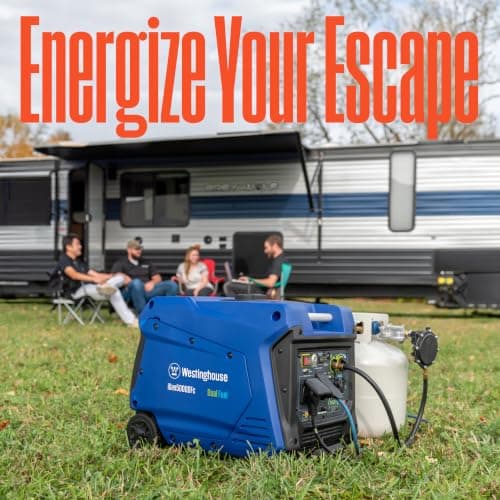
Guide
How Quiet Is a Quiet Generator?
Published decibel ratings side by side with their measurement conditions, and what a dB difference actually means.

Best Quiet Inverter
Best Quiet Inverter Generators for Home Backup
Inverter generators ranked on published noise and THD figures, with the brands that publish no measurable claim named.
Top pick · Westinghouse iGen5000DFc 5,000W Dual Fuel Inverter
$999.00See the iGen5000DFc 5,000W Dual Fuel Inverter on Amazon23% off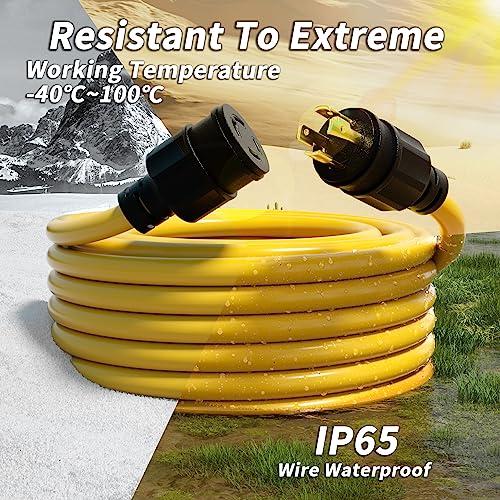
Reference
How Far Should a Generator Be From the House?
The published 20-foot minimum, what the distance is actually protecting against, and the cord and connection choices that make it achievable.
Best Running Cover
Best Generator Covers for Running in Rain
Running covers for generators ranked on published fit range, water shedding and setup — plus why a storage cover is not one.
Top pick · GenTent Universal Open Frame Generator Tent
$159.99See the Universal Open Frame Generator Tent on Amazon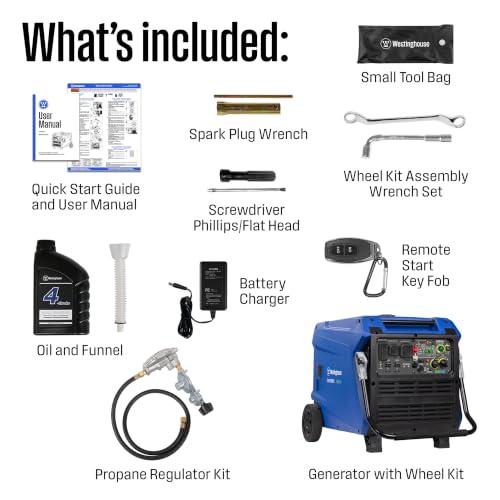
Inverter vs Conventional
Inverter vs Conventional Generator
Inverter against conventional generators on published noise, THD, fuel economy and output per dollar.