Model Reviews
Champion Generators Reviewed
The brand that publishes the numbers its competitors leave out — and the one range here where every machine states a decibel figure with a distance.
Written byMike M.
Published
Disclosure: we earn a commission on purchases made through links on this page, at no cost to you. It does not affect what we recommend or what we say about it — how we are funded.
The short answer
Champion is the best-documented generator brand in this registry: it publishes running and starting watts for every fuel it supports, decibel figures with a stated measuring distance, and a 3-year limited warranty with lifetime technical support on its machines. For home backup the pick is the 11,500 W dual fuel at 9,200 running watts on gasoline and 8,280 on propane with CO Shield shutdown. The 12,500 W tri-fuel is the one to buy if you have a gas line, and it ships with both the propane and natural gas hoses.
Brand reviews usually turn into a list of models. The more useful question about Champion is why its spec sheets read differently from everyone else's, because that is what you are actually buying: where DuroMax publishes peak watts and leaves the running figure blank, and where WEN describes its noise by comparison rather than measurement, Champion publishes the number — per fuel, with units, and with the condition attached.
The range, as published
| Model | Running watts | Starting watts | Noise | CO shutdown | Weight |
|---|---|---|---|---|---|
| 12,500 W Tri-Fuel | 10,000 W gas / 9,000 LP / 8,000 NG | 12,500 W gas | Not published | CO Shield | 231 lb |
| 11,500 W Dual Fuel | 9,200 W gas / 8,280 LP | 11,500 W gas | Not published | CO Shield | 209 lb |
| 11,000 W Inverter | 9,000 W | 11,000 W | 64 dBA at 23 ft | CO Shield | 200 lb |
| 4,500 W Dual Fuel Inverter | 3,500 W gas | 4,500 W gas | 61 dBA | CO Shield | 99.2 lb |
| 4,500 W RV Ready Inverter | 3,500 W | 4,500 W | 61 dBA | CO Shield | 92.2 lb |
| 2,500 W Ultralight Inverter | 1,850 W | 2,500 W | 53 dBA at 23 ft | Not listed | 39.7 lb |
Read the first two rows against each other, because that is the real Champion decision. The tri-fuel machine adds 800 running watts on gasoline and a natural gas capability for a meaningful premium; the dual fuel machine is lighter by 22 lb and costs less. Everything else about them — CO Shield, Intelligauge, electric start, the warranty — is shared.
Why the 11,500 W dual fuel is the pick for a house
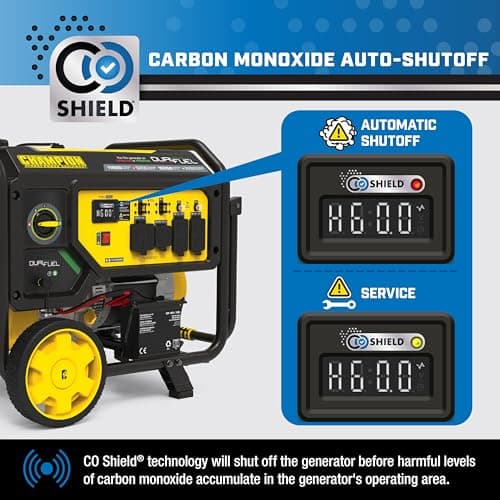
Champion publishes 9,200 running and 11,500 starting watts on gasoline, 8,280 running and 10,350 starting on propane, from a 459cc engine with electric start and the battery included. It carries CO Shield carbon monoxide auto shutoff, Intelligauge metering for voltage, hertz and run hours, and Volt Guard surge protection, under a 3-year limited warranty with lifetime technical support.
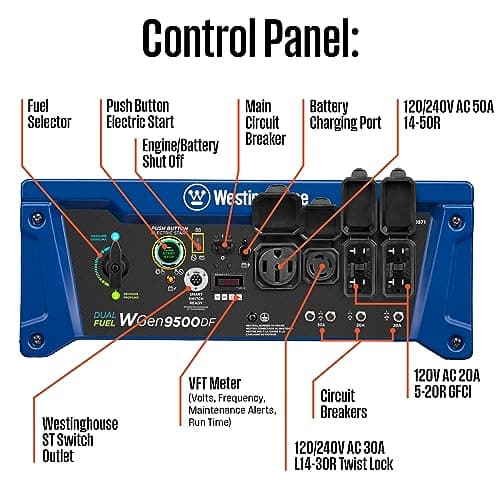
Nine thousand two hundred running watts covers the load most houses actually have: a well pump, a furnace blower, a refrigerator, a freezer and a great deal of lighting, with the starting headroom to bring the pump online while the rest is running. Against the class leaders it gives up a little — Westinghouse's WGen9500DF publishes 9,500 — and it answers with a published propane figure, a CO shutoff the Westinghouse lacks and support that is genuinely easier to reach.
Two things to be clear about. Volt Guard protects the generator, not your appliances — it is not a whole-house surge protector, and reading it that way is a mistake. And at 209 lb this is a two-person move on anything but flat, dry ground.
What Intelligauge, CO Shield and Cold Start actually do
- Intelligauge displays voltage, frequency and accumulated run hours. The run-hour counter is the useful part: it is the only way to service the machine on the published schedule rather than by memory. The generator maintenance schedule uses exactly those hours.
- CO Shield shuts the engine down when it detects carbon monoxide accumulating around the machine. It is a backstop for a placement mistake, not permission to run it closer to the house. Every clearance rule stands.
- Cold Start Technology, published on the 11,000 W inverter, is the feature that addresses the actual January scenario — a machine that has been standing in the cold being asked to start immediately.
- Lifetime technical support is unusual in this category and it is a real differentiator when something will not start at 2 a.m. on day three of an outage.
The inverters, and the one specification that separates them
Champion's inverter line is where the brand's documentation habit pays off most. The 4,500 W RV Ready inverter publishes 3,500 running watts, 61 dBA, up to 14 hours of runtime, under 3% THD and a 29.2 A RV outlet alongside a household duplex, at 92.2 lb. The 4,500 W dual fuel inverter is the same machine with propane capability for 7 lb and a price premium — and Champion does not publish its propane running figure, which is the one gap in an otherwise exemplary spec sheet.
The 11,000 W inverter is the serious one: 9,000 running watts, 64 dBA measured at 23 feet, up to 15 hours per tank, wireless remote start from up to 80 feet, Cold Start, CO Shield and a 459cc engine. It is the only machine in this registry that publishes how far its remote works, which is why it tops the best generators with remote start. Its honest flaws are gasoline-only operation at a dual-fuel price and an unusual 120/240 V 37.5 A outlet that you must check against your inlet and cord.
At the other end, the 2,500 W ultralight publishes 1,850 running watts, 53 dBA at 23 feet and 39.7 lb, with one AC duplex and no CO shutoff listed. It is the best-documented ultralight here and it is not a house generator — it is a fridge, some lamps and devices.
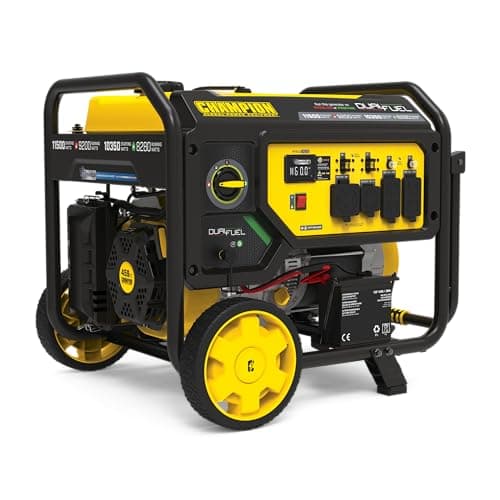
- Running watts
- 9,200 W gas / 8,280 W LP
- Starting watts
- 11,500 W gas
- CO shutdown
- CO Shield
#1 · Published propane numbers you can plan on
Champion 11,500W Dual Fuel Electric Start
The most honestly specified generator in its class, with CO shutoff and the best after-sale support in the category.
#ad Price as of November 19, 2026; it may have changed since. How we are funded.
Why we picked it
- Champion publishes running AND starting watts on both fuels, which makes honest sizing possible — many brands do not
- Intelligauge hour tracking makes the maintenance schedule something you can actually follow
- Lifetime technical support is a real, usable thing when you are troubleshooting at 2am in an outage
Good to know
- 209 lb
Published specification & our scoring
- 9,200 running / 11,500 starting watts on gasoline (manufacturer)
- 8,280 running / 10,350 starting watts on propane (manufacturer)
- 459cc Champion engine, electric start with included battery
- CO Shield carbon monoxide auto shutoff
- Intelligauge: voltage, hertz and run-time hours
- Volt Guard surge protection
- 3-year limited warranty with lifetime technical support (manufacturer)
- Published weight 209 lb
- Output headroom
- 9
- Fuel flexibility
- 9
- Transfer-switch fit
- 9
- Runtime
- 8
- Safety features
- 9
- Value
- 9
Specification figures are the manufacturer’s published values. Scores are our editorial judgment from those figures and are never published as structured review data — how we pick.
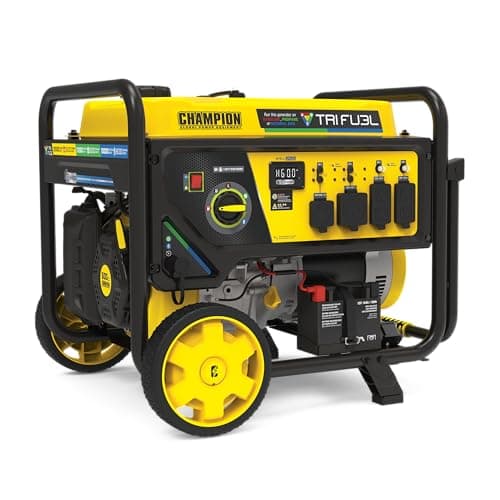
- Running watts
- 10,000 W gas / 8,000 W NG
- Starting watts
- 12,500 W gas
- Hoses
- LP + NG included
#2 · Tri-fuel with both hoses in the box
Champion 12,500W Tri-Fuel Home Backup
The most complete tri-fuel package on the shelf: three fuels, both hoses, every output figure published, CO shutdown included.
#ad Price as of November 19, 2026; it may have changed since. How we are funded.
Why we picked it
- Both fuel hoses are included — on most tri-fuel machines you buy them separately and discover that on delivery day
- Publishes all three fuels' running and starting watts, so you can size against your actual fuel plan
- 10,000 running watts on gasoline is top of this class
Good to know
- 231 lb
Published specification & our scoring
- Gasoline: 12,500 starting / 10,000 running watts (manufacturer)
- Propane: 11,250 starting / 9,000 running watts (manufacturer)
- Natural gas: 10,000 starting / 8,000 running watts (manufacturer)
- Natural gas AND propane hoses included in the box (manufacturer)
- 500cc Champion engine, electric start, battery included
- Intelligauge plus CO Shield auto shutoff
- Published weight 231 lb
- Output headroom
- 10
- Fuel flexibility
- 10
- Transfer-switch fit
- 9
- Runtime
- 10
- Safety features
- 9
- Value
- 8
Specification figures are the manufacturer’s published values. Scores are our editorial judgment from those figures and are never published as structured review data — how we pick.
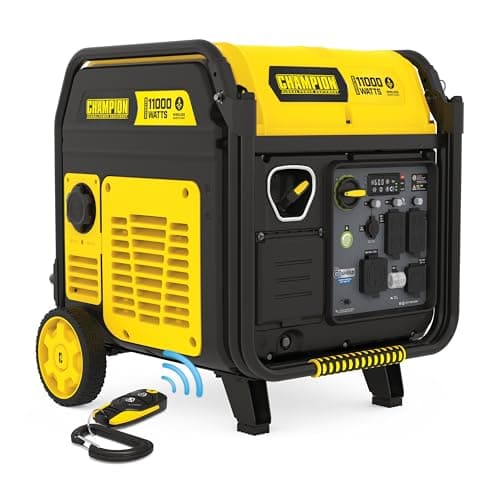
- Running watts
- 9,000 W
- Noise
- 64 dBA at 23 ft (mfr)
- Runtime
- Up to 15 h (mfr)
#3 · Quiet whole-house, gasoline
Champion 11,000W Remote Start Inverter
A quiet, well-documented 9,000-running-watt inverter whose Cold Start Technology is more useful than the spec sheet suggests — but it only runs on gasoline.
#ad Price as of November 19, 2026; it may have changed since. How we are funded.
Why we picked it
- Champion publishes the dBA figure and the measurement distance, which most of its rivals do not
- Cold Start Technology matters — a winter outage is exactly when a generator refuses to start
- 9,000 running watts of inverter power with 15-hour runtime
Good to know
- 200 lb
Published specification & our scoring
- 11,000 starting / 9,000 running watts (manufacturer)
- 64 dBA from 23 feet; up to 15 hours on a full tank (manufacturer)
- 459cc Champion engine with Cold Start Technology, electric start, battery included
- Wireless remote start from up to 80 feet
- CO Shield auto shutoff
- Two 120V 20A GFCI duplex, one 120/240V 30A locking, one 120/240V 37.5A, one 12V
- Published weight 200 lb
- Output headroom
- 9
- Power quality
- 9
- Noise
- 9
- Runtime
- 9
- Fuel flexibility
- 4
- Value
- 6
Specification figures are the manufacturer’s published values. Scores are our editorial judgment from those figures and are never published as structured review data — how we pick.
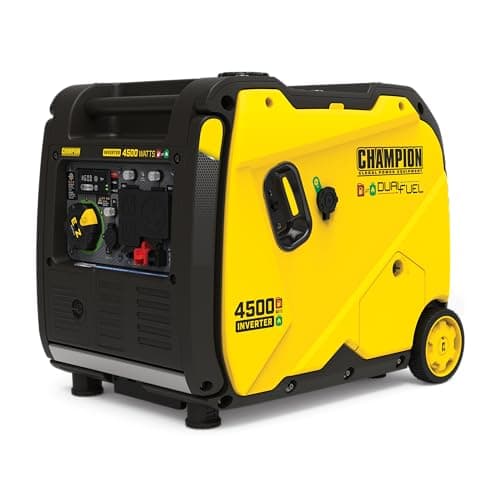
- Running watts
- 3,500 W
- Noise
- 61 dBA (mfr)
- Fuel
- Gas / propane
#4 · Quiet plus a propane contingency
Champion 4,500W Dual Fuel Inverter
The gas-only Champion 4500 with a propane option added — worth the premium if your outage plan runs on tanks rather than trips to a gas station.
#ad Price as of November 19, 2026; it may have changed since. How we are funded.
Why we picked it
- Propane capability on a quiet inverter is the best of both worlds for a multi-day outage
- Propane stores indefinitely, which is the single biggest practical advantage over gasoline
- The EZ Start dial removes the choke-and-pray step
Good to know
- Only 7 lb heavier than the gas-only version, but meaningfully more expensive
Published specification & our scoring
- 4,500 starting / 3,500 running watts (manufacturer)
- Dual fuel — gasoline or propane out of the box
- 61 dBA; up to 14 hours on gasoline at 3,500 running watts, up to 21 hours on propane at 3,150 running watts (manufacturer)
- CO Shield auto shutoff, electric start with EZ Start dial
- Intelligauge with power meter
- Parallel ready; published weight 99.2 lb
- Noise
- 8
- Power quality
- 9
- Fuel flexibility
- 9
- Output
- 7
- Safety features
- 9
- Value
- 8
Specification figures are the manufacturer’s published values. Scores are our editorial judgment from those figures and are never published as structured review data — how we pick.
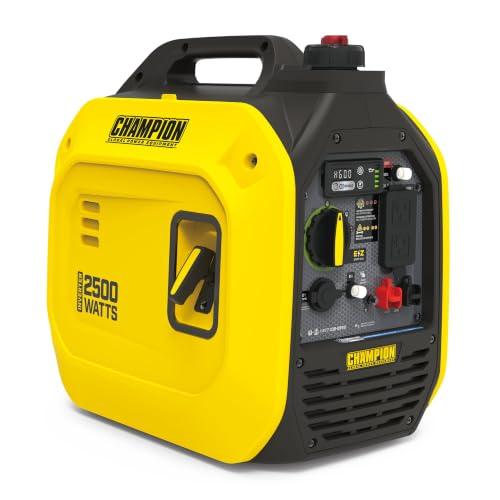
- Running watts
- 1,850 W
- Noise
- 53 dBA at 23 ft (mfr)
- Weight
- 39.7 lb
#5 · Published 53 dBA at 39.7 lb
Champion 2,500W Ultralight Inverter
The best-documented ultralight inverter: a real 53 dBA figure at a stated distance, 39.7 lb, and a parallel path if you need more later.
#ad Price as of November 19, 2026; it may have changed since. How we are funded.
Why we picked it
- 53 dBA with the measurement distance stated — directly comparable to Honda's figures, unlike most rivals
- Parallel capability doubles output later for the cost of a kit rather than a second category of purchase
- Lifetime technical support
Good to know
- Only one AC duplex outlet
Published specification & our scoring
- 2,500 starting / 1,850 running watts (manufacturer)
- 53 dBA from 23 feet (manufacturer)
- Manufacturer states it is one of the lightest 2,500-watt inverters in the industry at 39.7 lb
- 120V 15.4A household duplex (5-20R) at under 3% THD, plus a 12V automotive outlet
- Parallel ready with another 2,500W Champion inverter
- 3-year limited warranty with lifetime technical support
- Output
- 4
- Power quality
- 9
- Portability
- 10
- Noise
- 9
- Safety features
- 5
- Value
- 7
Specification figures are the manufacturer’s published values. Scores are our editorial judgment from those figures and are never published as structured review data — how we pick.
What Champion does not publish
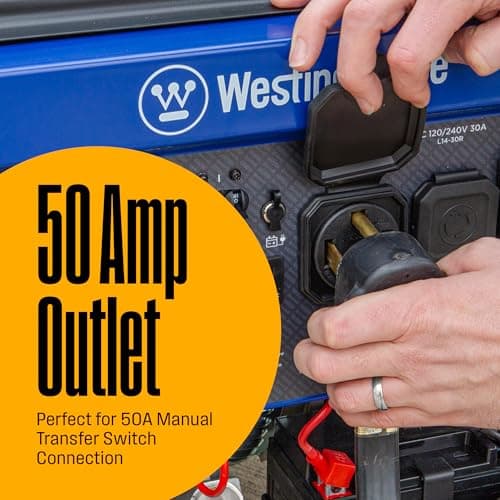
Three gaps, stated plainly because the brand's strength is documentation and these are the places it stops. There is no dBA figure for either open-frame machine, so the 11,500 W dual fuel and the 12,500 W tri-fuel cannot be compared on noise with the inverters. There is no propane running figure for the 4,500 W dual fuel inverter. And the outlet configuration is not listed on the tri-fuel machine, which matters if you are planning a 50 amp connection around it.
None of those is unusual in the category — most brands leave more blank — but a buyer should know where the sheet ends. Where a figure is missing here, the table above says "not published" rather than carrying an estimate.
The accessories that only work with a Champion
Champion's parallel kit links two of its own inverters of 2,500 W or higher with a clip-on connection and a 50 A RV outlet, which the manufacturer states is enough to start and run two 15,000 BTU RV air conditioners. It is Champion-only: it will not link a Champion to a Honda or a WEN, and the combined output is still 120 V, so it does not create a 240 V supply for a transfer switch.
The Champion connection kit
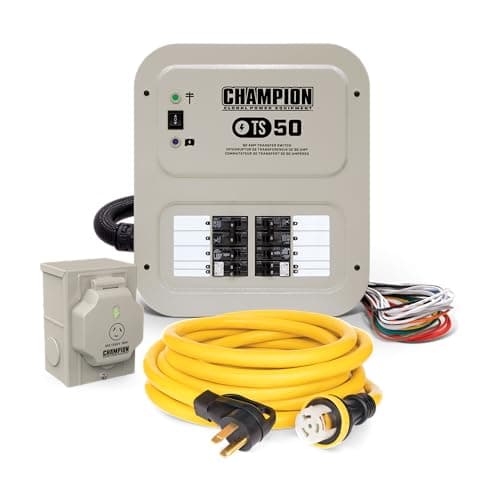
UL 1008 certified with a 30 ft cord
Champion 201193 50A 10-Circuit with Cord
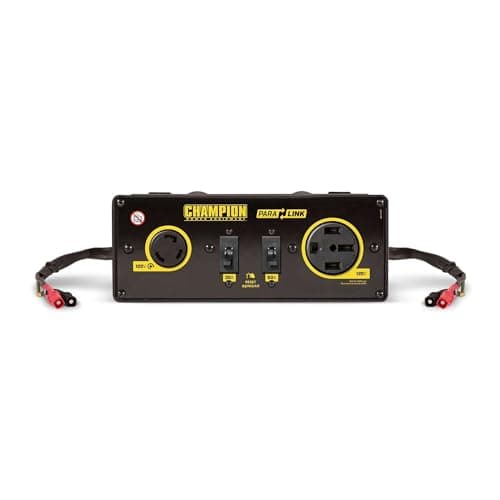
Doubling two Champion inverters
Champion ParaLINK 50A Parallel Kit
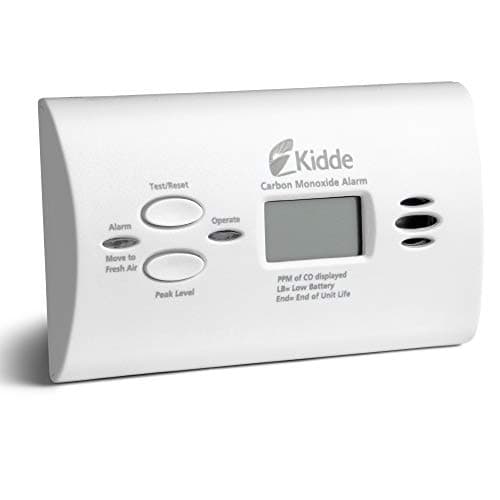
The one accessory nobody should skip
Kidde KN-COPP-B-LPM Battery CO Alarm
A UL 1008 certified 50 A 10-circuit transfer switch, prewired with labeled wires and a 30 ft cord and inlet box included; the ParaLINK kit for doubling two Champion inverters; and the battery CO alarm every combustion machine needs regardless of brand. The switch is indoor-rated, so it lives in a garage or basement rather than on an exterior wall.
For the brand-to-brand comparison rather than the range, the best generator brands compared sets Champion against Westinghouse, DuroMax, Generac, WEN and Honda on the specifications each one publishes. Westinghouse generators reviewed is the equivalent page for Champion's closest competitor, and DuroMax generators reviewed is the direct counterpoint — the brand that builds heavier frames and publishes far fewer numbers.
Brands: want your product tested? For Brands.
Questions people actually ask
Are Champion generators good?
They are the best-documented machines in this registry: running and starting watts published for every fuel, decibel ratings with a stated distance on the inverters, CO Shield shutdown across the range, and a 3-year limited warranty with lifetime technical support. Where rivals publish a peak figure and leave the running figure blank, Champion publishes both.
Which Champion generator is best for home backup?
The 11,500 W dual fuel: 9,200 running watts on gasoline and 8,280 on propane, 459cc, electric start with the battery included, CO Shield, Intelligauge and Volt Guard. If you have a natural gas line, the 12,500 W tri-fuel publishes 8,000 running watts on gas and includes both the LP and NG hoses.
How loud is a Champion generator?
Champion publishes 53 dBA at 23 feet for the 2,500 W ultralight, 61 dBA for both 4,500 W inverters and 64 dBA at 23 feet for the 11,000 W inverter. It does not publish a decibel figure for either open-frame machine, so the 11,500 W dual fuel and 12,500 W tri-fuel cannot be compared on noise.
What is Volt Guard on a Champion generator?
A built-in surge protector that guards the generator's own electrical system against voltage spikes. It protects the machine, not the appliances plugged into it — treating it as a whole-house surge protector is a misreading, and sensitive electronics still want an inverter machine or their own protection.
Can you connect two Champion generators together?
Yes, with the ParaLINK kit, which links two Champion inverters of 2,500 W or higher and provides a 50 A RV outlet. It only works between Champion inverters, and the parallel output is 120 V — it does not create the 240 V supply a house transfer switch needs.
What warranty do Champion generators come with?
A 3-year limited warranty with lifetime technical support on the machines in this registry. The technical support is the unusual part and it is genuinely useful: it is the brand difference you notice when a machine will not start during an outage rather than when you are comparing spec sheets.
Sources
- Eugene Water & Electric Board — Generator Sizing ConsiderationsPublished appliance running and additional-starting watt figures used to judge what this machine's output actually covers.
- US Consumer Product Safety Commission — Portable Generator Information CenterThe placement and carbon monoxide guidance referenced in the safety notes on this page.
Read next
Brand Comparison
Generator Brands Compared, Model by Model
Each major brand's best home backup generator compared on published specifications, with omissions marked.
Review
Westinghouse Generators Reviewed
Westinghouse's range read end to end — ten machines from 1,000 to 11,500 running watts — with the per-fuel figures, the outlets, and which models skip the CO shutdown.
Best Overall Home Backup
The Best Home Backup Generators
Nine conventional-frame generators ranked for whole-house backup, with per-fuel running watts and transfer-switch fit.
Top pick · Westinghouse WGen9500DF 12,500W Dual Fuel
$999.00See the WGen9500DF 12,500W Dual Fuel on Amazon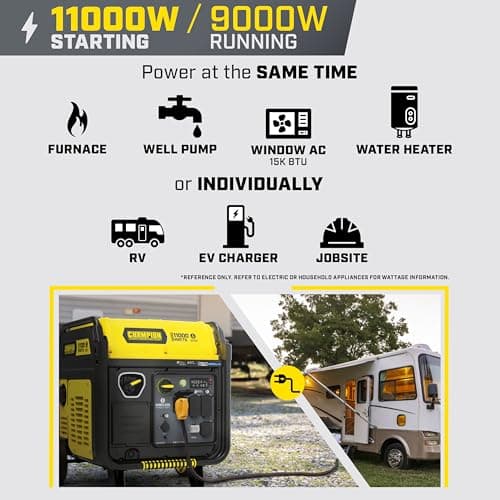
Best Remote Start
The Best Generators With Remote Start
Seven generators with a published remote or key-fob start, ranked on remote range, running watts and fuel — plus what remote start does not do.
Top pick · Champion 11,000W Remote Start Inverter
$1,899.00See the 11,000W Remote Start Inverter on Amazon
Best Quiet Inverter
Best Quiet Inverter Generators for Home Backup
Inverter generators ranked on published noise and THD figures, with the brands that publish no measurable claim named.
Top pick · Westinghouse iGen5000DFc 5,000W Dual Fuel Inverter
$999.00See the iGen5000DFc 5,000W Dual Fuel Inverter on Amazon23% off
Review
DuroMax Generators Reviewed
DuroMax's home backup range read end to end: eight machines plus the DuroStar value model, the features that are genuinely better than rivals, and the one figure the brand will not publish.