Generators
The Best Generator for a Food Truck
A service day is six to ten hours at a steady load — a completely different problem from backing up a house, and not one the peak-watt number on the box solves.
Written byMike M.
Published
Disclosure: we earn a commission on purchases made through links on this page, at no cost to you. It does not affect what we recommend or what we say about it — how we are funded.
The short answer
| Your truck | The published fit | Why |
|---|---|---|
| Cooks on propane, 30 A shore inlet | Westinghouse iGen5000DFc | 3,900 running watts on gas, 52 dBA, a TT-30R, and dual fuel so it shares your tanks |
| Any electric cooking, or a 240 V panel | WEN DF680iX | 5,100 rated watts on gas, plus both an L14-30R and a TT-30R |
| Full electric kitchen or a 50 A inlet | Westinghouse iGen12000DFc | 9,000 running watts on gas and a 14-50R |
| Coffee, dessert or market cart | Westinghouse iGen2550DFc | 1,900 rated watts, 42 lb, 52 dBA |
Manufacturer published figures from each product's live listing data. There is no single answer here because the two things that decide it — what your equipment draws and what connector your truck is wired for — are facts about your truck, not about the generator.
Almost every generator roundup written for a food truck ranks machines by the big number on the box. That number is the peak or surge rating, it lasts a few seconds, and it is close to irrelevant to mobile food service. A truck does not need a brief surge once a day when the grid fails. It needs to hold a steady load for the whole of a six to ten hour service, every service, and then do it again tomorrow.
That changes which specifications matter. Three facts about your truck settle the purchase, and none of them is the peak watt rating.
- 1What does your equipment actually draw, from its data plates? Not from a chart on the internet — from the plates. Commercial refrigeration, a hood fan and a water heater draw considerably more than their domestic equivalents, and the nameplate is the only number that is true of your truck.
- 2What connector is your truck wired for? A 30 A TT-30 shore inlet, a 240 V L14-30, or a 50 A 14-50. Buying a generator whose published outlets do not include yours means an adapter chain, and an adapter chain carrying 30 amps for ten hours a day is a genuine hazard rather than an inconvenience.
- 3Does your cooking already run on propane? If it does, a dual fuel generator can run on the same fuel you already buy, store and refill, and the published propane runtimes on these machines are long. If you cook on propane, a gasoline-only generator means carrying a second fuel for no reason.
Why this page gives you a method instead of a wattage table
Most food truck generator pages print a table of equipment wattages. This one will not, because we do not have verified published figures for commercial food service equipment and we are not going to invent them. A "commercial reach-in cooler: 800 W" row is a guess dressed up as data, and if you size a generator from it and come up short, the guess cost you a service day.
What we can give you is the arithmetic, which you can run against your own data plates in about ten minutes:
- 1Add the running watts of everything that will be on at once. Refrigeration, freezer, hood fan, lights, water heater, point-of-sale, device charging, any electric warming equipment. Use the plate figure; where a plate gives amps, multiply by 120 for a 120 V circuit.
- 2Add the largest single starting surge, once. Compressors and motors draw several times their running figure for a second or two at startup. Add only the biggest one — the odds of two compressors starting in the same instant are low, and sizing for that is how operators end up buying twice the machine they need.
- 3Do not plan to run the generator at its rated output. The running total from step one has to sit comfortably inside the generator's *running* watt rating, with headroom. A machine held at its rating for ten hours is being asked to treat its worst-case figure as a daily condition.
- 4Check the result against the running watt figure for the fuel you will use — not the peak figure, and not the gasoline figure if you are running propane. Every dual fuel pick below publishes both.
For a sanity check on the domestic-scale items — lights, a small fridge, device charging — the published figures in the appliance wattage chart are a reasonable floor. Treat them as a floor and nothing more: commercial equipment is built for duty cycle rather than for efficiency, and it draws accordingly. Starting watts vs running watts covers the surge arithmetic in step two properly.
The constraint nobody prints on the box: continuous duty
Read the published runtime figures on these machines carefully, because they are not quoted at the load you will run. Westinghouse states up to 18 hours for the iGen5000DFc and up to 19 hours for the iGen12000DFc, and both figures are explicitly at 25% load. Champion states up to 14 hours on gasoline for its 4,500 W dual fuel inverter and up to 21 hours on propane. Honda publishes a range for the EU3000iS — 6.9 to 19.6 hours — which is the honest way to do it, because the spread between light load and heavy load really is that large.
A food truck does not run at 25% load. It runs at whatever its equipment draws, for the whole service. The practical consequence is that your real refueling interval is a fraction of the headline number, and it is worth working out before you buy rather than discovering it during a lunch rush. This is also the strongest argument for the propane route: a 20 lb tank swap is a two-minute job you can do mid-service, where a hot gasoline refuel is not.
None of these machines is published as a commercial continuous-duty generator, and this page is not going to imply otherwise. They are prosumer inverter generators. What that means in practice is that running one well inside its rating, servicing it on schedule, and never treating the rated figure as a daily operating point is the difference between a machine that lasts several seasons and one that does not. The generator maintenance schedule is the relevant reading, and the intervals matter far more at ten hours a day than they do for a generator that runs twice a winter.
Match the connector before you compare anything else
This is the step most buyers skip and the one that causes the most expensive mistakes. Here is what each pick publishes, taken from its own listing:
| Generator | Published outlets | Fits a 30 A truck inlet | 240 V |
|---|---|---|---|
| Westinghouse iGen5000DFc | TT-30R 30 A, 5-20R 20 A duplex, 2 USB | Yes, directly | Only via the parallel kit |
| WEN DF680iX | L14-30R, TT-30R, two 120 V, 12 V DC, 2 USB | Yes, directly | Yes, L14-30R |
| Westinghouse iGen12000DFc | 14-50R 50 A, L14-30R 30 A, GFCI 5-20R duplex | No TT-30R published | Yes, both outlets |
| Champion 4,500 W RV Ready | 120 V 29.2 A RV outlet, 120 V 20 A duplex | Yes, 29.2 A RV outlet | No |
| Champion 4,500 W Dual Fuel | Not published on the listing | Not published | No |
| WEN 56432i | TT-30R, two 120 V, 12 V DC, 2 USB | Yes, directly | No |
| Westinghouse iGen2550DFc | TT-30R, two 120 V 20 A | Yes, directly | No |
| Honda EU3000iS | No receptacle list published | Not published | No |
Two practical notes. First, the WEN DF680iX's main published weakness elsewhere on this site is its bonded neutral, which is a real problem when feeding a house transfer switch — and is not your problem in a food truck, because you are plugging into a shore inlet rather than a service panel. That makes it a considerably better buy for a truck than its score here implies. Second, the iGen5000DFc has no 240 V outlet of its own: Westinghouse states the 240 V outlet lives on the parallel kit, which needs a second iGen5000DFc to use.
Propane is the food truck's structural advantage
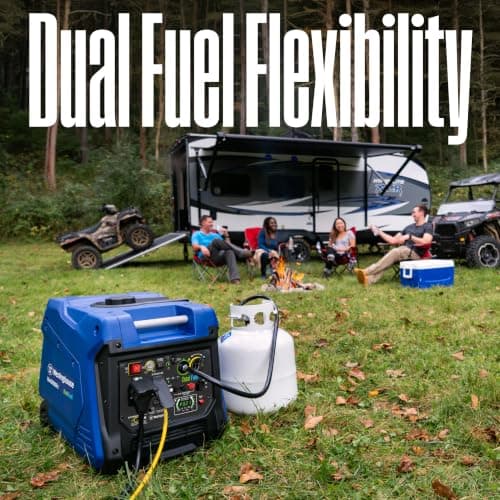
Most trucks cook on propane, because electric cooking draws more than a mobile setup can reasonably carry. If that is your truck, you already have a fuel supply chain: tanks, a supplier, a refill routine and somewhere safe to store them. A dual fuel generator plugs straight into that, and the published figures are good:
Published per-fuel running watts
- WEN DF680iX — gasoline
- 5,100 rated W
- WEN DF680iX — propane
- 4,500 rated W
- iGen5000DFc — gasoline
- 3,900 running W
- iGen5000DFc — propane
- 3,500 running W
- iGen12000DFc — gasoline
- 9,000 running W
- iGen12000DFc — propane
- 8,100 running W
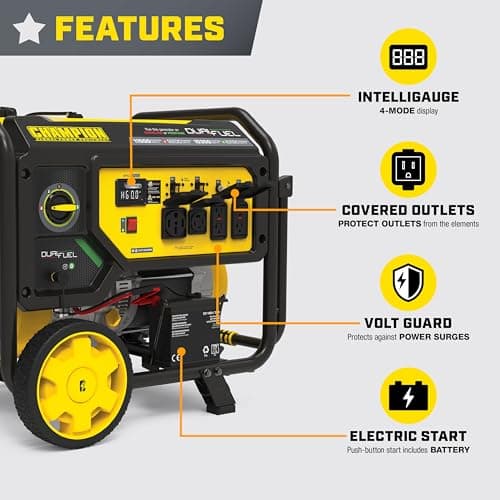
- Champion 4,500 DF — gasoline
- 3,500 running W, up to 14 h
- Champion 4,500 DF — propane
- 3,150 running W, up to 21 h
Each manufacturer's own published figures. Note the consistent pattern: propane costs roughly 10% of the running watts across all four machines. Size on the propane figure if propane is the plan, not on the gasoline one.
The 21-hour propane figure on the Champion is the longest published runtime of any pick here. The WEN DF680iX ships with a tool-free LPG quick-connector and a six-foot regulator hose, which is a small thing that matters when you are connecting and disconnecting daily.
Noise, and what it will cost you
Noise is a daily operating constraint for a truck in a way it is not for a home generator that runs twice a winter. Vending locations have rules, events have rules, and a loud machine is also a customer-experience problem when the queue is standing next to it. Here is who publishes a figure and who does not:
| Generator | Published noise | Published condition |
|---|---|---|
| Honda EU3000iS | 50-57 dB(A) | Range published, load not stated per end |
| Westinghouse iGen5000DFc | As low as 52 dBA | "As low as" — the low-load figure |
| Westinghouse iGen2550DFc | As low as 52 dBA | "As low as" — the low-load figure |
| Champion 4,500 W, both versions | 61 dBA | Single figure, condition not stated |
| Westinghouse iGen12000DFc | As low as 64 dBA | With Eco Mode engaged |
| WEN DF680iX | Not published | — |
| WEN 56432i | Not published | — |
The practical read: if the vending spot has a noise limit, or the queue stands close, the published 52 dBA machines are the defensible choice and the two WEN units are a gamble. How quiet is a quiet generator covers why a decibel figure without a distance is not really a number, and how to quiet a generator covers what can be done about one you already own.
The picks
The short answer
Quick picks
| # | Product | Best for | Score | Price |
|---|---|---|---|---|
| 1 | 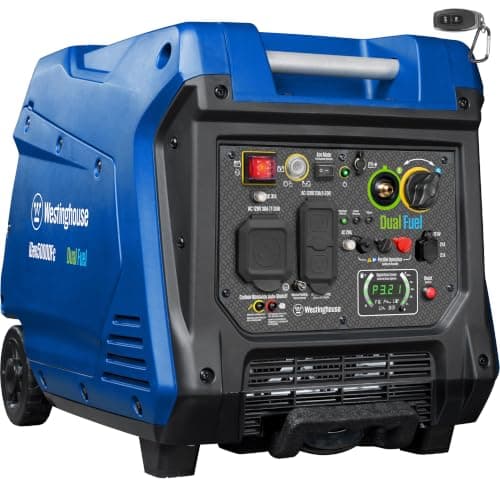 Westinghouse iGen5000DFc 5,000W Dual Fuel Inverter The quietest way to get around 4,000 running watts on either fuel, provided you are running cords rather than a transfer switch. | Quietest dual fuel at 4,000 running watts | 9.3/10 | $999.00 |
| 2 | 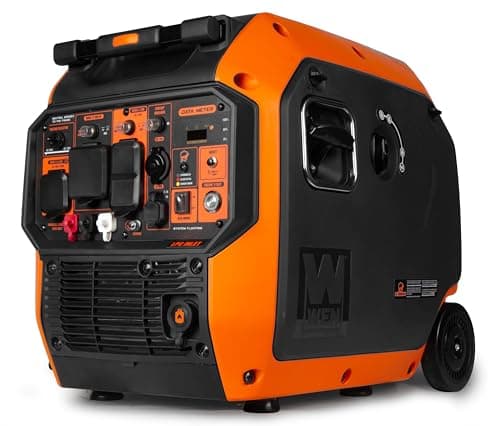 WEN DF680iX 6,800W Dual Fuel Inverter The lightest transfer-switch-capable dual fuel inverter here — with one serious caveat: its bonded neutral must be checked against your transfer switch. | Dual fuel inverter with 240V | 8.8/10 | $798.00 |
| 3 | 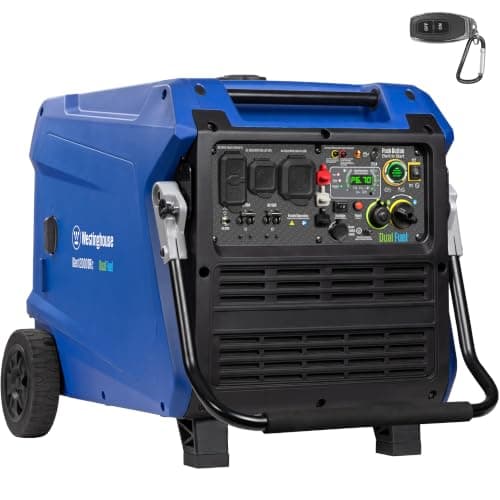 Westinghouse iGen12000DFc 12,000W Dual Fuel Inverter The best technical answer for whole-house backup if the budget allows: transfer-switch-ready output, inverter-clean power, and far less noise than the conventional alternative. | Whole-house backup with clean power | 9.5/10 | $1,899.00 |
| 4 | 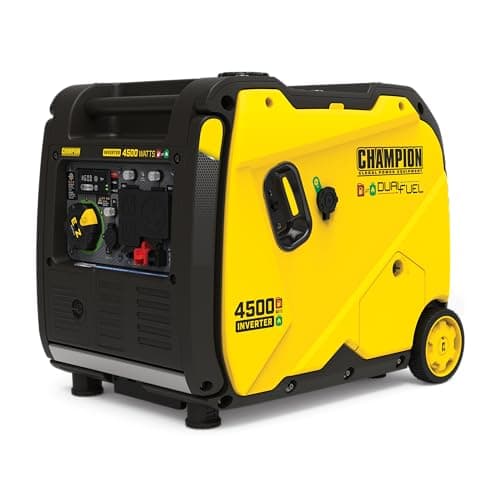 Champion 4,500W Dual Fuel Inverter The gas-only Champion 4500 with a propane option added — worth the premium if your outage plan runs on tanks rather than trips to a gas station. | Quiet plus a propane contingency | 9.2/10 | $999.00 |
| 5 | 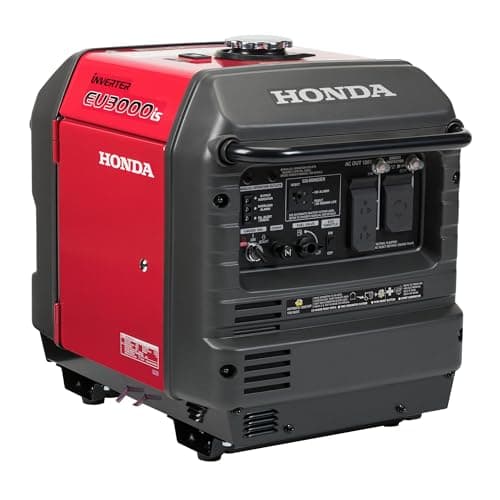 Honda EU3000iS 3,000W Inverter The quiet-at-all-costs answer for running a furnace, fridge and lighting overnight — priced accordingly. | Quiet backup for a furnace and fridge | 8.9/10 | $2,399.00 |
| 6 | 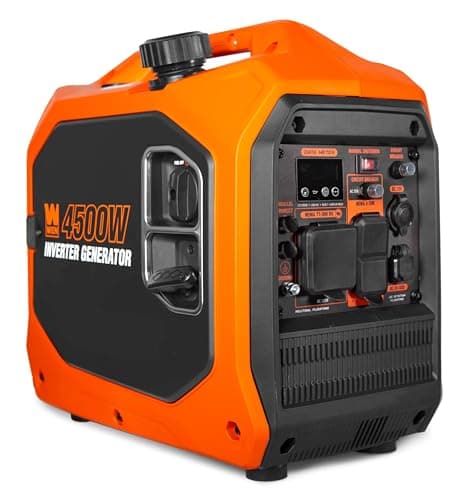 WEN 56432i 4,500W Inverter The cheapest route to 3,600 watts of clean inverter power at a weight one person can genuinely carry — the best output-to-weight ratio on this site. | Cheapest clean 3,600 running watts | 8.8/10 | $554.99 |
| 7 | 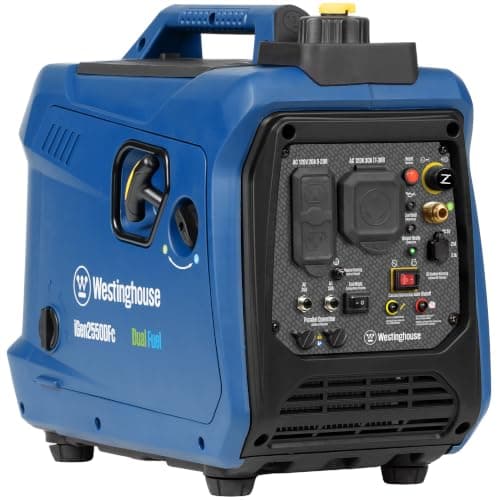 Westinghouse iGen2550DFc 2,550W Dual Fuel Inverter The right small dual fuel inverter if you have a genuinely safe outdoor place to run it — and for most apartment dwellers, a battery power station is the better answer. | Apartments and balconies | 8.9/10 | $529.00 |
#ad Amazon prices as of November 19, 2026; they may have changed since. Scores are our editorial judgment from published specifications, not test results — how we pick. How we are funded.
Why the iGen5000DFc wins for most trucks
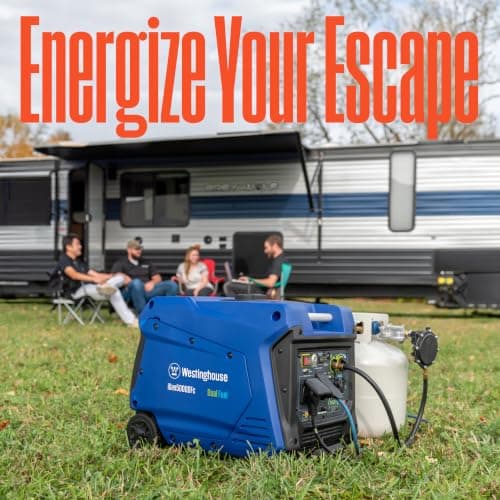
It is the only machine here that answers all four food truck questions at once with published figures. 3,900 running watts on gasoline and 3,500 on propane covers a propane-cooking truck's electrical load — refrigeration, freezer, hood fan, lights, water heater and point-of-sale — with headroom rather than at the limit. It publishes an RV-ready TT-30R, the connector most trucks are wired for, so there is no adapter chain. It publishes as low as 52 dBA, the best noise claim at this output. And it is dual fuel, so it runs on the tanks already on board.
Add the remote start key fob, the CO sensor, under 3% total harmonic distortion for the point-of-sale tablet, and the digital display showing remaining runtime, and it is a machine well suited to the job even though its listing talks about RVs and home backup. The honest limits: 105.8 lb in an enclosed case is awkward to move, the 52 dBA figure is the low-load figure and will climb under load, and there is no 240 V output unless you buy a second unit and the parallel kit.
If your truck has any electric cooking equipment at all, step up rather than across. 3,900 running watts disappears fast once a griddle or a fryer is in the mix, and the WEN DF680iX's 5,100 rated watts on gasoline with both an L14-30R and a TT-30R is the better-matched machine. If the kitchen is substantially electric, the iGen12000DFc's 9,000 running watts and 14-50R is the only pick here that will carry it.
Two small machines instead of one big one
Parallel capability deserves more attention than truck operators usually give it. Two 2,500 W-class inverters linked together weigh about the same in total as one 5,000 W machine, but each one is a genuine one-person lift — which matters when the generator comes off the truck at the end of a shift and goes into a garage. It also means a single engine failure costs you half your power rather than all of it. On a vehicle that earns money only while it is powered, that redundancy has a real value.
The parallel route
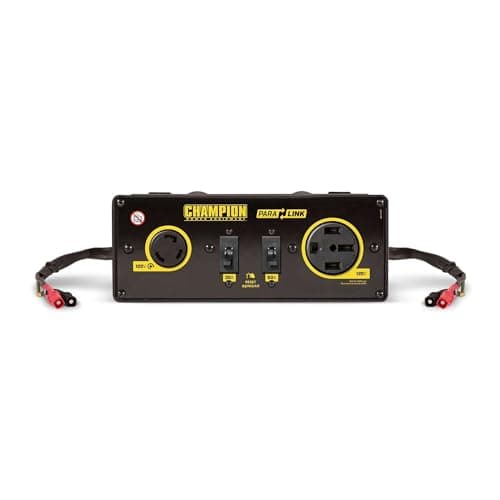
Doubling two Champion inverters
Champion ParaLINK 50A Parallel Kit
Champion's kit links two Champion inverters of 2,500 W or higher with a clip-on connection and presents a 50 A RV outlet. Read the compatibility limit carefully: it links Champion to Champion only, and the parallel output is still 120 V — it does not create a 240 V supply.
Westinghouse takes the same approach with its own kit and, unusually, states that its parallel kit includes a 240 V outlet, which is the only route to 240 V from the iGen5000DFc. Either way you end up with two engines to service, two oil changes and two things to refuel, so it is a trade rather than a free upgrade.
What we would actually buy
For a propane-cooking truck on a 30 A inlet, which is the common case, the Westinghouse iGen5000DFc — because it is the only machine here that publishes the connector, the noise figure, the per-fuel running watts and the safety hardware a truck needs, all at once. For a truck with any electric cooking, the WEN DF680iX, accepting that WEN publishes no decibel figure and that you are buying the extra 1,200 running watts partly blind on noise. For a substantially electric kitchen, the iGen12000DFc and nothing smaller.
The pick we would not make is the cheapest one. The WEN 56432i is genuinely good value at 3,600 rated watts and 53 lb, and it is the sensible spare to keep for a market stall or as a backup machine — but it publishes no CO shutdown sensor, and a food truck is the one application where that sensor is least optional. Buy it as a second machine, not as the one that runs your service.
If you are earlier in the decision than this, what size generator do I need walks the load arithmetic from the start, and the best quiet inverter generators ranks the same class of machine on noise alone for a residential setting.
In short
Our recommendation
Best Food Truck Generator
9.3/10Westinghouse iGen5000DFc 5,000W Dual Fuel Inverter
The quietest way to get around 4,000 running watts on either fuel, provided you are running cords rather than a transfer switch.
Runner-up
8.8/10WEN DF680iX 6,800W Dual Fuel Inverter
The lightest transfer-switch-capable dual fuel inverter here — with one serious caveat: its bonded neutral must be checked against your transfer switch.
#ad Price as of November 19, 2026; it may have changed since. How we are funded.
Brands: want your product tested? For Brands.
Questions people actually ask
What size generator does a food truck need?
It depends on whether you cook on propane or electricity, and the only honest way to find out is to add the running watts from your equipment data plates, add the single largest starting surge, then pick a generator whose RUNNING watt rating on the fuel you will use sits comfortably above that total. A propane-cooking truck is commonly in the 3,000-4,000 running watt range; a truck with electric cooking equipment can easily need 8,000 or more. Do not size from the peak figure on the box.
Can a food truck run on a 3,500 watt generator?
If all the cooking is propane, often yes — refrigeration, a freezer, a hood fan, lights, a water heater and a point-of-sale tablet can fit inside 3,500 running watts. Add any electric cooking equipment and it will not. Check your data plates rather than assuming, and size on the running watt figure for the fuel you plan to use, which on dual fuel machines is roughly 10% lower on propane than on gasoline.
Should a food truck generator run on propane or gasoline?
Propane, if your cooking already runs on it. You get one fuel supply chain instead of two, propane stores indefinitely where gasoline degrades, a tank swap is a two-minute mid-service job where a hot gasoline refuel is not, and the published propane runtimes are long — Champion states up to 21 hours on propane for its 4,500 W dual fuel inverter. The cost is roughly 10% of the running watts.
Which generator outlet does a food truck need?
Whichever one your truck's shore inlet is wired for, which is usually a 30 A TT-30, sometimes a 240 V L14-30, and on larger trucks a 50 A 14-50. Check the inlet first, then buy a generator that publishes that receptacle. Adapter chains carrying close to a connector's rated current for ten hours a day are a fire risk rather than a workaround.
How quiet does a food truck generator need to be?
Quiet enough for the rules at your vending locations and for a queue standing beside it, which in practice means buying on a published figure rather than on marketing language. Westinghouse publishes as low as 52 dBA on the iGen5000DFc and the iGen2550DFc, and Honda publishes 50-57 dB(A) on the EU3000iS. WEN markets both of its units here as quiet and publishes no decibel figure for either. Note that "as low as" is the light-load figure and your load will be higher.
Is it safe to mount a generator on a food truck?
It is routine, and the placement is the whole safety question. A truck has an open serving window, a hood fan pulling air inward and staff in a confined space for hours, which is a bad environment for engine exhaust. Mount the generator as far from the serving window and air intake as the setup allows, point the exhaust away from the truck, and fit a carbon monoxide alarm inside. A CO shutdown sensor on the generator is worth having and is not a substitute for placement.
How long will a generator last running a food truck every day?
Far less long than one that backs up a house twice a winter, and the published runtime figures will not tell you — they are quoted at 25% load on the Westinghouse units and with no stated condition on the Champion. None of these machines is published as a commercial continuous-duty generator. The things that actually extend service life are running well inside the rated output rather than at it, and keeping to the maintenance intervals, which come around fast at ten hours a day.
Is a portable power station an alternative to a generator for a food truck?
Not for a full service day. Battery capacity is measured in watt-hours and a truck's daily electrical demand runs into the tens of kilowatt-hours, far beyond any portable unit. Batteries make sense for a market stall, a coffee cart, or as a silent bridge for the point-of-sale and lights during a generator shutdown — not as the primary supply for refrigeration across a shift.
Sources
- Eugene Water & Electric Board — Generator Sizing ConsiderationsPublished appliance running and additional-starting watt figures used in the sizing arithmetic on this page.
- US Consumer Product Safety Commission — Portable Generator Information CenterThe placement and carbon monoxide guidance every generator page on this site links to.
Read next
Best Quiet Inverter
Best Quiet Inverter Generators for Home Backup
Inverter generators ranked on published noise and THD figures, with the brands that publish no measurable claim named.
Top pick · Westinghouse iGen5000DFc 5,000W Dual Fuel Inverter
$999.00See the iGen5000DFc 5,000W Dual Fuel Inverter on Amazon23% off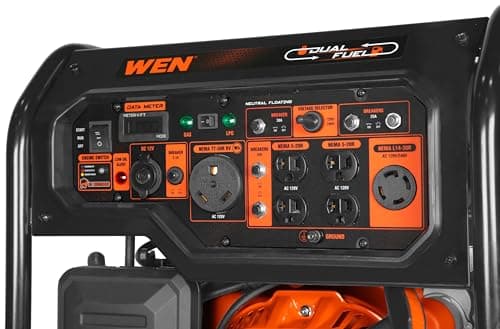
Guide
What Size Generator Do I Need?
The core sizing method: total running watts, add the single biggest surge, derate for continuous running, then match a wattage class.
Guide
Starting Watts vs Running Watts
What the surge figure means, why motors need it, and how to read the peak-watt number on a generator box.
Guide
How Quiet Is a Quiet Generator?
Published decibel ratings side by side with their measurement conditions, and what a dB difference actually means.
Guide
Generator Maintenance Schedule
A maintenance schedule built around the real failure mode of a standby-duty generator: fuel, battery and the quarterly test run.