Generators
What Oil Does a Generator Take?
Most portable generators run the same oil as a lawn mower. The interval is where backup duty changes the answer.
Written byMike M.
Published
Disclosure: we earn a commission on purchases made through links on this page, at no cost to you. It does not affect what we recommend or what we say about it — how we are funded.
The short answer
| Ambient temperature | Published recommendation |
|---|---|
| Above 40 F | SAE 30 |
| Varying temperatures | SAE 10W-30 (may increase consumption above 80 F) |
| All temperatures | Synthetic SAE 5W-30 |
| Continuous commercial use | Vanguard 15W-50 |
Briggs & Stratton's published small air-cooled engine oil recommendations. Your generator's own manual overrides this table — Honda, for example, ships 12 oz of 10W-30 in its own EU2200i tune-up kit.
A portable generator is an air-cooled four-stroke small engine, which is the same family of engine as a lawn mower or a pressure washer, and the oil recommendations are the same ones. There is no special "generator oil." What there is instead is a viscosity choice driven by the temperature you will run it in, an API quality classification to meet, and an interval question that backup duty genuinely changes.
Viscosity: pick for the temperature you will actually start it in
Briggs & Stratton publishes the clearest version of this guidance for small air-cooled engines, and it reads as four cases: SAE 30 for warmer temperatures above 40 F, SAE 10W-30 for varying temperatures with the caveat that it may increase oil consumption above 80 F, synthetic SAE 5W-30 for the best protection at all temperatures, and Vanguard 15W-50 for continuous commercial use.
For a home backup generator, the second and third cases are the ones that matter, and for one specific reason: you will be starting this machine cold, in bad weather, often in winter. That is the exact condition a multigrade oil exists for. A straight SAE 30 in a cold crankcase is thick, and a thick oil makes the engine harder to turn at the moment you most need it to start.
Choosing for backup duty specifically
- Mild climate, summer storms
- SAE 30 or 10W-30
- Four-season climate
- 10W-30
- Hard freezes, winter outages
- Synthetic 5W-30
- Quality classification
- API SF/SG/SH/SJ or higher
Viscosity grades and the API wording are Briggs & Stratton's published recommendations for small air-cooled engines; the mapping to backup duty is our reasoning, not a manufacturer claim. Briggs also specifies a high-quality detergent oil and says to avoid special additives.
Is synthetic worth it? For a standby machine, there is a decent argument that it is — the cold-start benefit lands exactly where this engine's hard job is, and the oil spends most of its life sitting rather than being consumed. Briggs is explicit about the limit of that argument though: using synthetic oil does not alter the required oil change interval. Synthetic buys you cold-start performance and temperature range, not a longer service life.
How often to change generator oil
Briggs & Stratton's published interval for its small engines is 50 hours. That figure is written for equipment in regular use, and a home backup generator may accumulate ten hours in an entire year — which is why following an hours-based interval on a standby machine means changing the oil roughly once every five years, and that is wrong.
| Duty | What governs the interval | Practical rule |
|---|---|---|
| Regular use (mower, jobsite) | Running hours | 50 hours, per Briggs & Stratton |
| Home backup, 5-20 h/year | The calendar | Annually, regardless of hours |
| A new machine | Break-in | The manual's early first change |
| After a multi-day outage | Hours just accumulated | Change it when the power comes back |
The reason the calendar wins on a backup machine is moisture. Oil sitting in a cold crankcase through a winter absorbs water from condensation, and combustion by-products from the last run are still in there acidifying slowly. Neither of those processes cares how many hours are on the meter. An annual change, done at the same time as the air filter and spark plug, is the sane default — and the generator maintenance schedule puts it in the context of the full year.
Two intervals to respect beyond the annual one. First, most manuals specify a much earlier first change after the initial break-in hours, because break-in puts metal particles in the oil. Second, if you have just run the machine for three days straight through an outage, it has accumulated more hours in that week than in the previous two years — change it when the power comes back rather than waiting for the anniversary.
How much oil, and where to find the real number
Capacity varies by engine displacement, and it is small: Honda's own tune-up kit for the EU2000i, EU2200i and EB2000i family ships a 12 oz bottle of 10W-30, which tells you the order of magnitude for a 2,000 watt class machine. Larger 400-500cc engines on 9,500-13,000 watt generators hold considerably more. The figure for yours is in the manual and usually on a sticker near the fill, and no chart beats it.
Checking is more useful than measuring. Most portable generators have a dipstick in the fill neck, and almost all of them have a low-oil shutdown that stops the engine before damage — a safety net, not a strategy, because it protects the engine by turning off your power. Check the level before every extended run.
The service shelf
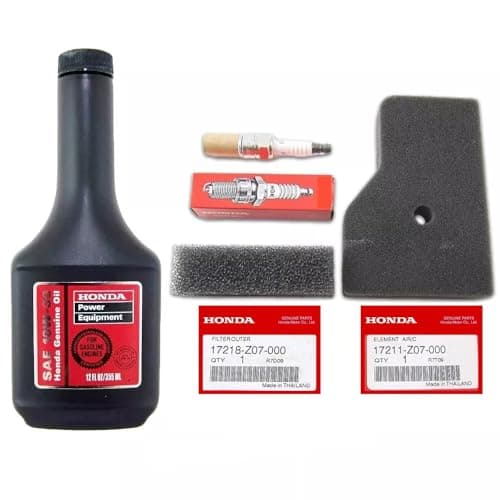
Honda EU2000i / EU2200i servicing
Honda EU2200i Tune-Up Kit
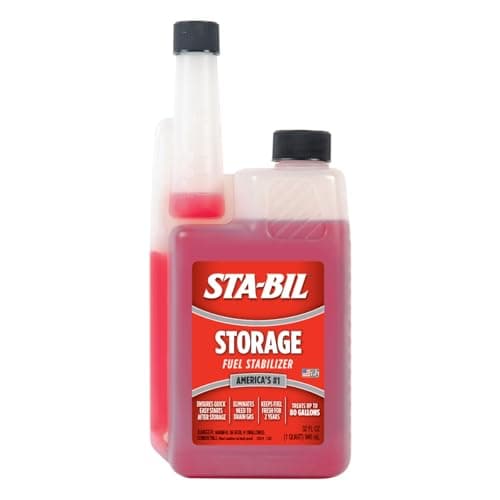
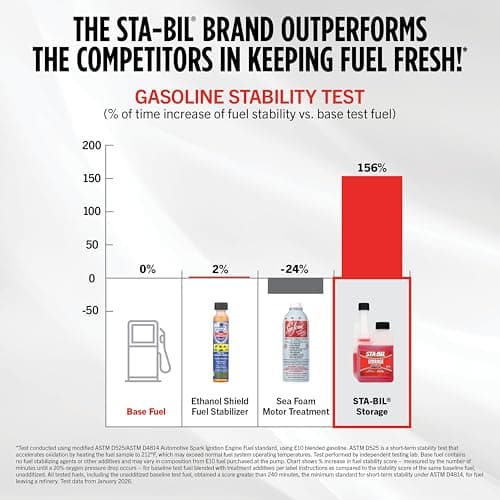
Keeping stored gasoline usable
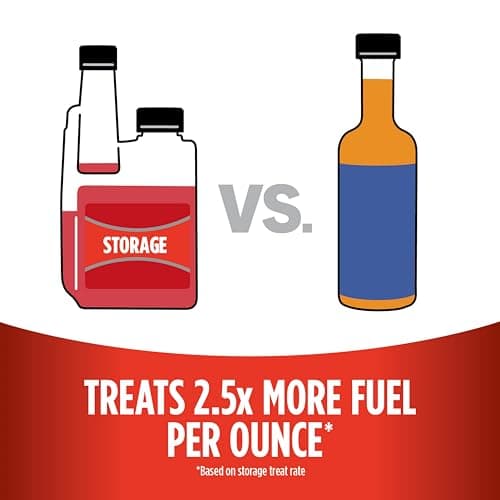
STA-BIL Storage Fuel Stabilizer, 32 oz
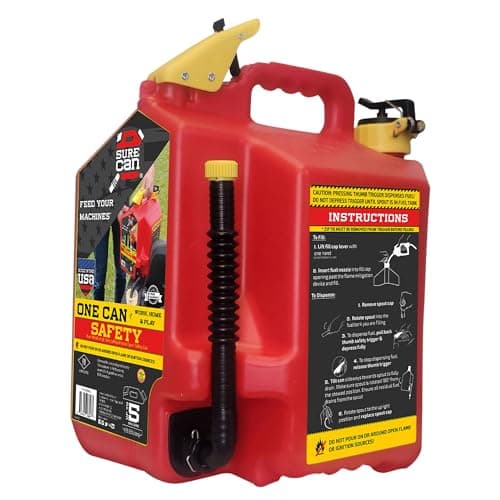
Pouring without lifting and tilting
SureCan SureCan 5 Gallon, Rotating Spout
A model-specific tune-up kit so the annual service is not a parts-sourcing project — Honda's publishes the air filter and outer filter part numbers along with the oil. The other two address the failure that is more common than worn oil: stale fuel.
The mistakes that actually cause damage
- Running it low. Air-cooled engines run hot and have no coolant to help. The low-oil shutdown is the last line, not the plan.
- Overfilling. More is not better; excess oil gets whipped into foam, which does not lubricate, and can push past seals.
- Two-stroke oil, or oil mixed into the fuel. Portable generators are four-stroke. Oil goes in the crankcase, fuel goes in the tank, and they do not mix.
- Checking it on a slope. A generator sitting on a driveway reads wrong. Level ground, engine off, give it a minute to drain back.
- Ignoring the break-in change. It is the one interval in the manual that is genuinely shorter than you expect, and it is there for a reason.
None of this is difficult, and that is the point worth ending on: the oil is not what strands people. Stale fuel is. If you do one thing for your generator this year, stabilize the fuel and run it under load for half an hour. Change the oil while it is warm and you have done the whole annual service in one afternoon.
The oil change that matters most is the first one: how to break in a new generator covers the break-in sequence, and how long do portable generators last explains what skipping it costs.
Questions people actually ask
What kind of oil does a generator take?
The same oil as other small air-cooled four-stroke engines. Briggs & Stratton publishes SAE 30 above 40 F, SAE 10W-30 for varying temperatures, and synthetic SAE 5W-30 for the best protection at all temperatures, in a high-quality detergent oil classified for service SF, SG, SH, SJ or higher. Your manual's specification comes first.
Can I use 10W-30 in my generator?
In most cases yes, and for a four-season home backup machine it is the usual choice. Briggs & Stratton lists 10W-30 as good for varying temperatures with the caveat that it may increase oil consumption above 80 F. Honda ships 12 oz of 10W-30 in its own EU2200i tune-up kit.
How often should I change the oil in a generator?
Briggs & Stratton's published interval is 50 hours, but a backup generator may only run ten hours a year, so treat the calendar as binding and change it annually. Also honor the manual's much earlier first change after break-in, and change it after any multi-day outage run.
Can I use synthetic oil in a generator?
Yes, and the cold-start benefit is genuinely useful on a machine you will be starting in winter weather. Briggs & Stratton is explicit that synthetic can be used across all temperature ranges but that it does not extend the required change interval.
How much oil does a portable generator hold?
Less than most people expect, and it scales with engine size. Honda's tune-up kit for the EU2000i/EU2200i class ships a 12 oz bottle, while a 400-500cc engine on a 9,500 watt machine holds considerably more. The exact capacity is in your manual and usually on a sticker near the fill.
What happens if a generator runs low on oil?
Almost every portable generator has an automatic low-oil shutdown that stops the engine before it is damaged. That protects the engine by cutting your power, usually at the worst moment, so it is a safety net rather than a maintenance plan. Check the level on level ground with the engine off before any long run.
Sources
- Briggs & Stratton — lawn mower and small engine oil type and capacityThe published viscosity-by-temperature recommendations, the API service classification wording, the synthetic oil guidance and the 50-hour change interval quoted on this page.
- US Consumer Product Safety Commission — Portable Generator Information CenterThe placement and carbon monoxide guidance every generator page on this site links to.
Read next
Guide
Generator Maintenance Schedule
A maintenance schedule built around the real failure mode of a standby-duty generator: fuel, battery and the quarterly test run.
Guide
Generator Fuel Storage and Stabilizer
Fuel degradation, stabilizer shelf-life claims, safe storage quantities and containers, and the propane alternative.

Guide
How to Store a Generator When Not in Use
Storing a generator so it starts: the fuel decision, the battery, the cover, and the long-term versus between-storms distinction.
Guide
Generator Won't Start: What to Check
A generator that will not start, diagnosed in order: the switches, the fuel, the oil shutdown, the battery and the carburetor.
Guide
Best Generator Brands
Brand-by-brand assessment based on what each publishes and omits, plus service network and positioning.