Power Stations
Battery Backup for a Home, Sized to Carry Circuits
Battery backup for a home is not the same purchase as a portable power station. This page ranks the units built to carry circuits and grow with you.
Disclosure: we earn a commission on purchases made through links on this page, at no cost to you. It does not affect what we recommend or what we say about it — how we are funded.
The short answer
Battery backup for a home comes down to three published figures: how much it stores, how much it can put out at once, and whether it does 240V — because only a 240V unit can feed panel circuits the way a generator does. On those, the Anker SOLIX F3800 Plus leads: 3,840 Wh of storage, 6,000 W of AC output, and both 120V and 240V. If you want to start smaller and grow, the Jackery HomePower 2000 Plus v2 begins at 2,048 Wh and expands to a manufacturer-stated 12 kWh on the same hardware.
"Home backup battery" and "portable power station" get used interchangeably and they are not the same purchase. A power station is a box you carry to the load — it runs a fridge through an extension cord and goes camping in July. A home backup battery is sized and wired to carry circuits, which means three things the portable framing ignores: capacity you can add to, an output ceiling high enough for more than electronics, and in the best case 240V. This page ranks on those. If what you want is the carry-it-anywhere version, the best home backup power stations is the page for that.
The short answer
Quick picks
| # | Product | Best for | Score | Price |
|---|---|---|---|---|
| 1 | 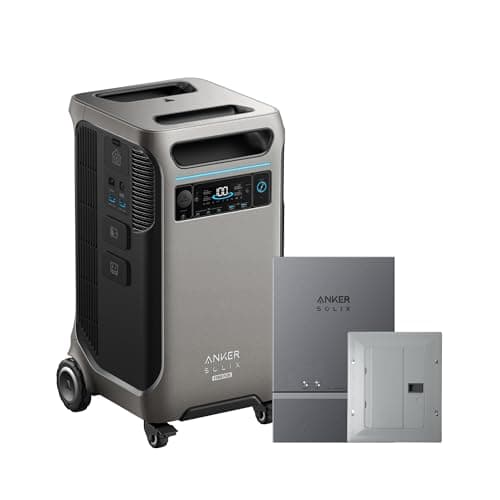 Anker SOLIX F3800 Plus The battery that can genuinely stand in for a generator on 240V circuits, with the registry's highest solar input ceiling, priced like the installed system it really is. | 240V loads plus generator pairing | 9.2/10 | $4,099.99 |
| 2 | 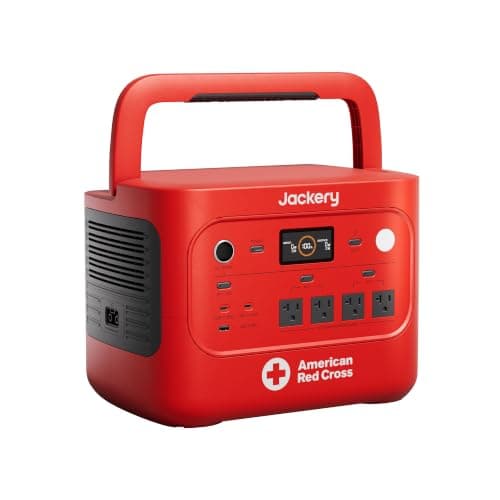 Jackery HomePower 2000 Plus v2 The right battery if you intend to grow the system: start at 2 kWh, add capacity as budget allows, and keep the same hardware. | Expandable whole-circuit backup | 9.3/10 | $1,299.00 |
| 3 | 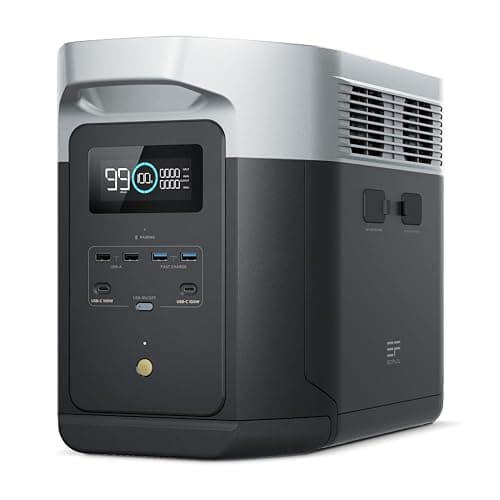 EcoFlow DELTA 2 Max The best choice if solar recharging is part of your plan: 1,000 W of solar input and a 43-minute AC recharge make it the hardest unit here to actually run flat. | Most outlets, expandable to 6 kWh | 9.4/10 | $1,029.00 |
| 4 | 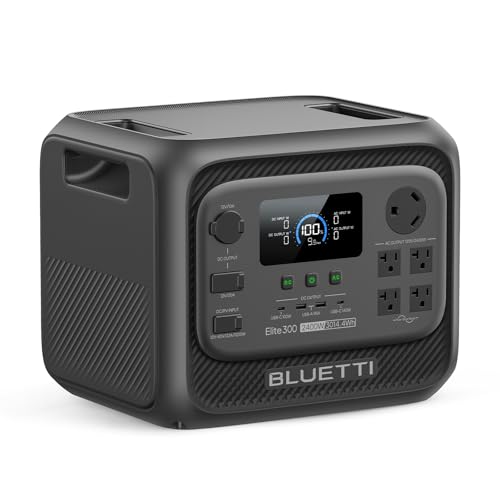 Bluetti Elite 300 The most capacity Bluetti sells in a single carryable box here: 3 kWh behind a 2,400 W inverter with a genuine 4,800 W surge, let down only by the lack of a 240 V outlet at a size where you start wanting one. | The most capacity in one carryable box | 9.0/10 | $1,299.00 |
| 5 | 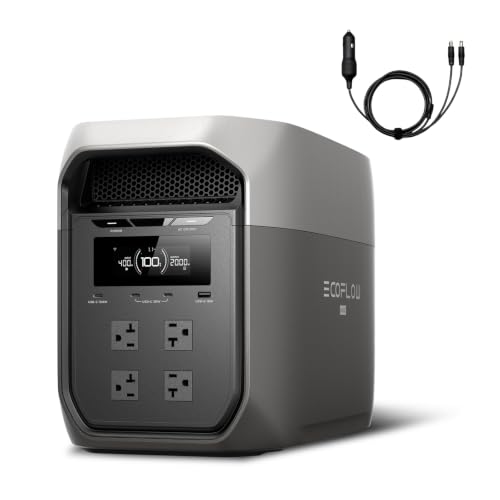 EcoFlow DELTA 3 Max The best battery here for keeping specific things running without interruption — the sub-10 ms transfer is a real functional difference, not a spec-sheet flourish. | UPS-grade switchover for a fridge | 9.4/10 | $999.00 |
| 6 | 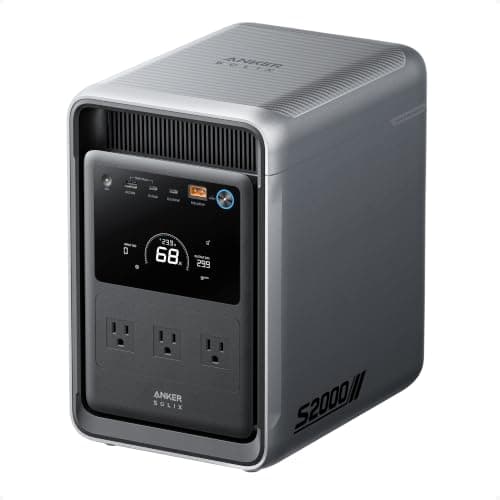 Anker SOLIX S2000 The endurance choice: the lowest idle draw and the longest cycle life here, with an output ceiling deliberately traded away to get them. | Longest fridge runtime per watt-hour | 9.3/10 | $699.99 |
#ad Amazon prices as of November 19, 2026; they may have changed since. Scores are our editorial judgment from published specifications, not test results — how we pick. How we are funded.
Published capacity, output and expansion, side by side
| Battery | Capacity | AC output | Expands to | 240V |
|---|---|---|---|---|
| Anker SOLIX F3800 Plus | 3,840 Wh | 6,000 W | 26.9 kWh (mfr) | Yes |
| Jackery HomePower 2000 Plus v2 | 2,048 Wh | 2,400 W | 12 kWh (mfr) | No |
| EcoFlow DELTA 2 Max | 2,048 Wh | 2,400 W | 6 kWh (mfr) | No |
| Bluetti Elite 300 | 3,014.4 Wh | 2,400 W / 4,800 W surge | Not published | No |
| EcoFlow DELTA 3 Max | 2,048 Wh | 2,400 W / 3,400 W boost | Not published | No |
| Anker SOLIX S2000 | 2,010 Wh | 1,500 W / 3,000 W peak | Not published | No |
Read the output column before the capacity column. Capacity decides how long; output decides whether. Four of the six units here top out at 2,400 W, and a well pump, a central air compressor or an electric water heater will not start on 2,400 W no matter how many watt-hours sit behind it. That ceiling, not the battery size, is the real dividing line between a battery that backs up a household and one that backs up a kitchen counter.
The 240V question, which decides most of this
What each output level actually reaches
- 1,500 W, 120V
- Fridge, electronics, lights, CPAP
- 2,400 W, 120V
- Adds a microwave, a space heater, a furnace blower
- 3,400 W boost, 120V
- Resistive loads only — not motors
- 120V and 240V
- Panel circuits, including 240V ones
Arithmetic from published output ratings, not a measurement of ours. EcoFlow is explicit that X-Boost works by reducing voltage to resistive loads and should not be relied on for motor loads — which is the honest limit of a boost figure.
If your backup plan is "keep the fridge, the furnace blower, the modem and some lights alive for a day or two," any 2 kWh unit on this list does it and the decision comes down to recharge speed and cycle life. If your plan involves a well pump, a septic pump, central air or anything on a 240V breaker, the F3800 Plus is the only battery here that can stand in for a generator — and at that point you should genuinely price it against a portable generator plus a transfer switch, because the installed cost is comparable and the generator does not run out.
Capacity you can add to beats capacity you buy once
The most common regret with a home backup battery is buying exactly enough. Outages are not an average; they are a distribution with a long tail, and the one that matters is the four-day one. Three of these units are explicitly modular — Anker publishes 26.9 kWh as the SOLIX F3800 Plus ceiling, Jackery 12 kWh for the HomePower 2000 Plus v2, and EcoFlow 6 kWh for the DELTA 2 Max with up to two extra batteries.
Jackery also pairs expansion with the feature that separates a battery system from a big extension cord: Smart Energy Management with Priority Routing, which the manufacturer describes as keeping essential circuits running as capacity falls. A battery that decides for itself to drop the dehumidifier before the refrigerator is doing load management you would otherwise be doing by hand, in the dark.
The honest counterweight: expansion batteries are priced like complete smaller units. A 12 kWh destination is a multi-purchase project, not a checkbox. What expansion buys you is the ability to spend that money in stages without replacing the hardware you already own.
Recharge is the spec people forget to compare
A battery's capacity is fixed, but its usefulness over a multi-day outage depends entirely on how fast it refills when power flickers back on or the sun comes out. EcoFlow publishes 0-80% in 43 minutes for the DELTA 2 Max combining up to 1,000 W of solar with AC input, and it accepts 1,000 W of solar; Anker publishes 3,200 W of solar input for the F3800 Plus, the highest ceiling here. Those two numbers are what turn a two-hour window of restored grid power into a full battery.
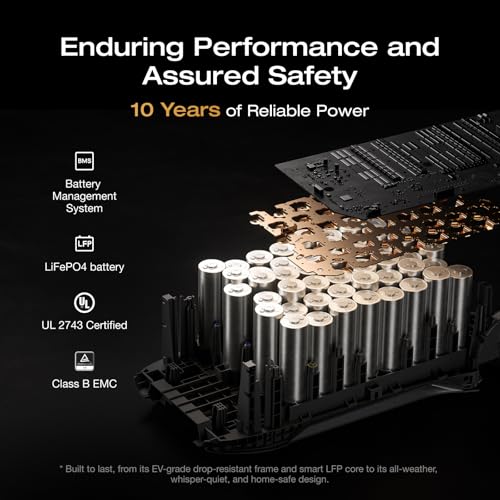
Cycle life is the other long-horizon spec, and the spread is wide: Anker rates the S2000's 314Ah LFP cells at 10,000 cycles with a stated 15-year lifespan, Jackery publishes 6,000+ LFP cycles and a 16-year design life for the HomePower, EcoFlow publishes 3,000 cycles for the DELTA 2 Max and Anker 3,000+ to 80% with a 10-year lifespan for the F3800 Plus. For a unit that cycles a handful of times a year, all four are effectively "longer than you will own it" — the figures matter if you intend to cycle daily for solar self-consumption. LiFePO4 vs lithium-ion covers why every unit on this page is LFP.
Who each one is for
- Anker SOLIX F3800 Plus — you have 240V loads, or you want a battery that can genuinely replace a generator. Price it as the installed system it is.
- Jackery HomePower 2000 Plus v2 — you want to start at one battery and grow, and you want priority routing doing the load management.
- EcoFlow DELTA 2 Max — solar is part of the plan, or your outages come with brief windows of restored power to refill in.
- Bluetti Elite 300 — the largest single-unit capacity here short of the F3800 Plus at 3,014.4 Wh, behind a 2,400 W inverter with a 4,800 W surge rating, with a TT-30R for an RV. No 240 V output, and the listing publishes no weight or cycle figure.
- EcoFlow DELTA 3 Max — specific equipment must not blink. A published sub-10 ms transfer means the fridge compressor and the home office never notice.
- Anker SOLIX S2000 — longest fridge runtime per watt-hour, from a published 6 W idle draw. The 1,500 W ceiling is the trade.
- Capacity
- 3,840 Wh
- AC output
- 6,000 W
- Voltage
- 120V and 240V
#1 · 240V loads plus generator pairing
Anker SOLIX F3800 Plus
The battery that can genuinely stand in for a generator on 240V circuits, with the registry's highest solar input ceiling, priced like the installed system it really is.
#ad Price as of November 19, 2026; it may have changed since. How we are funded.
Why we picked it
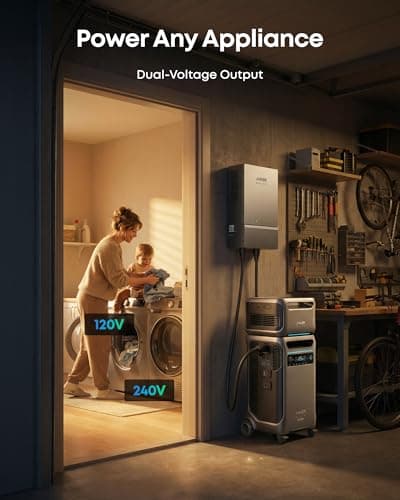
- 240V output at 6,000 W is what lets a battery feed panel circuits the way a generator does — almost nothing else in this class publishes it
- 3,840 Wh is nearly two days of fridge-plus-electronics duty
- 3,200 W of solar input is the highest here, so panels added later genuinely refill it inside a day
- The auto start-stop generator pairing is the closest a battery system comes to indefinite runtime
Good to know
- 135.6 lb, and effectively a fixed installation once it is placed
Published specification & our scoring
- 3,840 Wh LiFePO4 capacity, 6,000 W AC output (manufacturer)
- Dual-voltage 120V and 240V output — manufacturer cites powering a dryer
- 3,200 W solar input across two MPPT inputs — the highest ceiling in this registry (manufacturer)
- Expandable with BP3800 packs; manufacturer publishes a 26.9 kWh ceiling for one station
- Cells rated 3,000+ cycles to 80% capacity, 10-year lifespan, five-year warranty (manufacturer)
- Published weight 135.6 lb
- Compatible with the Smart Generator 5500 for automatic start-stop runtime extension (manufacturer)
- Current listing is the F3800 Plus paired with Anker's Home Power Panel, and publishes a 12,000 W maximum AC output for two stations run together (manufacturer)
- Usable capacity
- 10
- Output ceiling
- 10
- Expandability
- 10
- Portability
- 3
- Cycle life
- 9
- Value
- 5
Specification figures are the manufacturer’s published values. Scores are our editorial judgment from those figures and are never published as structured review data — how we pick.
- Capacity
- 2,048 Wh (to 12 kWh)
- AC output
- 2,400 W
- Cycles
- 6,000+ LFP (mfr)
#2 · Expandable whole-circuit backup
Jackery HomePower 2000 Plus v2
The right battery if you intend to grow the system: start at 2 kWh, add capacity as budget allows, and keep the same hardware.
#ad Price as of November 19, 2026; it may have changed since. How we are funded.
Why we picked it
- Expandable to 12 kWh means you can start at one battery and grow into genuine multi-day capacity
- 6,000 cycles is double what most LiFePO4 power stations claim
- Priority Routing is the feature that makes a battery behave like a backup system rather than a big extension cord
Good to know
- Expansion batteries cost as much as a complete smaller unit each — the 12 kWh figure is an expensive destination
Published specification & our scoring
- 2,048 Wh expandable to 12 kWh, 2,400 W output (manufacturer)
- 6,000+ LFP cycles; manufacturer states a 16-year design life
- Smart Energy Management with Priority Routing to keep essential circuits running (manufacturer)
- Manufacturer states it is the lightest expandable 2 kWh system and 34% lighter than the previous generation
- Published weight 40.6 lb
- Usable capacity
- 9
- Expandability
- 10
- Output ceiling
- 7
- Cycle life
- 10
- Portability
- 9
- Value
- 7
Specification figures are the manufacturer’s published values. Scores are our editorial judgment from those figures and are never published as structured review data — how we pick.
- Capacity
- 2,048 Wh (to 6 kWh)
- AC output
- 2,400 W
- Outlets
- 15
#3 · Most outlets, expandable to 6 kWh
EcoFlow DELTA 2 Max
The best choice if solar recharging is part of your plan: 1,000 W of solar input and a 43-minute AC recharge make it the hardest unit here to actually run flat.
#ad Price as of November 19, 2026; it may have changed since. How we are funded.
Why we picked it
- 43 minutes to 80% is the fastest recharge here — it means a two-hour window of restored grid power refills it completely
- 1,000 W of solar input is double what most 2 kWh units accept, which is the difference between solar being useful and decorative
- 15 outlets means no adapter juggling in the dark
Good to know
- 50.7 lb — the heaviest 2 kWh unit here
Published specification & our scoring
- 2,048 Wh, 2,400 W output, 15 outlets (manufacturer)
- 0-80% in 43 minutes combining up to 1,000 W solar with AC input (manufacturer)
- LFP chemistry rated 3,000 cycles to 80% capacity (manufacturer)
- Expandable from 2 kWh to 6 kWh with up to two extra batteries (manufacturer)
- Published weight 50.7 lb
- Usable capacity
- 9
- Recharge speed
- 10
- Solar input
- 10
- Output ceiling
- 7
- Cycle life
- 8
- Value
- 8
Specification figures are the manufacturer’s published values. Scores are our editorial judgment from those figures and are never published as structured review data — how we pick.
- Capacity
- 3,014.4 Wh
- AC output
- 2,400 W / 4,800 W surge
- RV outlet
- TT-30
#4 · The most capacity in one carryable box
Bluetti Elite 300
The most capacity Bluetti sells in a single carryable box here: 3 kWh behind a 2,400 W inverter with a genuine 4,800 W surge, let down only by the lack of a 240 V outlet at a size where you start wanting one.
#ad Price as of November 19, 2026; it may have changed since. How we are funded.
Why we picked it
- 3,014.4 Wh is the most capacity in this registry outside Anker's SOLIX F3800 Plus, and it arrives as one box rather than a stack of modules
- A 4,800 W surge rating against 2,400 W continuous is real headroom for a compressor or a pump motor, which most 2 kWh units do not have
- The TT-30R takes an RV cord directly, so the same unit covers an RV without an adapter chain
Good to know
- No 240 V output and no 14-50R, so it cannot feed a 50 A inlet the way Anker's F3800 Plus can — at this capacity that is the specification most likely to disappoint
- The listing is thin on the figures that decide a backup purchase: no published weight, cycle rating, UPS transfer time or solar input ceiling. Check the manual before buying if any of those decide it for you
Published specification & our scoring
- 3,014.4 Wh LiFePO4 capacity (manufacturer)
- 2,400 W AC output with a 4,800 W surge rating (manufacturer)
- TT-30R RV outlet and a 12 V/30 A DC output on the same unit (manufacturer)
- Bluetti describes it as the smallest 3 kWh solar generator it sells (manufacturer)
- Sold for RV and home backup use, with variants listed with an AC cable or a solar cable included (manufacturer)
- This listing does not publish a weight, a cycle count, a UPS transfer time or a solar input ceiling — figures we will not carry over from the discontinued Apex 300
- Usable capacity
- 10
- Output ceiling
- 8
- Surge headroom
- 9
- Published detail
- 5
- Value
- 9
Specification figures are the manufacturer’s published values. Scores are our editorial judgment from those figures and are never published as structured review data — how we pick.
- Capacity
- 2,048 Wh
- AC output
- 2,400 W / 3,400 W boost
- Switchover
- Under 10 ms (mfr)
#5 · UPS-grade switchover for a fridge
EcoFlow DELTA 3 Max
The best battery here for keeping specific things running without interruption — the sub-10 ms transfer is a real functional difference, not a spec-sheet flourish.
#ad Price as of November 19, 2026; it may have changed since. How we are funded.
Why we picked it
- A sub-10 ms switchover means plugged-in equipment never notices the outage — this is what makes it genuinely usable for a fridge, a modem or a home office
- 3,400 W in X-Boost handles appliances the 2,400 W rating would reject
- Usually cheaper than the DELTA 2 Max it replaces
Good to know
- EcoFlow states this version takes no expansion batteries, so 2,048 Wh is the ceiling — the older DELTA 2 Max reaches 6 kWh
Published specification & our scoring
- 2,048 Wh LFP battery, 2,400 W output (manufacturer)
- Up to 3,400 W continuous in X-Boost mode (manufacturer)
- Under 10 ms transfer time for home backup (manufacturer)
- 0-80% in 1.13 hours with X-Stream charging (manufacturer)
- Manufacturer states a decade of daily use and a 5-year service commitment
- Published weight 45 lb; 19.44 x 12 x 9.4 in. Current listing adds a cigarette-to-DC5521 adapter cable
- Usable capacity
- 9
- Output ceiling
- 8
- UPS behavior
- 10
- Recharge speed
- 8
- Cycle life
- 9
- Value
- 9
Specification figures are the manufacturer’s published values. Scores are our editorial judgment from those figures and are never published as structured review data — how we pick.
- Capacity
- 2,010 Wh
- AC output
- 1,500 W / 3,000 W peak
- Cycles
- 10,000 LFP (mfr)
#6 · Longest fridge runtime per watt-hour
Anker SOLIX S2000
The endurance choice: the lowest idle draw and the longest cycle life here, with an output ceiling deliberately traded away to get them.
#ad Price as of November 19, 2026; it may have changed since. How we are funded.
Why we picked it
- 10,000 cycles is more than three times what most LiFePO4 power stations claim — this is a buy-once battery
- A 6 W idle draw makes it one of the few units that is sensible to leave plugged in permanently
- The manufacturer's 35-hour fridge figure is the longest claim of any 2 kWh unit here
Good to know
- 1,500 W continuous is the lowest of the 2 kWh units — the 3,000 W peak starts a fridge, but sustained high loads are not what it is built for
Published specification & our scoring
- 2,010 Wh capacity, 1,500 W AC output with a 3,000 W peak (manufacturer)
- Manufacturer states up to 35 hours of fridge backup, from a 6 W idle draw and 10% higher efficiency
- 314Ah LFP cells rated 10,000 cycles with a stated 15-year lifespan (manufacturer)
- Manufacturer states it is 30% smaller and 25% lighter than the industry average 2 kWh unit
- Under 10 ms UPS switchover (manufacturer)
- Published weight 35.7 lb, 8.2 x 11.1 x 12.7 in
- Usable capacity
- 9
- Cycle life
- 10
- Standby efficiency
- 10
- Output ceiling
- 5
- Recharge speed
- 7
- Value
- 10
Specification figures are the manufacturer’s published values. Scores are our editorial judgment from those figures and are never published as structured review data — how we pick.
Two of the units above come from a line worth reading about on its own terms: Anker SOLIX for home backup covers the published 10,000-cycle cells, the 6 W idle draw and the 240 volt output that only one rival here matches.
For the mechanics behind the ranking — the four parts of a battery system, the plug-in route against the hard-wired one, and the loads a battery genuinely cannot take — see how home battery backup works.
In short
Our recommendation
Best Battery System
9.2/10Anker SOLIX F3800 Plus
The battery that can genuinely stand in for a generator on 240V circuits, with the registry's highest solar input ceiling, priced like the installed system it really is.
Runner-up
9.3/10Jackery HomePower 2000 Plus v2
The right battery if you intend to grow the system: start at 2 kWh, add capacity as budget allows, and keep the same hardware.
#ad Price as of November 19, 2026; it may have changed since. How we are funded.
Brands: want your product tested? For Brands.
Questions people actually ask
What is battery backup for a home?
A battery that stores grid power and releases it when the power goes out. The portable units on this site are sized in watt-hours and plug in, with published UPS switchover under 10 milliseconds on most current models, so a refrigerator never notices the outage started. An installed whole-home system is a different purchase with a different cost base — [what a home battery backup system costs](/costs/home-battery-backup-system-cost) covers that side.
Is battery backup for a home better than a generator?
For outages of hours, usually — it is silent, emission-free, needs no fuel stored and works from indoors. For outages of days with a real household load, a battery is a capacity rather than a supply and will run out. [Home battery backup versus a generator](/compare/home-battery-backup-vs-generator) is the full comparison.
What is the best home backup battery?
The Anker SOLIX F3800 Plus, on the strength of 3,840 Wh, 6,000 W of output and dual 120V/240V — the more capable of the two batteries here that can feed 240V circuits the way a generator does. If you want to start smaller and expand, the Jackery HomePower 2000 Plus v2 starts at 2,048 Wh and the manufacturer publishes a 12 kWh ceiling.
How big a home backup battery do I need?
Work from the load, not the capacity. A refrigerator plus lights, a modem and phone charging runs roughly 150-250 W averaged over a day, so a 2,000 Wh battery covers about a day of that. Adding a furnace blower roughly doubles the draw. The ceiling that stops people is output watts, not watt-hours.
Can a home backup battery run my whole house?
Only with 240V output and a panel connection, which on this list means the Anker SOLIX F3800 Plus — and even then the realistic scope is essential circuits, not unrestricted use. Four of the six units here cap at 2,400 W, which rules out well pumps, central air and electric water heating regardless of capacity.
Is a home backup battery better than a generator?
For short outages, yes on every axis except cost: no fuel, no carbon monoxide, no noise, and it works unattended at 3 a.m. For outages measured in days a battery empties and a generator does not, which is why many households end up owning a 2 kWh battery and a dual fuel generator rather than choosing.
Can you expand a home backup battery later?
On the modular units, yes. Jackery publishes 12 kWh as the HomePower 2000 Plus v2's ceiling, Anker 26.9 kWh for an expanded SOLIX F3800 Plus, and EcoFlow 6 kWh for the DELTA 2 Max with up to two extra batteries. Expansion batteries cost about as much as a complete smaller unit each, so plan it as a staged purchase.
How long does a home backup battery last before it needs replacing?
Longer than most owners expect. All six units here use LiFePO4 cells: Anker rates the S2000 at 10,000 cycles with a stated 15-year lifespan, Jackery publishes 6,000+ cycles and a 16-year design life, EcoFlow publishes 3,000 cycles for the DELTA 2 Max and Anker 3,000+ to 80% for the F3800 Plus. At a few outages a year, none of these is the limiting factor.
Sources
- Eugene Water & Electric Board — Generator Sizing ConsiderationsPublished appliance running and additional-starting watt figures used in the capacity arithmetic on this page.
- FoodSafety.gov — food safety during a power outageThe 4-hour refrigerator and 48-hour full-freezer guidance referenced when deciding how much capacity is needed.
Read next
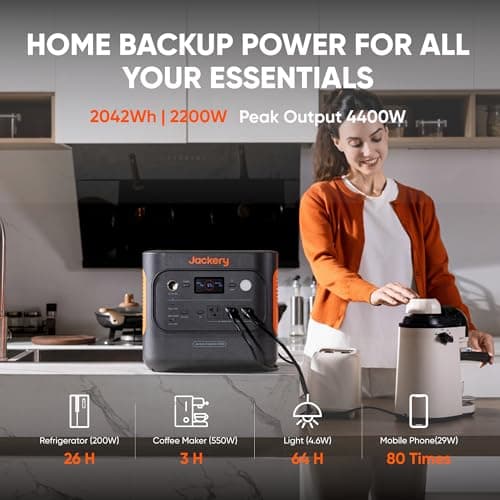
Best Overall Power Station
The Best Home Backup Power Stations
Battery power stations ranked for home backup on surge, capacity, recharge speed and cycle life.
Top pick · Jackery Explorer 2000 v2
$999.00See the Explorer 2000 v2 on Amazon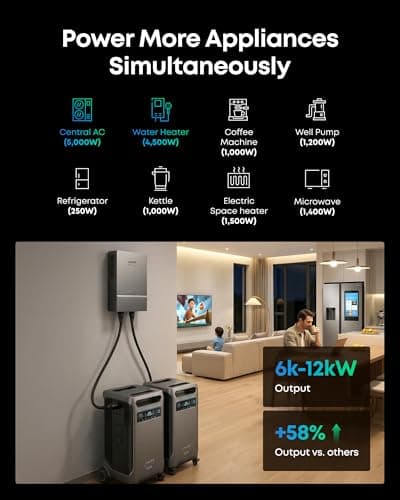
Comparison
Home Battery Backup vs Generator
Installed home battery systems against generators, and the expandable portable units that sit between them.
Guide
What a Home Battery Backup System Costs
The four cost components of a home battery backup system, what each one is for, and the honest comparison against a generator.
Comparison
LiFePO4 vs Lithium-Ion
Why LiFePO4 is the correct chemistry for backup power, with the published cycle claims that decide it.
Best Solar Kit
Best Solar Generators for Home Backup
Battery-plus-panel kits ranked on solar input ceiling and capacity, with honest expectations for real-world panel output.
Top pick · EcoFlow DELTA 3 Max + 2x100W Solar
$1,229.00See the DELTA 3 Max + 2x100W Solar on AmazonJackery vs EcoFlow
Jackery vs EcoFlow for Home Backup
Jackery against EcoFlow on the figures that decide a home backup purchase: switchover time, recharge speed, solar input, weight, cycle life and the expansion ceiling.