Power Stations
How Home Battery Backup Works
Four parts and one decision: whether it plugs in, or whether an electrician wires it to your panel.
Written byMike M.
Published
Disclosure: we earn a commission on purchases made through links on this page, at no cost to you. It does not affect what we recommend or what we say about it — how we are funded.
The short answer
A home battery backup system is four things: lithium cells that store energy, an inverter that converts their DC to household AC, a battery management system that protects them, and a charge source — the grid, solar panels or a generator. It comes in two forms. A plug-in power station needs no electrician: you run cords from it, or leave a refrigerator permanently plugged into it so the switchover is invisible. A hard-wired system is connected to your panel by an electrician and can feed circuits, including 240 volt ones on the larger units. Neither will start a well pump or run central air.
The reason this gets confusing is that "home battery backup" covers everything from a 42 lb box you carry to the kitchen to a 135 lb installation wired into your service panel. The hardware inside is the same idea at different scales; what changes is how it reaches your house, and that is the decision this page is about.
The four parts
What is inside, and what each part decides
- Cells (capacity)
- Watt-hours — how long it runs
- Inverter (output)
- Watts — what it can run at once
- Battery management
- Cycle life, safety, temperature limits
- Charge input
- How fast it refills, and from what
These are the four numbers worth comparing on any listing. Capacity and output are independent: a unit can hold a great deal of energy and still refuse a load that needs more watts than its inverter can deliver, which is the single most common disappointment with battery backup.
Hold those two apart in your head and most of the category becomes clear. Anker's SOLIX F3800 Plus publishes 3,840 Wh of capacity and 6,000 W of continuous output; Jackery's Explorer 2000 v2 publishes 2,042 Wh and 2,200 W. The first will start things the second will not, regardless of how full either one is.
Why the chemistry matters
Every unit in this registry worth buying for backup uses LiFePO4 — lithium iron phosphate — rather than the lithium-ion chemistry in a laptop. The reason is cycle life: Jackery publishes 6,000+ LFP cycles and a stated 16-year design life for the HomePower 2000 Plus v2, and Anker publishes 3,000+ cycles with a 10-year lifespan for the F3800 Plus. LiFePO4 versus lithium ion covers the trade in full.
How it gets into your house: the two routes
Route one — it plugs in
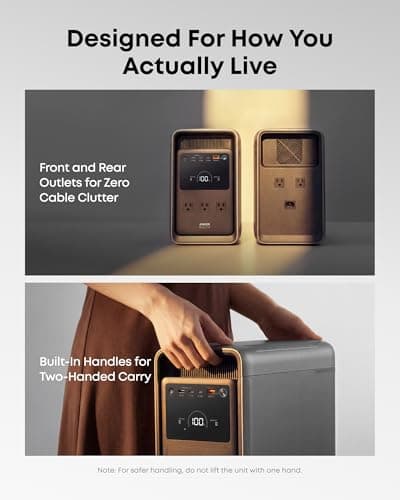
You put the unit where the problem is and run cords, or you leave an appliance permanently plugged into it. The second arrangement is the interesting one, because several units publish a UPS switchover time: EcoFlow states under 10 milliseconds for the DELTA 3 Max and Bluetti states a 10 ms DualGuard switch for the FridgePower. At those speeds a refrigerator, a modem or a medical device never knows the grid went away.
No electrician, no permit, nothing permanent, and it works in an apartment — which is why this is the right route for most households. Its limit is that nothing hard-wired is reachable: no furnace, no well pump, no lighting circuits.
Route two — an electrician wires it in
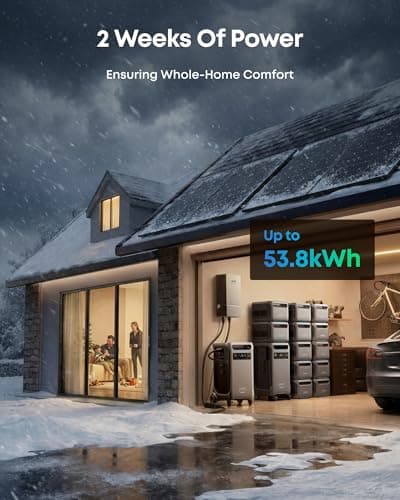
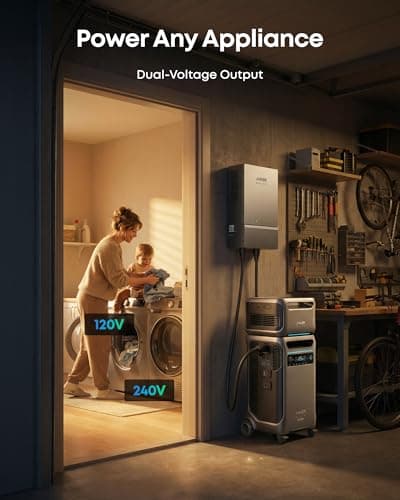
The larger units publish the hardware for this. Anker's F3800 Plus publishes dual-voltage 120 V and 240 V output, though the station is now sold bundled with Anker's Home Power Panel rather than on its own, so the panel is in the price whether you need it or not. Those are the two units here that can genuinely stand in for a generator on a 240 volt circuit.
What that costs is a real installation: a transfer arrangement, an electrician, and in most places a permit. The battery is not the whole project, exactly as a generator is not. Do I need a transfer switch applies to a battery feeding circuits for the same reason it applies to an engine.
How it recharges — the part that decides a long outage
A battery is a tank, not a well. Once it is empty it is empty, and a multi-day outage outlasts every unit on this site unless something refills it. There are three ways, and only two of them work when the grid is down.
- 1From the grid, before and between. Fast AC charging is the one that matters: Jackery publishes 0-80% in 66 minutes for the Explorer 2000 v2 and EcoFlow 0-80% in 43 minutes for the DELTA 2 Max. A brief grid restoration refills the unit almost completely.
- 2From solar. This is what turns a battery into a multi-day plan. Anker publishes a 3,200 W solar input across two MPPT inputs for the F3800 Plus — the highest ceiling in this registry — and EcoFlow publishes 1,000 W for the DELTA 2 Max. How to charge a power station in an outage covers the practicalities.
- 3From a generator. The hybrid plan, and an underrated one: run the engine for two hours to refill the battery, then shut it off and live quietly off the battery overnight. Anker publishes compatibility with its Smart Generator 5500 for automatic start-stop runtime extension.
That third option is how people with both pieces of equipment actually run an outage, and it solves the two complaints at once: the generator's noise and fuel use, and the battery's finite capacity.
What a battery will not do
- Start a well pump. EWEB publishes 1,000 running watts and 2,000 additional starting watts for a 1/3 HP well pump. A 2,400 W inverter cannot supply that inrush, and the pump simply will not start.
- Run central air. Not at any capacity sold as a portable unit. A 12,000 BTU window air conditioner alone publishes 3,250 running and 3,950 starting watts (EWEB).
- Last a long outage unaided. Two kilowatt-hours is a refrigerator and some lights for a day or so. Without solar or a generator, day three is dark.
- Reach hard-wired loads without an electrician. Cords plug into receptacles; a furnace has no plug.
Home battery backup versus a generator is the honest head-to-head, and can a power station run a furnace answers the question people ask most often about the boundary.
How long it will actually run your refrigerator
The arithmetic is simple and it is ours rather than a manufacturer claim. A domestic refrigerator cycles rather than running continuously, averaging roughly 150 watts over a day, and an inverter loses about 12% converting DC to AC. So usable watt-hours divided by about 170 gives the hours.
Fridge runtime by capacity
- 1,024 Wh
- Roughly 6 hours
- 2,042 Wh
- Roughly 12 hours
- 3,014.4 Wh
- Roughly 18 hours
- 3,840 Wh
- Roughly 22 hours
Our own arithmetic with the assumptions stated — a 150 W cycling average and a 12% inverter loss — not a manufacturer specification and not a measurement of ours. Your refrigerator's nameplate, its age and how often the door opens all move the figure. [How long will a power station run a fridge](/power-stations/how-long-will-a-power-station-run-a-fridge) works it through in detail.
The four shapes a battery system takes
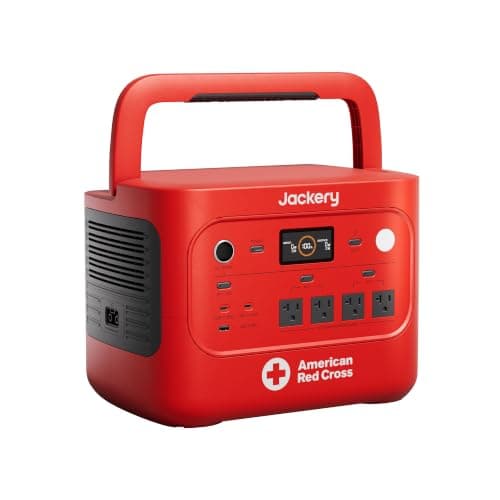
Expandable whole-circuit backup
Jackery HomePower 2000 Plus v2
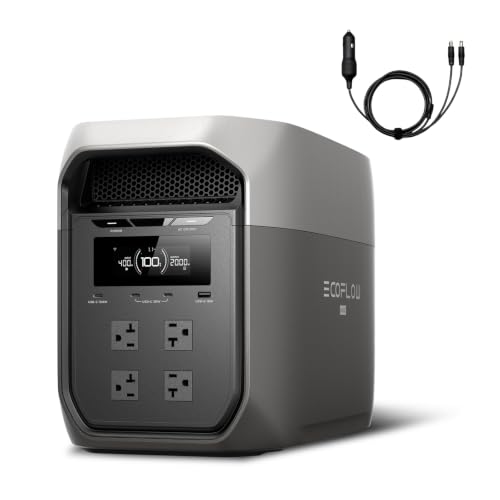
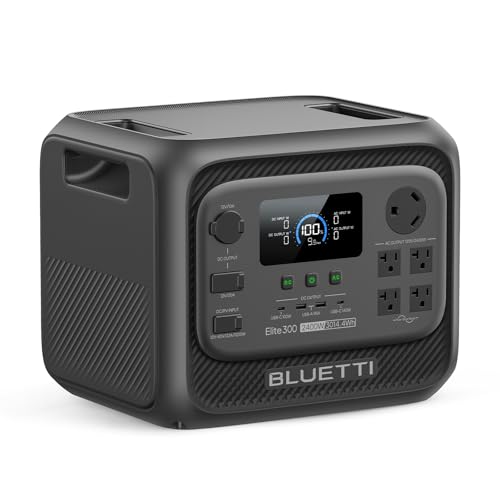
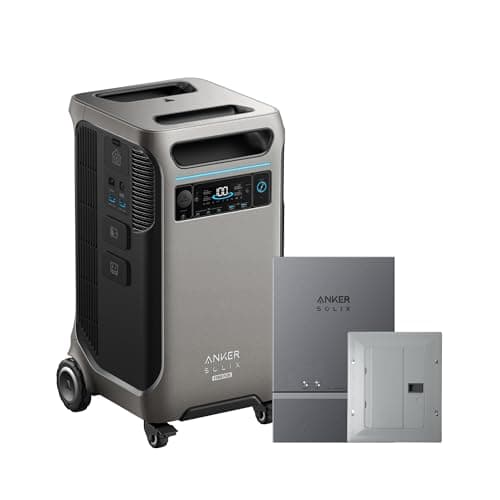
An expandable 2,048 Wh system published to 12 kWh with Priority Routing; a 2,048 Wh unit publishing under 10 ms switchover for loads that must not blink; a 3,014.4 Wh unit behind a 2,400 W inverter with a 4,800 W surge and a TT-30R; and a 3,840 Wh unit publishing 6,000 W and dual-voltage output, which is the one that can stand in for a generator on 240 V.
The best home backup batteries is the ranked buying page, the best home backup power stations covers the plug-in class, and home battery backup system cost sets out what the whole project comes to including the installed route.
One genuine advantage over every engine on this site: a battery runs indoors. No exhaust, no carbon monoxide, no placement rules, no fuel to store or rotate, and no noise beyond a fan. For an apartment, a condo or any house with nowhere safe to put a generator, that is not a convenience — it is the whole reason the category exists.
With the mechanism understood, the purchase comes down to three published figures. Battery backup for a home ranks the units on expandable capacity, output ceiling and whether they do 240 V at all.
Questions people actually ask
How does home battery backup work?
Lithium cells store energy, an inverter converts their DC output to household AC, a battery management system protects the cells, and a charge source — grid, solar or generator — refills it. It either plugs in, so you run cords or leave appliances connected to it, or it is wired to your panel by an electrician so it can feed circuits.
Can a home battery run my whole house?
Not in the portable class. The largest units here publish 3,840 Wh and 6,000 W, which covers a refrigerator, lights, electronics and some 240 V loads for a day or so — not central air, and not a well pump's starting surge. Whole-house battery systems are a different, installed product category.
Do I need an electrician for home battery backup?
Not for a plug-in power station: you run cords, or leave a fridge plugged into it permanently so the switchover is invisible. You do need one to feed hard-wired circuits or to use a unit's 240 volt output, which is a permanent connection to your panel and usually needs a permit.
How long does a home battery backup last in an outage?
By our arithmetic — a 150 W cycling average for a refrigerator and a 12% inverter loss — about 12 hours of fridge duty per 2,000 Wh of capacity. Add lights and devices and it is less. Solar input or a generator to recharge it is what turns a battery into a multi-day plan.
What is a UPS switchover time and does it matter?
It is how quickly the unit takes over when the grid fails. EcoFlow publishes under 10 milliseconds for the DELTA 3 Max and Bluetti publishes a 10 ms DualGuard switch for the FridgePower. At those speeds a refrigerator, a modem or a medical device never registers the outage, which is a real functional difference rather than a spec-sheet flourish.
Is a home battery better than a generator?
For short outages, indoor use, silence and zero maintenance, yes — and for an apartment it is the only option. A generator wins on motor loads, 240 volt circuits and multi-day capacity, because it keeps running as long as you feed it. Many people with both run the engine to recharge the battery, which is the best of each.
Sources
- Eugene Water & Electric Board — Generator Sizing ConsiderationsPublished appliance running and additional-starting watt figures used in the capacity arithmetic on this page.
- FoodSafety.gov — food safety during a power outageThe 4-hour refrigerator and 48-hour full-freezer guidance referenced when deciding how much capacity is needed.
Read next
Best Battery System
Battery Backup for a Home, Sized to Carry Circuits
Home backup batteries ranked on expandable capacity, 240V capability and what each unit will carry — not on portability.
Top pick · Anker SOLIX F3800 Plus
$4,099.99See the SOLIX F3800 Plus on Amazon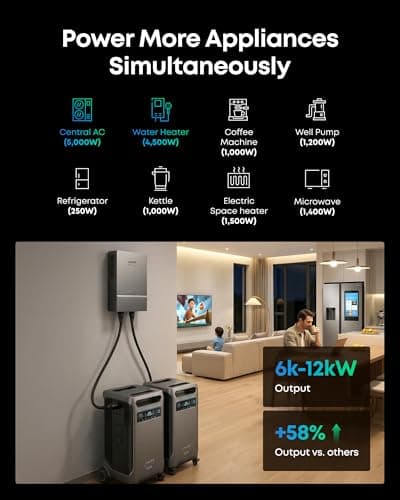
Comparison
Home Battery Backup vs Generator
Installed home battery systems against generators, and the expandable portable units that sit between them.
Guide
What a Home Battery Backup System Costs
The four cost components of a home battery backup system, what each one is for, and the honest comparison against a generator.
Comparison
LiFePO4 vs Lithium-Ion
Why LiFePO4 is the correct chemistry for backup power, with the published cycle claims that decide it.
Guide
How to Recharge a Power Station in an Outage
The four recharge routes during an outage, with published charge speeds and the realistic limits of each.