Power Stations
How Many Solar Panels Do You Need for a Power Station?
The answer is set by one published number most buyers never look up — the station's maximum solar input — and then by arithmetic you can run in ten minutes.
Written byMike M.
Published
Disclosure: we earn a commission on purchases made through links on this page, at no cost to you. It does not affect what we recommend or what we say about it — how we are funded.
The short answer
- 1Look up your station's published maximum solar input in watts. Panels beyond that number are wasted money, and no amount of extra panel changes it.
- 2Decide what you want solar to do: refill the whole battery in a day, or just replace what you use each day. The second goal is usually the right one and needs far fewer panels.
- 3Derate the panels. A rated watt is a standard-test-condition watt; plan on roughly 60-75% of the rating in good conditions.
- 4Divide the ceiling by the panel size to get your maximum panel count, then check the connector and the input voltage window before buying anything.
Step 1 is the one that decides the purchase. In this registry the published ceilings run from 400 W to 3,200 W — an eightfold spread between units of broadly similar capacity.
The question gets asked as though capacity decides it. It does not. A 2 kWh battery with a 400 W solar input ceiling and a 2 kWh battery with a 1,000 W ceiling are different products for solar purposes, and no amount of panel buying closes that gap. The ceiling is a hardware limit set by the station's charge controller, it is published on most listings, and it is the first thing to look up.
The best solar panels for a power station ranks the panels themselves and sets out the four-step sizing method at a high level. This page is the deeper version of step one and step four: every published ceiling in this registry, the arithmetic run end to end for each unit, and the wiring and connector details that decide whether the panels you bought will actually work with the battery you own.
The published ceilings, which is where this starts and sometimes ends
Here is every maximum solar input figure published for the stations in this registry. The gaps are as informative as the numbers.
| Station | Capacity | Published max solar input | Max useful panels (200 W modules) |
|---|---|---|---|
| Anker SOLIX S2000 | 2,010 Wh | 400 W | 2 |
| Bluetti AC180 | 1,152 Wh | 500 W | 2 (400 W) — 3 would exceed it |
| Anker SOLIX C1000 Gen 2 | 1,024 Wh | 600 W | 3 |
| EcoFlow DELTA 2 Max | 2,048 Wh | 1,000 W | 5 |
| Bluetti Elite 300 | 3,014.4 Wh | Not published on listing | Cannot be sized from published data |
| Anker SOLIX F3800 Plus | 3,840 Wh | 3,200 W across two MPPT inputs | 16, or 8 x 400 W |
| Jackery Explorer 2000 v2 | 2,042 Wh | Not published | Cannot be sized from published data |
| Jackery HomePower 2000 Plus v2 | 2,048 Wh | Not published | Cannot be sized from published data |
| Jackery Explorer 1000 v2 | 1,070 Wh | Not published | Cannot be sized from published data |
| Jackery Explorer 300 | 292 Wh | Not published | Cannot be sized from published data |
Read the two extremes in that table against each other, because it is the clearest illustration of why the ceiling matters more than the capacity. Anker's S2000 holds 2,010 Wh and accepts 400 W. Anker's own F3800 Plus holds 3,840 Wh — 91% more — and accepts 3,200 W, which is eight times as much. For an outage that lasts a weekend the two are comparable. For anything where panels have to actually refill the battery day after day, they are not in the same category at all.
Decide what you are asking solar to do
Most people size panels against the battery's capacity — enough panel to refill the whole thing in a day. That is the expensive goal, and it is usually the wrong one. The useful goal is to replace what you actually consume each day, which in an outage is a much smaller number than the battery's full capacity.
The difference is large. If your essential load draws 800 Wh a day and your battery holds 2,000 Wh, then sizing for a full daily refill means buying two and a half times the panel you need. Sizing to replace consumption means the battery stays topped up indefinitely and never actually empties — which is the outcome you wanted. Work out your daily watt-hours first; how long a power station will run a fridge does that arithmetic for the load most people care about, and the appliance wattage chart covers the rest.
The derate, and why rated watts are not delivered watts
Panel ratings are standard-test-condition ratings: a defined light intensity, a defined cell temperature, the sun square-on to the glass. None of those conditions describes a panel on your lawn. The US Department of Energy publishes the counter-intuitive part — solar cells generally work best at low temperatures, because a hot cell gains a little current and loses considerably more voltage. A panel baking on a July driveway is working against its own rating.
So the arithmetic below derates hard. The derate factor and the sun-hours figure are ours, not measurements, and they are shown so you can substitute your own:
The planning arithmetic
- Delivered watts
- Rated watts x 0.65
- Daily watt-hours
- Delivered watts x useful sun hours
- Derate band used here
- 0.6-0.75; 0.65 is the middle
- Sun hours used in examples
- 4 — a placeholder, not your number
The 4-hour figure is a placeholder so the examples below are checkable, not a national average. Useful sun depends on your latitude, your season, your roof line, your trees and where you can physically put a panel, and no honest page can fill it in for you. Check your own location against a public solar resource map, then re-run the examples with that number — every one of them is just multiplication.
Worked examples, one per station
Each row fills the published ceiling as closely as whole panels allow, then runs rated watts x 0.65 x 4 hours. Swap in your own sun figure and the ranking does not change — only the scale does.
| Station | Array at the ceiling | Delivered | Watt-hours per day | Refills per day |
|---|---|---|---|---|
| Anker SOLIX S2000 (2,010 Wh) | 2 x 200 W = 400 W | 260 W | 1,040 Wh | About half |
| Bluetti AC180 (1,152 Wh) | 2 x 200 W = 400 W | 260 W | 1,040 Wh | Just under one |
| Anker SOLIX C1000 Gen 2 (1,024 Wh) | 3 x 200 W = 600 W | 390 W | 1,560 Wh | About one and a half |
| EcoFlow DELTA 2 Max (2,048 Wh) | 5 x 200 W = 1,000 W | 650 W | 2,600 Wh | About one and a quarter |
| Anker SOLIX F3800 Plus (3,840 Wh) | 8 x 400 W = 3,200 W | 2,080 W | 8,320 Wh | A little over two |
Two conclusions fall out of that table. First, the S2000's 400 W ceiling means solar cannot refill it in a day no matter what you spend, so panels on that unit are a top-up strategy rather than a recharge strategy — which is worth knowing before you buy the panels rather than after. Second, past about 1,000 W of array the returns stop being about refill speed at all: the F3800 Plus clears two full refills a day at its ceiling, so the real question for a unit like that becomes how much panel you want to carry and store, not how much it can accept.
One large panel or several small ones
At the same total rated watts the electrical result is similar, and the practical differences decide it. From the published figures in this registry: Renogy's 400 W panel is 30.2 lb against 13.89 lb for its 200 W, so two 200 W panels are 27.78 lb in two one-hand carries versus 30.2 lb in one two-hand carry. The 400 W folds to 33.7 x 27.95 in and ships with a carry case; the 200 W folds to 23.72 x 22.99 x 1.97 in.
- Several small panels are easier to carry, easier to store, easier to angle individually at the sun, and let you start with one and add more up to the ceiling. They also give you redundancy — a damaged panel costs you a fraction of the array rather than all of it.
- One large panel is fewer cables, fewer connectors, one thing to set up and usually a lower cost per rated watt. It is also one thing to place, which matters if the only sunny spot is small.
- Shading changes the answer. A shadow across part of one panel in a string drags the whole string down. Several separately-placed panels let you move the shaded one; one large panel does not. Renogy makes this point explicitly on its 400 W listing, stating that parallel wiring reduces the impact of a shadow from a single tree or cloud.
Series, parallel and the input voltage window
This is where arrays that should work do not. Panels wired in series add their voltages and keep the current roughly the same; panels wired in parallel add their currents and keep the voltage roughly the same. Your station publishes an acceptable input voltage and current range, and the array has to land inside both — too little voltage and it will not start charging, too much and the station will refuse the input or fault.
No station in this registry publishes an input voltage window on its listing, which means the only reliable route is the manufacturer's own stated compatibility or their matched panels. Two practical rules follow:
- 1Match the panels in a string. In series the string current is limited by the lowest-current panel; in parallel a voltage mismatch wastes output. Mixing a 200 W panel with a 400 W one in the same string throws away part of what you paid for. Buy identical panels for a string, or give each panel type its own input.
- 2Count the voltage before you wire the string. Adding panels in series to reach a higher wattage can push you past the station's upper voltage limit well before you reach its wattage ceiling. The wattage ceiling and the voltage ceiling are two separate limits and the array must satisfy both.
The compatibility trap, in the manufacturers' own words
A connector fitting proves nothing, and the listings in this registry say so themselves. These are published statements, not our warnings:
- Jackery states its SolarSaga 100W Air is NOT compatible with the Explorer 300 or 300 v2, and that those units return an F7 input voltage error. That is the same brand, the same connector family, and it does not work.
- Bluetti asks you to confirm your unit's input voltage and connector first on the SORA 500 listing, and names the Elite 300, Elite 400 and Apex 300 as compatible — not the AC180. So a single 500 W SORA panel would exactly fill the AC180's 500 W ceiling on paper, and is not the panel Bluetti points AC180 owners at.
- Bluetti's 200 W PV200 lists its compatible stations explicitly, and the AC180 is on that list. Two of those is 400 W, inside the AC180's 500 W ceiling, and it is the combination the published data actually supports.
- Renogy states the 4-in-1 adapter cable is sold separately on both its 200 W and 400 W panels, which have MC4 output only. Budget for the adapter as part of the panel.
- Arkpax ships one XT60 DC cable with its 200 W panel, and Anker ships two 8.2 ft solar cables plus a 1.6 ft XT-60i cable with the PS200. What is in the box varies enormously between brands at the same price.
The pattern is that same-brand is safer than third-party, but same-brand is not a guarantee — as Jackery's own F7 note demonstrates. Check the three things in order every time: the station's published wattage ceiling, its published input voltage range, and the physical connector. If any of the three is unpublished for your unit, the manufacturer's own matched panel is the only route that does not involve guessing.
The panels worth buying several of
Because the ceiling is usually reached with two to six panels, cost per rated watt matters more here than on a single-panel purchase, and the 200 W class is the modular unit most ceilings divide into cleanly.
Sizing an array
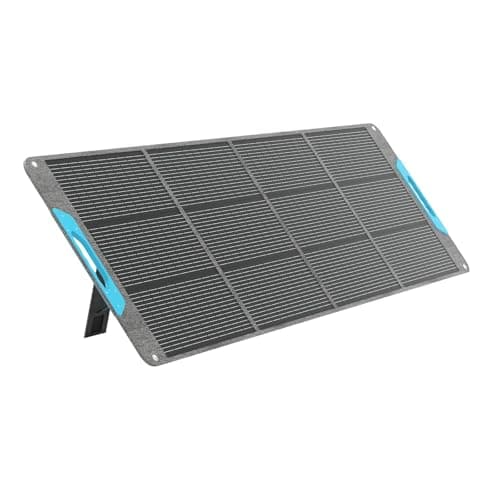
Most rated watts per dollar
Renogy 200W Portable Solar Panel (RPP200EF-SE)
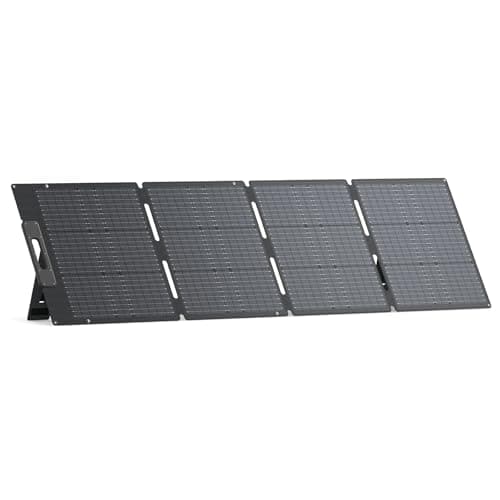
Brand-matched 200 W for a Bluetti
Bluetti 200W Portable Solar Panel
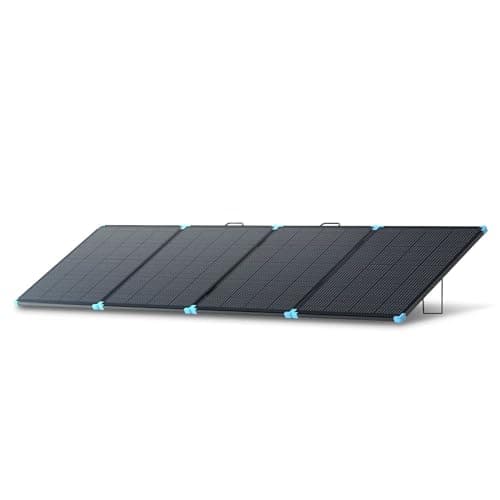
One-panel recharge for a 2 kWh battery
Renogy 400W Portable Solar Panel (RSP400LSC)
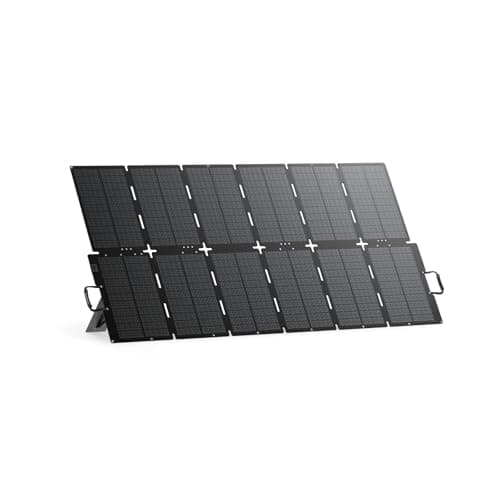
Highest rated output on one order
Bluetti 500W Portable Solar Panel (SORA 500)
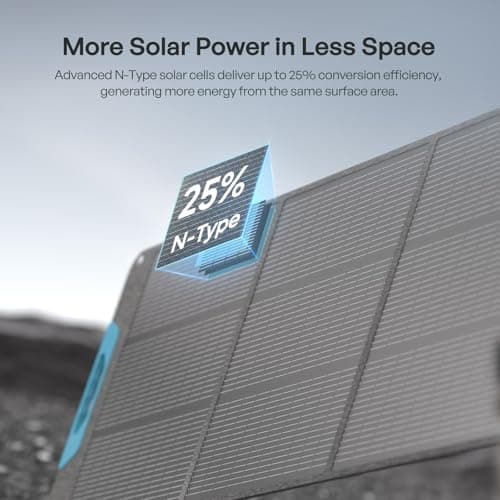
Renogy's 200 W is the cheapest route to the 25% N-type cell class and the module most ceilings divide into cleanly — remember the 4-in-1 adapter is a separate purchase. Bluetti's PV200 is the one whose listing names the AC180 among its compatible stations. The 400 W Renogy and the 500 W Bluetti SORA are the fewer-cables route for the high-ceiling units, where six 200 W panels would be unmanageable.
When the honest answer is that panels are the wrong purchase
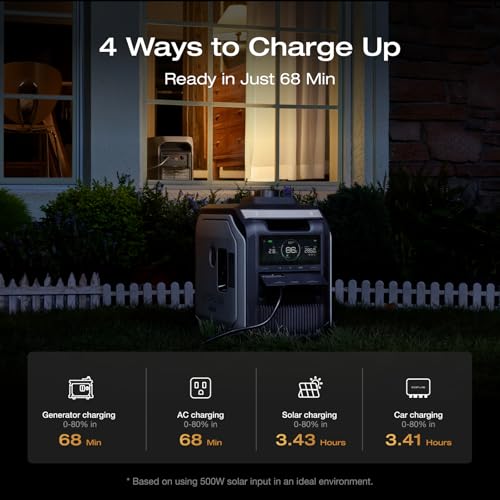
If your station's published ceiling is 400 or 500 W and the outages you are planning for run more than a day or two, panels will slow the battery's decline rather than stop it. The money is usually better spent on a bigger battery, on a unit with a higher ceiling, or on a generator to recharge from. How to charge a power station in an outage covers the other recharge routes, and solar generator vs gas generator is the comparison to have if the honest requirement is multi-day.
And if the essential list includes a well pump, central air or anything hard-wired at 240 V, no panel count fixes that. Solar refills a battery; it does not raise the battery's output ceiling. That is a different purchase, and the best home backup batteries covers the two units here that publish 240 V output at all.
Questions people actually ask
How many solar panels do I need for a power station?
Divide your station's published maximum solar input by the rated watts of the panel you want. A 600 W ceiling takes three 200 W panels; a 1,000 W ceiling takes five. Panels beyond the ceiling are wasted money because the station's charge controller will not accept the extra. If your station does not publish a ceiling — Jackery publishes none on any unit in this registry — you cannot size an array from published data, and the matched kit is the safe route.
Does a bigger battery need more solar panels?
Not necessarily, and that is the most common misconception here. The panel count is set by the station's published solar input ceiling, not by its capacity. In this registry Anker's 2,010 Wh S2000 accepts 400 W while Anker's own 3,840 Wh F3800 Plus accepts 3,200 W — eight times as much panel for 91% more capacity. Check the ceiling, not the watt-hours.
Will two 200 W panels fully recharge a power station in a day?
It depends on the battery's size and your sun. Running our planning arithmetic — 400 rated watts derated to about 260 W, across a four-hour placeholder day — gives roughly 1,040 watt-hours. That is just under one full refill of a 1,152 Wh Bluetti AC180 and about half a refill of a 2,010 Wh Anker S2000. Substitute your own sun-hours figure, because that number varies more than any other input.
Why does my panel never produce its rated watts?
Because the rating is a standard-test-condition figure: defined light intensity, defined cell temperature, sun square-on to the glass. Real output drops with sun angle, cloud, soiling, cable length and heat — the Department of Energy publishes that solar cells generally work best at low temperatures, since a hot cell loses more voltage than it gains in current. Planning on 60-75% of the rating in good conditions is realistic.
Can I mix different solar panels on one power station?
You can, but not in the same string without losing output. Wired in series the string current is limited by the lowest-current panel, and wired in parallel a voltage mismatch wastes output. Keep each string to identical panels, or give each panel type its own input on a station with two MPPT inputs. Mixing a 200 W and a 400 W panel in one string throws away part of what you paid for.
Will any solar panel work with any power station?
No, and the manufacturers say so themselves. Jackery states its SolarSaga 100W Air is not compatible with the Explorer 300 or 300 v2 and that those units return an F7 input voltage error — same brand, same connector family. Check three things in order: the station's published wattage ceiling, its published input voltage range, and the physical connector. A connector that fits proves nothing about the voltage.
Is it better to buy one 400 W panel or two 200 W panels?
Two 200 W panels if you will carry, store and angle them yourself, or if shade is a factor — a shadow on one of two separately-placed panels costs you less than a shadow on one large one, and two 200 W Renogy panels total 27.78 lb in two one-hand carries against 30.2 lb in one. One 400 W panel if you want fewer cables and connectors, a lower cost per rated watt, and only have one good sunny spot.
Do solar panels increase how much a power station can run?
No. Panels refill the battery; they do not change its output. A station's AC output ceiling is set by its inverter, so a unit rated at 1,800 W will still refuse a load above 1,800 W with any amount of panel attached. If the problem is that the battery cannot start a well pump or a central air compressor, more panels are not the answer.
Sources
- US Department of Energy — Solar Photovoltaic Performance and Efficiency BasicsPublished statement that solar cells work best at low temperatures, used on the panel roundup where it explains why a hot panel underperforms its rating.
- Eugene Water & Electric Board — Generator Sizing ConsiderationsPublished appliance running and additional-starting watt figures used in the capacity arithmetic on this page.
Read next
Best Solar Panel
The Best Solar Panels for a Power Station
Nine standalone portable solar panels ranked on rated watts per dollar, published weather protection and connector fit — with the arithmetic for how many you actually need.
Top pick · Renogy 200W Portable Solar Panel (RPP200EF-SE)
$252.97See the 200W Portable Solar Panel (RPP200EF-SE) on Amazon
Guide
How to Recharge a Power Station in an Outage
The four recharge routes during an outage, with published charge speeds and the realistic limits of each.
Best Solar Kit
Best Solar Generators for Home Backup
Battery-plus-panel kits ranked on solar input ceiling and capacity, with honest expectations for real-world panel output.
Top pick · EcoFlow DELTA 3 Max + 2x100W Solar
$1,229.00See the DELTA 3 Max + 2x100W Solar on Amazon
Guide
How Long Will a Power Station Run a Fridge?
The runtime calculation shown in full, the manufacturer claims, and why a cycling fridge lasts far longer than its running watts suggest.
Comparison
Solar Generator vs Gas Generator
Solar kits against gas generators on refueling, output, surge capability and real-world panel performance.
Bluetti vs Jackery
Bluetti vs Jackery for Home Backup
Bluetti against Jackery on the published figures that decide a home backup purchase: UPS transfer time, solar input ceiling, standby draw, weight, cycle life and the expansion path.