Transfer Switches & Connection
Generator Extension Cord Adapters
Most of these are ordinary parts solving an ordinary connector mismatch. One of them is the single most dangerous object in this whole category.
Written byMike M.
Published
Disclosure: we earn a commission on purchases made through links on this page, at no cost to you. It does not affect what we recommend or what we say about it — how we are funded.
The short answer
Most generator cord adapters exist to solve a connector mismatch — an L14-30 twist-lock on the machine against a 14-50 inlet on the house, or a 30 A outlet feeding several 120 V appliances. Those are ordinary parts. One widely sold item is not: a cord with a male plug on both ends, used to feed a house through a wall outlet. That energizes your wiring with no isolation from the utility and can kill a line worker. The correct answer to the problem it claims to solve is an inlet box with a transfer switch or an interlock kit.
Connector mismatches are the most common frustration in generator ownership, and they are almost always a buying problem rather than a wiring problem. The generator has one kind of socket, the thing you want to connect has another, and the question is whether there is a legitimate part in between. Usually there is.
Start by naming your connectors
Nearly every adapter confusion dissolves once both ends are named. These are the ones that appear on the machines and hardware in our registry:
The connectors in this category
- L14-30
- 4-prong twist-lock, 30 A, 125/250 V — the standard backup connector
- L14-20
- Same idea at 20 A, on smaller machines
- 14-50
- 50 A straight-blade, as on larger generators and the biggest home battery systems
- TT-30R
- 30 A, 120 V RV outlet — one hot leg, not 240 V
- SS2-50 / CS6375
- 50 A twist-lock inlet types on the house side
- 5-20R
- The ordinary household duplex, 20 A, 120 V
The TT-30R row is the one that causes the most trouble: it looks like a serious 30 A connector but delivers 120 V on a single leg, so it cannot feed a 240 V load whatever adapter you fit to it.
The adapters that are fine
- L14-30 to 14-50, and the reverse. A straightforward conversion between a generator outlet and a house inlet of a different type. PlugSaf's 50 A cord is a factory version of exactly this, publishing a NEMA 14-50P male plug rated 50 A, 250 V and 12,500 W into a weatherproof twist-locking connector for an SS2-50P or CS6375 inlet.
- A 30 A outlet to several 120 V outlets. Often sold as a triple-tap or a generator splitter: it takes one L14-30 or TT-30R and gives you household sockets. Legitimate, provided the total load stays under the outlet's rating — the splitter does not create capacity.
- Cord couplers, joining two cords to make a longer run. Fine electrically, but voltage drop is cumulative, so check the cord gauge guide before joining two long cords rather than buying one.
- RV adapters, converting a TT-30R to a household plug or vice versa. Common and correct, with the 120 V caveat above.
What all four have in common is that they end in a socket. Power flows from the generator outwards into something you plug in. Every safe adapter in this category preserves that direction.
The reason people reach for it is real: they have a generator, they want the house powered, and an inlet box plus a transfer switch or interlock is an installation that takes planning and money. That is the correct answer anyway, and it is the only one. Do I need a transfer switch is the honest version of that decision.
The short answer
Buy the right cord instead of adapting the wrong one
| # | Product | Best for | Score | Price |
|---|---|---|---|---|
| 1 | 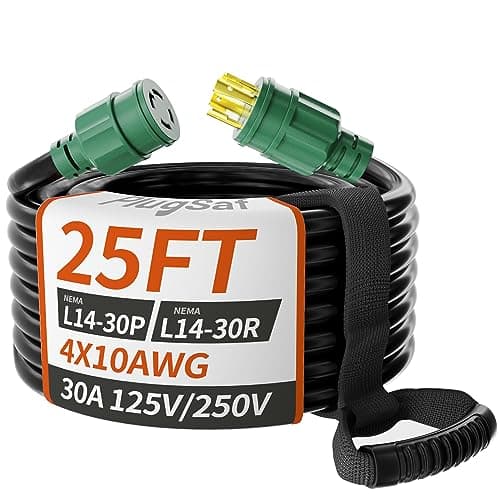 PlugSaf 25 ft 30A L14-30 Cord, 10 AWG The correct first cord for most installations: 25 feet of 10 AWG with L14-30 twist-locks at both ends. | The default generator cord | 9.5/10 | $64.99 |
| 2 | 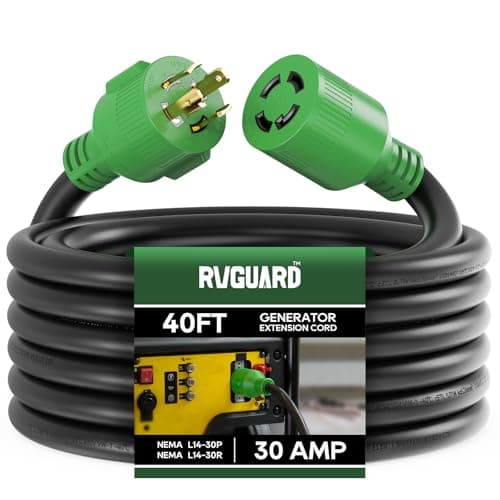 RVGUARD 40 ft 30A L14-30 Cord, ETL Listed The best-certified 30 A cord here: ETL listed, pure copper and jacket-rated to -40 F at a useful 40-foot length. | ETL listing and pure copper | 9.5/10 | $89.99 |
| 3 | 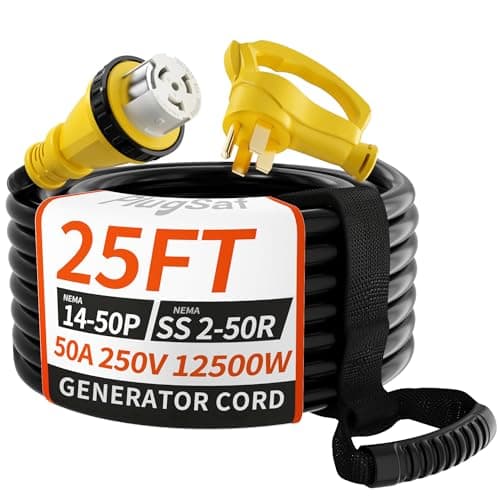 PlugSaf 25 ft 50A 14-50P to SS2-50R Cord The right 50 A cord for the common arrangement — just verify both connector types against your generator and your inlet before ordering. | 50A generators to a 50A inlet | 9.4/10 | $107.99 |
| 4 | 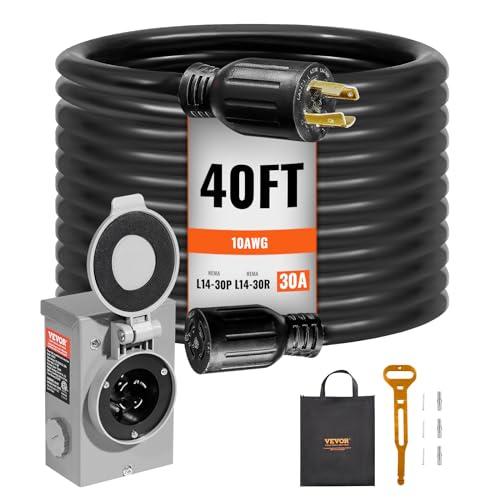 VEVOR 30A Cord + Inlet Box Kit, 40 ft The simplest way to buy the 30 A connection parts correctly: matched ETL-certified cord and inlet in one order, with 40 feet of reach so the generator clears the house comfortably. | Matched 30A cord and inlet | 9.3/10 | $101.92 |
| 5 | 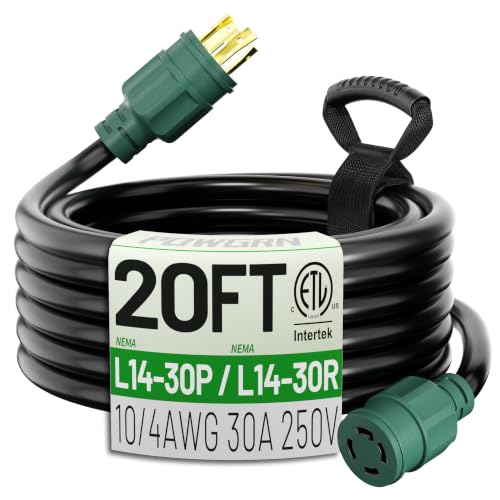 POWGRN 20 ft 30A L14-30 Cord, ETL Listed Only buy this length when the geometry genuinely works: 20 feet of ETL-listed 10 AWG at the lowest price here, and too short for most houses. | The shortest length worth buying | 8.8/10 | $52.99 |
#ad Amazon prices as of November 19, 2026; they may have changed since. Scores are our editorial judgment from published specifications, not test results — how we pick. How we are funded.
Why a matched cord usually beats a stack of adapters
Every adapter is two more connections, and connections are where this equipment fails. Generator runs but no power exists largely because of corroded, loose and water-ingressed cord ends — a twist-lock that is not fully rotated into lock makes intermittent contact that looks exactly like a dead generator.
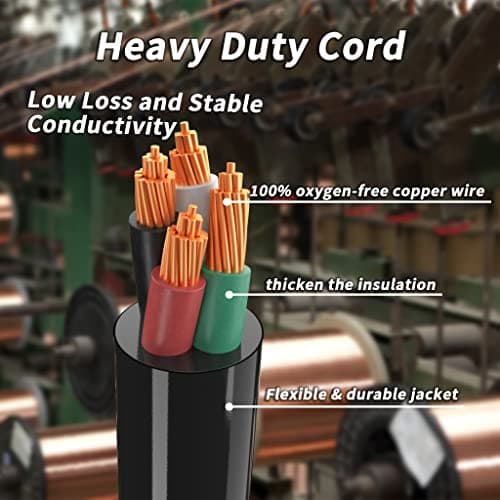
A single cord with the right connector at each end removes that entirely, and the published specifications tell you whether you have one: RVGUARD publishes SJTW 10-gauge, 125/250 V and up to 7,500 W on its 40-foot L14-30 cord along with an ETL listing; VEVOR publishes a 40-foot STW cord at 10 AWG in its matched 30 amp cord-and-inlet kit. Matched kits are the simplest route of all, because the connector question never comes up.
The permanent fix for the connector problem
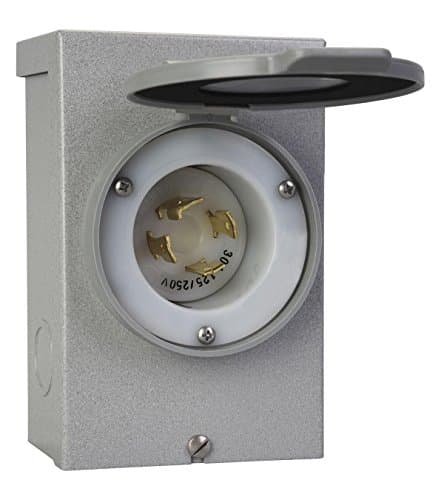
The standard 30A inlet
Reliance Controls PB30 30A Power Inlet Box
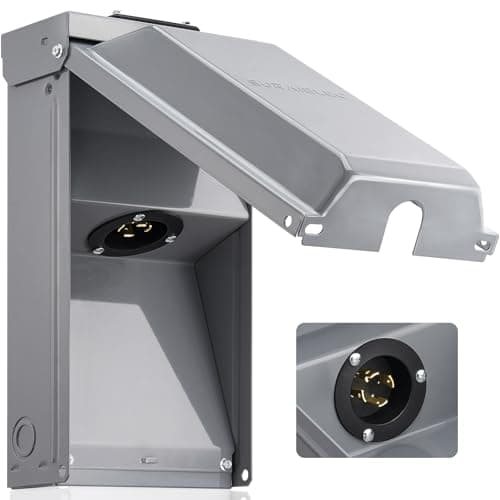
Easiest 30A inlet to wire
SURAIELEC PIB30B 30A Power Inlet Box
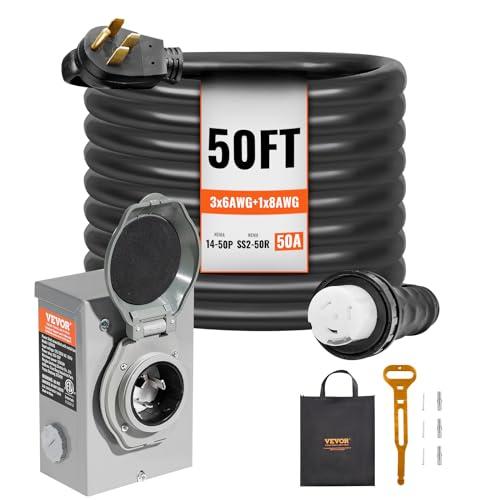
Matched 50A cord and inlet
VEVOR 50A Cord + Inlet Box Kit, 50 ft
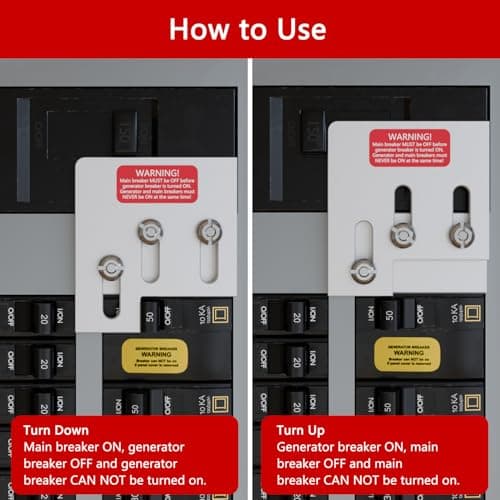
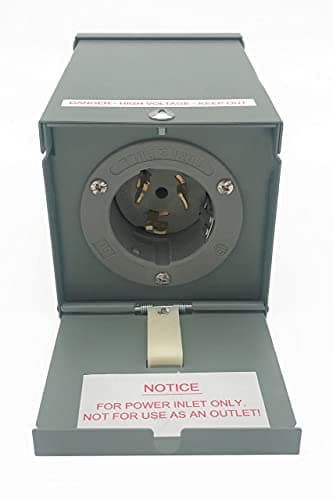
An inlet box in the wall, wired by an electrician to a transfer switch or an interlock, ends the adapter question for good — one cord, two matched connectors, no stack of converters in the rain.
Questions people actually ask
Is it safe to use an adapter with a generator extension cord?
Usually yes, if it ends in a socket and you respect the ratings — L14-30 to 14-50 conversions, 30 A to household splitters and RV adapters are all ordinary parts. The exception is a cord with a male plug at both ends, which is never safe under any circumstances.
What is a male-to-male generator cord and why is it dangerous?
It is a cord with a plug on both ends, intended to feed a house through a wall outlet. It leaves live pins exposed, bypasses the panel's circuit protection, and back-feeds the utility transformer, which can re-energize a line a worker believes is dead. The correct alternative is an inlet box with a transfer switch or interlock kit.
Can I use a splitter to run several things from a generator?
Yes. A triple-tap or generator splitter turns one 30 A outlet into several household sockets and is a legitimate part. It does not create capacity — the total load still has to stay under what that outlet is rated for, and the surge from a motor starting counts against it.
Can I adapt a TT-30R RV outlet to run 240 volt equipment?
No. A TT-30R is 30 A at 120 V on a single hot leg, despite looking like a heavy-duty connector. No adapter can make 240 V out of one leg, so anything needing both legs has to come from the L14-30 or 14-50 outlet instead.
Is it better to join two cords or buy one long one?
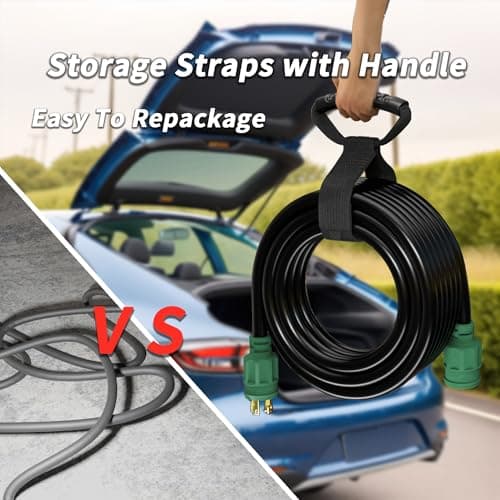
Buy one. Every join is two more connections in the weather, and voltage drop is cumulative over the whole run — two 50-foot cords joined behave like 100 feet, not like 50. Check the published gauge against the length you actually need.
Does an adapter change how many amps a cord can carry?
No. The chain carries whatever its weakest link is rated for, and on a long run that is normally the conductor gauge rather than the connector. Converting a 50 A plug onto a 30 A cord does not make the cord a 50 A cord.
Sources
- US Consumer Product Safety Commission — Portable Generator Information CenterThe 20-foot placement guidance that sets the minimum practical cord length referenced on this page.
Read next
Best Generator Cord
The Best Generator Extension Cords
Generator cords by gauge, length and connector type, with the certification and connector-match checks that matter.
Top pick · PlugSaf 25 ft 30A L14-30 Cord, 10 AWG
$64.99See the 25 ft 30A L14-30 Cord, 10 AWG on Amazon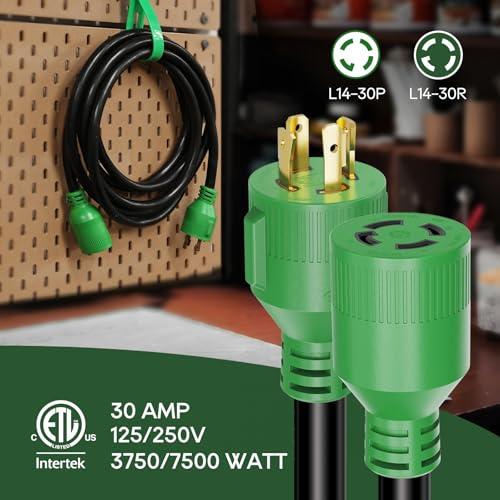
Reference
Generator Cord Gauge Guide
Conductor gauge requirements by amperage, the copper-versus-copper-clad question, and how length affects voltage drop.
Guide
The Dangers of Back-Feeding a Generator
What back-feeding does electrically, why it is lethal to line workers, and the inexpensive compliant alternatives.
Reference
Can You Use a Regular Extension Cord With a Generator?
When a household extension cord is acceptable with a generator and when it is not, with the gauge and voltage reasons.
Best Inlet Box
The Best Generator Power Inlet Boxes
Power inlet boxes ranked on enclosure rating, wiring room and connector match, for 30A and 50A installations.
Top pick · Connecticut Electric EGSPI50 50A Power Inlet Box
$62.95See the EGSPI50 50A Power Inlet Box on Amazon