Generator Sizing
What Will a 10,000 Watt Generator Run?
Enough for a whole house, as long as the house is not trying to do everything at once. The load list, from published figures.
Written byMike M.
Published
Disclosure: we earn a commission on purchases made through links on this page, at no cost to you. It does not affect what we recommend or what we say about it — how we are funded.
The short answer
A 10,000 watt generator runs a full essential-circuit panel plus one large load. From published figures that means a refrigerator, a freezer, a furnace blower, a well pump, a sump pump, lights, devices and a microwave — roughly 4,500 running watts — with enough left for either a 12,000 BTU window air conditioner at 3,250 running watts or an electric water heater at 4,500, but not both. Plan from about 8,000 watts of continuous load, and check your connection: a 30 amp transfer switch passes only about 7,200 watts no matter how big the machine is.
Ten thousand watts is the size where the generator stops being the limiting factor and the connection becomes one. That is the single most expensive misunderstanding in home backup power, and it is why this page covers the outlet before it covers the appliances.
Your connection may be the real ceiling
What each connection passes
- L14-30 / 30 A at 240 V
- ~7,200 W
- At 80% continuous
- ~5,760 W
- 14-50 / 50 A at 240 V
- ~12,000 W
- At 80% continuous
- ~9,600 W
Arithmetic from the amp ratings, shown so you can check it. The 80% figure is the conventional continuous-load derating; your electrician and local code decide what is permitted on your installation. A 10,000 watt machine behind a 30 amp switch delivers 7,200 watts — you have paid for 2,800 watts that cannot reach the panel.
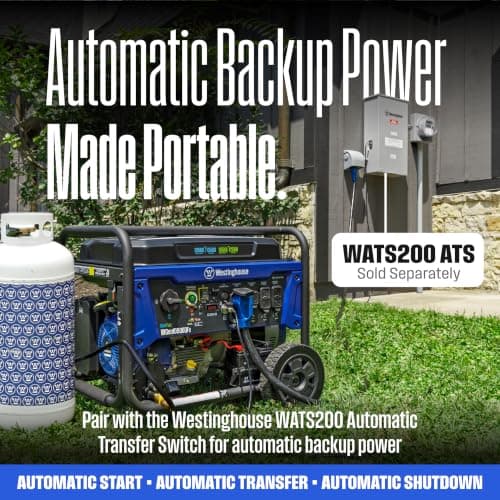
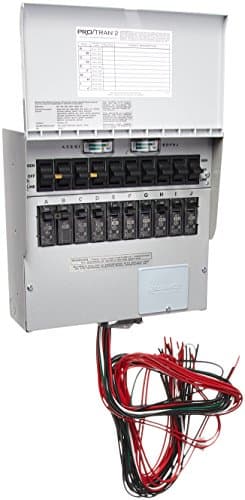
So the honest sequence is: settle the connection, then size the machine to it. Transfer switch amp rating guide covers the 30-versus-50 decision, and what size breaker for a generator explains why the connection rather than the engine sets the breaker. If you are at 10,000 watts and planning the install now, go to 50 amps.
Is yours a 10,000 watt generator?
As with every size class, the number on the box is usually the peak. In this registry, Generac's GP8000E publishes 10,000 starting watts and no running figure; FIRMAN's T08072 publishes 10,000 starting and 8,000 running watts, without saying which of its three fuels the running figure is for. Meanwhile the Westinghouse ecoGen10000 publishes 7,600 running and 10,000 peak — same headline number, a 2,400 watt difference in what it actually holds.
Plan from the running figure, derated 20%. For a genuine 10,000 running watt machine that is about 8,000 watts of continuous load; for a machine whose 10,000 is a peak figure, it is nearer 6,000. Starting watts versus running watts is the full explanation.
The load list, from the published charts
| Load | Running watts | Additional starting watts | Source |
|---|---|---|---|
| Refrigerator / freezer | 700 | 2,200 | EWEB |
| Furnace fan blower, 1/3 HP | 700 | 1,400 | EWEB |
| Water well pump, 1/3 HP | 1,000 | 2,000 | EWEB |
| Sump pump, 1/2 HP | 1,050 | 2,200 | EWEB |
| Electric water heater | 4,500 | 0 | EWEB |
| Window AC, 12,000 BTU | 3,250 | 3,950 | EWEB |
| Electric stove (element) | 2,000 | 0 | Champion |
| Electric dryer | 1,000 | 3,000 | Champion |
| Dishwasher | 1,200 | 1,500 | Champion |
| Microwave, 1,000 W rated | 1,000 | 0 | EWEB |
| Washing machine | 500 | 1,200 | Champion |
| Lights, devices, router, TV | ~300-400 | 0 | EWEB + Champion |
Two worked examples
A house with a well, a sump and gas heat
Refrigerator 700, chest freezer 700, furnace blower 700, 1/3 HP well pump 1,000, 1/2 HP sump pump 1,050, lights and devices 400, microwave 1,000 when in use: about 5,550 running watts at the busiest moment. The largest single surge is the sump pump's additional 2,200 watts, giving a planning figure near 7,750 watts — inside a genuine 10,000 watt machine, and comfortably clear of the 80% derating.
This is the scenario 10,000 watts is genuinely right for. It is also the scenario where a 30 amp connection would spoil it: 7,750 watts does not fit through 7,200.
The same house, adding electric water heating
An electric water heater publishes 4,500 running watts on its own (EWEB). Added to the 5,550 above you are at 10,050 running watts before any surge — past the machine. The practical answer is not a bigger generator; it is switching the water heater's breaker off during the outage and heating water in short deliberate bursts when nothing else is starting.
That is the real skill of running a house on a generator, and it applies at every size: large resistive loads take turns. How to run your house on a generator covers the sequencing in practice.
What 10,000 watts still will not do
- Central air plus everything else. Neither published chart gives a figure for a central air condenser, which is itself telling: the load varies enormously by tonnage and the surge is the problem rather than the running draw. Assume it consumes most of a 10,000 watt machine and read running AC on a generator before planning around it.
- An electric range at full tilt. One element is 2,000 watts (Champion); a full oven and several elements is a different proposition entirely.
- Electric water heating continuously. 4,500 running watts for one appliance, indefinitely, is not how to spend this machine's output.
- Anything above its connection. Worth repeating: through a 30 amp switch this is a 7,200 watt generator.
What to look for in a machine this size
- 1A published running-watt figure. Several machines in this class publish only a starting figure, and the gap is up to 2,400 watts.
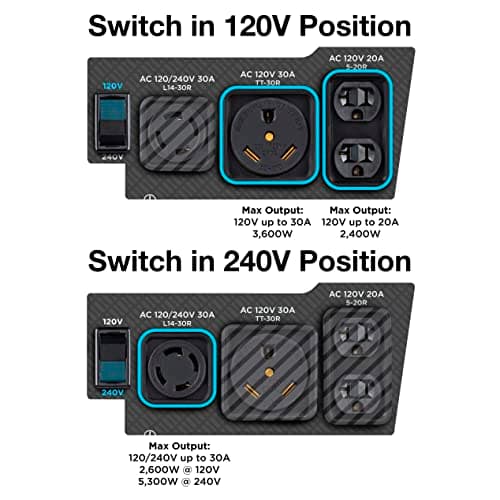
- 2A 14-50R as well as an L14-30R. At this output the 50 amp outlet is what lets you use the machine. Both Westinghouse WGen models and the iGen12000DFc publish the pair.
- 3Dual fuel or tri-fuel. Ten thousand watts drinks fuel; propane does not go stale and natural gas does not run out.
- 4CO shutdown, which most of this class now publishes — with the notable exception of the WGen9500DF.
- 5Low THD, if you have a modern furnace board or variable-speed air handler. Two machines here publish under 3%.
Machines that genuinely deliver this
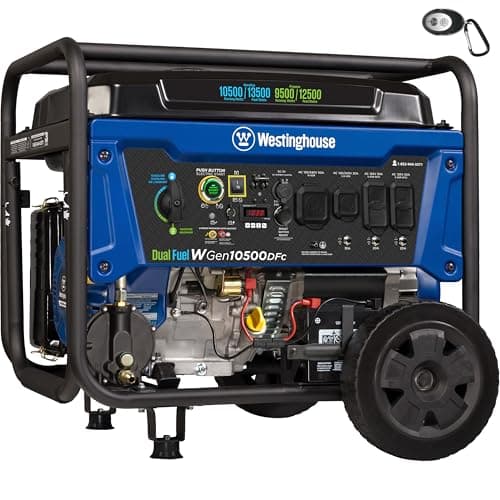
Same layout, with CO shutdown
Westinghouse WGen10500DFc 13,500W Dual Fuel
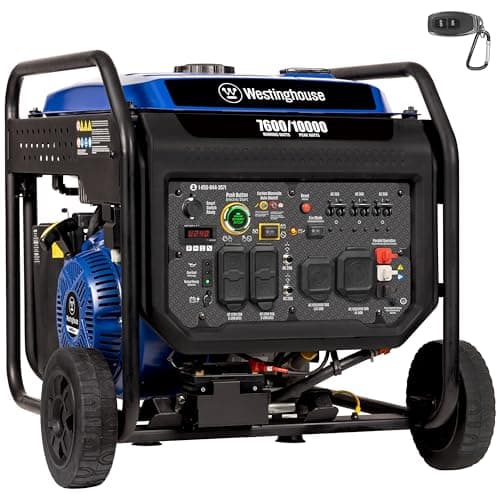
Clean power at 7,600 running watts
Westinghouse ecoGen10000 10,000W Open-Frame Inverter
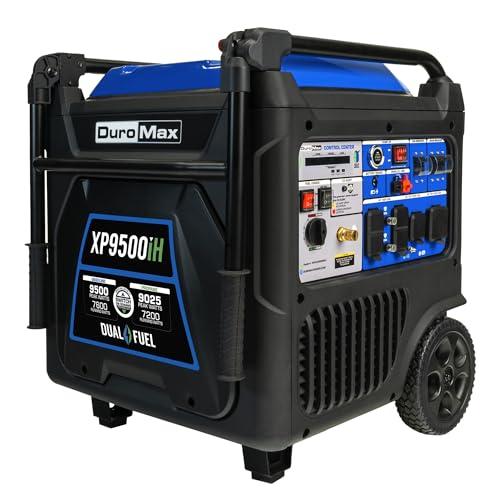
Dual fuel inverter at 7,600 running watts
DuroMax XP9500iH 9,500W Dual Fuel Inverter
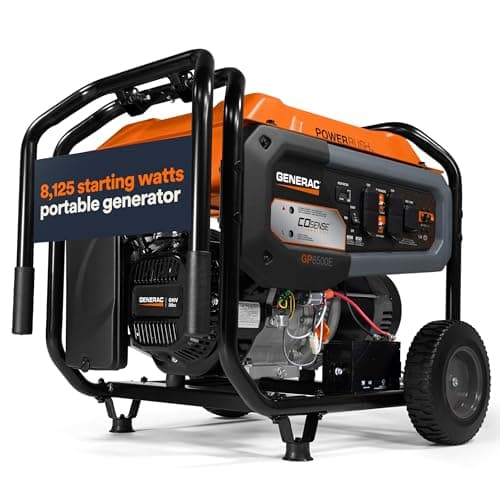
Essential circuits on a budget
Generac 8,125W Starting Portable
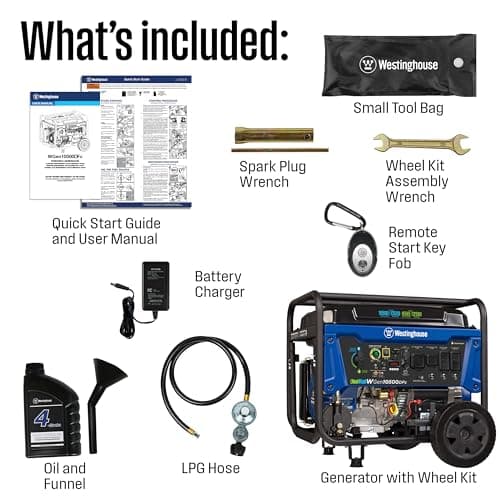
The WGen10500DFc publishes 10,500 running watts on gasoline and 9,500 on propane with CO shutdown and both 240 V outlets. The ecoGen10000 publishes 7,600 running watts at under 3% THD — an honest 10,000 peak machine. The DuroMax XP9500iH publishes 7,600 running watts on either fuel with remote start. The Generac 8,125 W publishes 6,500 running watts with PowerRush and COsense, for the house whose list came in lower than it feared.
The best 10,000 watt portable generators is the roundup for this class, the best 50 amp generators ranks the machines that can actually deliver it through a 50 amp connection, and what can a 5,000 watt generator run is the step down if your load list came out smaller than you expected.
Questions people actually ask
What will a 10,000 watt generator run?
A full essential-circuit panel — refrigerator, freezer, furnace blower, well pump, sump pump, lights and devices, about 4,500 running watts — plus one large load such as a 12,000 BTU window air conditioner at 3,250 running watts or an electric water heater at 4,500. Not both, and not an electric range at the same time.
Will a 10,000 watt generator run a whole house?
It runs a whole house in which large loads take turns. Published figures put an electric water heater at 4,500 running watts on its own, so a house with electric water heating and electric cooking will exceed it if everything is left switched on. Plan on about 8,000 watts of continuous load from a genuine 10,000 running watt machine.
Will a 10,000 watt generator run central air?
Possibly, and it will consume most of the machine doing it. Neither published chart we use gives a central-air figure because the load varies enormously with tonnage and the start-up surge is the real obstacle. Check your condenser's nameplate for its locked-rotor or minimum-circuit figures before assuming.
How many amps is a 10,000 watt generator?
About 41.7 amps at 240 volts, or 83 amps at 120 volts, by arithmetic on the output. In practice the connection limits you: a 30 amp L14-30 passes about 7,200 watts and a 50 amp 14-50 about 12,000, so a 10,000 watt machine needs the 50 amp connection to deliver its output.
Is a 10,000 watt generator too big for a house?
For a house with city water and gas heat, usually yes — that house is comfortable on 5,000 to 7,500 watts and the extra capacity is fuel you burn at low load. For a house with a well, a sump pump and a large freezer it is about right. The load list decides it, not the square footage.
Can I run a 10,000 watt generator through a 30 amp transfer switch?
Safely, yes, but you only get about 7,200 watts — the switch and the outlet decide what passes, not the engine. If the generator is already bought, upgrading to a 50 amp connection is what unlocks the output you paid for.
Sources
- Eugene Water & Electric Board — Generator Sizing ConsiderationsPublic-utility wattage chart: the running and additional-starting figures quoted on this page, and the add-the-single-largest-surge method.
- Champion Power Equipment — Quick Reference WattageManufacturer wattage chart: the second published figure wherever it differs from EWEB's, and the kitchen and laundry loads EWEB does not list.
- US Consumer Product Safety Commission — Portable Generator Information CenterCarbon monoxide placement guidance referenced wherever this page tells a reader where to put the machine.
Read next
Guide
What Can a 5,000 Watt Generator Run?
A worked load list for a 5,000 watt generator from published appliance wattages: what fits, what has to take turns, and what will not run at all.
Best 10,000W Class
Best 10,000 Watt Portable Generators
The 10,000 watt class ranked on real running watts, with the 50 amp connection requirement explained.
Top pick · Westinghouse WGen10500DFc 13,500W Dual Fuel
$1,099.00See the WGen10500DFc 13,500W Dual Fuel on Amazon
Reference
How Many Watts to Run a House on a Generator?
The watts needed for survival, essential and comfortable circuit sets, totaled from published figures.
Guide
Transfer Switch Amp Rating Guide
Matching transfer switch amp rating to generator output, with the arithmetic and the whole-chain cost implications.
Best 50A Match
The Best 50 Amp Generators for Home Backup
Six generators with a published 50 amp outlet, ranked on how much of a 50 amp connection's 12,000 watt capacity their running watts actually use.
Top pick · Westinghouse WGen10500DFc 13,500W Dual Fuel
$1,099.00See the WGen10500DFc 13,500W Dual Fuel on Amazon