Comparisons
Portable Solar vs Rooftop Solar for Backup
Start with the fact most solar owners find out during their first outage: the panels on the roof stop working when the grid does.
Written byMike M.
Published
Disclosure: we earn a commission on purchases made through links on this page, at no cost to you. It does not affect what we recommend or what we say about it — how we are funded.
The short answer
A grid-tied rooftop solar array produces nothing during a power outage. The US Department of Energy states that residential solar panels alone are not enough to make a home resilient, because solar systems generally depend on the grid and are designed to switch off for safety when grid power is lost — and that producing power on their own requires two things: a properly configured inverter and a storage system. Portable solar is the opposite trade: it always works because it was never connected to the grid, but a typical 400 rated watt panel set returns only about a third of a refrigerator's daily draw. Rooftop plus storage covers a whole house automatically and costs tens of thousands; portable solar plus a battery covers a few circuits and costs low four figures.
This page exists because of one specific and very common disappointment. Someone has solar on the roof, the power goes out, and the house goes dark anyway — with sunshine falling on 8 kilowatts of panels the whole time. It feels like a fault. It is not a fault; it is the system working exactly as designed, and it is the single most important thing to understand before spending anything on solar backup.
Why the roof goes dark: it is a safety rule, not a failure
When the utility drops, line workers have to be able to treat the wires as de-energized. A rooftop array still pushing power into the neighborhood grid would make that assumption lethal. So grid-tied inverters are required to detect the loss of utility power and stop exporting — the standard behavior the industry calls anti-islanding.
The Department of Energy puts it plainly: "Residential solar panels alone are not enough to make your home resilient. This is because solar systems generally depend on the electrical grid to produce power—and, for safety reasons, they're designed to switch off if the grid power cuts out." The same source states what it takes to change that: "For solar panels to produce power on their own, they need two things: a properly configured inverter and a storage system."
Read that second sentence carefully, because it is the whole decision. Backup from a roof is not a panel purchase. It is an inverter capable of islanding plus a battery plus, usually, a separate backup load panel so the system knows which circuits to keep alive. Panels are the part you already have. The expensive part is everything else.
The two routes, side by side
| Portable solar + power station | Rooftop solar + storage | |
|---|---|---|
| Works in an outage | Always — never grid-connected | Only with an islanding inverter and a battery |
| Typical published capacity | 1-4 kWh in one unit, expandable | 13.5 kWh in the DOE benchmark system |
| Typical daily solar harvest | Roughly 1.1-1.4 kWh from 400 rated watts | Roughly 24-32 kWh from 8 kW DC |
| Benchmark installed cost | Low four figures, bought as a product | $34,600-$36,700 at the 2025Q1 DOE benchmark |
| Covers whole house | No — selected appliances by cord | Yes, via a backup load panel |
| Automatic changeover | No, unless used as a UPS | Yes |
| Starts a well pump or central AC | Only the largest units, and not reliably | Depends on the inverter and battery sizing |
| Works for renters and condos | Yes | No |
| Value when the power is on | Camping, job sites, RV | Lower electricity bills every month |
What rooftop plus storage actually costs
This is worth doing with published numbers rather than installer quotes. The Department of Energy benchmarks a representative residential system at 8 kW DC of panels with 13.5 kWh of energy storage, and publishes 2025Q1 installed cost benchmarks of $4.33 to $4.59 per watt DC for PV plus storage, and $2.78 to $2.95 per watt DC for PV alone, inflation-adjusted to 2024 dollars.
The arithmetic on an 8 kW benchmark system
- PV plus storage, low end
- 8,000 W x $4.33 = $34,640
- PV plus storage, high end
- 8,000 W x $4.59 = $36,720
- PV only, low end
- 8,000 W x $2.78 = $22,240
- PV only, high end
- 8,000 W x $2.95 = $23,600
- Implied cost of the storage half
- about $12,400 to $13,100
Our arithmetic from the DOE's published per-watt benchmarks and its own representative system size, before any federal, state or utility incentive and before local labor variation. A real quote for your roof will differ — the point of the calculation is the shape of the number, not a prediction.
That last row is the one to hold onto. If you already have panels, the outage capability costs roughly twelve to thirteen thousand dollars at benchmark pricing — that is the battery, the islanding-capable inverter and the backup panel, not the modules. And it buys something no portable product can: the whole house, automatically, with the roof refilling the battery every day without anyone carrying anything.
For context on what the same money does elsewhere in backup power, home battery backup system cost and home backup generator cost set out the alternatives, and home battery backup vs generator is the comparison underneath both.
What portable solar actually covers
Here is the arithmetic nobody selling solar kits puts on the box. Portable panels are rated at standard test conditions, which is a laboratory condition, not a backyard in October. Real output depends on angle, cloud, temperature and cable loss, and a derate of 0.6 to 0.75 against the rated figure is the honest planning range.
A 400 rated watt panel set against a refrigerator
- Rated panel output
- 400 W (standard test conditions)
- Usable peak-sun hours assumed
- 4.5 h
- Derate applied
- 0.60 to 0.75
- Daily harvest
- about 1,080 to 1,350 Wh
- Refrigerator at a ~150 W cycling average
- about 3,600 Wh per day
- Share of the fridge covered by solar
- roughly 30 to 38%
Our arithmetic, not a measurement. The 150 W cycling average is an assumption — a compressor runs in bursts rather than continuously, so a fridge averages far below the 700 running watts EWEB's chart lists for it. Substitute your own sun hours and your own appliance average; the method is what matters.
So the honest headline is this: 400 rated watts of portable panel does not keep a refrigerator running indefinitely. It extends a battery by roughly a third of a day per day of sun, which turns a one-night battery into a two or three night battery — a real and useful change, and not the same thing as energy independence.
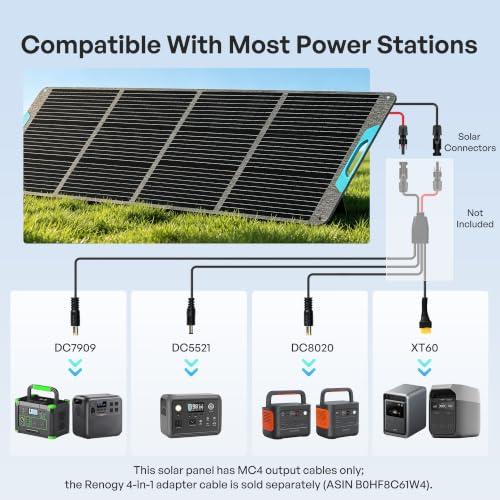
To carry a refrigerator on solar alone you need roughly 1,100 to 1,400 rated watts of panel, which is three to four 400 W panels and a battery whose solar input ceiling can accept them. That is precisely why the input ceiling on the station matters more than the panel count: Anker publishes 3,200 W of solar input on the SOLIX F3800 Plus, where EcoFlow's DELTA 2 Max publishes 1,000 W and Bluetti's AC180 publishes 500 W. A 500 W ceiling caps your plan no matter how many panels you buy. The best solar panels for a power station covers the panel side, and how to charge a power station in an outage covers every other way of refilling one.
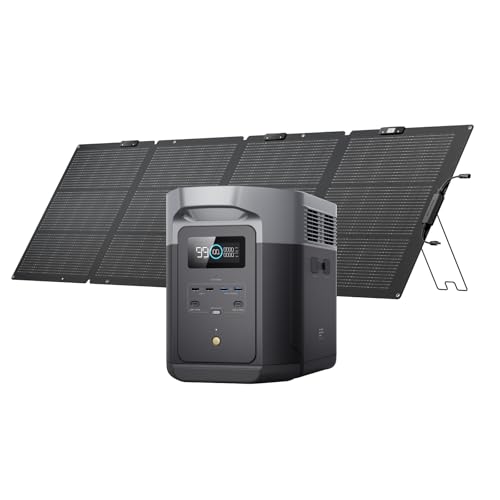
- Capacity
- 2,048 Wh
- Solar
- 1 x 220 W
- Recharge
- 0-80% in 43 min (mfr)
#1 · Fastest solar recharge
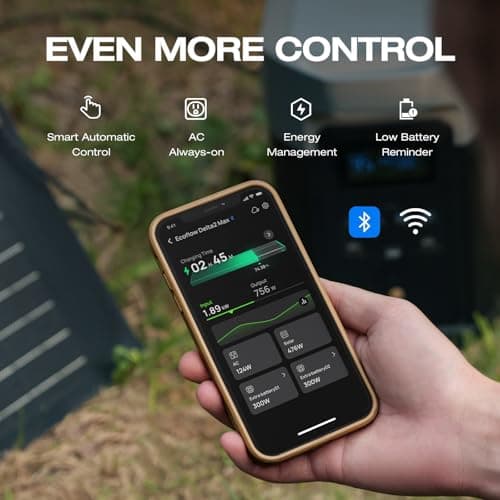
EcoFlow DELTA 2 Max + 220W Solar
The right solar kit if you intend to expand: 1,000 W of solar headroom, 6 kWh of battery headroom and the fastest published recharge here, all from the same hardware.
#ad Price as of November 19, 2026; it may have changed since. How we are funded.
Why we picked it
- 43 minutes to 80% combining solar and AC is the fastest recharge in this registry — a short window of restored grid power refills most of the battery
- The unit accepts up to 1,000 W of solar, so there is real headroom to add panels later
- Expandable battery capacity as well as panel capacity: 2 kWh to 6 kWh from the same hardware
- 220 W is the most rated panel of any kit here, and one panel is a single thing to place and stow rather than two
Good to know
- The most expensive kit here — the same station without the panel costs several hundred dollars less, so the bundle carries a real premium
- 220 W of panel against 2,048 Wh is a daily top-up, not a full solar refill, and EcoFlow publishes no solar-only charge time for this configuration
- A published 71 lb for the kit makes it the heaviest thing here to carry and reposition
Published specification & our scoring
- 2,048 Wh LiFePO4 capacity with one 220 W solar panel included (manufacturer)
- 0-80% in 43 minutes combining up to 1,000 W of solar input with AC, or 80% on AC alone in 1.1 hours (manufacturer)
- LFP chemistry rated 3,000 cycles to 80% capacity, with a 5-year service period (manufacturer)
- Expandable from 2 kWh to 6 kWh with up to two extra batteries (manufacturer)
- 2,400 W output across 15 outlets, with up to 3,400 W in X-Boost mode (manufacturer)
- Charging noise stated from 30 dB (manufacturer)
- EcoFlow publishes no solar-only charge time for this configuration; published kit weight 71 lb, 20 x 12.2 x 9.7 in
- Usable capacity
- 9
- Solar capability
- 9
- Expandability
- 10
- Output ceiling
- 7
- Portability
- 6
- Value
- 6
Specification figures are the manufacturer’s published values. Scores are our editorial judgment from those figures and are never published as structured review data — how we pick.
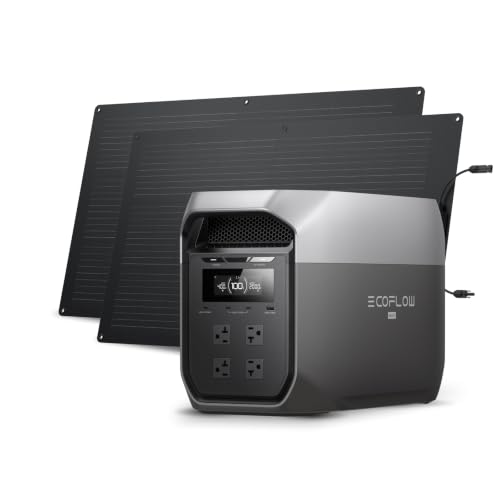
- Capacity
- 2,048 Wh
- Solar
- 2 x 100 W
- AC output
- 2,400 W / 3,400 W boost
#2 · A 2 kWh kit that rides through the cut
EcoFlow DELTA 3 Max + 2x100W Solar
The best-rounded 2 kWh kit: a current-generation station, a 1.13 hour AC recharge and a sub-10 ms handover that keeps the fridge running through the cut itself, with two 100 W panels in the box.
#ad Price as of November 19, 2026; it may have changed since. How we are funded.
Why we picked it
- The current-generation station of the two 2 kWh kits here, with a published sub-10 ms handover the older DELTA 2 Max does not state
- A sub-10 ms transfer time is the one feature that makes a kit behave like backup rather than a large extension cord — the fridge never notices the cut
- The panels fold and store, so this does not require a roof installation
- The cheapest 2 kWh kit here by a clear margin, panels included
Good to know
- 200 W of panel is a daily top-up rather than a full refill of 2 kWh — angle, cloud and winter sun take most of the rating, and EcoFlow does not publish this station's solar input ceiling on the listing
- Joint-lowest panel wattage here — the DELTA 2 Max kit ships 220 W, and the Jackery and Bluetti kits match this 200 W with a single panel instead of two cable runs
- EcoFlow does not publish a weight for this listing, which matters for a kit you may have to carry and reposition
Published specification & our scoring
- 2,048 Wh LiFePO4 capacity, 2,400 W AC output, up to 3,400 W continuous in X-Boost mode (manufacturer)
- Two 100 W solar panels included — 200 W of panel in the box (manufacturer)
- 0-80% in 1.13 hours on X-Stream AC charging (manufacturer)
- Activates in under 10 ms during an outage, so a plugged-in load rides through the cut itself (manufacturer)
- Manufacturer states the LiFePO4 pack is built for a decade of daily use, with a 5-year service period
- EcoFlow app control for real-time monitoring and charge scheduling (manufacturer)
- Published size 19.44 x 12 x 9.4 in; EcoFlow publishes no weight on this kit listing
- Usable capacity
- 9
- Solar capability
- 6
- Output ceiling
- 8
- UPS behavior
- 10
- Cycle life
- 9
- Value
- 9
Specification figures are the manufacturer’s published values. Scores are our editorial judgment from those figures and are never published as structured review data — how we pick.
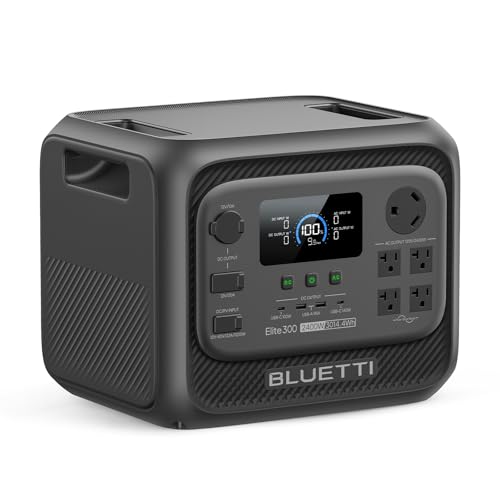
- Capacity
- 3,014.4 Wh
- AC output
- 2,400 W / 4,800 W surge
- RV outlet
- TT-30
#3 · The most capacity in one carryable box
Bluetti Elite 300
The most capacity Bluetti sells in a single carryable box here: 3 kWh behind a 2,400 W inverter with a genuine 4,800 W surge, let down only by the lack of a 240 V outlet at a size where you start wanting one.
#ad Price as of November 19, 2026; it may have changed since. How we are funded.
Why we picked it
- 3,014.4 Wh is the most capacity in this registry outside Anker's SOLIX F3800 Plus, and it arrives as one box rather than a stack of modules
- A 4,800 W surge rating against 2,400 W continuous is real headroom for a compressor or a pump motor, which most 2 kWh units do not have
- The TT-30R takes an RV cord directly, so the same unit covers an RV without an adapter chain
Good to know
- No 240 V output and no 14-50R, so it cannot feed a 50 A inlet the way Anker's F3800 Plus can — at this capacity that is the specification most likely to disappoint
- The listing is thin on the figures that decide a backup purchase: no published weight, cycle rating, UPS transfer time or solar input ceiling. Check the manual before buying if any of those decide it for you
Published specification & our scoring
- 3,014.4 Wh LiFePO4 capacity (manufacturer)
- 2,400 W AC output with a 4,800 W surge rating (manufacturer)
- TT-30R RV outlet and a 12 V/30 A DC output on the same unit (manufacturer)
- Bluetti describes it as the smallest 3 kWh solar generator it sells (manufacturer)
- Sold for RV and home backup use, with variants listed with an AC cable or a solar cable included (manufacturer)
- This listing does not publish a weight, a cycle count, a UPS transfer time or a solar input ceiling — figures we will not carry over from the discontinued Apex 300
- Usable capacity
- 10
- Output ceiling
- 8
- Surge headroom
- 9
- Published detail
- 5
- Value
- 9
Specification figures are the manufacturer’s published values. Scores are our editorial judgment from those figures and are never published as structured review data — how we pick.
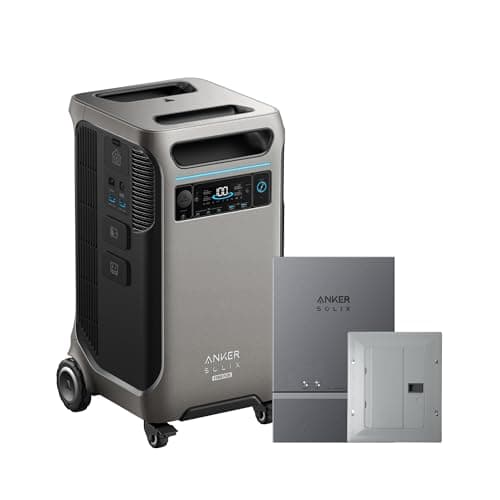
- Capacity
- 3,840 Wh
- AC output
- 6,000 W
- Voltage
- 120V and 240V
#4 · 240V loads plus generator pairing
Anker SOLIX F3800 Plus
The battery that can genuinely stand in for a generator on 240V circuits, with the registry's highest solar input ceiling, priced like the installed system it really is.
#ad Price as of November 19, 2026; it may have changed since. How we are funded.
Why we picked it
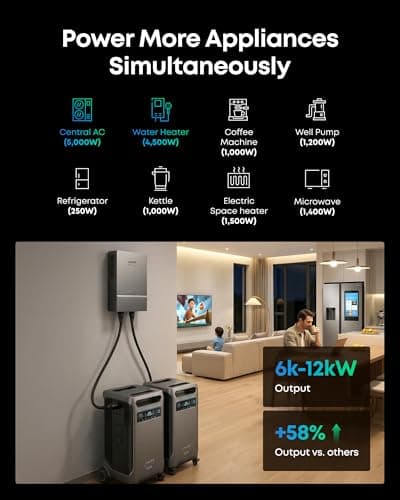
- 240V output at 6,000 W is what lets a battery feed panel circuits the way a generator does — almost nothing else in this class publishes it
- 3,840 Wh is nearly two days of fridge-plus-electronics duty
- 3,200 W of solar input is the highest here, so panels added later genuinely refill it inside a day
- The auto start-stop generator pairing is the closest a battery system comes to indefinite runtime
Good to know
- 135.6 lb, and effectively a fixed installation once it is placed
Published specification & our scoring
- 3,840 Wh LiFePO4 capacity, 6,000 W AC output (manufacturer)
- Dual-voltage 120V and 240V output — manufacturer cites powering a dryer
- 3,200 W solar input across two MPPT inputs — the highest ceiling in this registry (manufacturer)
- Expandable with BP3800 packs; manufacturer publishes a 26.9 kWh ceiling for one station
- Cells rated 3,000+ cycles to 80% capacity, 10-year lifespan, five-year warranty (manufacturer)
- Published weight 135.6 lb
- Compatible with the Smart Generator 5500 for automatic start-stop runtime extension (manufacturer)
- Current listing is the F3800 Plus paired with Anker's Home Power Panel, and publishes a 12,000 W maximum AC output for two stations run together (manufacturer)
- Usable capacity
- 10
- Output ceiling
- 10
- Expandability
- 10
- Portability
- 3
- Cycle life
- 9
- Value
- 5
Specification figures are the manufacturer’s published values. Scores are our editorial judgment from those figures and are never published as structured review data — how we pick.
The third route: a big battery with portable panels
The comparison is usually framed as cheap-and-limited against expensive-and-complete, and there is a genuine middle that has only existed for the last couple of years. The largest portable stations now publish expansion ceilings that reach rooftop-battery territory without a roof, a permit or an installer.
- Bluetti's Elite 300 publishes 3,014.4 Wh behind a 2,400 W inverter with a 4,800 W surge rating and a TT-30R RV outlet. Its listing publishes no solar input ceiling, so a panel array cannot be planned for it from published data.
- Anker's SOLIX F3800 Plus publishes 3,840 Wh base capacity with a stated 26.9 kWh ceiling using BP3800 packs, 6,000 W AC output, dual-voltage 120 V and 240 V, and 3,200 W of solar input — the highest input ceiling in this registry.
- The Anker is a stacked purchase rather than something in one box, and at a published 135.6 lb it is a fixture rather than portable in any ordinary sense. Bluetti publishes no weight at all for the Elite 300.
At a 27 kWh ceiling, the Anker exceeds the 13.5 kWh storage in the DOE's benchmark rooftop system, and it gets there without touching the service entrance. What they do not get you is the roof: 3,200 W of panel input is only useful if you own and deploy 3,200 W of portable panel, which is eight 400 W panels to lay out and stow, where a roof array simply sits there generating. And using the 240 V output into house circuits still needs an electrician and a compatible inlet or transfer switch, which is the point at which this route stops being a product purchase. The best home backup batteries covers this tier properly, and how home battery backup works explains the installed-system version.
The honest limit on all of it: no battery in this registry reliably starts a well pump, and published AC output is not the same as motor starting capability. If your outage plan includes a well pump or central air, read generator size for well pump and running AC on a generator before you shop for batteries at all — the answer there is usually an engine.
Which one you need
Neither route wins outright, so here is the decision as a set of facts about your situation rather than a verdict.
- 1You already have grid-tied rooftop solar and no battery. You have no outage capability today, regardless of array size. Your choices are to add storage and an islanding inverter through a licensed installer, or to buy a portable station and panels as a separate, independent system. Many people with solar do the second because it is a tenth of the cost and arrives in a box.
- 2You rent, or you live in a condo or apartment. Rooftop is not available to you. Portable solar plus a battery is the only solar route, and the best portable generator for an apartment covers the non-solar options and the rules that usually apply.
- 3Your goal is strictly outage resilience and the budget is a few thousand dollars. Portable, every time. Spend on the battery's capacity and its solar input ceiling, in that order, and add panels over time.
- 4Your goal is a lower electricity bill, with resilience as a bonus. Rooftop, with storage. The bill saving is what justifies the cost; the backup capability is a byproduct you should specify deliberately rather than assume.
- 5You need the whole house, automatically, for days. Neither solar route is the cheapest answer. A correctly sized generator with a transfer switch is, and portable power station vs generator is the comparison that settles it. Solar generator vs gas generator covers the same ground from the solar side.
Portable panels worth adding
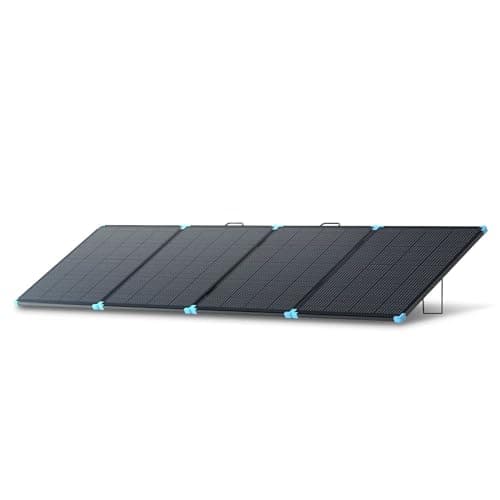
One-panel recharge for a 2 kWh battery
Renogy 400W Portable Solar Panel (RSP400LSC)
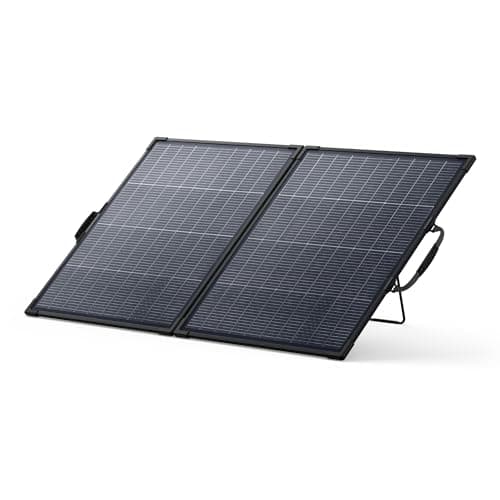
Lightest 200 W panel, longest warranty
Anker SOLIX PS200 Bifacial Solar Panel
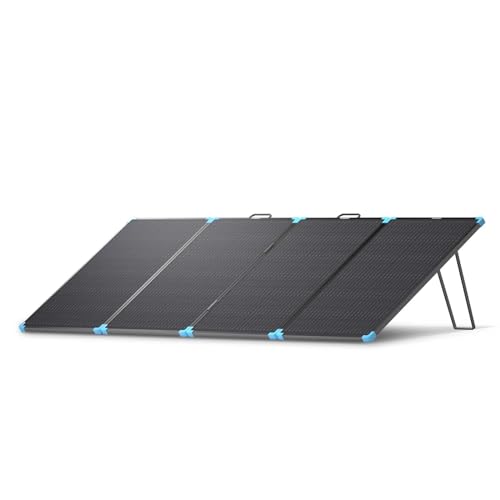
Most rated watts in a one-hand carry
Renogy 220W Portable Solar Panel (RSP220LSC)
Rated watts are standard-test-condition figures from each manufacturer. Check your station's published solar input ceiling before buying panels — panels beyond that ceiling are wasted money, and a 500 W input limit caps a plan no matter how much panel area you own.
What neither option changes
Sun is seasonal and outages are not. The worst outages in most of the country arrive with winter storms and hurricanes — short days, heavy cloud, snow on a roof array, and no safe way to stand outside angling a portable panel. Solar of either kind is the route with the best running cost and the worst availability precisely when demand peaks, and a plan that depends entirely on it has a weather assumption built in.
That is not an argument against solar. It is an argument for knowing which failure you have bought. Winter storm power outage checklist and hurricane season power prep cover the seasonal planning, and how long food lasts in a power outage sets the deadline that most backup plans are really working against.
In short
Our recommendation
Portable vs Rooftop Solar
9.0/10EcoFlow DELTA 2 Max + 220W Solar
The right solar kit if you intend to expand: 1,000 W of solar headroom, 6 kWh of battery headroom and the fastest published recharge here, all from the same hardware.
Runner-up
9.0/10EcoFlow DELTA 3 Max + 2x100W Solar
The best-rounded 2 kWh kit: a current-generation station, a 1.13 hour AC recharge and a sub-10 ms handover that keeps the fridge running through the cut itself, with two 100 W panels in the box.
#ad Price as of November 19, 2026; it may have changed since. How we are funded.
Questions people actually ask
Do rooftop solar panels work during a power outage?
Not on their own. The Department of Energy states that residential solar panels alone are not enough to make a home resilient, because solar systems generally depend on the grid and are designed to switch off for safety if grid power is lost. To produce power independently, DOE states a system needs two things: a properly configured inverter and a storage system. Without a battery and an islanding-capable inverter, a grid-tied array produces nothing in an outage no matter how much sun is falling on it.
Why does my solar inverter shut off when the power goes out?
Because utility line workers must be able to treat de-energized wires as de-energized. A rooftop array still exporting power into the neighborhood grid would make that assumption dangerous, so grid-tied inverters are designed to detect the loss of utility power and stop — the behavior known as anti-islanding. It is a deliberate safety requirement, not a malfunction, and it is not something to work around at home.
Is portable solar enough to run a refrigerator?
Not by itself at typical kit sizes. Working from a 400 rated watt panel set, 4.5 usable peak-sun hours and a 0.6 to 0.75 derate gives roughly 1,080 to 1,350 watt-hours a day, against about 3,600 watt-hours for a refrigerator at a 150 W cycling average — roughly a third of the demand. Carrying a fridge on solar alone takes roughly 1,100 to 1,400 rated watts of panel plus a battery whose published solar input ceiling can accept it. That arithmetic is ours, shown so you can substitute your own figures.
How much does it cost to add battery backup to existing solar?
At the Department of Energy's 2025Q1 benchmarks, a representative 8 kW DC residential system runs $4.33 to $4.59 per watt DC with storage and $2.78 to $2.95 per watt DC without, inflation-adjusted to 2024 dollars. On an 8,000 W system that is roughly $34,600 to $36,700 with storage against $22,200 to $23,600 without, implying about $12,400 to $13,100 for the storage, inverter and backup panel. That is our arithmetic from published benchmarks, before incentives, and a quote for your house will differ.
Can a portable power station replace a home solar battery?
On capacity, the largest ones now can. Anker publishes 26.9 kWh for an expanded SOLIX F3800 Plus, above the 13.5 kWh of storage in DOE's benchmark rooftop system. What they do not replace is the roof — a fixed array generates every day without being deployed — and using their 240 V output on house circuits still requires an electrician and a compatible inlet or transfer switch.
Which is better for backup, portable solar or rooftop solar?
They answer different questions. Portable solar plus a battery always works in an outage because it was never grid-connected, costs low four figures, and covers selected appliances by cord. Rooftop plus storage covers the whole house automatically and refills from the roof daily, at tens of thousands of dollars. If resilience is the only goal, portable is the better value; if a lower electricity bill is the goal and resilience is a bonus, rooftop with storage specified deliberately is the right route.
Will solar keep working if my roof array is covered in snow?
No, and this is the central weakness of any solar-only backup plan. The outages most likely to last for days in most of the country come with winter storms and hurricanes, which is exactly when a roof array can be covered, days are shortest and cloud is heaviest, and when standing outside to angle a portable panel is least practical. Solar has the best running cost of any backup route and the worst availability at peak demand, which is why a fuel-based option is usually part of a serious plan.
Sources
- US Department of Energy — Solar and Resilience BasicsPublished statement that residential solar panels alone are not enough for resilience because grid-tied systems switch off when grid power is lost, and that independent operation needs a properly configured inverter plus storage. Quoted directly on this page.
- US Department of Energy — Solar Photovoltaic System Cost BenchmarksThe 2025Q1 residential benchmark figures used in the cost arithmetic: an 8 kW DC representative system with 13.5 kWh of storage at $4.33-$4.59/W DC with storage and $2.78-$2.95/W DC without, inflation-adjusted to 2024 dollars.
- Eugene Water & Electric Board — Generator Sizing ConsiderationsPublished appliance running and additional-starting watt figures used in the load arithmetic on this page.
Read next
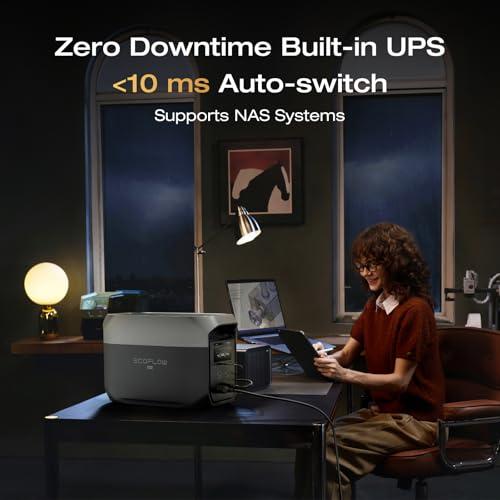
Comparison
Solar Generator vs Gas Generator
Solar kits against gas generators on refueling, output, surge capability and real-world panel performance.
Comparison
Home Battery Backup vs Generator
Installed home battery systems against generators, and the expandable portable units that sit between them.
Best Solar Panel
The Best Solar Panels for a Power Station
Nine standalone portable solar panels ranked on rated watts per dollar, published weather protection and connector fit — with the arithmetic for how many you actually need.
Top pick · Renogy 200W Portable Solar Panel (RPP200EF-SE)
$252.97See the 200W Portable Solar Panel (RPP200EF-SE) on Amazon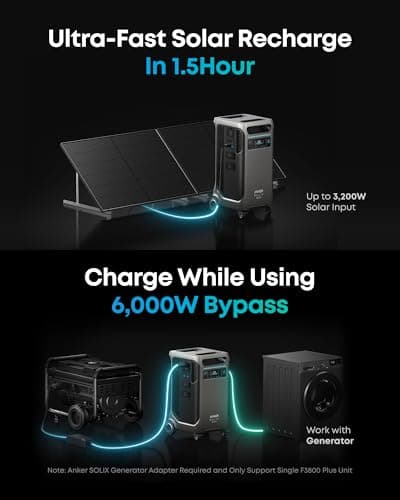
Best Battery System
Battery Backup for a Home, Sized to Carry Circuits
Home backup batteries ranked on expandable capacity, 240V capability and what each unit will carry — not on portability.
Top pick · Anker SOLIX F3800 Plus
$4,099.99See the SOLIX F3800 Plus on Amazon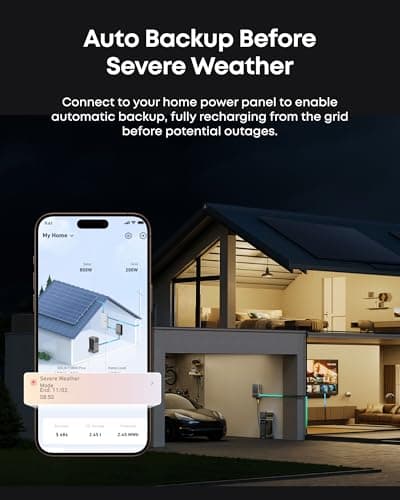
Guide
What a Home Battery Backup System Costs
The four cost components of a home battery backup system, what each one is for, and the honest comparison against a generator.
Guide
How to Recharge a Power Station in an Outage
The four recharge routes during an outage, with published charge speeds and the realistic limits of each.